

If you’ve ever watched tennis on television or spoken to an experienced player, you’ve probably heard someone say they “hit the sweet spot.”
It’s one of the most common phrases in tennis, but what does it actually mean?
The sweet spot isn’t a marked area on your strings. Instead, it’s the part of the string bed where the racquet performs at its best. Shots struck in this area feel cleaner, sound better and usually produce more power with less effort.
Although every racquet has a sweet spot, not all sweet spots are the same size or in exactly the same position.
Understanding the sweet spot can help you choose the right racquet and improve the consistency of your shots.
Quick Answer
The sweet spot is the area near the centre of a tennis racquet’s string bed where the racquet performs most efficiently.
When you hit the ball on the sweet spot, you’ll usually experience:
- More power
- Better control
- Less vibration
- Greater comfort
- A cleaner feel
Shots struck away from the sweet spot often feel less solid and are more difficult to control.
What Is the Sweet Spot?
Every tennis racquet has a point where impact feels almost effortless.
When the ball meets the strings in this area:
- Energy is transferred efficiently.
- The racquet twists less.
- Vibrations are reduced.
- The ball leaves the strings more cleanly.
Players often describe this as a “clean” or “solid” strike.
Although we usually talk about the sweet spot as a single point, it’s actually a small area in the middle of the string bed.
Why Is It Called the Sweet Spot?
The term comes from the noticeably different sensation players experience when they make perfect contact.
Instead of feeling harsh or unstable, the racquet feels smooth and balanced.
The sound also changes.
Many players can tell whether they’ve hit the sweet spot simply by listening to the contact.
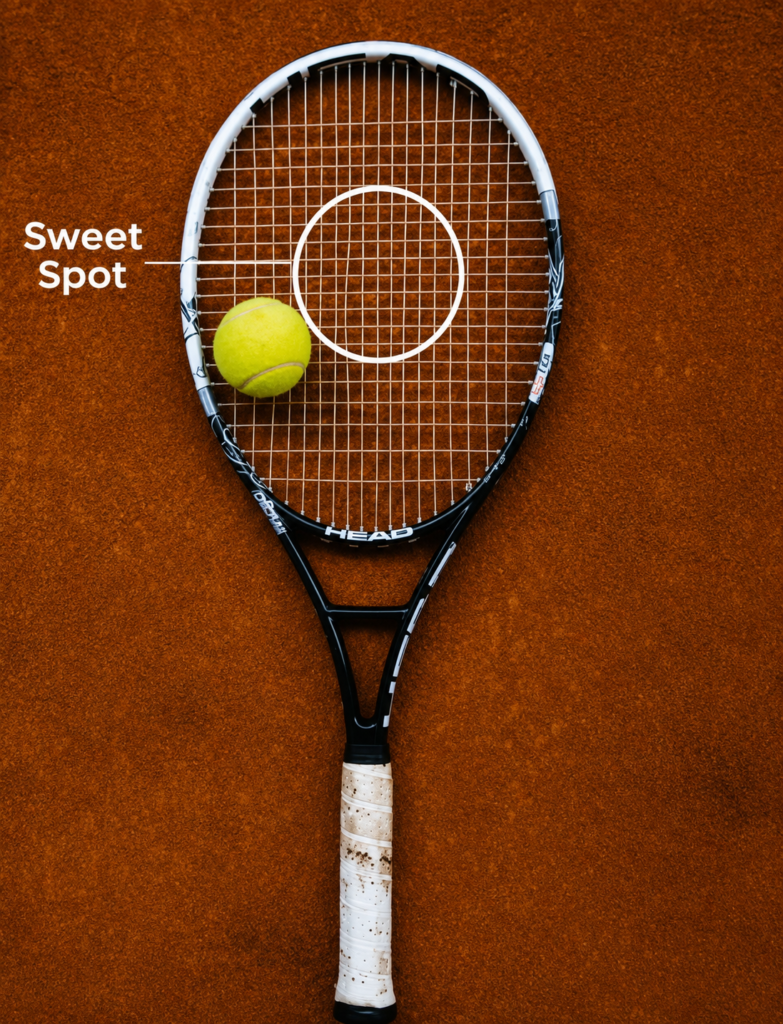
Where Is the Sweet Spot?
Most people assume the sweet spot is exactly in the centre of the strings.
In reality, it’s usually slightly above the geometric centre of the string bed.
This is because the racquet naturally rotates around the hand during impact, and manufacturers design modern racquets to perform best slightly higher in the string bed.
The exact location varies depending on the racquet’s design.
What Happens When You Hit the Sweet Spot?
Striking the sweet spot produces several benefits.
More Power
Less energy is wasted through unwanted movement of the racquet.
More energy is transferred into the ball.
Better Control
The racquet remains more stable during impact, helping the ball travel in the intended direction.
Greater Comfort
Less shock and vibration travel into your hand and arm.
Improved Feel
The ball seems to stay on the strings fractionally longer, giving players greater confidence and feedback.
What Happens When You Miss the Sweet Spot?
Off-centre shots produce very different results.
The racquet may:
- Twist in your hand.
- Vibrate more.
- Produce less power.
- Feel uncomfortable.
- Send the ball in an unexpected direction.
Everyone misses the sweet spot from time to time—including professional players.
The goal isn’t perfection, but improving consistency.
Does Head Size Affect the Sweet Spot?
Yes.
Generally speaking, larger racquet heads have larger sweet spots.
For example:
| Head Size | Sweet Spot |
|---|---|
| 85–95 sq in | Smaller |
| 98–100 sq in | Medium |
| 102–110 sq in | Larger |
| 110+ sq in | Very Large |
This is one reason many beginners are encouraged to use racquets with larger head sizes.
A larger sweet spot makes it easier to hit clean, consistent shots.
Does String Tension Affect the Sweet Spot?
Yes.
Lower string tensions generally create a larger, more forgiving hitting area.
Higher tensions often produce a firmer string bed with a slightly smaller effective sweet spot.
However, the differences are subtle, and players should choose a tension that suits their game rather than chasing the largest sweet spot.
Does Racquet Weight Affect the Sweet Spot?
Not directly.
However, heavier racquets are usually more stable when contact is slightly off-centre.
This means mishits may still feel relatively solid.
Lighter racquets can twist more easily, making off-centre hits feel less forgiving.
Does Frame Thickness Affect the Sweet Spot?
Indirectly.
Thicker frames tend to be more stable and forgiving.
This can make the effective sweet spot feel slightly larger.
However, head size remains the biggest factor.
Can Strings Change the Sweet Spot?
Strings don’t move the sweet spot itself, but they can influence how forgiving the string bed feels.
For example:
- Softer strings often feel more forgiving.
- Lower tensions can make off-centre hits feel better.
- Fresh strings usually perform more consistently than worn strings.
How to Hit the Sweet Spot More Often
No equipment change can replace good technique.
If you’d like to improve your consistency, focus on the following.
Watch the Ball
Keep your eyes on the ball all the way to contact.
This simple habit dramatically improves the quality of your strike.
Move Your Feet
Poor footwork is one of the biggest reasons players miss the sweet spot.
Getting into position early makes clean contact much easier.
Maintain Good Balance
A stable body position allows the racquet to travel smoothly through the ball.
Avoid Rushing
Many mishits happen because players swing before they’ve fully prepared.
Early preparation usually leads to better timing.
Practise Regularly
The more balls you hit, the more naturally you’ll find the sweet spot.
Consistent practice develops timing and confidence.
Common Myths
“The sweet spot is a single point.”
False.
It’s actually a small area on the string bed.
“Professional players never miss the sweet spot.”
False.
Even the world’s best players occasionally mishit the ball.
“A bigger sweet spot means more power everywhere.”
Not necessarily.
A larger sweet spot simply means more of the string bed performs well on off-centre hits.
“Only beginners care about the sweet spot.”
Not true.
Players of every level benefit from consistently striking the middle of the strings.
Frequently Asked Questions
Where is the sweet spot on a tennis racquet?
It’s usually located slightly above the centre of the string bed, although the exact position varies between racquets.
Does a larger head size have a bigger sweet spot?
Generally, yes.
Larger racquets provide a more forgiving hitting area.
Can I increase my racquet’s sweet spot?
You can’t significantly change the sweet spot itself, but choosing a larger head size, lowering string tension or using softer strings can make the racquet feel more forgiving.
Why do mishits vibrate more?
When the ball strikes away from the sweet spot, the racquet twists and vibrates more, reducing both comfort and control.
How can I hit the sweet spot more consistently?
Good footwork, early preparation, balanced movement and keeping your eyes on the ball are the biggest factors.
Final Thoughts
The sweet spot is one of the simplest concepts in tennis, yet it has a significant impact on every shot you hit.
Making contact near the sweet spot gives you more power, greater control, improved comfort and a cleaner feel. While every racquet has a sweet spot, its size and forgiveness depend on factors such as head size, frame thickness, weight, balance, swingweight and string setup.
Rather than searching for a racquet with a “perfect” sweet spot, choose one that matches your ability and playing style. Then, focus on developing sound technique so you can consistently strike the ball cleanly. Ultimately, improving your timing and footwork will have a far greater impact than any piece of equipment.
Continue Reading
- Tennis Racquet Stiffness Explained
- Tennis Racquet Balance Explained
- Tennis Racquet Frame Thickness Explained
- Tennis Racquet Head Size Explained
Read more of our instructional articles here.
Read more of our player focus articles here.
Follow The Tennis Site on X: @thetennissite
Follow Todd Scoullar on X: @toddscoullar

Comments are closed, but trackbacks and pingbacks are open.