
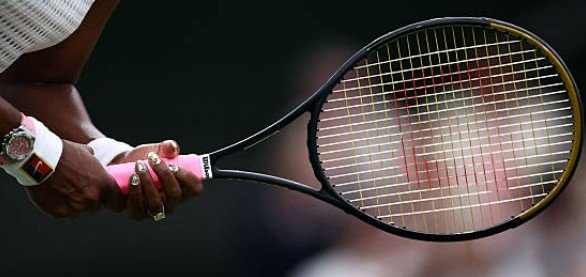
When comparing tennis racquets, you’ll often see a specification called the RA rating.
Unlike weight or head size, it’s not immediately obvious what this number represents. Yet racquet stiffness can dramatically affect how a racquet feels and performs.
A stiff racquet generally delivers more power and a crisper response. A flexible racquet often provides more comfort and a softer feel.
Neither is automatically better. The right choice depends on your technique, playing style and physical comfort.
In this guide, we’ll explain what racquet stiffness is, how the RA rating works and what it means for your game.
Quick Answer
The RA rating measures how much a tennis racquet bends during impact.
- A higher RA rating means a stiffer racquet.
- A lower RA rating means a more flexible racquet.
In general:
- Stiffer racquets provide more power.
- More flexible racquets offer greater comfort and feel.
Most modern racquets fall between RA 60 and RA 70.
What Is the RA Rating?
RA is a laboratory measurement used to describe a racquet’s stiffness.
The racquet is clamped into a testing machine and pressure is applied to the frame. The less the frame bends, the higher its RA rating.
Although different manufacturers may feel slightly different on court, the RA rating provides a useful comparison between racquets.
Typical RA Ratings
| RA Rating | Stiffness |
|---|---|
| Below 60 | Very Flexible |
| 60–64 | Flexible |
| 65–68 | Medium |
| 69–72 | Stiff |
| Above 72 | Very Stiff |
These ranges are guidelines rather than strict categories.
Why Does Racquet Stiffness Matter?
Stiffness affects several aspects of performance, including:
- Power
- Comfort
- Feel
- Ball feedback
- Shock transmitted to the arm
It’s another specification that works alongside weight, balance and swingweight to influence how a racquet plays.
Stiff Racquets
Stiff racquets bend less during impact.
Because less energy is absorbed by the frame, more energy is returned to the ball.
This generally makes them feel more powerful.
Advantages
- Easy access to power.
- Crisp response.
- Excellent stability.
- Less energy lost through frame flex.
- Popular with modern baseline players.
Disadvantages
- Firmer feel.
- More vibration transmitted to the arm.
- Can feel harsh with stiff strings.
- Less feedback at impact.
Flexible Racquets
Flexible racquets bend more when the ball strikes the strings.
Some of the impact energy is absorbed by the frame before the ball leaves the strings.
Many players describe flexible racquets as feeling softer and more connected.
Advantages
- Comfortable.
- Softer feel.
- Better touch.
- Excellent feedback.
- More arm friendly.
Disadvantages
- Less free power.
- Requires faster swings.
- Can feel less stable against heavy hitters.
Does a Stiffer Racquet Produce More Power?
Generally, yes.
A stiff frame loses less energy through bending, allowing more energy to be transferred to the ball.
However, stiffness is only one contributor to power.
Other important factors include:
- Swingweight
- Head size
- String tension
- String type
- Player technique
Even a flexible racquet can produce plenty of power when swung efficiently.
Does a Flexible Racquet Provide More Control?
Not directly.
Many players associate flexible racquets with better control because they often provide a softer feel and greater feedback.
However, control comes from many factors working together, including technique, strings, tension and swingweight.
A flexible frame won’t automatically improve accuracy.
Does Stiffness Affect Comfort?
Yes.
This is one of the biggest reasons players pay attention to RA ratings.
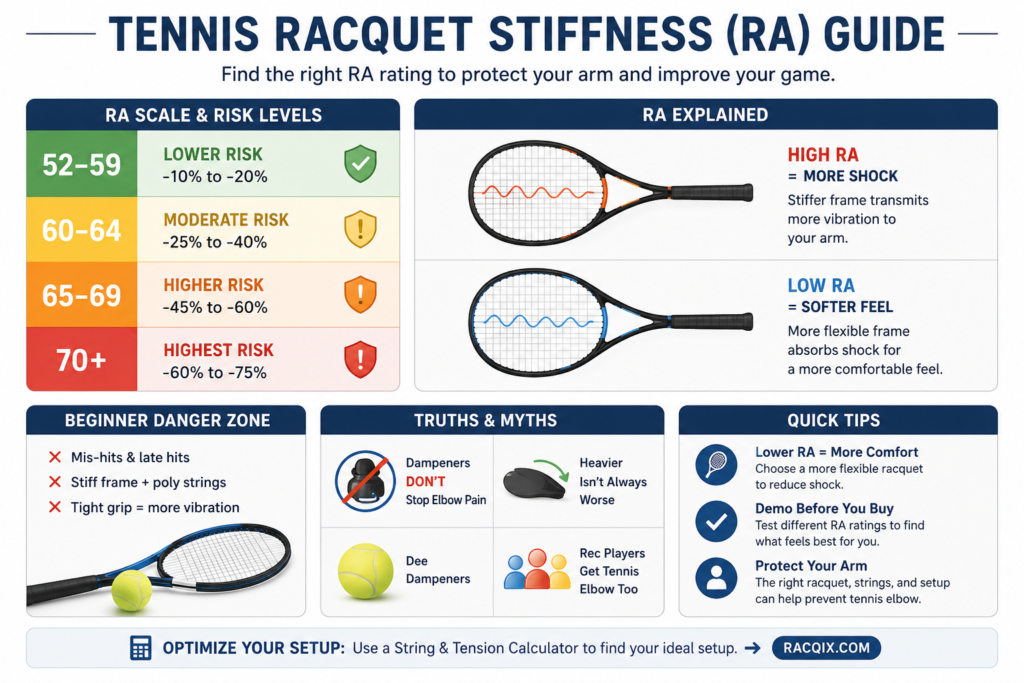
Flexible racquets generally absorb more impact before the vibration reaches the player’s arm.
Stiff racquets tend to transfer more shock.
For players with arm discomfort or a history of tennis elbow, choosing a more flexible racquet—and pairing it with softer strings—may improve comfort.
Does Stiffness Affect Spin?
Not significantly.
Spin is created primarily by:
- Racquet-head speed.
- Swing path.
- Contact point.
- String movement.
Frame stiffness plays only a relatively small role compared with technique.
Which RA Rating Do Professionals Use?
Professional players use racquets across a wide range of stiffness ratings.
Many modern professionals use racquets with RA ratings in the low-to-mid 60s, although some prefer considerably stiffer frames.
It’s also important to remember that many professionals use customised racquets, meaning published specifications don’t always reflect what they’re actually using.
There is no “professional” RA rating.
Which RA Rating Is Best for Beginners?
Most beginners will be comfortable using racquets with an RA rating between 64 and 69.
These racquets provide a good balance of:
- Power
- Comfort
- Forgiveness
Players who develop arm discomfort may prefer a slightly more flexible frame combined with softer strings.
How Stiffness Works with Strings
Stiffness should never be considered on its own.
For example:
Stiff Racquet + Polyester Strings
This combination often produces excellent control and durability but may feel firm, particularly for recreational players.
Flexible Racquet + Multifilament Strings
This setup usually provides outstanding comfort and is popular among players looking to reduce arm strain.
Stiff Racquet + Low String Tension
Lowering the string tension can soften the overall feel of a stiffer racquet.
This is one reason many experienced players fine-tune their equipment through both racquet choice and string setup.
Common Myths
“Higher RA ratings are always better.”
False.
Higher stiffness produces more power but often sacrifices comfort.
“Flexible racquets can’t hit powerful shots.”
Not true.
Power depends largely on swing speed and technique.
Many advanced players generate tremendous pace using relatively flexible racquets.
“RA rating tells you everything about comfort.”
No.
Strings, tension, swingweight and overall racquet design all contribute to how comfortable a racquet feels.
“Professionals all use stiff racquets.”
False.
Professional players use a wide variety of frame stiffnesses depending on their preferences and customised equipment.
Embed from Getty ImagesFrequently Asked Questions
What is a good RA rating for a tennis racquet?
For most recreational players, an RA rating between 64 and 69 provides an excellent balance of comfort and power.
Is a lower RA rating better?
Not necessarily.
Lower RA ratings generally improve comfort, while higher ratings typically provide more free power.
What RA rating is considered stiff?
Most racquets with an RA rating of 69 or higher are considered stiff.
Does RA rating affect tennis elbow?
It can.
More flexible racquets generally transmit less shock, although strings, tension and technique are also important factors.
Can two racquets with the same RA rating feel different?
Yes.
Weight, balance, swingweight, beam width, string pattern and string setup all influence how a racquet feels in play.
Final Thoughts
Racquet stiffness is one of the most misunderstood specifications in tennis, yet it has a noticeable impact on how a racquet feels.
A stiffer frame typically offers more power and a crisp response, while a more flexible frame provides greater comfort and feel. Neither is universally better, and most players will benefit from finding a balance that matches their style of play.
When choosing a racquet, don’t focus solely on the RA rating. Consider it alongside head size, weight, balance, swingweight, strings and string tension. Together, these specifications determine how a racquet performs far more than any single number.
Continue Reading
- Tennis Swingweight Explained
- Tennis Racquet Balance Explained
- Tennis Racquet Weight Explained
- Tennis Racquet Head Size Explained
Read more of our instructional articles here.
Read more of our player focus articles here.
Follow The Tennis Site on X: @thetennissite
Follow Todd Scoullar on X: @toddscoullar

Comments are closed, but trackbacks and pingbacks are open.