
This article contains affiliate links.
Quick Answer
A standard adult tennis racquet measures 27 inches (68.6 cm) in length.
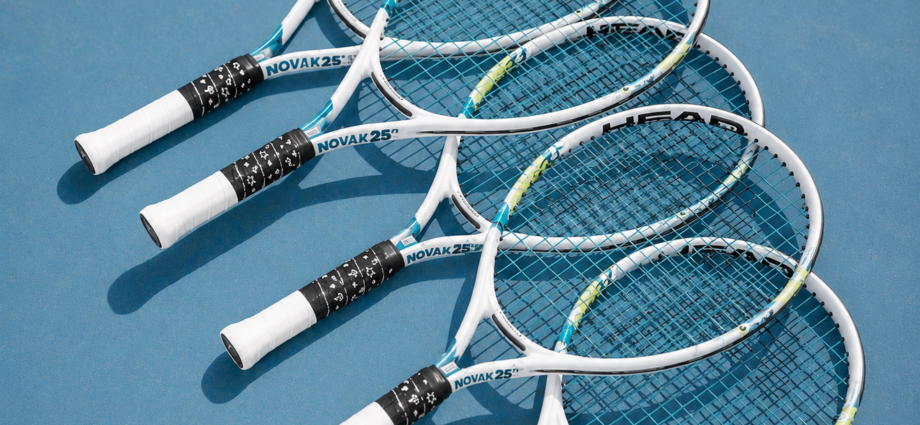
Junior racquets range from 17 inches to 26 inches, with the correct size depending primarily on a player’s height, age and experience. Choosing the right racquet length makes the game easier to learn, helps develop proper technique and reduces unnecessary strain on a player’s arm and shoulder.
What Is Tennis Racquet Length?
Tennis racquet length is the distance measured from the bottom of the handle (the butt cap) to the very top of the racquet head.
Although it might seem like a small specification, racquet length has a significant influence on how the racquet performs. A longer racquet provides greater reach and can generate additional power, while a shorter racquet is generally easier to control and manoeuvre.
For children and developing players, choosing the correct length is particularly important. A racquet that is too long can make it difficult to develop proper swing mechanics, while one that is too short may limit reach and eventually hold back a player’s development.
Length is just one of several important racquet specifications. It works together with factors such as Weight, Balance, and Grip Size to determine how a racquet feels on court.
Standard Tennis Racquet Length
For almost every adult player, the standard racquet length is:
27 inches (68.6 cm)
This has become the industry standard because it provides an excellent balance between:
- Reach
- Power
- Control
- Manoeuvrability
The vast majority of professional players on the ATP and WTA Tours use a standard-length racquet, although a small number choose slightly longer frames for additional leverage.
The International Tennis Federation (ITF) allows racquets to measure up to 29 inches (73.7 cm), but racquets longer than 27 inches remain relatively uncommon.
Tennis Racquet Sizes for Juniors
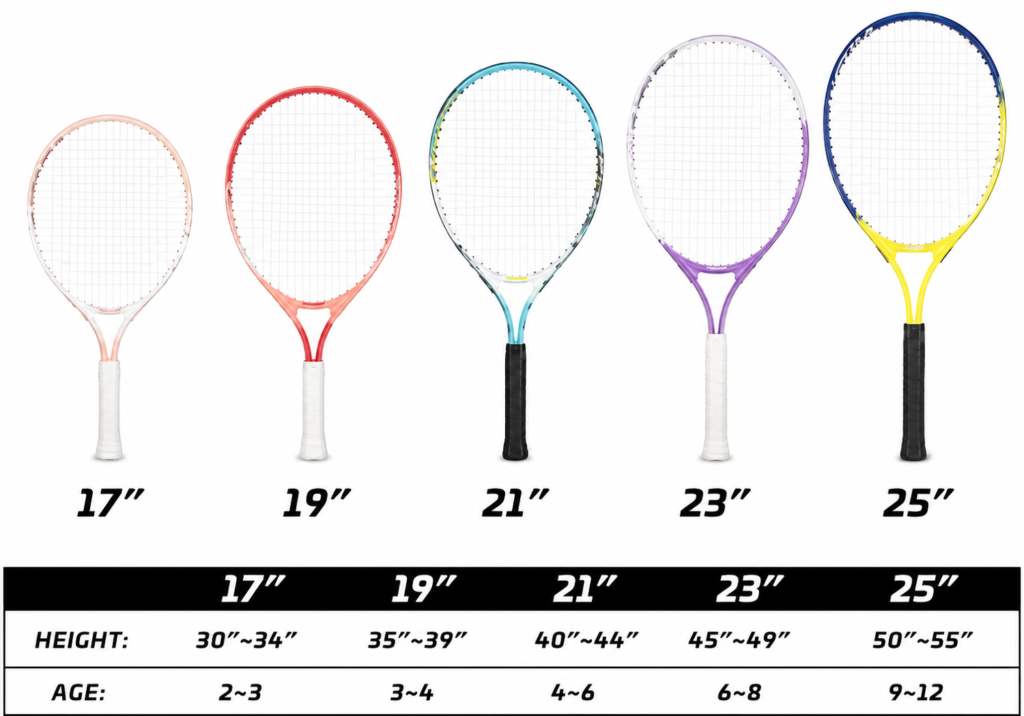
Unlike adult racquets, junior racquets are available in several different lengths.
As children grow, they gradually progress through larger racquets until they eventually transition to the standard 27-inch adult frame.
The goal isn’t simply to buy the biggest racquet possible. Instead, the correct length should allow the child to swing comfortably while maintaining good technique.
Junior Tennis Racquet Size Guide
| Racquet Length | Typical Age | Approximate Height |
|---|---|---|
| 17 inches | 2–4 years | Under 95 cm |
| 19 inches | 3–5 years | 95–105 cm |
| 21 inches | 5–6 years | 105–115 cm |
| 23 inches | 6–8 years | 115–125 cm |
| 25 inches | 8–10 years | 125–140 cm |
| 26 inches | 10–12 years | 140–155 cm |
| 27 inches | Teenagers & Adults | Over 155 cm |
Once you’ve established the appropriate length, you can compare rackets in that size. The Head Speed junior racket is one example; check its length, weight and grip size as well before choosing.
These recommendations are intended as a guide only. Height is generally a better indicator than age because children develop at different rates.
Choosing the Right Racquet for Young Players
Parents often ask whether they should buy a slightly larger racquet so their child can “grow into it.”
In most cases, the answer is no.
A racquet that is too large becomes heavier to swing, harder to control and encourages poor technique. Young players may compensate by using awkward movements that become difficult to correct later.
A properly sized racquet allows children to:
- Swing naturally.
- Generate racquet head speed.
- Learn correct stroke mechanics.
- Build confidence.
- Enjoy the game.
As players become stronger and more technically sound, they can comfortably move to the next size.
When Should a Child Move Up to the Next Racquet?
Rather than focusing purely on birthdays, it’s better to watch for signs that the current racquet is becoming too small.
A player may be ready for the next size if they:
- Have grown significantly taller.
- Consistently strike the ball comfortably.
- Can swing the current racquet with ease.
- Are beginning to outgrow its reach.
Many coaches also observe how easily a child can generate topspin and racquet head speed. If the current racquet looks undersized relative to the player’s height and strength, it may be time to move up.
Transitioning to an Adult Racquet
One of the biggest milestones for junior players is moving from a 26-inch racquet to a full-size 27-inch frame.
For many players, this occurs between the ages of 10 and 12, although there is no universal rule.
Some taller juniors transition earlier, while smaller players may benefit from remaining with a 26-inch racquet for a little longer.
The decision should be based on factors such as:
- Height.
- Strength.
- Technique.
- Playing frequency.
- Coach recommendation.
Simply moving to an adult racquet because of age alone is not always the best approach.
Should Adults Ever Use a Shorter Racquet?
In almost every case, adult recreational players should use a standard 27-inch racquet.
However, there are occasional exceptions.
Some adults with smaller frames or limited strength may find a shorter junior racquet easier to handle when first learning the game. Likewise, modified or adaptive tennis programs sometimes use shorter racquets for specific teaching purposes.
For the vast majority of adult players, though, a full-size racquet provides the best combination of power, control and reach.
Extended-Length Tennis Racquets
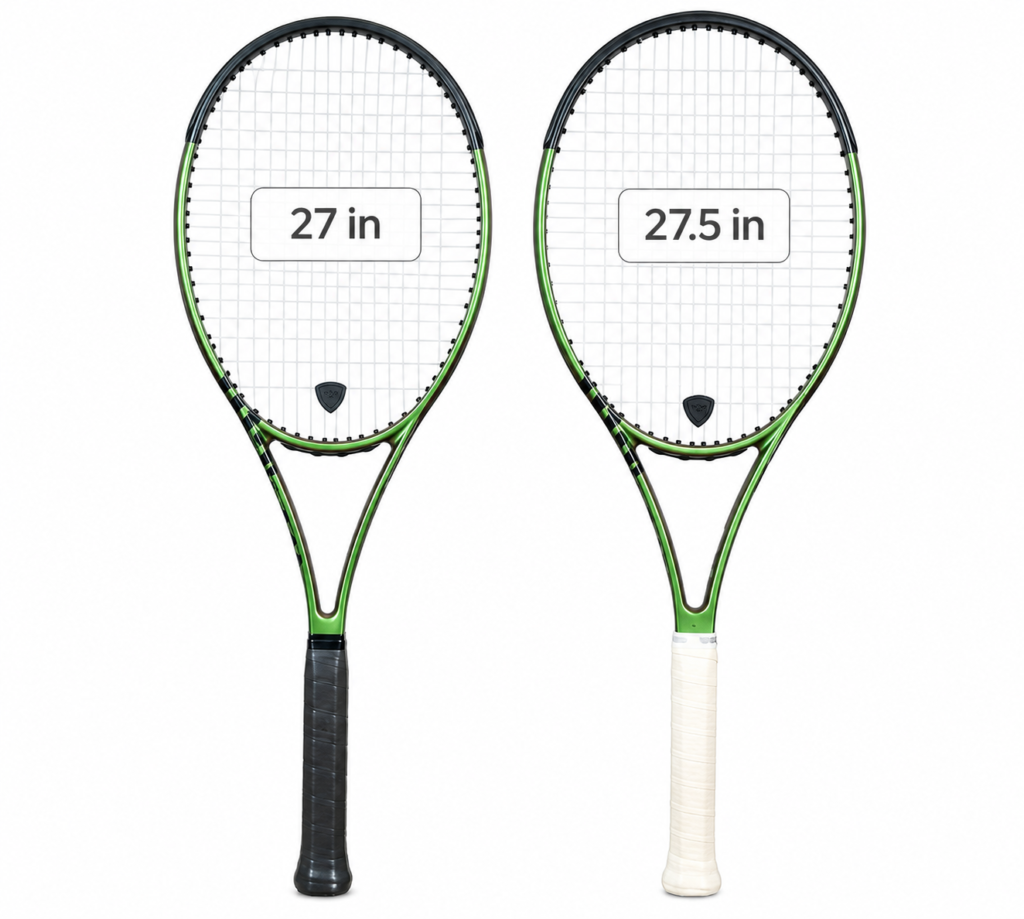
Although 27 inches is the standard, some manufacturers produce racquets that are slightly longer.
Common extended lengths include:
- 27.25 inches
- 27.5 inches
- 28 inches
These racquets provide several potential advantages.
A longer frame creates a larger swing arc, allowing players to generate slightly more racquet head speed. This can translate into additional power on serves and groundstrokes, as well as a little extra reach on wide balls.
However, the trade-off is reduced manoeuvrability.
Because the racquet becomes more difficult to accelerate and control, extended-length racquets are generally better suited to experienced players than beginners.
The added length also increases Tennis Swingweight Explained (🔗 Internal Link), which changes how heavy the racquet feels during the swing.
Does Racquet Length Affect Power?
Yes, racquet length can influence how much power you generate.
A longer racquet acts as a longer lever, allowing the racquet head to travel slightly faster during the swing. This additional speed can produce more powerful groundstrokes and serves, particularly when combined with good technique.
For this reason, some advanced players choose extended-length racquets to gain a little extra pace without changing their swing.
However, racquet length is only one part of the equation.
Specifications such as Racquet Weight, Racquet Balance, and Frame Thickness often have an even greater influence on a racquet’s power.
For most recreational players, choosing the correct length is more important than simply chasing extra power.
Does Racquet Length Affect Control?
Longer racquets generally provide more power, but they can also be slightly more difficult to control.
Because the racquet is longer, it has a larger swing arc and a higher swingweight. This means it takes a little more effort to change direction quickly, particularly during fast exchanges at the net or when returning powerful serves.
A standard 27-inch racquet offers an excellent balance between power and control, which is why it has become the industry standard.
Players who value manoeuvrability often prefer a standard-length racquet, while those looking for extra leverage on serves may experiment with a slightly longer frame.
Does Racquet Length Affect Reach?
Absolutely.
One of the biggest advantages of a longer racquet is increased reach.
Although an extra half-inch may not sound significant, it can make a noticeable difference when:
- Returning wide shots.
- Stretching for volleys.
- Chasing passing shots.
- Reaching high serves.
Professional players who use extended-length racquets often appreciate the additional reach on serve, where every little advantage can help.
For beginners and juniors, however, reach is usually less important than developing sound technique with a racquet that is easy to swing.
Common Mistakes When Choosing Racquet Length
Selecting the correct racquet length is relatively straightforward, but there are a few common mistakes to avoid.
Buying a Racquet That’s Too Big for a Child
One of the most frequent mistakes is purchasing a larger racquet so a child can “grow into it.”
While it may seem economical, an oversized racquet can make learning the game more difficult and encourage poor technique.
A correctly sized racquet is almost always the better choice.
Moving to an Adult Racquet Too Early
Some juniors are eager to use the same racquet as professional players.
However, transitioning to a full-size racquet before a player is physically ready can reduce swing speed and confidence.
It’s better to progress naturally through the junior sizes before making the move.
Assuming Longer Always Means Better
Extended-length racquets certainly have advantages, but they are not automatically superior.
Many of the world’s best players continue to use standard 27-inch racquets because they provide an excellent combination of power, control and manoeuvrability.
Frequently Asked Questions
What is the standard tennis racquet length?
The standard length for an adult tennis racquet is 27 inches (68.6 cm). This is the most common length used by recreational and professional players.
What size tennis racquet should a 10-year-old use?
Most 10-year-olds use either a 25-inch or 26-inch racquet, depending on their height and experience. Taller or more advanced players may be ready to transition to a 27-inch adult racquet.
What size tennis racquet should a child use?
Junior racquets range from 17 inches to 26 inches. The correct size depends mainly on the child’s height, although age can also be used as a general guide.
Are extended-length tennis racquets legal?
Yes. The International Tennis Federation allows racquets up to 29 inches (73.7 cm) in length, although most players use the standard 27-inch size.
Do professional tennis players use extended racquets?
A small number do, but most professional players continue to use standard 27-inch racquets because they offer an excellent balance of power, control and manoeuvrability.
Is racquet length more important than weight?
Both are important.
Length affects reach, leverage and power, while weight has a major influence on stability, control and swing speed. Choosing the right combination is more important than focusing on a single specification.
Final Thoughts
Choosing the correct tennis racquet length is one of the simplest ways to make the game more enjoyable and to support long-term development.
For young players, using an appropriately sized junior racquet helps build confidence, encourages proper technique and makes learning the fundamentals much easier. As players grow, they can gradually move through the junior sizes before transitioning to the standard 27-inch adult racquet.
For adults, the standard 27-inch frame remains the best choice for most players, offering an ideal balance of power, control and manoeuvrability. While extended-length racquets can provide additional reach and leverage, they are generally best suited to experienced players who understand the trade-offs.
Ultimately, racquet length should always be considered alongside other key specifications, including weight, balance, head size, grip size and string pattern. Together, these factors determine how a racquet feels and performs on court.
Continue Reading
If you’re learning about tennis racquets, these guides explain the other important specifications that affect performance:
- How to Choose a Tennis Racquet
- Tennis Grip Size Guide
- Tennis Racquet Head Size Explained
- Tennis Racquet Weight Explained
- Tennis Racquet Balance Explained
- Tennis Swingweight Explained
- Tennis Racquet Frame Thickness Explained
- Tennis Racquet Stiffness (RA) Explained
- 16×19 vs 18×20 String Patterns
- Tennis String Types Explained
Read more of our instructional articles here.
Read more of our player focus articles here.
Follow The Tennis Site on X: @thetennissite
Follow Todd Scoullar on X: @toddscoullar

Comments are closed, but trackbacks and pingbacks are open.