

For a young tennis player, earning enough ranking points to compete regularly on the professional circuit presents a familiar problem: gaining entry to stronger tournaments often requires the very ranking points those tournaments offer.
A talented teenager might be capable of competing at ATP Challenger level but find themselves outside the ranking cut-off for direct entry. Without opportunities to play, climbing the rankings becomes considerably more difficult.
The ATP Next Gen Accelerator was created to address that problem.
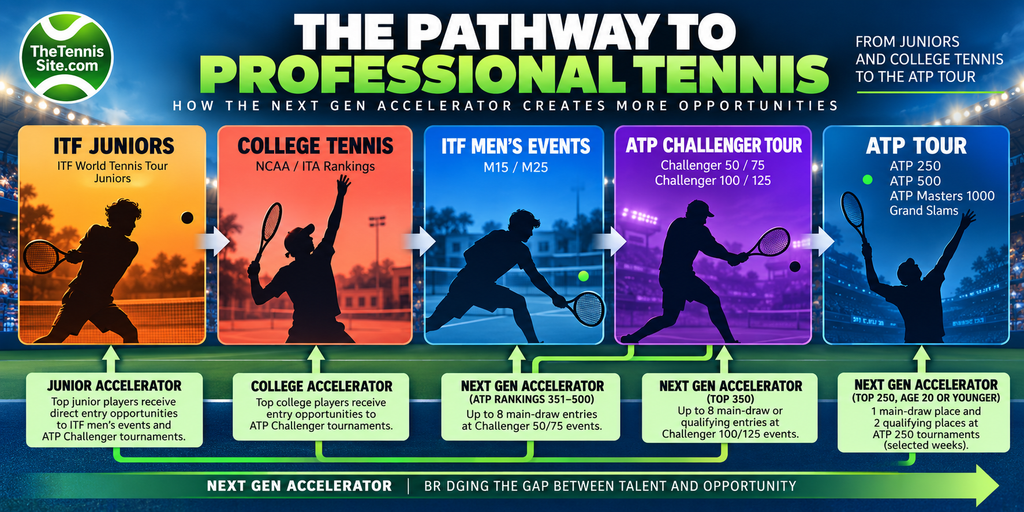
By providing additional tournament places to promising young players, the program offers a more direct route from junior, college and lower-level professional tennis into the ATP Challenger Tour and, eventually, ATP Tour events.
The initiative has expanded considerably since its introduction. In 2026, it combines tournament access with financial assistance, performance technology and educational support.
For emerging players, the potential benefits extend well beyond receiving a place in a tournament draw.
What Is the ATP Next Gen Accelerator?
The ATP Next Gen Accelerator is a player-development program that provides eligible young players with additional opportunities to enter professional tennis tournaments.
Its central purpose is to help talented players progress through the professional rankings without being restricted entirely by the usual tournament-entry requirements.
Under the program, qualifying players can receive reserved entry positions at selected ATP Challenger Tour events. Those who achieve sufficiently high professional rankings may also become eligible for places at ATP 250 tournaments.
The opportunities are awarded according to specific eligibility criteria rather than through a conventional tournament wild card.
The program forms part of the ATP’s broader Next Gen initiative, which also includes the Next Gen ATP Finals.
However, the Accelerator and the Next Gen ATP Finals serve different purposes.
The Finals is a season-ending competition for leading young professionals. The Accelerator is designed to help developing players obtain the tournament opportunities needed to advance their careers.
Who Qualifies for the ATP Next Gen Accelerator?
Eligibility depends on a player’s age, professional ranking or achievements in junior and college tennis.
For the professional-ranking pathway in 2026, eligibility is restricted to players born in 2006 or later.
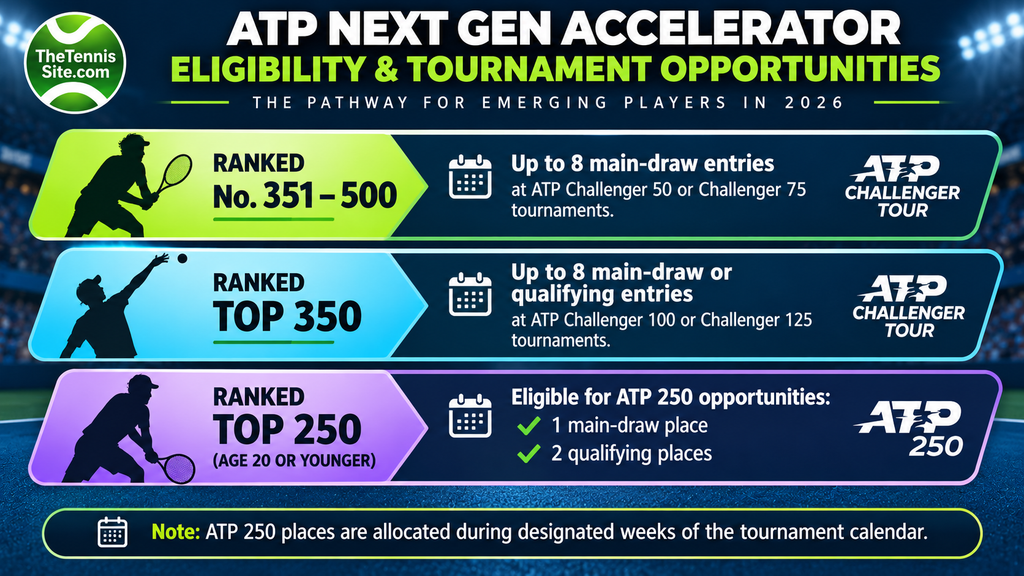
The opportunities are divided into three principal ranking categories.
Players Ranked Between No. 351 and No. 500
Eligible players in this ranking range can receive up to eight main-draw opportunities at ATP Challenger 50 or Challenger 75 tournaments during the calendar year.
These tournaments represent an important step above the lower levels of the professional circuit.
The reserved places allow eligible players to compete at Challenger level even when their ranking would otherwise leave them outside the direct-entry cut-off.
Players Ranked Inside the Top 350
Eligible players aged 20 or younger and ranked inside the world’s Top 350 can receive up to eight main-draw or qualifying opportunities at ATP Challenger 100 or Challenger 125 tournaments.
These higher-category Challenger events offer stronger competition and greater ranking-point opportunities.
For players approaching the ATP Tour, regular exposure to this level can be particularly valuable.
Players Ranked Inside the Top 250
Players aged 20 or younger who reach the Top 250 become eligible for additional opportunities at ATP 250 tournaments.
During designated weeks, the program provides access to one main-draw position and two qualifying positions at ATP 250 level.
These are program positions available to eligible players, not a guarantee that every qualifying player will receive three entries.
The ATP determines allocations according to its eligibility and ranking-priority rules.
Unlike the Challenger opportunities, ATP 250 access is restricted to certain weeks of the tournament calendar.
The Accelerator provides a route into tournaments, but players must still earn their results and ranking points on court.
ATP Next Gen Accelerator Eligibility at a Glance
| Professional ranking | Age requirement | Tournament opportunities |
| No. 351–500 | Born in 2006 or later | Up to eight Challenger 50/75 main-draw entries |
| Top 350 | Born in 2006 or later | Up to eight Challenger 100/125 main-draw or qualifying entries |
| Top 250 | Born in 2006 or later | Eligible for ATP 250 main-draw and qualifying positions during designated weeks |
The Top 250 opportunities are additional to the Challenger pathway.
The table summarises the professional-ranking provisions for 2026. Separate eligibility arrangements apply to leading junior and college players.
How Does the Junior Accelerator Program Work?
Not every promising teenager has an established professional ranking.
Some of the world’s leading junior players have spent much of their early careers competing in junior tournaments, leaving them with limited opportunities to enter professional events directly.
The ITF Junior Accelerator Program provides a separate route into higher-level competition.
Introduced on 1 January 2023, the program rewards successful junior players with reserved opportunities at professional tournaments.
For boys, it operates in collaboration with the ATP and provides access to selected Challenger events.
Boys Finishing in the Junior Top 10
Players who finish a season ranked inside the Top 10 of the ITF boys’ year-end rankings are eligible for up to eight main-draw places at ATP Challenger 50 and Challenger 75 tournaments during the following year.
They can also receive up to two main-draw opportunities at ITF M15 or M25 tournaments.
This allows leading juniors to begin testing themselves against professional opposition without first having to establish a ranking high enough for regular Challenger entry.
Boys Finishing Between No. 11 and No. 20
Players finishing between No. 11 and No. 20 in the year-end junior rankings can receive up to eight Challenger 50/75 qualifying opportunities.
They are also eligible for opportunities at ITF M15 and M25 events.
The difference between main-draw and qualifying access reflects the player’s year-end junior ranking.
Junior Grand Slam Champions and Finalists
Junior Grand Slam results can provide another route into the program.
Boys’ Grand Slam singles champions receive opportunities equivalent to those available to year-end Top 10 juniors, even if they finish outside that ranking group.
Junior Grand Slam singles finalists can receive opportunities equivalent to those available to players finishing between No. 11 and No. 20.
Consequently, an outstanding performance at a junior Grand Slam can have implications well beyond the junior circuit.
What About Players Ranked No. 21–30?
Boys finishing between No. 21 and No. 30 in the year-end junior rankings can receive up to eight entry opportunities at ITF M15 or M25 tournaments the following year.
Although these are below Challenger level, they still offer an important bridge between junior and professional competition.
The ITF also operates an Accelerator pathway for girls, with eligible players receiving reserved opportunities at women’s ITF World Tennis Tour events.
Those arrangements are separate from the ATP’s men’s professional-ranking pathway.
Which Junior Players Qualified in 2026?
The ITF confirmed that the following players, having finished inside the Top 10 of the 2025 boys’ year-end rankings, qualified for Challenger main-draw Accelerator opportunities in 2026:
- Ivan Ivanov (BUL)
- Max Schoenhaus (GER)
- Alexander Vasilev (BUL)
- Yannick Alexandrescou (FRA)
- Jacopo Vasami (ITA)
- Jack Kennedy (USA)
- Benjamin Willwerth (USA)
- Niels McDonald (GER)
- Luis Guto Miguel (BRA)
- Andres Santamarta Roig (ESP)
Each qualified for up to eight Challenger 50/75 main-draw opportunities, subject to the program’s conditions.
The list illustrates the international reach of the initiative, with players from Europe, North America and South America gaining access to professional tournaments.

College Tennis Provides Another Pathway
The ATP Next Gen Accelerator is not limited to junior players and young professionals.
It also includes a pathway for players emerging from the American college tennis system.
Working with the Intercollegiate Tennis Association (ITA), the ATP awards Challenger opportunities to eligible college players based on their collegiate rankings and performances.
In June 2026, the ATP announced that 23 college players had qualified for Accelerator benefits.
The group included Jay Friend, Michael Zheng, Dylan Dietrich and Oliver Tarvet.
Under the college pathway, players who finish inside the Top 20 of the final ITA singles rankings and have completed their education can receive up to eight Challenger 50/75 opportunities.
The opportunities are divided between main-draw entry for Top 10 players and qualifying entry for those ranked No. 11–20.
Additional places are available to eligible players who reach the quarterfinals or better of the NCAA Division I singles championships.
Players continuing their college education have different arrangements, including six opportunities over a six-month period in the second half of 2026.
This pathway recognises that college tennis can produce players capable of competing professionally before their ATP rankings fully reflect their ability.
It also gives players another option when deciding whether to remain in education or pursue professional tennis.
What Financial Support Do Players Receive?
Tournament entry is only one part of the Accelerator’s expanded support.
Travelling internationally to compete on the professional circuit can be expensive, particularly for players who are not yet earning substantial prize money.
Flights, accommodation, coaching, equipment and medical care can place considerable pressure on a developing player’s finances.
Alongside the Accelerator’s tournament-entry opportunities, the ATP has introduced separate financial-support initiatives for developing players.
In 2024, its Next Gen Expense Support Program offered eligible players US$1,000 per qualifying Challenger event, up to US$12,000. Those figures relate to the 2024 initiative and should not be treated as confirmed payments under the 2026 Accelerator.
The ATP has also described broader player-development support, including medical and performance-related resources. The availability and conditions of individual benefits depend on the relevant program.
These benefits are intended to support the broader development of eligible players rather than simply rewarding tournament results.
Importantly, the US$12,000 figure represents a maximum annual contribution under the program, not a guaranteed payment to every eligible player.
Technology, Coaching and Education
The expanded 2026 program includes access to Tennis IQ powered by PIF, the ATP’s performance analytics platform.
The technology provides players with access to match analysis, opponent scouting and video information.
For emerging professionals, these resources can help bridge the gap between the support available to established ATP Tour players and those still developing their careers.
The program also incorporates educational sessions addressing subjects beyond match performance.
Topics include mental health, injury prevention, integrity and business literacy.
The ATP has reported that Rafael Nadal participated in a question-and-answer session with players, coaches, agents and family members during 2026.
For young players beginning to navigate professional tennis, understanding the demands of the tour can be as important as preparing for the next match.
Has the Next Gen Accelerator Produced Results?
There are already examples of players using Accelerator opportunities to make significant progress.
One of the most prominent is João Fonseca.
The Brazilian received an Accelerator entry into the ATP 250 tournament in Buenos Aires in 2025.
He went on to win the title, securing his first ATP Tour singles championship.
Fonseca’s achievement illustrates what can happen when a player is given access to a tournament at a level their ranking might otherwise have prevented them from entering.
Another example is Jakub Menšík, who used a Next Gen opportunity to enter the ATP 250 tournament in Doha in 2024.
Menšík reached the final, and his ranking rose from No. 116 to No. 87 following the event.
Reflecting on that opportunity, Menšík told the ATP:
“From the beginning, I didn’t even get to this tournament on my own ranking. I had to use the Next Gen spot, so I tried to enjoy every moment on the court.”
The ATP also highlighted Martín Landaluce as a beneficiary in 2026, identifying Accelerator entries into Brisbane and the Challenger 125 tournament in Monza.
Landaluce described the programme’s value in an interview published by the ATP:
“This program allows me to escalate in the rankings more easily because I can play tournaments that I wouldn’t be able to without this help.”
Oliver Tarvet and Dylan Dietrich were also among the college players named as repeat Accelerator qualifiers in 2026. Both have subsequently enjoyed success on the ATP Challenger Tour, although their qualification for the programme does not establish that they used an Accelerator place to enter any particular tournament.
These examples should not be interpreted as proof that an Accelerator place guarantees success.
Players still have to win matches against established professional opponents.
However, the results show that reserved entry opportunities can have a meaningful impact when a young player is ready to compete at a higher level.
Why Does the Next Gen Accelerator Matter?
Professional tennis has traditionally relied heavily on rankings to determine tournament entry.
That system rewards results, but it can also create difficulties for young players attempting to move between levels.
A junior champion might be competitive enough for Challenger tennis but lack the professional ranking required to enter those tournaments.
A college player might have the ability to compete against established professionals but possess relatively few ATP ranking points.
A teenager ranked No. 400 might be improving rapidly without receiving regular opportunities against stronger Challenger fields.
The Accelerator provides an additional route for players in each of those situations.
It does not remove the importance of the ranking system. Instead, it creates limited, performance-based exceptions for players who meet defined development criteria.
There are broader implications for the sport.
Providing talented juniors with earlier access to professional tournaments may help them assess their level, gain experience and make more informed decisions about their careers.
The college pathway gives another group of players access to higher-level competition.
Financial and educational support can also make the transition less dependent on a player’s ability to fund every aspect of their development independently.
The program is not a complete solution to the costs and difficulties of pursuing professional tennis. Its benefits are limited to eligible players, and reserved tournament positions remain subject to allocation rules.
Nevertheless, it represents a more structured approach to helping promising players move through the professional system.
The Next Generation’s Route to the ATP Tour
The gap between junior success and an established professional career remains substantial.
Many talented young players struggle to translate their junior achievements into sustained results on the ATP Challenger Tour, while others need time to adapt to the physical and competitive demands of professional tennis.
The ATP Next Gen Accelerator cannot eliminate those challenges.
What it can do is provide additional opportunities for eligible players to compete at the appropriate level, supported by resources that may otherwise be difficult to access.
For a teenager attempting to make the transition from junior tennis, a Challenger main-draw place can represent an important first step.
For a young professional approaching the Top 250, an ATP Tour opportunity can provide exposure to stronger opposition and the possibility of a significant rankings breakthrough.
As the program develops, its longer-term value will depend on how effectively those opportunities help players establish sustainable professional careers.
For now, it has already provided a route into tournaments that some of tennis’s emerging talents might otherwise have been unable to enter.
Continue Reading
- ATP Tour Explained
- ATP Challenger Tour Explained
- ITF World Tennis Tour Explained
- How ATP Ranking Points Work
- ATP 250 Tournaments Explained
- Next Gen ATP Finals Explained
Read more of our exclusive feature articles here.
Read more of our player focus articles here.
Follow The Tennis Site on X: @thetennissite
Follow Todd Scoullar on X: @toddscoullar

Comments are closed, but trackbacks and pingbacks are open.