

Professional tennis can make its biggest stars extraordinarily wealthy.
Win a Grand Slam and the prize cheque can run into millions. Reach the later stages of the biggest ATP and WTA tournaments and a player can earn substantial sums in a single week.
But that is only one end of professional tennis.
Further down the rankings, players can spend much of their income simply travelling to tournaments, paying coaches, booking accommodation and covering the other costs required to compete professionally.
Unlike athletes in many major team sports, most professional tennis players do not receive a guaranteed salary simply for being on Tour.
They earn much of their playing income tournament by tournament.
Win, and the rewards increase.
Lose early, and the financial picture can look very different.
So how exactly does tennis prize money work?
Quick Answer: How Does Tennis Prize Money Work?
Professional tennis tournaments have a prize-money pool, often called a prize purse, which is distributed among players according to their results.
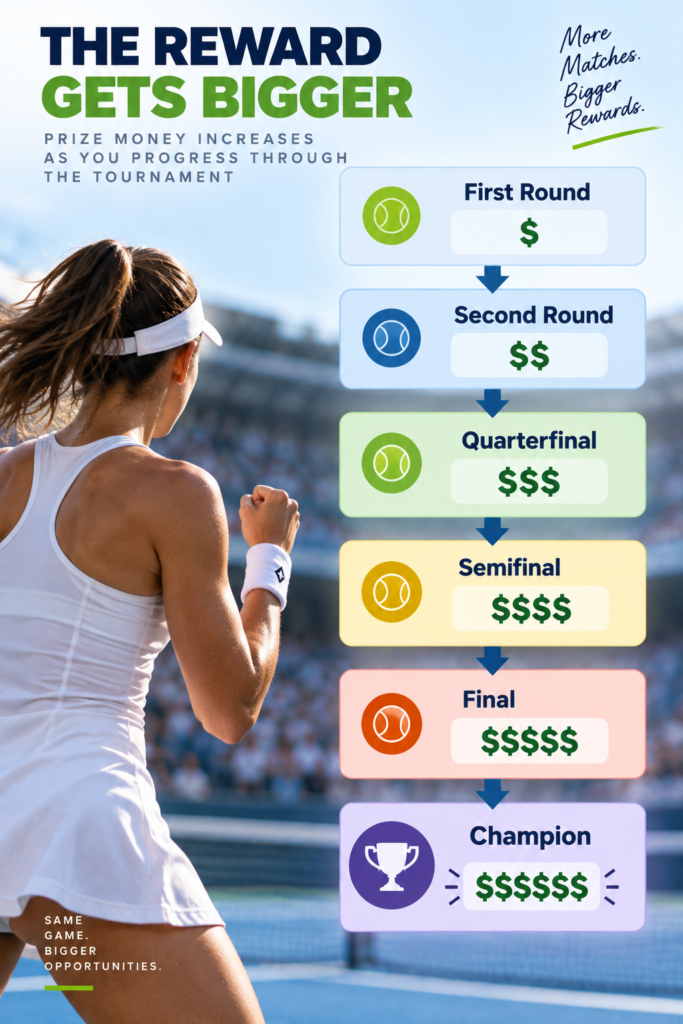
In a standard knockout singles tournament, players generally earn progressively more money for each round they reach.
A player who loses in the first round receives the amount allocated to first-round participants.
Reach the second round and the payment increases.
Continue through the tournament and the rewards become progressively larger, with the champion receiving the biggest individual payment.
Prize money varies considerably according to the tournament.
Grand Slams generally offer the largest purses, while ATP and WTA tournaments offer different amounts according to their level, location and individual tournament finances.
Importantly, ranking points and prize money are separate systems.
Two tournaments belonging to the same ranking category can award the same number of ranking points to their champions while offering different amounts of prize money.
Do Professional Tennis Players Receive a Salary?
Generally, professional tennis doesn’t work like a traditional team sport.
A Premier League footballer, NBA player or AFL player typically has a contract with a team that provides an agreed salary.
Professional tennis players are usually independent competitors.
There is no universal ATP or WTA salary paid simply because someone holds a professional ranking.
Tournament prize money therefore forms an important part of a player’s income.
Players may also earn money from:
- Sponsorships and endorsements
- Appearance fees
- Exhibition events
- Bonuses
- Club or league competition
- Other commercial arrangements
For the very biggest stars, sponsorship income can exceed their tournament earnings.
For players further down the rankings, however, prize money can be critical to whether a professional career is financially sustainable.
Do Tennis Players Get Paid If They Lose?
Yes, at many professional tournaments.
A player does not normally need to win the tournament — or even win a main-draw match — to receive prize money.
If a tournament allocates prize money to first-round participants, a player who competes and loses in that round receives the applicable amount, subject to the event’s rules.
The amount then increases as the player progresses.
This means two players losing on the same day can earn very different amounts if one is losing in the first round and another in the quarterfinals.
At Grand Slams in particular, simply reaching the main draw can be financially significant.
That helps explain why qualifying can mean far more to a lower-ranked player than simply having their name placed in the main tournament.
Why Grand Slam Qualification Matters Financially
Consider a player ranked somewhere outside the automatic main-draw positions.
They enter Grand Slam qualifying and must win several matches to reach the main draw.
If successful, they don’t just earn the opportunity to play on one of tennis’s biggest stages.
They also secure the main-draw prize money associated with that tournament.
For a player who spends much of the season competing at lower levels, that can represent an important injection of income.
Win a main-draw match and the financial reward increases again.
This is one reason the final round of Grand Slam qualifying can be among the most consequential matches of a player’s season.
See What Is a Qualifier in Tennis? for more on how players reach tournament main draws.
How Much Money Does a Grand Slam Winner Receive?
There isn’t one permanent figure.
Each Grand Slam determines its prize-money distribution, and amounts can change from year to year.
The four Grand Slams are:
- Australian Open
- Roland Garros
- Wimbledon
- US Open
All four offer enormous overall prize pools, with singles champions receiving multimillion-dollar payments in their respective currencies.
But using one figure as “Grand Slam prize money” would be misleading because the tournaments don’t all pay exactly the same amount and exchange rates make international comparisons more complicated.
Prize money also tends to change over time.
This is an important difference from ranking points.
A Grand Slam singles champion receives 2,000 ranking points under the current ATP and WTA systems, regardless of which of the four majors they win.
The amount of money attached to that victory, however, depends on the individual tournament.
See Grand Slams Explained for the place of the majors within professional tennis.
Does ATP Tournament Level Determine Prize Money?
Tournament level is strongly associated with the scale of an event, but the number in an ATP tournament category refers primarily to ranking points, not dollars.
For example:
ATP Masters 1000 → champion earns 1,000 ranking points
ATP 500 → champion earns 500 ranking points
ATP 250 → champion earns 250 ranking points
It does not mean an ATP 500 tournament pays $500,000 or that an ATP 250 has a $250,000 prize pool.
The number isn’t a financial figure.
This is a useful distinction because tournament names can otherwise be misleading to newer fans.
For the ranking system itself, see Tennis Ranking Points Explained.
Does WTA Tournament Level Determine Prize Money?
The same principle applies to the WTA.
A WTA 1000 champion receives 1,000 ranking points under the current structure, while WTA 500 and WTA 250 champions receive 500 and 250 respectively.
But the category number does not tell you the tournament’s prize purse.
Two events in the same WTA category can have different financial structures.
Tournament category, ranking points and prize money are therefore related concepts — but they are not interchangeable.
For the complete women’s tournament hierarchy, see The WTA Tour Explained.
Ranking Points vs Prize Money
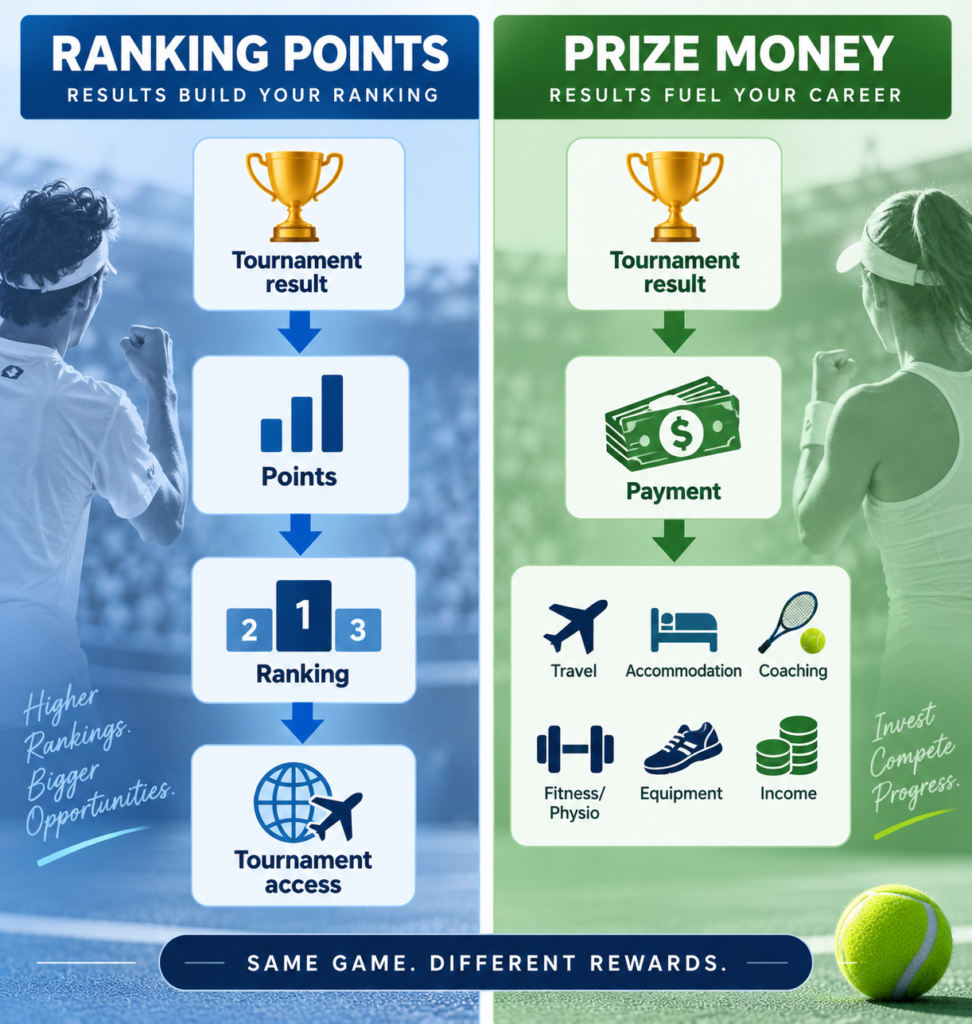
This distinction is important enough to show visually.
| Ranking Points | Prize Money |
|---|---|
| Determines ranking position | Financial payment |
| Governed by ranking system | Determined by event/prize structure |
| Closely tied to tournament category | Can vary between tournaments |
| Influences future tournament access | Helps fund player’s career |
| Cannot be spent | Actual income |
A player can care enormously about both.
But for different reasons.
Ranking points can provide access to future tournaments.
Prize money can provide the financial resources needed to continue competing in them.
Why Do Different Tennis Tournaments Pay Different Amounts?
Professional tennis tournaments vary enormously.
A Grand Slam with hundreds of thousands of spectators, enormous broadcasting contracts and major international sponsors operates on a completely different financial scale from a smaller professional tournament.
Prize money can be influenced by factors including:
Tournament category — larger events generally offer substantially more.
Commercial revenue — sponsorship, ticket sales, hospitality and broadcasting all contribute to tournament economics.
Tournament size — draw sizes and competition formats affect how prize money is distributed.
Location and market — commercial conditions vary between tournaments and countries.
Tour requirements — ATP and WTA tournament categories operate within financial and regulatory standards.
Individual tournament decisions — organisers determine how their available purse is distributed within applicable rules.
As a result, there is no universal amount for “winning a professional tennis tournament.”
Do Men and Women Receive Equal Prize Money?
At the four Grand Slams, men and women receive equal prize money for equivalent singles results.
That means the men’s and women’s singles champions receive the same payment at each respective major, as do equivalent finishers in other rounds.
The US Open became the first Grand Slam to offer equal prize money to men and women in 1973. The Australian Open ultimately established permanent parity in 2001, Roland Garros reached full equality in 2007, and Wimbledon did the same in 2007.
Outside the Grand Slams, the situation is more complicated.
The ATP and WTA are separate tours with different tournaments, commercial structures and prize-money levels. Even when men’s and women’s tournaments are staged together, prize-money arrangements have historically not always been identical.
The WTA has established a pathway aimed at achieving equal prize money at combined WTA 1000 and 500 events by 2027, with single-week WTA 1000 and 500 events targeted by 2033.
Why Isn’t Prize Money the Same Across the Entire ATP and WTA Tours?
Equal prize money at Grand Slams is relatively straightforward to understand because men and women are competing at the same major event.
Across the wider professional calendar, however, the ATP and WTA operate separate tournament structures.
A men’s ATP 500 in one country and a women’s WTA 500 somewhere else are separate businesses with different:
- Sponsors
- Ticket sales
- Broadcasting arrangements
- Venues
- Commercial markets
- Operating costs
That means simply comparing the category names doesn’t necessarily provide a meaningful financial comparison.
The wider question of pay equity in professional tennis has therefore involved not only individual prize purses but also the commercial structure of the tours themselves.
How Is Prize Money Split Through a Tournament?
Most tournament prize structures are heavily progressive.
A simplified fictional example might look like this:
| Result | Fictional Prize Money |
|---|---|
| Champion | $1,000,000 |
| Finalist | $550,000 |
| Semifinal | $300,000 |
| Quarterfinal | $175,000 |
| Fourth Round | $100,000 |
| Third Round | $65,000 |
| Second Round | $40,000 |
| First Round | $25,000 |
These figures are illustrative only.
But they demonstrate an important principle.
Prize money doesn’t normally rise evenly from one round to the next.
The biggest financial rewards are concentrated towards the end of the tournament.
That creates enormous stakes in later rounds.
Winning a semifinal, for example, can be worth far more financially than winning an early-round match.

Do Doubles Players Receive Prize Money?
Yes.
Professional doubles competitions have their own prize-money allocations.
However, doubles prize money is generally considerably lower than singles prize money at major professional tournaments.
There is another important difference.
Doubles prize money is normally listed per team.
If a doubles championship awards a particular amount to the winning team, that amount is then shared between the two players.
The exact financial arrangement between partners may depend on the circumstances, but published doubles prize money should not automatically be interpreted as the amount each individual player receives.
Do Qualifying Players Receive Prize Money?
At major professional tournaments, qualifying competitions can carry their own prize-money allocations.
Players may therefore earn money even if they don’t reach the main draw.
The amount generally increases according to how far they progress through qualifying.
This provides an important financial cushion, particularly at Grand Slams, where qualifying itself can represent a meaningful payday for players who spend much of the season outside the main Tour.
But there is a considerable difference between earning qualifying prize money and securing main-draw money.
That makes the final qualifying round financially significant as well as competitively important.
Do Wild Cards Receive Prize Money?
Yes.
A Wild Card doesn’t receive reduced prize money simply because they entered the tournament through an invitation.
Once in the draw, they are competing for the prize money associated with their results under the tournament rules.
A wild card who wins the tournament receives the champion’s prize money.
A wild card who loses in the first round receives the applicable first-round payment.
The same basic principle applies to Lucky Losers and players who entered through qualifying.
How you reached the draw and how far you progress once you’re there are separate questions.
Do Protected-Ranking Players Receive Normal Prize Money?
Yes.
A Protected Ranking is primarily an entry mechanism.
It can help an eligible returning player gain access to a tournament, but it does not create a separate prize-money category.
Once the player enters the competition, their earnings are determined by their result in the same way as other entrants.
Is Tennis Prize Money Taxed?
Yes, professional tennis earnings can be subject to taxation.
The precise situation is complicated because tennis is an international sport.
A player may live in one country, hold citizenship in another and earn prize money in numerous jurisdictions throughout the season.
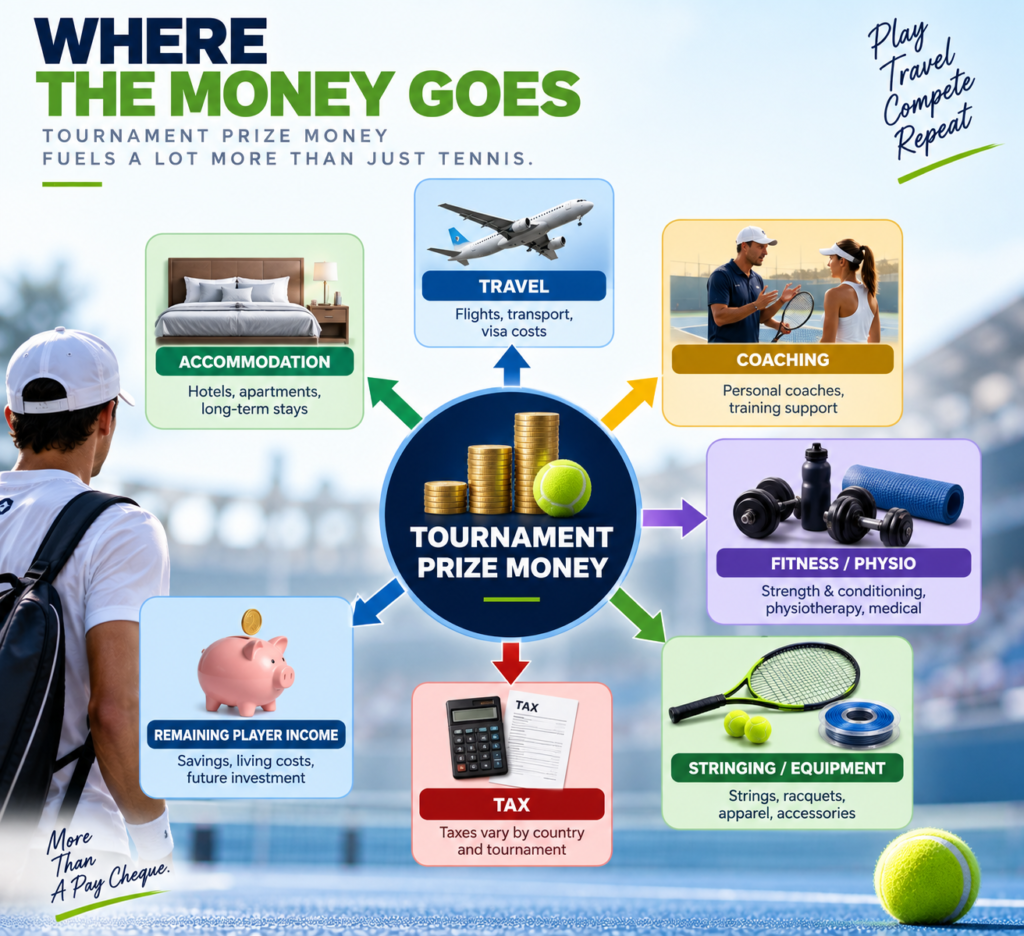
Tournament winnings may be subject to withholding taxes in the country where the event takes place, while the player’s ultimate tax position can also depend on residence, tax treaties and domestic laws.
For that reason, headline career prize-money figures should not be interpreted as the amount a player has taken home.
Tax is only one deduction.
Professional expenses can be substantial as well.
How Much Does It Cost to Be a Professional Tennis Player?
This is the other side of the prize-money story.
Professional players can have significant expenses, including:
- Coaching
- Fitness training
- Physiotherapy
- Flights
- Hotels
- Meals
- Racquet stringing
- Equipment not covered by sponsors
- Medical expenses
- Agent or management costs
- Tournament-related travel
A leading player may travel with a coach, fitness trainer, physiotherapist and other specialists.
Those costs can be considerable, although elite players also have much greater income and sponsorship opportunities.
For players lower down the rankings, the equation can be harsher.
They may have substantially less prize money while still needing to travel internationally to compete.
Does the Winner Receive the Entire Tournament Prize Pool?
No.
When you hear that a tournament has a prize pool of, for example, tens of millions of dollars, that does not mean the champion receives that amount.
The total purse is distributed across the competition.
Money may be allocated to:
- Singles players
- Doubles teams
- Qualifying
- Different rounds
- Other competitions where applicable
The singles champions receive only one portion of the overall prize pool.
This distinction matters when comparing headlines about tournament prize money.
Total prize pool and winner’s prize are completely different numbers.
What Does “Career Prize Money” Mean?
Career prize money generally refers to the amount a player has officially earned from tournament competition across their career.
It can be a useful measure of longevity and success.
But it shouldn’t be confused with net worth.
A player’s actual financial position can include sponsorships, investments and other income while also being reduced by taxes and career expenses.
So if a player is listed as having earned $20 million in career prize money, that does not mean they have $20 million sitting in a bank account.
Nor does it include every dollar they may have earned away from tournaments.
Why Career Prize-Money Comparisons Can Be Misleading
Comparing players from different eras purely by career prize money tells us surprisingly little.
Prize money has increased dramatically over the history of professional tennis.
A champion from several decades ago could dominate the sport while earning a fraction of the nominal prize money available to a modern player.
Inflation complicates comparisons further.
Modern players also compete in a much larger commercial environment.
Career prize money is therefore useful for comparing contemporary players, but much less useful as a direct measure of greatness across generations.
Titles, rankings, Grand Slam results and strength of competition provide much better sporting context.
Prize Money at the Challenger and ITF Levels
The financial divide becomes particularly visible below the main ATP and WTA Tours.
Players competing on the Challenger Tour and ITF World Tennis Tour can earn prize money, but the amounts are much smaller than those available at the highest levels.
At the same time, many of the costs remain.
Players still need to travel.
They still need accommodation.
They still need equipment, food and often coaching.
This is why climbing the professional rankings can be financially transformative.
Moving from ITF competition into Challengers, then into regular ATP or WTA events and eventually Grand Slam main draws doesn’t simply mean facing better players.
It can change the economics of a player’s career.
The Financial Importance of the Top 100
There is no magical financial guarantee attached to being ranked No. 100.
But reaching approximately that level can open doors.
A ranking high enough to gain direct entry into Grand Slam main draws can provide access to substantially larger prize-money opportunities than are available at lower professional levels.
That can create something of a financial flywheel:
Strong results
↓
More ranking points
↓
Higher ranking
↓
Access to bigger tournaments
↓
Greater prize-money opportunities
↓
More resources to invest in the player’s career
This doesn’t guarantee continued success.
But it demonstrates why rankings and money are so closely connected even though ranking points themselves have no direct monetary value.
Ranking Points and Prize Money Reward Different Things
At first glance, ranking points and prize money appear almost interchangeable.
Both increase when players progress through tournaments.
But they ultimately serve very different purposes.
Ranking points determine where a player sits within professional tennis.
Prize money helps determine whether that player can financially sustain their career.
For the world’s leading players, both can become enormous.
For someone fighting to climb through the lower levels, however, the relationship can be much more precarious.
A handful of ranking points might secure entry into a bigger tournament.
One successful tournament might then provide enough prize money to fund several months of competition.
That is why matches well outside the television spotlight can carry extraordinary consequences for the players involved.
Frequently Asked Questions
How do tennis players get paid?
Professional players earn tournament prize money according to their results and may also receive income from sponsorships, endorsements, exhibitions, appearance fees and other commercial arrangements.
Do tennis players receive a salary?
There is no universal ATP or WTA salary simply for being a professional player. Tournament prize money is therefore an important source of playing income.
Do tennis players get paid if they lose in the first round?
At many professional tournaments, yes. Main-draw participants receive the prize money allocated to the round in which they finish, subject to the tournament’s rules.
How much does a Grand Slam winner earn?
The amount varies between the Australian Open, Roland Garros, Wimbledon and US Open and can change each year. Grand Slam singles champions currently receive multimillion-dollar prizes.
Do male and female tennis players receive equal prize money?
Men and women receive equal prize money for equivalent results at all four Grand Slams. Prize-money structures across the wider ATP and WTA Tours are more complex.
Does ATP 500 mean $500,000 prize money?
No. The “500” refers to the ranking points awarded to the singles champion, not the tournament’s prize money.
Do doubles players split their prize money?
Published doubles prize money is generally awarded per team rather than individually, so it is shared between the partners.
Do qualifiers get paid?
Qualifying competitions at major professional tournaments can award prize money even to players who don’t reach the main draw.
Do wild cards receive normal prize money?
Yes. A wild card earns prize money according to their tournament result under the same applicable prize structure.
Is career prize money the same as net worth?
No. Career prize money measures official tournament earnings and does not account for all taxes, expenses, sponsorship income or other financial assets.
Final Thoughts
The headline numbers at the top of professional tennis can make the sport look extraordinarily lucrative.
For a small group of players, it is.
Grand Slam champions can earn millions from a single tournament, while the biggest stars combine prize money with substantial sponsorship and commercial income.
But professional tennis is much larger than the handful of players lifting trophies on centre court.
Thousands of competitors are trying to finance travel, coaching and tournament expenses while earning enough points to climb the rankings and reach more lucrative events.
That is what makes prize money such an important part of understanding professional tennis.
It isn’t simply a reward for winning.
It is part of the economic ladder of the sport.
Results produce ranking points. Ranking points create opportunities. Those opportunities provide access to bigger tournaments and greater prize money.
And for many players, climbing that ladder can determine not only how far they progress in professional tennis — but how long they can afford to remain there.
Continue Reading
- Tennis Ranking Points Explained
- The ATP Tour Explained
- The WTA Tour Explained
- Live Rankings Explained
- Protected Ranking Explained
- What Is a Qualifier in Tennis?
- Grand Slams Explained
- Challenger Tour Explained
- ITF World Tennis Tour Explained
Read more of our instructional articles here.
Read more of our player focus articles here.
Follow The Tennis Site on X: @thetennissite
Follow Todd Scoullar on X: @toddscoullar

Comments are closed, but trackbacks and pingbacks are open.