

The Next Gen ATP Finals brings together eight of the most promising young players in men’s professional tennis for a season-ending championship unlike any other on the ATP calendar.
Featuring players aged 20 and under, the tournament combines a round-robin competition with shorter sets, modified scoring and a series of innovations designed to make tennis faster and more engaging.
Since its introduction in 2017, the event has provided an early glimpse of players who would subsequently become major figures in the sport. Jannik Sinner, Carlos Alcaraz and Stefanos Tsitsipas are among its former champions.
But the Next Gen ATP Finals is more than a showcase for emerging talent. It offers substantial prize money, valuable experience in a high-profile environment and an opportunity to compete against the strongest players of the same generation.
Here’s how the tournament works.
What Are the Next Gen ATP Finals?
The Next Gen ATP Finals is an annual men’s singles tournament featuring eight leading players aged 20 and under.
Unlike most ATP tournaments, qualification is based on a separate season-long race restricted to eligible young players.
The competition uses a similar structure to the traditional ATP Finals, with two round-robin groups followed by semifinals and a final.
However, the Next Gen event uses a distinctive scoring system and has historically served as a testing ground for changes to professional tennis.
The tournament was first held in Milan, Italy, in 2017, and remained there through 2022. It subsequently moved to Jeddah, Saudi Arabia, for the 2023, 2024 and 2025 editions.
In 2026, the championship returns to Italy, with Reggio Calabria hosting the tournament from 9–13 December at PalaCalafiore.
The ATP has announced a total prize-money offering of US$2 million for the 2026 event.
How Do Players Qualify for the Next Gen ATP Finals?
Qualification is determined by the ATP Race to the Next Gen Finals, a separate standings list tracking eligible players’ ranking points earned during the season.
The event is restricted to players who remain aged 20 or under throughout the relevant calendar year.
For 2026, that means players born in 2006 or later.
The ATP’s selection rules provide for seven direct acceptances from the season-ending Next Gen race, together with one wild card selected by the ATP.
The wild-card recipient must also meet the age requirement.
The race is different from the ordinary ATP rankings because it considers points accumulated during the current season rather than a rolling 52-week period.
A player may therefore be ranked higher in the official ATP rankings but sit below another eligible player in the Next Gen race.
Can a Player Qualify for Both the ATP Finals and Next Gen Finals?
Yes, a sufficiently successful young player could meet the qualification criteria for both events.
However, under the 2026 regulations, a player who qualifies for the traditional ATP Finals as a direct acceptance or designated alternate is exempt from mandatory participation in the Next Gen ATP Finals. In 2026 Rafael Jodar qualified for both, but made the obvious choice to play the ATP Finals.
The two championships serve different purposes.
The ATP Finals brings together the leading performers of the entire season, regardless of age. The Next Gen ATP Finals focuses specifically on the emerging generation.
What Is the Next Gen ATP Finals Tournament Format?
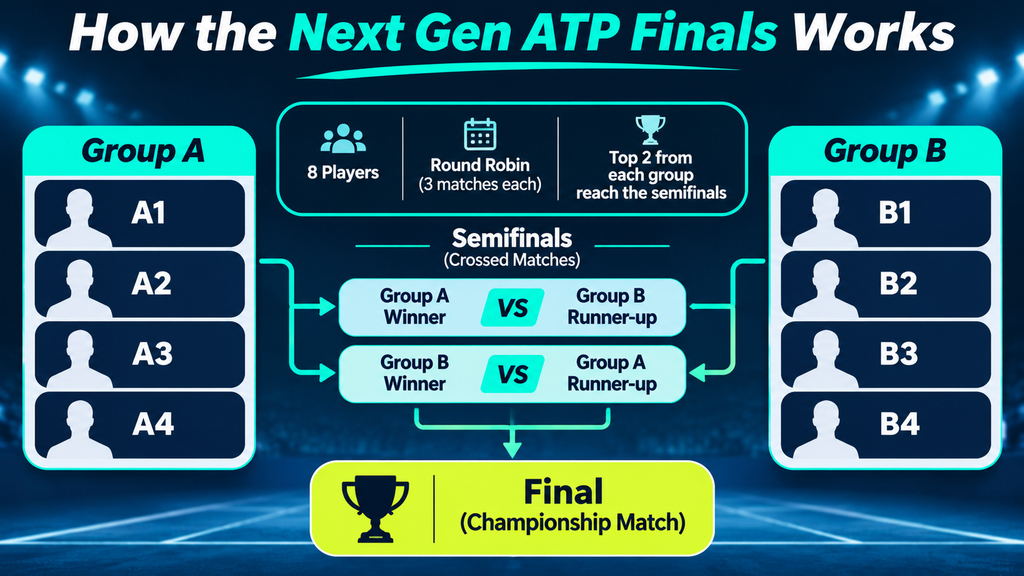
The eight participants are divided into two groups of four players.
Each player competes against the other three players in his group, producing three round-robin matches per participant.
The top two players from each group advance to the semifinals.
From that point, the tournament becomes a knockout competition.
| Stage | Format |
|---|---|
| Group stage | Two groups of four players |
| Round-robin matches | Three per player |
| Semifinals | Group A winner vs Group B runner-up, and vice versa |
| Final | Winners of the two semifinals |
| Maximum matches | Five for a finalist |
Unlike a conventional knockout tournament, losing a match during the group stage does not necessarily eliminate a player.
A competitor can lose once and still progress to the semifinals or win the championship.
How Are Group Ties Decided?
The ATP uses a series of criteria to determine which players advance when group records are tied.
The first considerations include the number of matches won and the number played.
If two players remain tied, their head-to-head result can decide their positions.
Three-player ties may require additional calculations involving the percentage of sets won, percentage of games won and, if necessary, ATP rankings.
These rules are important because the final group standings cannot always be determined simply by looking at the number of victories.
How Does Scoring Work at the Next Gen ATP Finals?
The scoring system is the most recognisable difference between the Next Gen ATP Finals and conventional professional tennis.
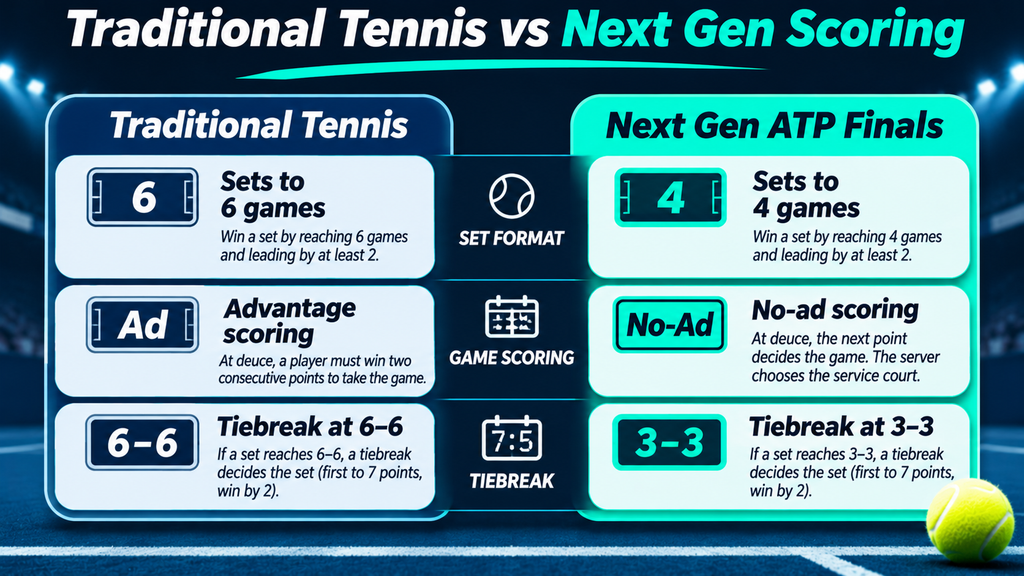
Matches are played over the best of five sets, but each set is considerably shorter than a traditional six-game set.
First to Four Games
A player wins a set by reaching four games with a margin of at least two games.
Possible set scores include:
- 4–0
- 4–1
- 4–2
- 4–3, following a tiebreak
If the score reaches 3–3, a tiebreak decides the set.
This means every game carries greater importance than in a conventional set. A single break of serve can quickly put a player in a commanding position.
Best of Five Sets
Although the sets are shorter, a player must still win three sets to win the match.
A match might finish 4–2, 3–4, 4–1, 4–3.
This combination allows for several momentum changes without requiring the same number of games as a traditional best-of-five match.
No-Ad Scoring
The tournament also uses no-ad scoring.
Under traditional tennis rules, players reaching deuce must win two consecutive points to claim the game.
At the Next Gen ATP Finals, the next point after deuce decides the game.
The server chooses which service court to serve into for that deciding point.
This removes extended deuce exchanges and increases the significance of individual points.
For a broader explanation of conventional scoring, see our complete guide to tennis scoring.
Tiebreaks at 3–3
If a set reaches three games all, the players contest a conventional seven-point tiebreak.
The winner must reach at least seven points and lead by two.
A tiebreak can therefore finish 7–5, 8–6 or continue beyond that if neither player establishes a two-point advantage.
What Special Rules Are Used at the Next Gen ATP Finals?
Beyond its scoring format, the tournament has experimented with several changes intended to reduce interruptions and improve the viewing experience.
Some have been retained over multiple editions, while others have been modified or discontinued.
For the 2025 tournament, the ATP confirmed several distinctive procedures.
Shorter Breaks Between Points
Players were allowed 15 seconds between points when the preceding rally contained fewer than three shots.
Longer rallies retained the standard 25-second limit.
The objective was to reduce unnecessary delays after very short points while giving players more recovery time following demanding exchanges.
Second-Serve Shot Clock
A separate shot clock allowed up to eight seconds between the first and second serves.
This introduced a visible time limit for a part of the service routine that does not ordinarily have its own separate on-screen countdown.
Reduced Changeovers
Players did not change ends after the opening game.
Instead, the event used a modified changeover schedule, including 90-second seated breaks at specified points during a set.
On-Court Warm-Up
The 2025 tournament allowed a three-minute on-court warm-up.
This is worth noting because earlier editions experimented with eliminating the traditional warm-up altogether.
Greater Freedom of Spectator Movement
The event also permitted more spectator movement within the arena, subject to restrictions designed to prevent interference with players.
This was intended to create a more flexible spectator experience than the traditional requirement to wait for changeovers before moving around the stands.
Enhanced Performance Data
The Next Gen ATP Finals has also been used to display advanced match statistics.
Alongside conventional information such as aces and first-serve percentages, the ATP has introduced measures covering shot quality, attacking play and defensive performance.
Coaches can access additional match analysis through ATP Tennis IQ.
These initiatives allow the ATP to assess how innovations function in competitive matches before considering their wider use.
The shorter-set and no-ad scoring format is established in the 2026 ATP regulations. The other initiatives described above are confirmed for 2025; their precise application in 2026 depends on that edition’s announced rules.
Do Players Earn ATP Ranking Points at the Next Gen Finals?
No.
Unlike the traditional ATP Finals, the Next Gen ATP Finals does not award ATP ranking points.
The event is an official ATP championship, but its results do not contribute additional points towards a player’s singles ranking.
This is a significant distinction.
An undefeated champion at the traditional ATP Finals can earn up to 1,500 ranking points, while the Next Gen champion receives no ranking points for winning the event.
The value of the Next Gen Finals instead comes from prize money, competitive experience and the opportunity to establish a reputation against other leading young players.
For more information, see our guide to how ATP and WTA ranking points work.
How Much Prize Money Is Available?
The Next Gen ATP Finals offers substantial financial rewards, particularly for players who have spent much of the season competing at ATP Challenger level.
In 2025, the total prize-money pool was US$2,101,250.
The ATP published the following breakdown:
| Achievement | Prize money (USD) |
|---|---|
| Participation fee | $154,000 |
| Each round-robin victory | $37,500 |
| Semifinal victory | $116,000 |
| Final victory | $157,250 |
| Undefeated champion — total earnings | $539,750 |
An undefeated champion receives the participation fee plus payments for three group victories, a semifinal victory and the final.
The 2026 edition has been announced with US$2 million in prize money, although the individual payment schedule should be checked against the official 2026 breakdown when available.
For emerging professionals, these earnings can be particularly important.
Travel, coaching and accommodation costs can place significant pressure on players competing below the top levels of the ATP Tour.
A successful appearance at the Next Gen Finals can provide financial resources that help support the following season.
Who Has Won the Next Gen ATP Finals?
The tournament’s list of champions illustrates why it has developed a reputation as a showcase for future stars.
| Year | Champion |
|---|---|
| 2017 | Hyeon Chung |
| 2018 | Stefanos Tsitsipas |
| 2019 | Jannik Sinner |
| 2020 | Not held |
| 2021 | Carlos Alcaraz |
| 2022 | Brandon Nakashima |
| 2023 | Hamad Medjedovic |
| 2024 | João Fonseca |
| 2025 | Learner Tien |
Sinner and Alcaraz subsequently became Grand Slam champions and World No. 1 players.
Tsitsipas went on to win the traditional ATP Finals in 2019 and reach Grand Slam finals.
Fonseca’s 2024 victory in Jeddah preceded his first ATP Tour titles in 2025.
However, winning the Next Gen Finals does not guarantee future success at the highest level.
The tournament identifies players who have already produced strong results at a young age. Their subsequent development depends on many factors, including fitness, consistency and the ability to compete against more experienced opponents.
Next Gen ATP Finals vs ATP Finals: What’s the Difference?
Although both tournaments use round-robin groups followed by knockout matches, they are designed for different groups of players.
| Feature | Next Gen ATP Finals | ATP Finals |
|---|---|---|
| Players | Eight young singles players | Eight singles players and eight doubles teams |
| Age restriction | 20 and under | None |
| Qualification | Next Gen season race and wild card | ATP season race and qualification rules |
| Set format | Best of five, first to four games | Best of three conventional sets in singles |
| Scoring | No-ad | Traditional advantage scoring |
| Ranking points | None | Up to 1,500 |
| Purpose | Emerging-player championship and innovation platform | Elite season-ending championship |
The Next Gen Finals is not simply a smaller version of the ATP Finals.
Its age restrictions, scoring rules and developmental emphasis give it a separate identity.
Is the Next Gen ATP Finals the Same as the Next Gen Accelerator?
No.
The two initiatives operate under the ATP’s broader Next Gen programme, but serve different purposes.
The Next Gen ATP Finals is a season-ending championship for leading young players.
The Next Gen Accelerator is a player-development programme that provides eligible emerging players with additional opportunities to enter ATP Challenger and selected ATP Tour tournaments.
A player can benefit from the Accelerator without qualifying for the Finals.
Similarly, qualifying for the Finals does not depend on previously receiving an Accelerator entry.
For a detailed explanation, read ATP Next Gen Accelerator Explained: How Young Players Reach the Professional Tour.
Why Are the Next Gen ATP Finals Important?
The tournament provides a platform that few other events can offer.
Young players compete against their peers in a high-profile championship, with substantial prize money and international attention.
The round-robin format guarantees each player several matches, rather than the possibility of an immediate first-round exit.
The competition also gives players experience of a season-ending event, including group-stage calculations, media commitments and the pressure of competing for a title against other leading prospects.
For spectators, it offers an opportunity to follow emerging players before they become established names.
And for the ATP, it provides a controlled environment in which to test changes to the presentation and rules of professional tennis.
Not every innovation will prove suitable for wider adoption. Some may improve the spectacle, while others could alter elements of tennis that players and spectators value.
That tension is part of what makes the tournament distinctive.
The Next Gen ATP Finals is both a competition in its own right and an experiment in how professional tennis might evolve.
Continue Reading
- ATP Finals Explained: Format, Qualification, Ranking Points, Prize Money & History
- ATP Next Gen Accelerator Explained: How Young Players Reach the Professional Tour
- Tennis Scoring Explained: A Complete Guide
- Tennis Ranking Points Explained: How the ATP and WTA Points Systems Work
- How Tennis Tournament Entry Lists Work
Read more of our exclusive feature articles here.
Read more of our player focus articles here.
Follow The Tennis Site on X: @thetennissite
Follow Todd Scoullar on X: @toddscoullar

Comments are closed, but trackbacks and pingbacks are open.