

A serious injury can keep a professional tennis player away from competition for months — sometimes more than a year.
During that time, their world ranking can fall dramatically.
A player who was ranked inside the Top 20 before an injury might return to find themselves outside the Top 100, leaving them unable to enter tournaments they would previously have qualified for automatically.
This is where a protected ranking can help.
A protected ranking allows an eligible player returning from a lengthy absence to use a previous ranking position for entry into certain tournaments.
But the name can be misleading.
A protected ranking does not freeze a player’s world ranking. It does not preserve their ranking points, guarantee them a place in every tournament or automatically make them a seeded player.
It is primarily an entry mechanism designed to give eligible players a pathway back into professional competition.
Quick Answer: What Is a Protected Ranking in Tennis?
A protected ranking allows an eligible player who has been absent from competition for an extended period to use a ranking based on their position before or during the beginning of that absence to enter certain tournaments after returning.
On the ATP Tour, the mechanism is known as Entry Protection, commonly referred to as a protected ranking.
On the WTA Tour, the corresponding mechanism is called a Special Ranking.
The precise eligibility requirements and usage rules differ between the ATP and WTA.
Most importantly:
A protected ranking protects tournament entry opportunities — not the player’s actual ranking.
Why Do Protected Rankings Exist?
Tennis rankings are built around recent tournament results.
If a player stops competing, the results contributing to their ranking eventually leave the ranking calculation.
Their ranking can therefore fall even though the reason they’re not playing has nothing to do with their ability.
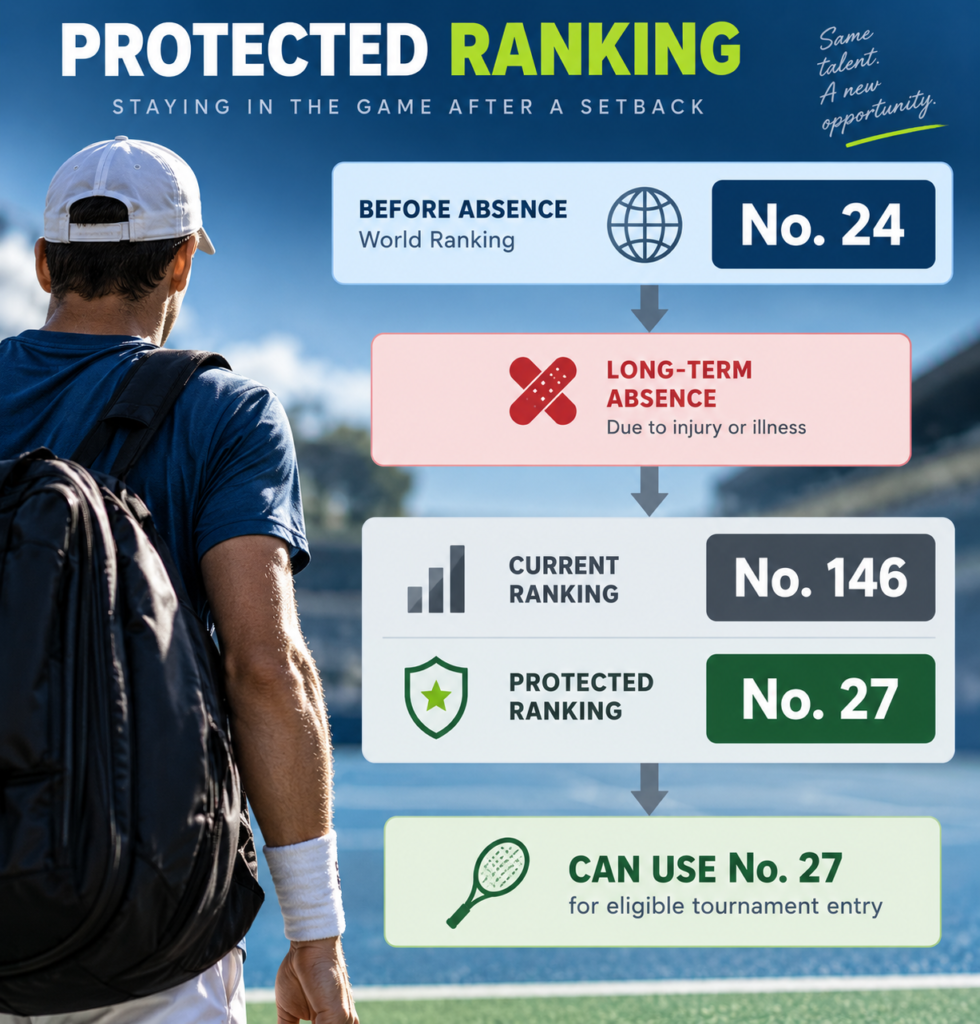
Consider a player ranked No. 30 who suffers a serious injury and misses a year.
By the time they return, many of the points responsible for that No. 30 ranking will have disappeared.
Their current ranking might now be No. 150 — or they may have fallen even further.
Without some form of protection, that player could suddenly struggle to enter ATP or WTA Tour tournaments.
They might need wild cards or be forced to return through much lower-level events.
Protected ranking systems provide eligible players with a limited opportunity to enter tournaments using a ranking connected to where they were before their extended absence.
Does a Protected Ranking Freeze a Player’s Ranking?
No.
This is probably the biggest misconception surrounding protected rankings.
Suppose a player is ranked No. 20 when they stop competing.
Their ranking is not frozen at No. 20.
As their previous results leave the ranking calculation, their official ranking can continue falling.
When they return, they might officially be ranked No. 120 while holding a protected ranking around No. 20.
The two rankings exist for different purposes.
Current ranking: reflects the player’s actual position in the rankings.
Protected ranking: can be used for entry into eligible tournaments.
The protected number doesn’t replace the player’s current ranking.
How Does the ATP Protected Ranking Work?
The ATP officially describes the system as Entry Protection.
Under the current ATP rules, a player may petition for Entry Protection when they have been unable to compete in any tennis event for at least six months because of physical injury or documented medical illness. The provision also covers compulsory military service under specified conditions.
The request must satisfy the ATP’s eligibility requirements rather than being automatically granted simply because a player has been injured.
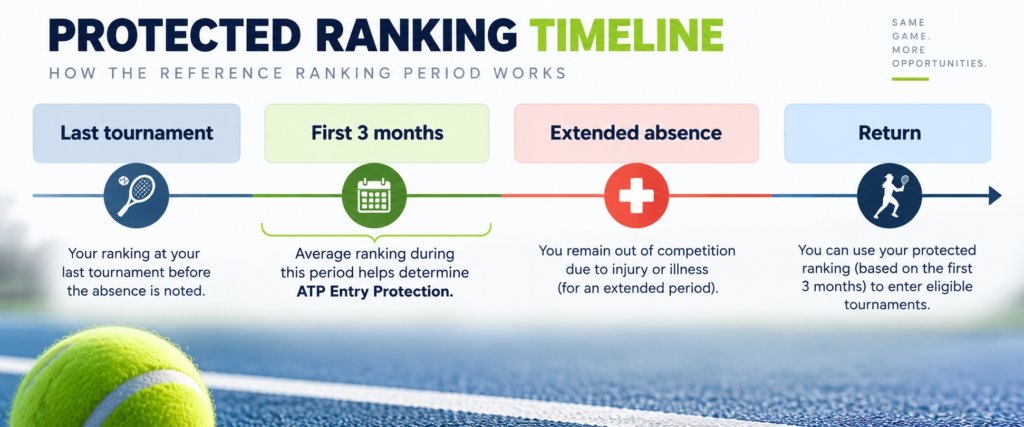
The protected position is calculated using the player’s average ATP ranking position during the first three months after their last event played.
That detail is important.
The protected ranking isn’t necessarily identical to the player’s ranking on the day they played their final match.
How Long Can an ATP Player Use a Protected Ranking?
The ATP limits both the number of tournaments and the period in which Entry Protection can be used.
For a qualifying absence, Entry Protection is generally available for the player’s first nine tournaments using the protection or for up to nine months beginning with the player’s first event back, whichever limit is reached first.
If the player has been out for 12 months or longer because of physical injury, the allowance can extend to the first 12 singles tournaments and 12 doubles tournaments using the protection, or up to 12 months from the player’s return, subject to the ATP’s detailed rules.
There is also an overall activation limit. Under the 2026 ATP rules, a player has three years from their original last event played to activate their protected ranking.
The important principle is that protected ranking isn’t permanent.
It provides a temporary window in which the player can rebuild their normal ranking through new tournament results.
What Is a WTA Special Ranking?
The WTA uses the term Special Ranking rather than Protected Ranking.
The principle is similar: an eligible player returning after a qualifying absence can use a Special Ranking for entry purposes under WTA rules.
However, the WTA has its own regulations and eligibility provisions, so it is incorrect to assume that ATP protected-ranking rules automatically apply to women.
The WTA has also developed specific return provisions relating to pregnancy and motherhood. Players including Belinda Bencic and Elina Svitolina have used the WTA’s Special Ranking Rule when returning to competition after becoming mothers.
Because these rules can evolve, players’ eligibility and permitted use are governed by the current WTA rulebook.
Does a Protected Ranking Give a Player Ranking Points?
No.
A protected ranking does not give a player free ranking points.
This is another crucial distinction.
Imagine a player has:
Current ranking: No. 180
Protected ranking: No. 35
The No. 35 protected ranking might allow them to enter a tournament that their current ranking would not have been sufficient to enter.
But once the tournament begins, they must earn ranking points normally.
If they lose in the first round, they receive whatever ranking points — if any — normally apply to that result.
If they reach the semifinal, they earn the normal semifinal points.
The protected ranking merely helps open the door.
What happens after that is determined by the player’s results.
For more on how those points are awarded, see Tennis Ranking Points Explained.
Can a Protected Ranking Be Used for Seeding?
Generally, no.
On the ATP Tour, Entry Protection cannot be used for seeding.
That can create an unusual situation.
A former Top 10 player returning from a lengthy absence might use a protected ranking to gain entry into a tournament but enter the draw unseeded because their current ranking isn’t high enough to earn a seed.
They could therefore be drawn against a leading seed immediately.
This is one reason returning stars can create particularly dangerous early-round matchups.
Can a Protected Ranking Be Used at Grand Slams?
Protected or special rankings can be used for Grand Slam entry where the relevant rules permit.
For ATP players, use of a protected ranking to enter singles and/or doubles at a Grand Slam is limited to once per Grand Slam event.
This can be enormously valuable.
Grand Slam entry is one of the biggest practical benefits available to a returning player because the majors offer substantial prize money and ranking points.
A player whose current ranking would otherwise require them to enter qualifying may potentially use their protected ranking to gain entry under the applicable rules.
However, possessing a protected ranking does not automatically guarantee entry. The protected position still needs to be good enough relative to the tournament’s entry requirements.
Does a Protected Ranking Guarantee Main-Draw Entry?
No.
A protected ranking acts like a ranking position for certain entry purposes.
It doesn’t guarantee that the ranking will be high enough to make the draw.
Suppose the effective entry cut-off for a tournament falls around No. 70.
A player with:
Protected ranking: No. 45
could be in a strong position to receive direct entry.
A player with:
Protected ranking: No. 115
might not.
The same basic issue applies to ordinary rankings: entry depends on the tournament, draw size, entry list and applicable rules.
Protected Ranking vs Wild Card
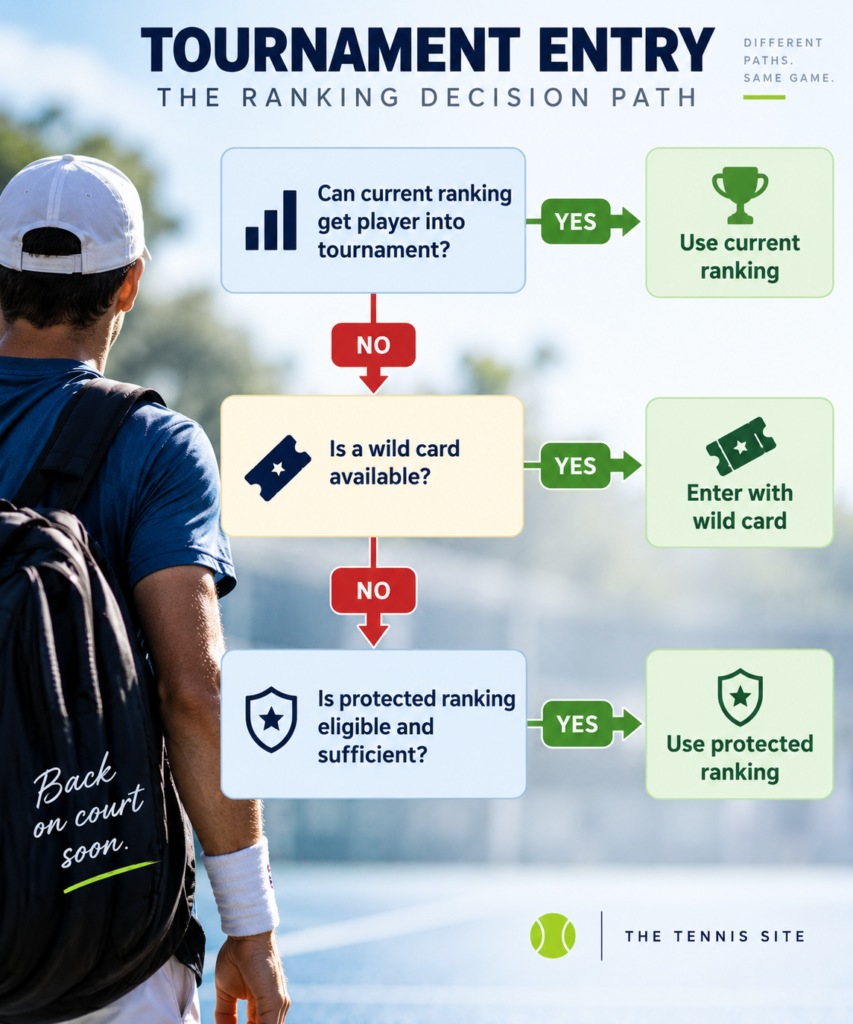
A protected ranking and a wild card can both allow a player to enter a tournament that their current ranking would otherwise prevent them from entering.
But they work very differently.
| Protected Ranking | Wild Card |
|---|---|
| Governed by eligibility rules | Awarded by tournament organisers |
| Usually connected to an extended absence | Can be awarded for many reasons |
| Uses a protected/special ranking for entry | Does not require a sufficient ranking |
| Limited in use | Tournament-specific invitation |
| Player must qualify under Tour rules | Organisers choose the recipient |
A returning former champion may sometimes receive wild cards instead of using a protected ranking.
That can be strategically useful because it may preserve a protected-ranking use for another tournament.
Under ATP rules, for example, certain tournaments entered through a wild card rather than by using Entry Protection do not count against the player’s protected-ranking tournament allowance.
Protected Ranking vs Qualifying
A player whose current ranking isn’t sufficient for direct main-draw entry may otherwise need to play qualifying.
Using a protected ranking can sometimes allow the player to enter the main draw directly instead.
For example:
Current ranking: No. 170
Protected ranking: No. 48
If No. 48 is sufficient for direct entry, the player could potentially avoid qualifying.
That can make a significant difference for someone returning from injury.
Instead of needing to win several matches merely to reach the main draw, they can begin the tournament alongside the direct entrants.
See What Is a Qualifier in Tennis? for more on how qualifying works.
Protected Ranking vs Lucky Loser
These systems have almost nothing in common beyond being alternative ways players can appear in tournament draws.
A Lucky Loser is a player who loses in the final round of qualifying but subsequently enters the main draw after another player withdraws.
A protected ranking is an entry mechanism connected to an eligible player’s extended absence.
On the ATP Tour, protected rankings are specifically not used for Lucky Loser consideration.
Can a Player Use Their Protected Ranking Whenever They Want?
Not indefinitely.
There are restrictions on:
- Eligibility
- When the protection must be requested
- When it must be activated
- How many tournaments it can be used for
- How long the protection remains available
- Which competitions permit its use
The rules can also differ between ATP, WTA and Grand Slam competition.
Players and their teams therefore have to think carefully about when using the protection provides the greatest benefit.
Why Would a Player Not Use Their Protected Ranking?
Suppose a returning player has:
Current ranking: No. 85
Protected ranking: No. 30
They enter an ATP tournament where their current No. 85 ranking is already sufficient for direct acceptance.
There may be little reason to use the protected ranking.
Instead, they can enter using their current ranking and preserve the protection for a tournament where it might actually be needed.
Similarly, if the player receives a wild card, they may not need to use their protected position for that event.
This creates an element of strategy around the return.
What Happens to the Player’s Normal Ranking While They Use It?
The normal ranking continues operating.
Every tournament the player competes in gives them the opportunity to earn new ranking points.
As those results accumulate, their current ranking can begin climbing again.
Eventually, the aim is for the normal ranking to become high enough that the protected ranking is no longer necessary.
For example:
Return to competition
Current ranking: No. 240
Protected ranking: No. 55
After several tournaments:
Current ranking: No. 130
Protected ranking: No. 55
After further strong results:
Current ranking: No. 62
Protected ranking: No. 55
Eventually:
Current ranking: No. 38
At that stage, the player’s real ranking has overtaken the protected position.
The protection has effectively served its purpose.
Can a Player Have a Protected Ranking and a Live Ranking?
Yes.
These are completely different concepts.
A player might simultaneously have:
Official ranking: No. 115
Live ranking: No. 96
Protected ranking: No. 42
The official ranking tells us where the player currently stands.
The Live Ranking estimates where current results could place them at the next ranking update.
The protected ranking may allow them to enter certain tournaments based on their position before the qualifying absence.
All three numbers can therefore legitimately exist at the same time.
What Happens If a Player Is Injured Again?
The ATP rules contain provisions for players who return and then suffer another injury.
An eligible player may petition for a freeze of the remaining protected-ranking period if they are again out of competition for at least three months.
When they return, they can resume with the number of events and weeks that remained when the freeze began, subject to the ATP’s restrictions and overall expiration rules.
The ATP currently permits a maximum of two such freezes during the relevant protected-ranking period.
This prevents a genuine re-injury from necessarily consuming the entire remaining protection period while the player is again unable to compete.
Why Protected Rankings Matter
Professional tennis is unusual because a player’s ability to enter tournaments is closely connected to their ranking.
An injury therefore creates two problems.
First, the player cannot compete.
Second, while they are unable to compete, the ranking that determines their future tournament access can deteriorate.
Protected-ranking systems attempt to address the second problem.
They don’t restore the player’s fitness.
They don’t restore lost ranking points.
They don’t guarantee victories.
And they don’t permanently return the player to their former position.
Instead, they provide something much simpler: access.
The player receives a limited opportunity to enter tournaments at a level broadly connected to where they were before the extended absence and then has to rebuild their career through results.
Frequently Asked Questions
What is a protected ranking in tennis?
A protected ranking allows an eligible player returning from a lengthy absence to use a ranking based on their previous position for entry into certain tournaments.
Does a protected ranking freeze a player’s ranking?
No. The player’s normal ranking can continue falling during their absence. The protected ranking is primarily used for tournament entry.
How long must an ATP player be out to qualify?
Under current ATP rules, a player seeking Entry Protection for physical injury or documented medical illness must have been unable to compete in tennis events for a minimum of six months and satisfy the other eligibility requirements.
Is a WTA protected ranking called the same thing?
The WTA generally uses the term Special Ranking for its corresponding mechanism.
Can protected rankings be used for seeding?
ATP Entry Protection cannot be used for seeding.
Does a protected ranking give a player ranking points?
No. Players must earn ranking points through their tournament results after returning.
Can a protected ranking be used at a Grand Slam?
Yes, subject to the relevant rules and entry requirements. ATP rules limit protected-ranking use for singles and/or doubles entry to once per Grand Slam event.
Can a player use a wild card instead?
Yes. A returning player may receive a wild card, which is a different entry mechanism and can sometimes allow them to preserve a protected-ranking use for another tournament.
Is protected ranking the same as live ranking?
No. A live ranking projects a player’s current ranking movement based on recent results. A protected ranking is an entry mechanism available to eligible players returning from qualifying absences.
Final Thoughts
The term protected ranking makes the system sound more generous than it really is.
A player’s ranking isn’t frozen. Their points aren’t protected. Their previous position isn’t restored when they return.
What is protected is their opportunity to enter certain tournaments.
For players who have spent months or even years away from professional tennis, that opportunity can be enormously important.
Instead of beginning again at the very bottom of the professional ladder, eligible players have a limited period in which they can use their protected or special ranking to access tournaments and rebuild their current ranking through new results.
After that, the safety net disappears.
From there, just as before the absence, their place in professional tennis depends on what they can achieve on court.
Continue Reading
- Live Rankings Explained
- Tennis Ranking Points Explained
- The ATP Tour Explained
- The WTA Tour Explained
- What Is a Wild Card in Tennis?
- What Is a Qualifier in Tennis?
- What Is a Lucky Loser in Tennis?
- Tennis Prize Money Explained
Read more of our instructional articles here.
Read more of our player focus articles here.
Follow The Tennis Site on X: @thetennissite
Follow Todd Scoullar on X: @toddscoullar

Comments are closed, but trackbacks and pingbacks are open.