

The WTA Tour is the highest level of women’s professional tennis, taking the world’s leading players to tournaments across the globe throughout the season.
But the structure behind it can initially seem complicated.
What is the difference between a WTA 1000 and WTA 500? Are the Grand Slams part of the WTA Tour? How do players qualify for tournaments? And why can a player’s world ranking differ from her position in the Race to the WTA Finals?
The system becomes much easier to understand once the different pieces are put together.
From WTA 250 tournaments through to the Grand Slams and season-ending WTA Finals, results throughout the year determine rankings, tournament entry and ultimately who finishes the season as the world’s No. 1 player.
Quick Answer: What Is the WTA Tour?
The Women’s Tennis Association (WTA) oversees the leading global professional tennis tour for women.
The main WTA Tour consists of three regular tournament categories:
- WTA 1000
- WTA 500
- WTA 250
There is also the WTA Finals at the end of the season, while WTA 125 tournaments form an important level below the main Tour.
The four Grand Slams sit above regular WTA Tour events in terms of ranking points and prestige, although they are not operated by the WTA.
In 2026, the WTA calendar contains more than 50 tournaments across 26 countries and territories, in addition to the four Grand Slams.
What Does WTA Stand For?
WTA stands for the Women’s Tennis Association.
The organisation was founded in 1973 following a meeting led by Billie Jean King involving many of the leading women’s players of the era.
The creation of the WTA brought professional women’s tennis together under a unified organisation and helped establish the structure that eventually developed into today’s global Tour.
The WTA now oversees areas including its tournament calendar, rankings and the season-ending WTA Finals.
The men’s equivalent is the ATP Tour, although the two organisations operate separately.
How Is the WTA Tour Structured?
Not every professional tournament carries the same importance.
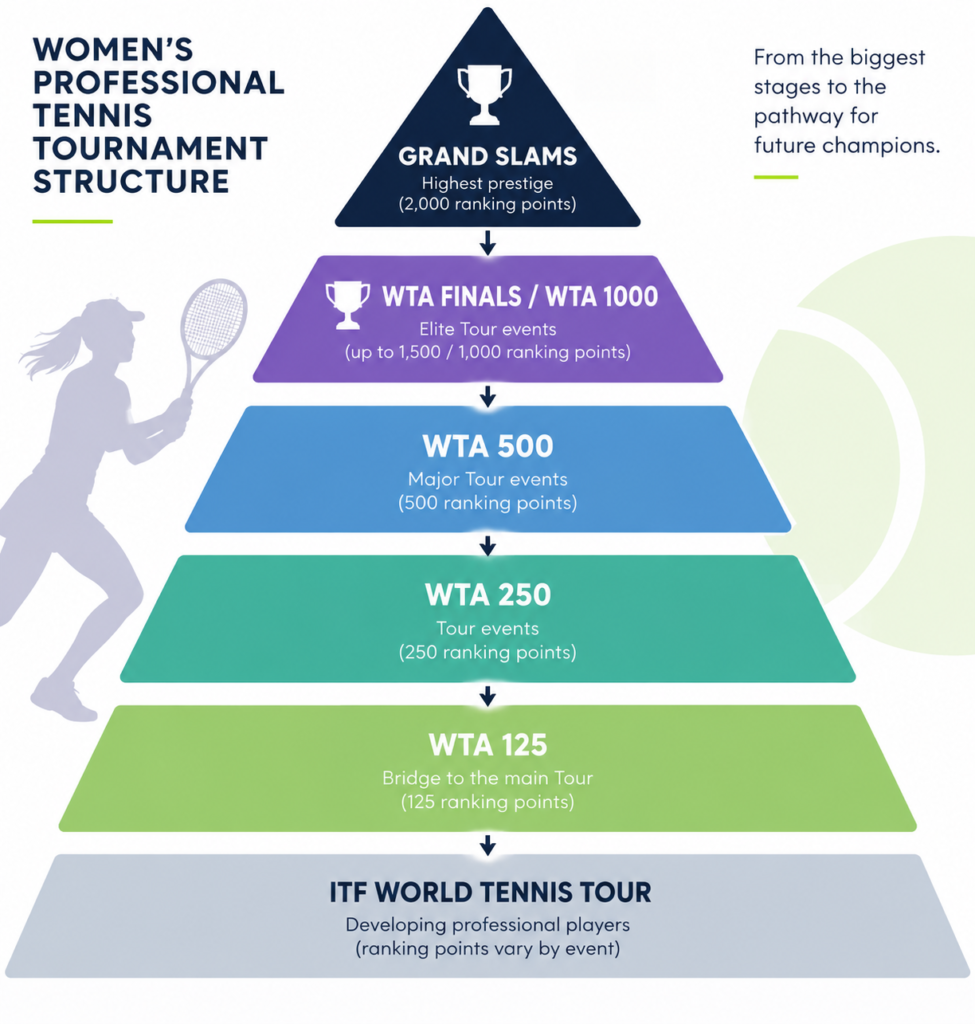
The principal WTA Tour categories are:
| Tournament Level | Ranking Points for Champion |
|---|---|
| Grand Slam | 2,000 |
| WTA Finals | Up to 1,500 |
| WTA 1000 | 1,000 |
| WTA 500 | 500 |
| WTA 250 | 250 |
Below these are WTA 125 tournaments and events on the ITF World Tennis Tour.
The numbers attached to WTA 1000, 500 and 250 tournaments now provide a particularly straightforward indication of the points awarded to the singles champion. The WTA aligned the points with these tournament classifications from the 2024 season.
Grand Slams
The four Grand Slams are the biggest individual tournaments in tennis:
- Australian Open
- Roland Garros
- Wimbledon
- US Open
A Grand Slam singles champion receives 2,000 WTA ranking points, twice the number awarded for winning a WTA 1000 tournament.
The Grand Slams also feature larger singles draws than regular WTA tournaments, with 128 players competing in each main draw.
However, there is an important distinction.
The Grand Slams are not WTA-owned tournaments. They are independently organised major championships operating within the wider structure of professional tennis.
Their results nevertheless count towards the WTA Rankings.
We cover the four majors and their place within professional tennis in Grand Slams Explained
WTA 1000 Tournaments
WTA 1000 tournaments are the highest category of regular events on the WTA Tour.
The singles champion receives 1,000 ranking points.
In 2026, there are 10 WTA 1000 tournaments on the calendar. Seven use the expanded 12-day format that has become increasingly prominent at the top of professional tennis.
These tournaments generally attract extremely strong fields and play an important role in determining the upper reaches of the world rankings.
We’ll examine this level in detail in WTA 1000 Explained
WTA 500 Tournaments
The next level is WTA 500.
The singles champion receives 500 ranking points.
There are 17 WTA 500 tournaments on the 2026 Tour calendar.
These events can feature exceptionally strong fields, particularly when they form part of an established swing leading into a Grand Slam or WTA 1000 tournament.
A WTA 500 title therefore represents a significant achievement and can have a substantial impact on a player’s ranking.
See WTA 500 Explained for a complete breakdown.
WTA 250 Tournaments
WTA 250 tournaments form another major part of the Tour calendar.
The champion receives 250 ranking points.
The 2026 schedule contains 22 WTA 250 tournaments.
These events can be particularly important for players trying to establish themselves at Tour level.
A rising player may use strong performances at WTA 250 tournaments to accumulate ranking points, gain experience against established opponents and eventually earn direct entry into larger events.
But calling WTA 250 tournaments “minor” events can be misleading. They remain fully professional WTA Tour tournaments capable of attracting highly ranked players.
Read more in WTA 250 Explained.
What Is WTA 125?
Below the main WTA Tour sits the WTA 125 level.
As the name now suggests, the champion receives 125 ranking points.
These tournaments provide an important bridge between the ITF World Tennis Tour and the higher levels of the WTA circuit.
Players competing at this level can include emerging prospects, established professionals trying to improve their ranking and experienced players returning from injury or a period away from competition.
The pathway isn’t completely linear — players regularly move between different levels according to their ranking and tournament availability — but WTA 125 events provide valuable opportunities for players who aren’t consistently gaining entry into larger WTA tournaments.
What Is the ITF World Tennis Tour?
Below WTA 125 level is the ITF World Tennis Tour, which forms the foundation of international professional tennis.
This is where many players begin building their professional rankings.
Successful performances can gradually allow a player to progress from ITF tournaments to WTA 125 events and eventually into WTA 250, 500 and 1000 tournaments.
The process can take years.
Only a small percentage of professional players become established members of the world’s Top 100.
We’ll explain this pathway separately in ITF World Tennis Tour Explained.
How Do Players Enter WTA Tournaments?
Players don’t simply choose any tournament they want to play.
Entry is largely determined by ranking.
A tournament has a fixed number of places in its draw, and players who meet the relevant entry requirements can receive direct acceptance.
When the number of entrants exceeds the places available, ranking becomes crucial.
A player whose ranking isn’t high enough for direct entry may still have several other routes into the tournament.
Qualifying
Many tournaments hold a qualifying competition immediately before the main draw.
Players who successfully complete qualifying earn a place in the main tournament.
See What Is a Qualifier in Tennis?
Wild Cards
Tournament organisers can award selected players a place in a draw without requiring their ranking to be high enough for normal direct entry.
These are known as wild cards.
They may be given to promising young players, local competitors, former champions or other players the tournament wishes to include.
See What Is a Wild Card in Tennis?
Lucky Losers
A player who loses in the final round of qualifying can sometimes still reach the main draw when another player withdraws.
That replacement player is known as a lucky loser.
See What Is a Lucky Loser in Tennis?
Special Ranking
Players who have been unable to compete for an extended period because of certain circumstances can, if eligible under WTA rules, use a Special Ranking for entry into a limited number of tournaments.
This prevents a lengthy absence from necessarily destroying a player’s ability to enter appropriate tournaments immediately upon returning.
This concept is explained further in Protected Ranking Explained.
How Do WTA Rankings Work?
The WTA Rankings provide the official hierarchy of professional women’s tennis.
A player’s ranking affects areas such as:
- Tournament entry
- Seeding
- Qualification
- Position in tournament draws
- Who is officially recognised as world No. 1
The current system operates on a rolling 52-week basis.
That means rankings aren’t simply reset at the beginning of each season.
Instead, points are continually added and removed as tournaments take place.
The current WTA singles ranking can include results from a maximum of 18 tournaments, or 19 for a player who competed at the WTA Finals.
This distinction is important because rankings aren’t simply a total of every point a player earns during the year.
We’ll examine the mechanics separately in Tennis Ranking Points Explained.
Why Do Ranking Points Drop Off?
Imagine a player wins a WTA 1000 tournament.
She receives 1,000 ranking points.
Those points don’t remain on her ranking permanently. Under the rolling ranking system, results generally remain relevant for approximately 52 weeks before the corresponding result leaves the ranking calculation.
This is why commentators often talk about players “defending points.”
If a player earned a large number of points at a tournament the previous year, she may need another strong result when that period rolls around to maintain her ranking position.
Importantly, a player isn’t literally given bonus points for successfully “defending” a title. It is simply shorthand for replacing expiring ranking points with new ones.
What Are Live Rankings?
Official rankings are published periodically, but fans increasingly follow live rankings during tournaments.
Live rankings estimate how the rankings would look if they were updated at that moment, accounting for results being gained or dropping from players’ totals.
That makes them particularly interesting late in tournaments, when one victory can potentially move a player several positions.
See Live Rankings Explained for a full explanation.
What Is the Race to the WTA Finals?
The Race to the WTA Finals is different from the normal WTA Rankings.
The standard ranking is rolling and looks across the relevant 52-week period.
The Race focuses on results from the current season and is used to determine qualification for the season-ending WTA Finals.
That means the two lists can look quite different, particularly early in the year.
A player may be highly ranked because of excellent results late in the previous season but sit much lower in the Race if she hasn’t performed as strongly in the current year.
As the season progresses, the Race becomes increasingly important.
What Are the WTA Finals?
The WTA Finals are the season-ending championships of women’s professional tennis.
The event features eight singles players and eight doubles teams.
Unlike a standard knockout tournament, the competition begins with round-robin groups. The leading players or teams then progress to the semifinals and final.
An undefeated singles champion can earn as many as 1,500 ranking points.
For 2026, the WTA Finals are being held at the Indian Wells Tennis Garden in California from November 8–15.
The event represents the culmination of the WTA season and brings together the players who have produced the strongest qualifying results across the year.
What Surfaces Does the WTA Tour Use?
The WTA Tour is played primarily across three surfaces:
Hard courts – The most commonly used surface across the calendar.
Clay courts – Most prominent during the European clay season leading into Roland Garros.
Grass courts – Used during the relatively short grass season culminating at Wimbledon.
Each surface creates different playing conditions.
Court speed, bounce, weather, altitude and even the particular composition of a hard court can affect how a tournament plays.
This variation is one of the defining features of professional tennis. A player capable of succeeding throughout the season must continually adapt as the Tour moves between countries, climates and surfaces.
How Long Is the WTA Season?
Women’s professional tennis has one of the longest seasons in elite sport.
The main calendar begins in the opening weeks of January and continues through to the WTA Finals late in the year.
The 2026 calendar includes more than 50 WTA tournaments across 26 countries and territories, alongside the four Grand Slams.
Players don’t compete every week.
Instead, they build schedules according to factors including ranking, tournament requirements, surface preferences, physical condition and preparation for major events.
WTA Tour vs ATP Tour
The WTA and ATP Tours perform broadly similar roles but govern different professional circuits.
| WTA | ATP |
|---|---|
| Women’s professional tour | Men’s professional tour |
| WTA 1000 | ATP Masters 1000 |
| WTA 500 | ATP 500 |
| WTA 250 | ATP 250 |
| WTA Finals | ATP Finals |
The tours increasingly use similar tournament terminology, making the overall structure easier for fans to understand.
However, they remain separate organisations with their own rankings, regulations and tournament structures.
For the men’s circuit, see The ATP Tour Explained.
Are the Grand Slams Part of the WTA Tour?
Technically, no.
This is one of the most commonly misunderstood aspects of professional tennis.
The Australian Open, Roland Garros, Wimbledon and US Open are not WTA tournaments.
However, they are integral to the women’s professional season, and their results count towards WTA rankings.
They also award more ranking points than any regular WTA tournament, with 2,000 points going to the singles champion.
That’s why discussions of the WTA season almost always include the Grand Slams even though they sit outside the WTA’s own tournament structure.
Why the WTA Tour Structure Matters
Understanding the tournament hierarchy makes professional tennis much easier to follow.
A WTA 250 title is a significant achievement, but winning a WTA 1000 carries substantially more ranking points.
A Grand Slam victory carries twice the ranking points of a WTA 1000 title.
Meanwhile, players outside the elite level may spend much of their season competing in WTA 125 and ITF tournaments simply trying to improve their ranking enough to gain entry into bigger events.
The Tour therefore functions as an interconnected ladder.
Players can rise through it quickly — but maintaining a position near the top is considerably harder.
Frequently Asked Questions
What does WTA stand for?
WTA stands for the Women’s Tennis Association, the organisation responsible for the leading professional women’s tennis tour.
What are the different levels of WTA tournaments?
The three principal regular WTA Tour categories are WTA 1000, WTA 500 and WTA 250. WTA 125 tournaments sit below the main Tour, while the four Grand Slams are independently organised major championships.
How many points does a WTA 1000 winner receive?
The singles champion receives 1,000 ranking points.
How many points does a Grand Slam winner receive?
A Grand Slam singles champion receives 2,000 ranking points.
Are Grand Slams WTA tournaments?
No. The Grand Slams are independently organised, although their results award WTA ranking points and form a central part of the professional women’s season.
What is the difference between WTA Rankings and the WTA Race?
The WTA Rankings operate on a rolling 52-week system. The Race measures qualifying results from the current season and determines who reaches the WTA Finals.
How many players compete at the WTA Finals?
Eight singles players and eight doubles teams compete at the season-ending championships.
What is below the WTA Tour?
WTA 125 tournaments and the ITF World Tennis Tour provide important competitive levels below the main WTA Tour.
Final Thoughts
The WTA Tour is much more than a collection of tournaments.
It is a global system connecting players at different stages of their careers, from professionals trying to build rankings at lower-level events to the world’s leading players competing for Grand Slam titles and the No. 1 ranking.
WTA 250, WTA 500 and WTA 1000 tournaments form the core of the main Tour, while the Grand Slams stand at the pinnacle of the sport and the WTA Finals bring the leading performers together at the end of the season.
Once that hierarchy is understood, rankings, tournament entries and the professional calendar become considerably easier to follow.
And beneath all of it is the pathway that makes professional tennis possible: players earning points, improving their ranking and attempting to climb from smaller tournaments towards the biggest stages in the sport.
Continue Reading
- The ATP Tour Explained
- Live Rankings Explained
- Protected Ranking Explained
- Tennis Ranking Points Explained
- Tennis Prize Money Explained
- Grand Slams Explained
- WTA 1000 Explained
- ITF World Tennis Tour Explained
Read more of our instructional articles here.
Read more of our player focus articles here.
Follow The Tennis Site on X: @thetennissite
Follow Todd Scoullar on X: @toddscoullar

Comments are closed, but trackbacks and pingbacks are open.