

Follow a major tennis tournament and you will regularly hear that a player has moved into the Top 10, reached a career-high ranking or dropped several places — even though the official rankings haven’t been updated.
That’s because commentators and fans increasingly follow live tennis rankings.
Live rankings calculate how the ATP and WTA rankings would look if they were updated at that moment. As tournament results come in, ranking points are added, old points are removed and players can move up or down throughout the week.
A player might begin a tournament ranked No. 12, move to a projected No. 9 after reaching the semifinals and finish the week at No. 8 after winning the title.
Understanding live rankings is particularly useful during Grand Slams and other major tournaments, when a single match can determine who reaches No. 1, enters the Top 10 or earns direct entry into an important future event.
Quick Answer: What Are Live Tennis Rankings?
Live tennis rankings are continuously updated projections of the ATP and WTA world rankings based on results taking place during the current ranking period.
Unlike the official rankings, which are formally published according to the tours’ ranking schedules, live rankings account for points being gained and removed as the current week’s tournaments unfold.
They allow fans to see where a player is projected to rank next if no further results change the calculation.
The ATP now provides an official Live Rankings service that updates as matches are completed and describes it as a predictor of where players will sit in the next published ATP Rankings.
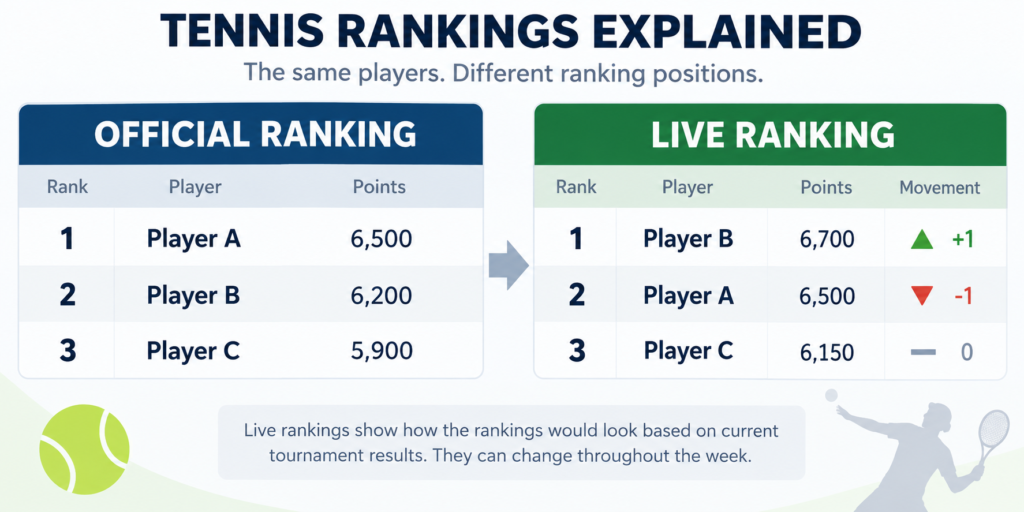
What Is the Difference Between Official and Live Rankings?
This is the most important distinction.
An official ranking is the player’s formally published ATP or WTA ranking.
A live ranking is a calculation showing where that player is projected to appear when the rankings are next updated.
Imagine two players begin the week like this:
| Player | Official Ranking | Ranking Points |
|---|---|---|
| Player A | 10 | 3,000 |
| Player B | 11 | 2,900 |
During the week, Player B reaches the semifinals of a tournament and increases her relevant ranking total to 3,050 points.
Her live ranking could therefore move ahead of Player A.
The official ranking may still show:
No. 10 – Player A
but the live ranking could show:
No. 10 – Player B
Until the rankings are formally updated, Player B’s new position remains a projected or live ranking.
Why Do Tennis Rankings Change During a Tournament?
Professional tennis uses ranking points earned from tournament results.
Players can gain points by progressing further in tournaments, but ranking calculations also involve points from previous results leaving their total.
This creates two processes:
Points coming on
and
Points coming off.
Both can affect a player’s live position.
The ATP’s official live rankings, for example, reflect both points dropped from a player’s calculation and points added from results during the current tournament week.
Understanding this is the key to understanding why a player can sometimes fall in the live rankings despite winning matches.
Why Do Ranking Points Drop Off?
ATP and WTA rankings are based around a 52 week rolling ranking period rather than simply accumulating indefinitely.
A result therefore cannot remain part of a player’s ranking forever.
When an old result leaves the relevant ranking period, the points associated with it can come out of the player’s ranking calculation.
This is where the commonly used expression “defending points” comes from.
Suppose a player won a tournament during the equivalent period the previous year and earned 500 ranking points.
When that result reaches the point at which it leaves the ranking calculation, those points need to be replaced by the player’s new results if the player is to maintain the same total.
If the player wins the tournament again, the effect on the ranking could be relatively small.
If the player loses early, however, the ranking total could fall considerably.
For a deeper explanation of how results become ranking points, see Tennis Ranking Points Explained
What Does “Defending Points” Mean?
This is one of the most frequently misunderstood expressions in tennis.
Players don’t literally begin a tournament with points that can be physically taken away during a match.
“Defending points” is shorthand for comparing a player’s current result with a previous result that forms part of the ranking calculation.
For example:
Last relevant result:
Champion – 500 points
New result:
Quarterfinal – 100 points
If the previous 500-point result leaves the ranking calculation and is effectively replaced by a 100-point result, the player’s ranking total could decrease significantly.
The player may therefore have reached the quarterfinals and still fall in the rankings.
This is perfectly normal.

Can a Player Move Up Without Playing?
Yes.
This is one of the most interesting consequences of a relative ranking system.
A player’s ranking position depends not only on their own points but also on the totals of everyone around them.
Suppose Player A isn’t competing this week and remains on 2,000 ranking points.
Player B is ranked slightly above with 2,050 points but has a significant previous result leaving their ranking calculation.
If Player B’s total falls to 1,900, Player A could move above them without playing a match.
The same principle works in reverse.
A player can remain on exactly the same number of ranking points and fall several positions because other players have passed them.
Can a Player Win a Match and Still Fall in the Live Rankings?
Yes.
Winning a match does not guarantee that a player’s ranking will improve.
Imagine a player has a large number of points leaving their ranking calculation during the week.
They might gain some new points by winning one or two matches but still fail to replace all the points being removed.
Their total can therefore decline despite winning.
This is why looking only at a player’s current tournament result doesn’t always explain their ranking movement.
Can a Player Lose and Still Move Up?
Again, yes.
Suppose a player loses in the first round and their ranking total doesn’t change substantially.
Several players immediately below them could simultaneously lose a large number of points from previous results.
The first player could then move higher despite losing.
Rankings are relative.
Your position depends on your total compared with everyone else’s.
How Do Live Rankings Work During Grand Slams?
Grand Slams can create some of the biggest movements in live rankings because they award the most ranking points.
A singles champion receives 2,000 ranking points, with substantial points also available for reaching the later rounds.
This means a deep Grand Slam run can transform a player’s ranking.
A player entering a major outside the Top 100 can potentially make a substantial jump by reaching the second week.
At the top of the rankings, Grand Slams can also determine the battle for world No. 1.
One player may need to reach the semifinal to remain No. 1.
Another might need to reach the final.
A third might become No. 1 only by winning the tournament.
Live rankings allow those scenarios to be followed as the tournament progresses.

What Does “Live No. 1” Mean?
During a tournament, you may hear that a player has become the live world No. 1.
That means current results have moved the player into the projected No. 1 position.
It doesn’t necessarily mean they have officially become world No. 1 yet.
Another player’s subsequent result could change the calculation again before the rankings are formally published.
This can produce fascinating scenarios late in major tournaments.
A player can effectively hold the projected No. 1 ranking for a few hours before another match changes it again.
When Do Official Tennis Rankings Update?
The ATP and WTA publish official rankings according to their respective ranking schedules, with rankings generally updated weekly.
There are exceptions and complications created by tournament schedules, particularly when major events extend across more than one week.
This is another reason live rankings are useful.
Rather than waiting for the next official publication, fans can follow the projected effect of results immediately.
The ATP’s own Live Rankings update as matches finish and reset to look ahead to the coming tournament week when the next official ranking calculation is made.
Are Live Rankings Official?
This requires a distinction.
Historically, many of the live rankings followed by tennis fans were calculations produced by independent websites.
The ATP now publishes its own official ATP Live Rankings, calculated in real time as matches finish.
However, a live ranking is still different from the formally published world ranking.
Think of it this way:
Official ranking: Where the player is officially ranked now.
Live ranking: Where current calculations project the player to be at the next ranking update.
The ATP’s official live table even displays a player’s official points alongside live points and projected movement.
What Do “Next Points” and “Max Points” Mean?
Live ranking tables can provide more than a player’s current projected position.
The ATP’s official system includes Next Points and Max Points.
Next Points show the player’s projected total if they win their next match.
Max Points show the maximum total they could reach by winning the tournament they are currently playing.
These numbers make it possible to calculate ranking scenarios before matches take place.
For example, you might be able to determine that:
Player A will enter the Top 20 by reaching the semifinal.
Player B can overtake Player C by reaching the final.
Player D can become world No. 1 by winning the title.
This has turned rankings themselves into an important part of following professional tournaments.

Live Rankings vs the ATP Race and WTA Race
Live rankings should not be confused with the season-long Race.
The normal ATP and WTA rankings use a rolling ranking system.
The Race looks primarily at results earned during the current season and is used to determine qualification for the season-ending championships.
On the men’s Tour this leads towards the ATP Finals.
On the women’s Tour it leads towards the WTA Finals.
A player can therefore have three different-looking positions:
Official ranking: No. 8
Live ranking: No. 6
Race position: No. 4
None of those numbers necessarily contradicts the others.
They are measuring different things.
For more on the structure of the men’s and women’s circuits, see The ATP Tour Explained and The WTA Tour Explained
Why Are Live Rankings Useful for Players?
Rankings aren’t simply a scoreboard showing who is playing best.
They have practical consequences.
A player’s ranking can influence:
- Direct entry into tournaments
- Whether they need to play qualifying
- Tournament seeding
- Grand Slam entry
- Access to higher-level events
- Career opportunities
This makes ranking movement particularly important around certain thresholds.
Moving from No. 110 to No. 95, for example, may be much more significant for a player’s career than moving from No. 55 to No. 50 because of what that position could mean for entry into major tournaments.
For players further down the rankings, a handful of points can therefore be enormously valuable.
Why Does the Top 100 Matter So Much?
The Top 100 has considerable symbolic importance in professional tennis, but it also has practical significance.
Grand Slam singles main draws contain 128 players, although not every position goes to the highest 128 players in the rankings.
Places must also be allocated to qualifiers, wild cards and other eligible entrants.
That means being somewhere around the Top 100 can often put a player in contention for direct Grand Slam main-draw entry, depending on the entry list and withdrawals.
Direct entry can be enormously valuable.
Instead of needing to win several matches in qualifying merely to reach the main tournament, the player begins in the main draw and receives the associated opportunity to earn ranking points and prize money.
This is one reason players and fans pay such close attention to ranking movements well outside the Top 10.
Why Do Different Live Ranking Websites Sometimes Disagree?
Occasionally, two live-ranking services can display slightly different totals.
There can be several reasons.
Ranking calculations involve rules governing which tournament results count, mandatory events, replacement results, points dropping from previous tournaments and the precise timing of updates.
Independent services may also update their databases at different times.
For ATP rankings, the ATP’s own live ranking service provides the governing Tour’s calculation.
When following unofficial projections, small temporary discrepancies should therefore be treated with caution.
Do Live Rankings Determine Tournament Seedings?
Not directly.
Tournament entry lists and seedings are based on the relevant official rankings used under that tournament’s rules, rather than a constantly changing live ranking displayed during another event.
This distinction matters.
A player might appear as the live No. 15 during a tournament while officially remaining No. 18 until the next ranking update.
The projected ranking can tell us where they are heading, but it doesn’t retroactively change ranking lists already used for tournament procedures.
Why Live Rankings Have Become So Popular
Live rankings turn the ranking system into part of the tournament itself.
Instead of waiting until the following week to discover the consequences of a result, fans can immediately see what is at stake.
A quarterfinal might put someone into the Top 50.
A semifinal might secure a career-high ranking.
A final could put a player into the Top 10.
And occasionally, one match can decide who becomes world No. 1.
The ranking race therefore becomes another storyline running alongside the matches themselves.

Frequently Asked Questions
What is a live ranking in tennis?
A live ranking is a projection showing where a player would rank based on results and ranking-point changes occurring during the current tournament period.
Are ATP live rankings official?
The ATP now publishes official ATP Live Rankings, which update as matches are completed. They remain distinct from the formally published ATP Rankings.
Can a tennis player’s live ranking change without playing?
Yes. A player’s position can change because other players gain or lose ranking points.
Can a player win and still drop in the rankings?
Yes. If more points are leaving the player’s ranking calculation than they gain from their current result, their overall points total can decrease.
Can a player lose and move up the rankings?
Yes. Other players around them may lose more points, allowing the player to move higher without increasing their own total.
What does defending points mean?
It refers to ranking points associated with an earlier tournament result that are due to leave the player’s ranking calculation. The player’s new result determines how many points they can add back into their ranking total.
What does live world No. 1 mean?
It means current results project a player to become No. 1 at the next official ranking update. That projection can change again as other matches are completed.
Are live rankings the same as the ATP or WTA Race?
No. Live rankings project changes to the normal world rankings, while the Race measures results within the current season for qualification for the season-ending championships.
Final Thoughts
Live rankings provide a real-time window into one of the most important systems in professional tennis.
Instead of simply seeing that a player won or lost, they reveal what that result means.
A victory might produce a career-high ranking. A defeat could cost a player a place in the Top 100. A Grand Slam semifinal might secure direct entry into future tournaments. At the very top of the sport, a single match can even determine who becomes world No. 1.
But the most important distinction is simple:
Official rankings tell you where a player is ranked now. Live rankings show you where current results are projected to take them next.
Once that difference is understood — along with points being added, removed and replaced — the constant movement of the tennis rankings becomes considerably easier to follow.
Continue Reading
- Tennis Ranking Points Explained
- Protected Ranking Explained
- The ATP Tour Explained
- The WTA Tour Explained
- What Is a Qualifier in Tennis?
- What Is a Wild Card in Tennis?
- Tennis Prize Money Explained
Read more of our instructional articles here.
Read more of our player focus articles here.
Follow The Tennis Site on X: @thetennissite
Follow Todd Scoullar on X: @toddscoullar

Comments are closed, but trackbacks and pingbacks are open.