

At one end of professional tennis, a player can lose a single match and walk away with $140,000. At the other, a player can win several matches, spend a week travelling and competing, and return home poorer than when they arrived.
The difference is not necessarily talent, ambition or dedication. Sometimes, it is simply where a player sits in the rankings.
In 2026, the US Open offered a record $108 million in total player compensation. Yet further down the professional ladder, players are still sleeping in campervans, sharing hotel rooms with opponents, working second jobs and travelling without coaches because they cannot afford them.
Australian Dane Sweeny has spoken about losing money despite winning matches on the Challenger Tour. Irish professional Ammar Elamin has entered tournaments expecting to make a financial loss. And British player Francesca Jones, despite reaching the world’s top 100, has questioned whether professional tennis provides a sustainable living for those outside its elite.
Their experiences expose a side of the sport rarely seen beneath the floodlights of its biggest stadiums.
Professional tennis has never offered greater riches at the top. Prize money on the Challenger and ITF circuits has also increased substantially, while new financial support programs promise greater security for emerging players.
But for hundreds of professionals trying to establish themselves, the question is not how much they might eventually earn.
It is how long they can afford to keep playing.
Winning matches, losing money
Australian Dane Sweeny knows the financial realities of the Challenger Tour particularly well.
During a Challenger 125 tournament in Busan, South Korea, Sweeny reached the second round of singles and the quarter-finals of doubles. Despite those results, the cost of travel and accommodation for himself and his coach meant he finished the week with a financial loss.
Speaking to Tennishead, Sweeny explained the contradiction:
“It’s the level just below a tour event, so it should be paying pretty well, yet I’m still down.”
He also described the gap between the public perception of professional tennis and the everyday experience of competing below the main tour.
Players may stay in hotels, practise at excellent facilities and travel internationally, but that lifestyle comes with considerable financial pressure.
Sweeny’s experience is particularly relevant to Australian players, whose international schedules can involve numerous long-haul flights and extended periods away from home.
His fortunes clearly illustrate how quickly that calculation can change though.
At the 2026 US Open, Sweeny reached the third round and earned $290,000, a career-changing payday that provided the opportunity to invest further in his tennis.
“The financial side of things, that will help with coaching and people you travel with.”
Rather than viewing the money simply as personal income, Sweeny saw it as a way to strengthen the professional support around him, in the hope it would facilitate more big pay days down the track.
It is a recurring theme among players trying to establish themselves: the money required to improve often arrives only after they have achieved the results they were hoping that investment would help produce. It’s a ‘chicken and egg’ style scenario.
“You don’t break even unless you’re in the top 75”
British professional Francesca Jones has reached a level most aspiring players will never achieve, reaching a career high of #65 in the world. Yet even competing near or inside the world’s top 100 does not necessarily provide financial security.
During the 2026 French Open, Jones told BBC Sport that the economics of professional tennis remained difficult for players outside the elite.
“There’s not enough money for players on tour.”
Jones explained that even after earning almost £900,000 in career prize money, she had not made a significant profit. Her particular physical requirements also meant maintaining a larger support team than some players of comparable ranking.
She estimated that players generally needed to be inside the top 75 to break even, and even there the margins remained narrow.
Jones went on to say that reaching the later rounds of Grand Slams could change a player’s circumstances significantly, allowing them to spend more on preparation, coaching and support.
The financial benefits could therefore subsequently improve performances on court.
German professional Anna-Lena Friedsam offered an even more damning perspective, estimating that she needed to earn approximately £300,000 annually to break even when operating with her preferred professional support.
If earnings fell short, travelling without a coach became one way to reduce expenses.
The figures illustrate a critical distinction often overlooked when professional tennis earnings are discussed or published.
Prize money is revenue, not profit.
Players must pay for international flights, accommodation, meals, coaching, fitness training, physiotherapy, racket stringing and other professional expenses. Taxes can further reduce their take-home income. Tennis is not like a team sport, where nearly all support structures are paid for.
A player earning $200,000 in prize money has not necessarily made $200,000 from tennis. Depending on their expenses, they may have retained very little.
For those trying to improve, reducing costs can create another problem. Travelling without a coach or physiotherapist may save money in the short term, but could also affect preparation and performance. It’s a cycle that then becomes hard to climb out of.
As Australian Rinky Hijikata told BBC Sport:
“To invest back into your own game takes a lot of money and effort.”
Hijikata recalled periods earlier in his career when he saved money by not eating proper meals, highlighting how financial pressure can affect even basic decisions about nutrition and recovery.
Now, the ATP Challenger events, and some higher level ITF events include hospitality, including accommodation, and some meals at the tennis club. But it wasn’t long ago that players on the Challenger circuit would also have to stump up costs for their stay.
The Irish professional who expects to lose money
For Ammar Elamin, the financial equation is considerably more difficult.
The Irish player with a ranking outside of the world’s top 1000, told The Irish Times in June 2026 that his combined career singles and doubles prize money stood at $13,802, despite years spent competing professionally.
His estimated weekly tournament expenses ranged from €800 to €1,000.
Flights typically cost €200–€400, accommodation around €40 per night and meals another €20–€30 daily. Racket stringing, transport and other expenses increased the total.
Elamin could not afford to travel with a coach.
“I always travel alone because I can’t afford to”
The 24-year-old supplements his income through club tennis in Germany, UTR competitions and domestic tournaments in Ireland.
He is far from alone. Those competitions can often provide better financial returns than professional events offering ranking points.
It creates an unusual situation in which a player must earn money outside the professional ranking system to finance participation within it. Yet they still need to chase points to enter events, in order to lift their ranking. It’s essentially one big hamster wheel.
Elamin was candid about the economics.
“I don’t even consider that as an income, to be honest.”
His comments referred to the modest prize money earned from professional tournaments, rather than the income he generated elsewhere.
Asked whether he expected to make money when entering events, Elamin explained that he generally anticipated a financial loss.
He also questioned whether the campaigns by leading players for a greater share of Grand Slam revenue would materially improve circumstances for those competing well outside the top 200.
Elamin did not oppose those efforts. His point was that additional Grand Slam money offered little immediate assistance to players who were not competing in those tournaments.
The problem was more fundamental: finding a way to make lower-level professional competition financially sustainable.
The campervans that kept two careers alive
Two players separated by different generations found remarkably similar solutions to the cost of competing.
When Dustin Brown returned to Europe from Jamaica in 2004, his parents helped finance a Volkswagen campervan that allowed him to travel between lower-level tournaments without paying for conventional accommodation.
The vehicle had beds and cooking facilities, enabling Brown to prepare meals and sleep near tournament venues.
In a 2010 interview with The Guardian, Brown recalled how precarious his financial situation had become.
“Money was pretty tight most of the time.”
A first-round defeat at a Futures tournament could produce only a modest payment, barely enough to finance the next journey.
The campervan allowed Brown to continue playing regularly despite those limited earnings.
He also owned a racket-stringing machine and offered his services to other players for approximately half the price charged by tournament stringers at the time.
In a later interview, Brown recalled spending evenings stringing rackets while other players occasionally paid to use spare beds in his campervan.
His resourcefulness helped sustain a career that eventually took him into the world’s top 100 and produced memorable victories over Rafael Nadal, including at Wimbledon in 2015.
British player Billy Harris followed a remarkably similar path.
Harris spent approximately three and a half years travelling around Europe in a converted Ford Transit van, sleeping in the back and cooking beside the road.
In an interview reported by BBC Sport, Harris recalled:
“I was travelling around in my Transit van for three and a half years”
His accommodation arrangements were basic. He parked in club car parks and outside McDonald’s restaurants, occasionally waking in freezing conditions.
In France, Harris remembered scraping ice from the inside of the vehicle after particularly cold nights.
Yet the arrangement allowed him to compete in tournaments he otherwise might not have been able to afford.
“At the start I didn’t have the money for flights every week.”
Harris eventually recorded his first ATP Tour-level singles victory at 28, before reaching his first ATP quarter-final at Queen’s in 2024 and making his Wimbledon singles debut later that year.
“I wouldn’t say it was a massive struggle.”
Harris explained that sleeping in his van was simply how he managed to travel between tournaments. Other players were doing the same thing, and his greater frustration was spending seven or eight years on the Futures circuit without meaningful rewards.
His career was a reminder that the route to the main tour can take considerably longer than expected, particularly when players must carefully manage every expense.
Travelling 48 hours to save money
For Algerian professional Ines Ibbou, financial difficulties were compounded by geography and visa restrictions.
In a 2022 interview with BBC Sport Africa, Ibbou estimated that competing for one week could cost €1,500–€2,000, even without travelling with a coach.
Flights alone could cost €400–€500.
“Flight tickets are very very expensive at the moment.”
At one tournament in the Canary Islands, Ibbou travelled for approximately 48 hours to secure cheaper flights and shared a hotel room with another player.
The two had competed against each other on court.
Ibbou also described using the same four rackets for approximately two years because replacing equipment regularly was beyond her budget. At another event in Germany, a local woman helped by providing accommodation and meals.
Those experiences illustrate how much lower-ranked players can depend on informal assistance, and good will from genuine tennis fans simply to remain on the circuit.
Visa requirements added further complications. As an Algerian player, Ibbou sometimes faced lengthy administrative processes that made planning international tournament schedules difficult.
For someone based in a country with fewer professional tournaments, the cost of reaching events can be significantly higher than for competitors living in established European tennis centres.
Bolivian player Juan Carlos Prado Angelo raised similar concerns during the 2026 French Open.
Prado Angelo explained that international travel was particularly expensive for South American players, who often faced lengthy journeys between training bases and tournaments.
His experience highlights another form of inequality in professional tennis: two players with comparable rankings may face very different costs simply because of where they live.
The $20,000 monthly bill
Japanese professional Taro Daniel offered yet another revealing perspective in a 2025 interview with the Financial Times.
Daniel, who had previously reached the world’s top 60, explained that even competing around No. 150 could involve considerable expenses.
“As a tennis player, you’re like a small company”
He estimated that his operational costs could reach approximately $20,000 per month, excluding salaries paid to his support team.
Coaching could add another substantial amount. Daniel estimated that employing a relatively inexperienced travelling coach might cost at least $100,000 annually once salary, commissions and associated expenses were considered.
He recalled how, earlier in his career, he had avoided paying extra for avocado with his meals to save money.
The anecdote might sound trivial, but Daniel believed excessive cost-cutting could become counterproductive.
“When you try to save too much it ends up impacting people’s games negatively.”
Players need adequate nutrition, recovery and professional support to perform consistently. Saving money by sacrificing those essentials may ultimately reduce their chances of earning more.
Daniel’s experience illustrates why even established professionals can struggle to retain a significant proportion of their published prize-money earnings.
For Australian Tristan Schoolkate, the expenses can be particularly difficult to manage because of the distances involved.
In an October 2025 interview with The First Serve, Schoolkate estimated that a player competing in approximately 30 tournaments could operate on around A$50,000 annually with aggressive cost-cutting.
A more typical budget might be approximately A$70,000, while someone investing more heavily in coaching and travel could spend A$100,000–A$120,000.
“Most players would be around $70,000.”
Schoolkate explained that international travel from Australia could quickly inflate those costs. A return flight to the United States might cost A$3,000–A$5,000, while competing across multiple continents created further expenses.
European players often have access to tournaments much closer to home, allowing them to travel more cheaply and return home between events.
For Australians, an extended overseas schedule can become the only practical way to compete regularly without constantly purchasing long-haul flights.
The financial and emotional toll
The challenges extend beyond money.
Serbian professional Dušan Lajović has spoken about the emotional demands of life on tour, including the constant travel, isolation and pressure to maintain a ranking.
In a 2025 Guardian feature examining the Challenger circuit, Lajović described a professional lifestyle dominated by international flights and long periods away from home.
“We take almost as many flights as pilots.”
For players competing outside the elite, the demands can be especially difficult. They may travel without coaches, friends or family, moving between unfamiliar cities with little opportunity to establish a routine.
The financial consequences of losing can also make every match feel disproportionately important.
A defeat may mean more than the loss of ranking points. It can mean another week of expenses without sufficient prize money to cover them.
Former Irish No. 1 Conor Niland described that world in a deeply personal 2024 essay for The Guardian.
Niland recalled competing in 24 matches over five weeks during 2005, an exhausting stretch that ended with him collecting just $480 before a 20% tax deduction from his final tournament.
He had entered professional tennis hoping to reach the highest level, but discovered that the lower circuits could be an unforgiving environment.
“I wasn’t schlepping my way through the lower ranks”
For Niland, the motivation was never the modest prize money available at Futures tournaments. The objective was to escape those competitions and reach a level where the rewards justified the sacrifices.
He compared the Futures circuit to a form of purgatory, a place where ambitious players were determined not to remain.
His account captures something that statistics cannot: the psychological difficulty of pursuing a career without knowing whether the breakthrough will ever arrive.
Niland has also written an exceptionally good book about his time on the lower levels of the tennis tour, which goes into excellent detail about just how tough it is.
When a former top-20 player loses six figures
Even reaching the highest levels of professional tennis does not guarantee permanent financial security.
Georgian professional Nikoloz Basilashvili reached a career-high ranking of No. 16 and won five ATP singles titles.
Yet injuries and declining results eventually forced him back into lower-level competition.
In a 2025 interview with The Guardian, Basilashvili reported earning $63,183 in prize money during 2024 while recording an estimated net loss of approximately $120,000 after expenses.
His experience illustrates how quickly a professional career can become financially difficult when results deteriorate.
A player attempting to rebuild their ranking still needs coaching, training, travel and appropriate medical support. Those expenses do not disappear simply because the prize money becomes smaller.
The same issue affects players returning from serious injuries, who may spend months financing rehabilitation before they are able to compete regularly again.
For those without substantial savings, the financial pressure can influence decisions about whether to continue playing.
The Grand Slam payday that changes everything
For players ranked around the world’s top 100, Grand Slam qualification can transform the financial outlook for an entire season.
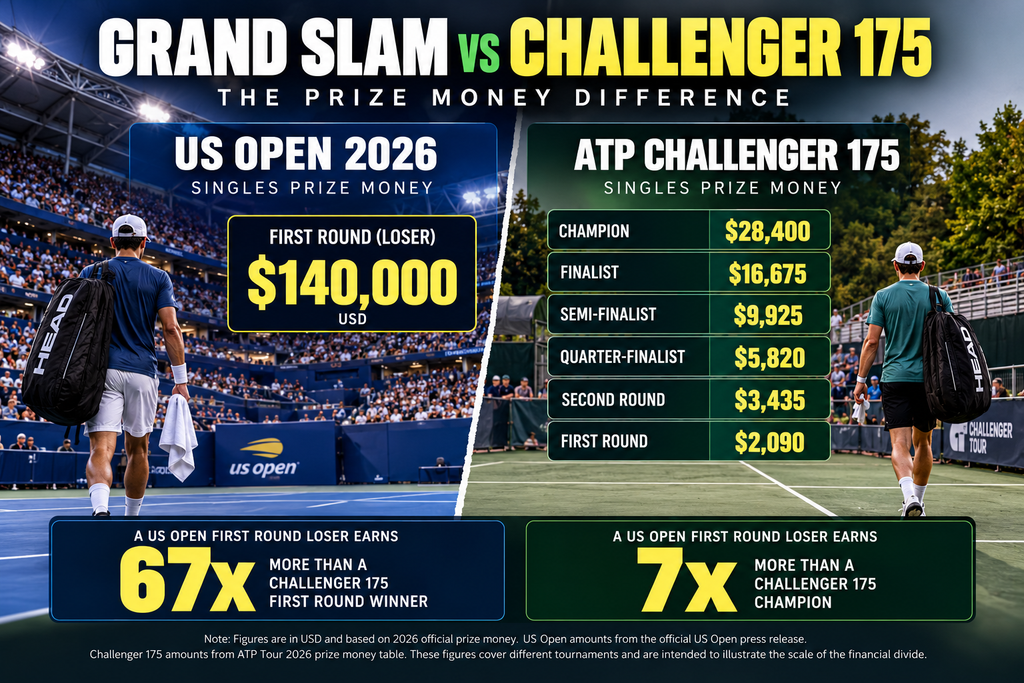
The 2026 US Open offered $32,000 to players eliminated in the first round of qualifying, $66,000 to those losing in the final qualifying round and $140,000 to players losing in the opening round of the singles main draw.
The eventual champions received $5.5 million each.
2026 US Open singles prize money
| First qualifying round | $32,000 |
| Final qualifying round | $66,000 |
| First round, main draw | $140,000 |
| Second round | $190,000 |
| Third round | $290,000 |
| Champion | $5,500,000 |
British player Toby Samuel experienced the significance of a Grand Slam breakthrough at the 2026 French Open.
After qualifying for his first Grand Slam main draw, Samuel earned £75,000, which BBC Sport reported was sufficient to finance the remainder of his season.
“These events are where you make real money”
His experience is a prime example of how a single successful tournament can provide the resources necessary to employ a coach, travel more comfortably and prepare properly for future events.
But the financial gulf between reaching a Grand Slam and missing out can be enormous.
A player who narrowly fails to qualify may face a completely different financial year from someone only a few ranking places higher.
And those financial differences can subsequently influence their ability to improve.
A $200,000 investment that helped transform a career
Dutch professional Jesper de Jong provides one of the clearest examples of how financial support can help a player progress.
De Jong finished 2024 ranked No. 112, having recorded just two ATP Tour-level victories.
Although close to breaking into the top 100, he lacked the financial certainty to make several investments he believed would improve his career.
That changed when he received a $200,000 advance through the ATP’s Baseline Newcomer Investment program at the beginning of 2025.
The funding allowed him to travel with fitness coach Bas van Bentum and add former world No. 40 Thiemo de Bakker to his team.
Speaking to the ATP in January 2026, De Jong explained the importance of being able to plan his season without constantly worrying about expenses.
“That brings a sense of calm.”
The financial assistance was particularly valuable after a disappointing start to 2025, when De Jong failed to win a match during January despite the considerable expense of travelling to Australia.
With funding already secured, he could maintain his coaching arrangements rather than reducing his professional support.
The results improved substantially.
De Jong finished 2025 ranked No. 73, having recorded 17 tour-level victories and earned more than $780,000.
The $200,000 advance was repayable under the program’s terms, but its immediate value was allowing De Jong to invest in his career before those additional earnings arrived.
His experience does not prove that financial support guarantees success. It does, however, show how access to resources can influence a player’s ability to prepare and compete.
Is professional tennis finally becoming more sustainable?
There has been meaningful progress in recent years.
The ATP announced that Challenger Tour prize money would reach a record $32.4 million in 2026, representing a 167% increase since 2022.
The organisation also outlined plans to expand the calendar from 216 to 265 events, providing more opportunities for players to earn ranking points and prize money.
ATP Chairman Andrea Gaudenzi acknowledged both the progress and the need for further investment.
“There’s more room to grow”
The increased funding is substantial, although the overall prize-money allocation is distributed across hundreds of tournaments and thousands of individual performances.
The ATP’s Baseline programme has also introduced minimum-income guarantees for eligible players ranked inside the top 250, alongside injury protection and investment assistance.
Under the published 2025 structure, the guaranteed annual earnings thresholds were $300,000 for players ranked 1–100, $200,000 for those ranked 101–175 and $100,000 for players ranked 176–250.
These guarantees are subject to eligibility requirements and cover shortfalls in qualifying earnings rather than providing additional salaries on top of prize money.
The ITF has also invested in entry-level professional tennis, increasing prize-money allocations and introducing additional accommodation support at selected tournament levels.
At Grand Slam level, the US Open committed an initial $2 million towards a new player-support programme in 2026, alongside its record $108 million total compensation package.
Those measures are important, but they do not eliminate the financial difficulties facing players ranked 300, 500 or 1,000 in the world.
For that group, a sustainable professional career can remain a distant objective.
How many careers end before they really begin?
The experiences of these players reveal a sport in which financial resources can influence opportunity almost as much as results.
Brown and Harris needed campervans to remain on the circuit. Ibbou navigated expensive international travel and visa restrictions. Elamin finances his professional ambitions through other tennis work.
Jones and Friedsam have described the considerable costs of maintaining a professional operation, while Daniel and Schoolkate have shown how quickly coaching and international travel expenses accumulate.
Sweeny’s Grand Slam breakthrough illustrates the transformative effect of a substantial payday. De Jong’s experience suggests that financial support can help players invest in their development before the results arrive.
Meanwhile, Niland and Lajović have described the emotional strain of a lifestyle involving constant travel, isolation and uncertainty.
The sport has undoubtedly improved its financial support structures, particularly at Challenger level and for players approaching the top 100.
But the fundamental question remains.
How many talented players abandon professional tennis before discovering how good they might have become?
The difference between a future Grand Slam champion and a player who never reaches the main tour may be considerable. Talent, physical ability, resilience and competitive performance all play decisive roles.
Yet access to money also influences how long a player can continue developing those qualities.
Not everyone who pursues professional tennis will succeed. That is the reality of elite sport.
But a professional pathway that allows more talented players to compete without facing constant financial uncertainty would give the next generation a better opportunity to discover their potential.
The prize money at the top of tennis has never been greater.
The challenge is ensuring that those trying to reach that level can afford the journey.
Continue Reading
- ATP Challenger Tour Explained
- ITF World Tennis Tour Explained
- How ATP Ranking Points Work
- Tennis Prize Money Explained
Read more of our exclusive feature articles here.
Read more of our player focus articles here.
Follow The Tennis Site on X: @thetennissite
Follow Todd Scoullar on X: @toddscoullar

Comments are closed, but trackbacks and pingbacks are open.