
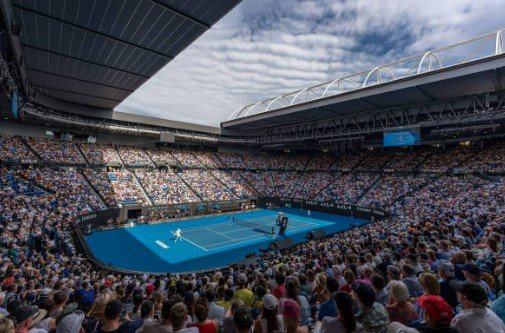
There are thousands of professional tennis tournaments played around the world, but four stand above everything else.
The Australian Open, Roland Garros, Wimbledon and US Open are tennis’s Grand Slam tournaments — commonly called the majors.
Winning any one of them can define a career.
Winning all four puts a player into a much smaller and more celebrated group.
The Grand Slams offer the largest ranking-point prizes available at a standard tournament, enormous prize-money purses and the biggest stages in the sport. They are also unusual because they sit outside the regular ATP and WTA tournament structures while remaining central to both tours’ rankings and seasons. The four events are independently owned and organised by their respective national tennis bodies and Wimbledon organisers, working with the sport’s global governing body through the Grand Slam Board.
So what actually makes a tournament a Grand Slam? Why are there only four? And how do they fit into professional tennis?
Quick Answer: What Is a Grand Slam in Tennis?
A Grand Slam is one of the four most prestigious individual tournaments in professional tennis:
| Grand Slam | Location | Surface | Usual Time |
|---|---|---|---|
| Australian Open | Melbourne, Australia | Hard | January |
| Roland Garros | Paris, France | Clay | May–June |
| Wimbledon | London, England | Grass | June–July |
| US Open | New York, USA | Hard | August–September |
Together, these four tournaments form the Grand Slam calendar. World Tennis, formerly known as the ITF, describes them as the most prestigious individual competitions in tennis.
Winning the men’s or women’s singles title earns 2,000 ranking points, the largest standard single-tournament award in the ATP and WTA ranking systems.
But ranking points are only part of their importance.
A major title carries a historical significance that no ordinary ATP or WTA tournament can match.
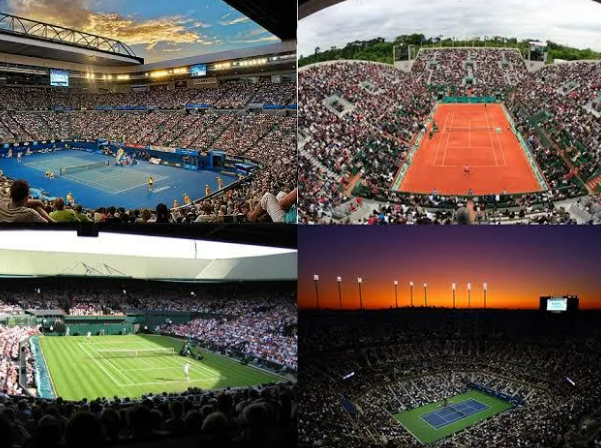
Why Are Grand Slams So Important?
The simplest explanation is history.
The majors did not become tennis’s biggest tournaments because somebody created a modern ranking system and decided they should be worth the most.
Their prestige developed over generations.
Each tournament became one of the great championships of international tennis, and collectively they came to represent the highest level of achievement in the individual game.
Today their status is reinforced by almost everything surrounding them.
They offer:
- 2,000 ranking points to singles champions
- Some of tennis’s largest prize-money purses
- Huge international television audiences
- Large singles draws
- Men’s and women’s competitions at the same event
- Singles, doubles and other championship categories
- Enormous historical prestige
Most importantly, players themselves measure careers by them.
World No. 1 rankings matter.
Olympic medals matter.
ATP and WTA titles matter.
But when the careers of the greatest players are compared, one statistic almost inevitably appears near the beginning of the discussion:
How many Grand Slams did they win?
What Are the Four Grand Slams?
Each major has its own personality.
That is one of the things that makes the Grand Slam season so distinctive.
Players aren’t simply trying to win four versions of the same tournament.
They must succeed in very different environments.
Australian Open
The Australian Open is the first Grand Slam of the calendar year.
It is held at Melbourne Park in Melbourne, usually during January. The tournament has been staged at Melbourne Park since 1988.
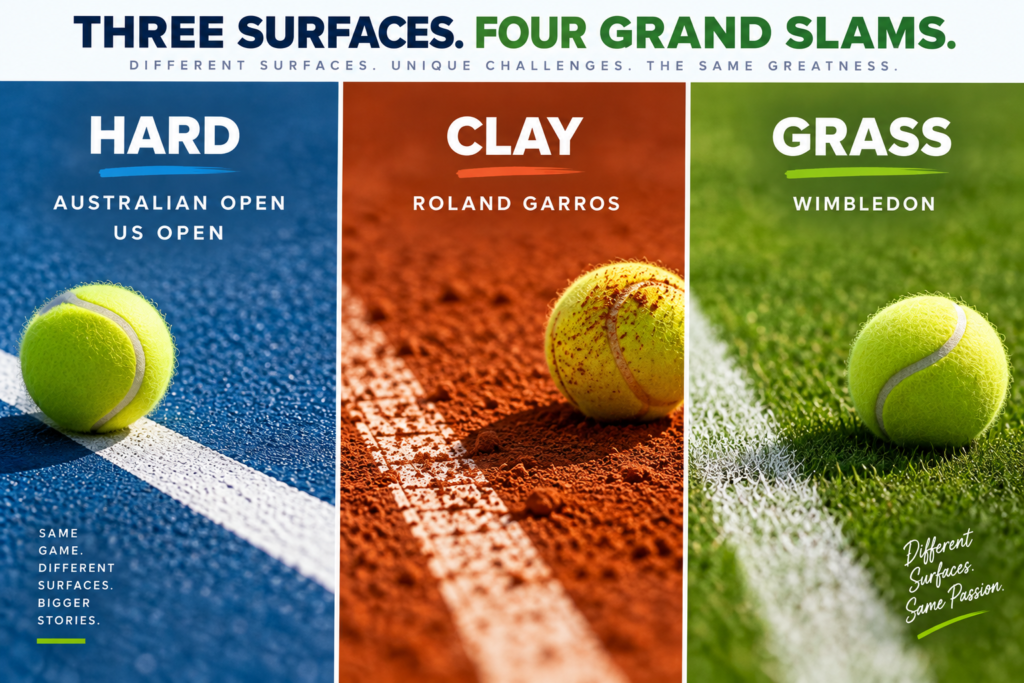
Surface: Hard court
The Australian Open is played in the middle of the Australian summer, meaning heat can become an important factor.
Its position at the beginning of the season creates another challenge. Players arrive after the relatively short off-season and must quickly be ready for best-of-five-set Grand Slam tennis on the men’s side and the intensity of a two-week major.
The tournament has also become known for its modern facilities and retractable-roof stadium courts.
Roland Garros
The second major of the year is Roland Garros, commonly called the French Open.
It is played in Paris.
Surface: Clay
This makes Roland Garros unique among the four current majors.
Clay generally produces slower court conditions and higher bounces than faster surfaces, while movement requires players to slide and recover differently.
Long rallies and physically demanding matches are common.
Success on hard courts or grass therefore doesn’t automatically translate to dominance in Paris.
That difference is one reason completing a Career Grand Slam is so difficult.
Wimbledon
Wimbledon is the third Grand Slam of the season.
It is held at the All England Lawn Tennis and Croquet Club in London.
Surface: Grass
Wimbledon is the only Grand Slam played on grass.
The surface historically produced extremely fast tennis, although modern grass-court conditions and playing styles have evolved considerably.
Wimbledon also maintains traditions that distinguish it from virtually every other professional tournament, including its famous predominantly white clothing requirement.
The tournament’s history, grass courts and traditions have made Wimbledon perhaps the most immediately recognisable tennis event in the world.
In the 2026 ATP calendar, Wimbledon remained the sole Grand Slam within the European grass-court season.
US Open
The US Open is the final Grand Slam of the calendar year.
It is played at the USTA Billie Jean King National Tennis Center in New York.
Surface: Hard court
Its atmosphere is often markedly different from Wimbledon.
New York crowds can be loud, night sessions can stretch late and the enormous Arthur Ashe Stadium provides one of tennis’s most imposing settings.
The US championships date back to 1881 on the men’s side, with women’s competition beginning in 1887. The modern US Open emerged with the beginning of the Open Era in 1968.
By the time players reach New York, they have already travelled through most of a long professional season.
That makes the final major as much a test of durability as talent.
Why Are There Only Four Grand Slams?
Because “Grand Slam” isn’t simply another tournament category that an event can apply to join.
The four majors developed their status historically and operate within their own Grand Slam governance structure.
They are:
Australian Open — organised by Tennis Australia
Roland Garros — organised by the French Tennis Federation
Wimbledon — organised through the All England Lawn Tennis & Croquet Club and Lawn Tennis Association structure
US Open — organised by the United States Tennis Association
The global governing body works closely with the four tournaments through the Grand Slam Board and provides governance, administrative and officiating support.
This is why an ATP Masters 1000 cannot simply become a Grand Slam by increasing its prize money or expanding its draw.
Grand Slams occupy a distinct place within tennis.
Are Grand Slams Part of the ATP and WTA Tours?
This is where the structure can be confusing.
The Grand Slams are not ordinary ATP or WTA-owned tournaments.
The ATP itself describes its calendar as featuring its Tour tournaments in addition to the four Grand Slam events.
However, Grand Slam results count towards ATP and WTA rankings.
So from a player’s perspective, the majors are absolutely central to the professional season even though their governance differs from regular ATP and WTA events.
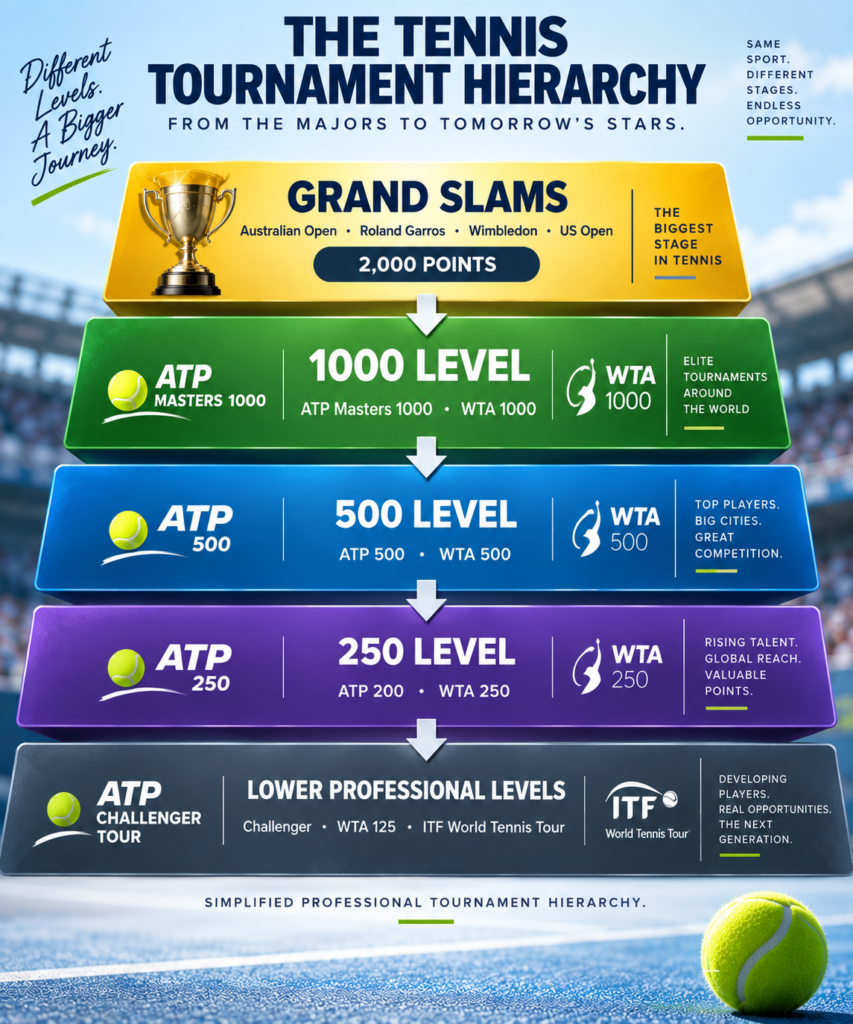
A useful way to visualise professional tennis is:
GRAND SLAMS
Australian Open
Roland Garros
Wimbledon
US Open
↓
MAIN TOURS
ATP Tour / WTA Tour
↓
DEVELOPMENTAL PROFESSIONAL LEVELS
ATP Challenger / WTA 125 / ITF-level competition
The exact organisational structure is more complicated, but this captures the competitive hierarchy.
How Many Ranking Points Do Players Earn at Grand Slams?
A Grand Slam singles champion receives 2,000 ATP or WTA ranking points.
That makes a major the largest standard single-event ranking opportunity.
For comparison:
| Tournament Level | Champion’s Points |
|---|---|
| Grand Slam | 2,000 |
| ATP Masters 1000 / WTA 1000 | 1,000 |
| ATP 500 / WTA 500 | 500 |
| ATP 250 / WTA 250 | 250 |
The exact points awarded in earlier rounds differ between the ATP and WTA systems.
For example, under the current WTA table, a Grand Slam singles champion receives 2,000 points, the finalist 1,300, semifinalists 780 and quarterfinalists 430.
See Tennis Ranking Points Explained for a full breakdown of how ranking points work.
Why Is Winning a Grand Slam Worth So Much?
Consider the ranking-point mathematics.
One Grand Slam title:
2,000 points
That headline total is equivalent to:
Two 1000-level titles
or
Four 500-level titles
or
Eight 250-level titles
That doesn’t mean those achievements are identical — ranking systems involve counting rules and different tournament obligations — but it demonstrates the enormous ranking weight of one major championship.
A player who performs exceptionally across the four Grand Slams can build a huge portion of their ranking total from just those events.
Conversely, an elite player who performs poorly at the majors may find it difficult to challenge for No. 1 even if they are consistently successful elsewhere.
How Big Are Grand Slam Singles Draws?
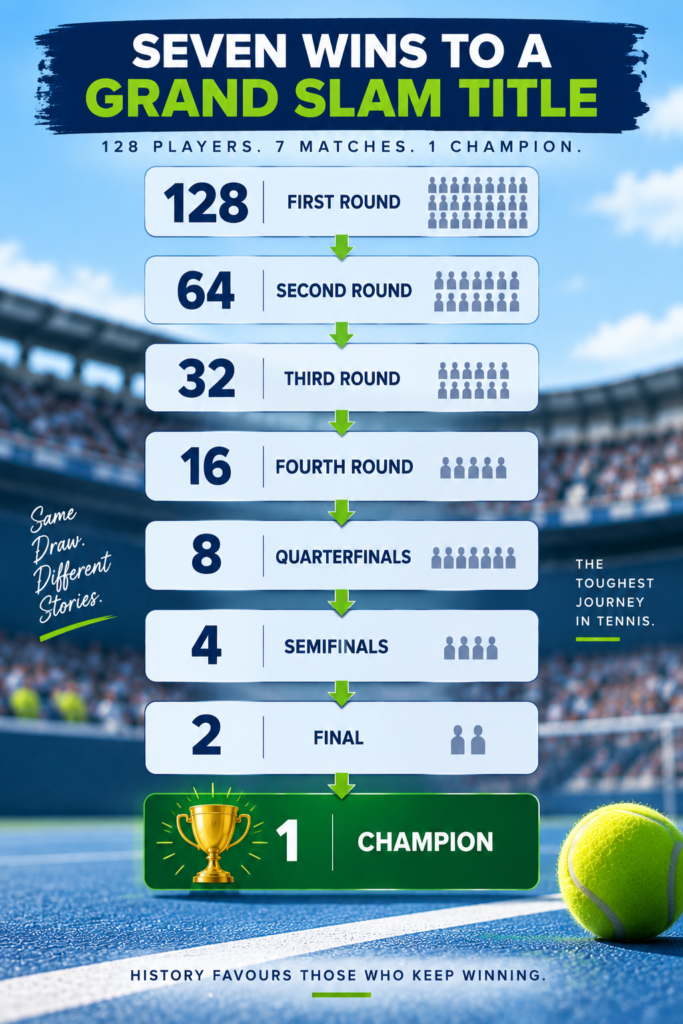
Grand Slam singles main draws contain 128 players.
That is substantially larger than many regular Tour tournaments.
A player who starts in the first round must win seven matches to become singles champion.
The progression is:
First Round — 128 players
↓
Second Round — 64
↓
Third Round — 32
↓
Fourth Round — 16
↓
Quarterfinals — 8
↓
Semifinals — 4
↓
Final — 2
↓
Champion — 1
That seven-match journey is one reason winning a major is so demanding.
And for players who begin in qualifying, the road can be longer still.
How Do Players Get Into a Grand Slam?
There are several routes into a Grand Slam singles draw.
Direct Acceptance
Most places go to players whose ranking is sufficiently high at the relevant entry deadline.
For the world’s leading players, this is routine.
For players around the cut-off, a handful of ranking positions can determine whether they enter the main draw directly or need another route.
Qualifying
Players who don’t receive direct acceptance may enter the qualifying tournament if their ranking is high enough.
They then need to progress through qualifying to earn a main-draw position.
See What Is a Qualifier in Tennis?
Wild Cards
Tournament organisers can award a limited number of Wild Cards.
These can go to promising local players, former champions, returning stars or other players selected by the tournament.
Lucky Losers
If a main-draw player withdraws after qualifying has progressed, an eligible player who lost in qualifying may sometimes enter as a Lucky Loser.
This can transform a player’s tournament — and occasionally their career — almost overnight.
Are Grand Slam Matches Best of Five Sets?
In men’s singles, Grand Slam main-draw matches are played as best-of-five sets.
A player must win three sets to win the match.
Women’s Grand Slam singles matches are played best-of-three sets, requiring two sets to win.
This makes men’s Grand Slam tennis different from standard ATP Tour singles, where matches are normally best-of-three.
The physical consequences are significant.
A five-set match can last several hours, and a player may then need to recover quickly for another demanding match.
Over seven rounds, that can become an extraordinary test of endurance.
Do All Four Grand Slams Use the Same Rules?
The fundamental Rules of Tennis apply across the majors, but that doesn’t mean every aspect of the four tournaments is identical.
Tournament procedures, scheduling, court conditions and some competition regulations can vary.
Grand Slam regulations are implemented and enforced through the Grand Slam Board, with a dedicated Grand Slam rule book.
This is another reason fans should be careful about assuming something seen at one major automatically works identically at another.
How Much Prize Money Do Grand Slam Players Earn?
The Grand Slams offer some of the largest prize-money pools in tennis.
But there is no permanent universal “Grand Slam prize money” figure.
Each event sets its own purse and distribution, and amounts change over time.
Players receive increasing amounts as they progress through the draw.
That means even reaching a Grand Slam main draw can be financially important for a lower-ranked professional.
For the biggest stars, winning can mean a multimillion-dollar payday.
For a player who spends most of the season at Challenger or ITF level, merely qualifying for the main draw can materially change their annual earnings.
See Tennis Prize Money Explained for a deeper look at how tournament earnings work.
Do Men and Women Receive Equal Grand Slam Prize Money?
Yes.
All four Grand Slams award equal prize money to men and women for equivalent results in their respective singles draws.
That means the men’s singles champion and women’s singles champion at the same major receive the same winner’s prize.
The same principle applies round by round within their corresponding singles events.
What Does “Winning a Grand Slam” Mean?
This phrase can cause confusion because it is used in two different ways.
In everyday tennis conversation, someone might say:
“She won a Grand Slam.”
Usually, they mean the player won one major tournament.
For example, winning Wimbledon is commonly described as winning a Grand Slam title.
Technically, however, the Grand Slam has historically meant winning all four major singles championships in the same calendar year.
So there is a difference between:
A Grand Slam title — winning one major
and
The Grand Slam — winning all four majors in the same calendar year.
What Is a Career Grand Slam?
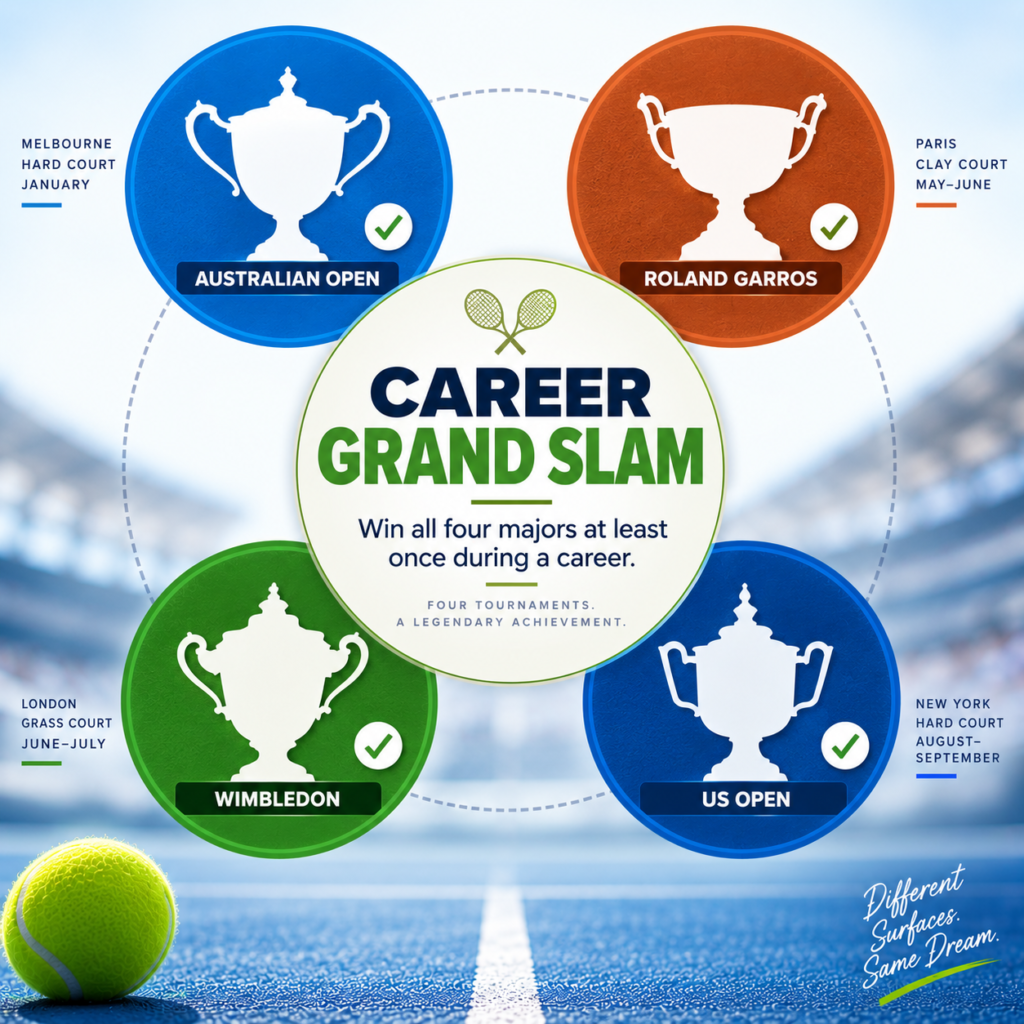
A Career Grand Slam means winning all four majors at least once during a player’s career.
The titles don’t need to come in the same year or consecutively.
A player could win:
Australian Open in one season
Wimbledon three years later
US Open the following year
Roland Garros five years after that
and still complete the Career Grand Slam.
It is extraordinarily difficult because it requires success across hard courts, clay and grass.
The ATP defines the Career Grand Slam as winning each of the Australian Open, Roland Garros, Wimbledon and US Open at least once during a career.
What Is a Calendar Grand Slam?
A Calendar Grand Slam means winning all four majors during the same calendar year.
That means winning:
Australian Open
↓
Roland Garros
↓
Wimbledon
↓
US Open
all in one season.
This is considerably harder than a Career Grand Slam because there is no room to wait until another season to complete the collection.
A player must remain dominant across different surfaces, conditions and continents throughout the year.
What Is a Non-Calendar-Year Grand Slam?
A player can also hold all four major titles simultaneously without winning them in the same calendar year.
For example, they might win:
Wimbledon
↓
US Open
↓
Australian Open
↓
Roland Garros
That gives them four consecutive major titles spanning two calendar years.
Novak Djokovic achieved this from Wimbledon 2015 through Roland Garros 2016, becoming the first man since Rod Laver in 1969 to hold all four major singles titles simultaneously.
It is sometimes called a non-calendar-year Grand Slam, although terminology can vary.
What Is the Golden Slam?
A Golden Slam adds Olympic singles gold to the four Grand Slam titles.
The most famous version is the Calendar Golden Slam — winning all four majors and Olympic gold in the same calendar year.
Steffi Graf accomplished that feat in singles in 1988.
A Career Golden Slam refers to winning all four majors and Olympic singles gold at some point across a career. At the time of writing, only Steffi Graf has achieved this.
This is covered more fully in our upcoming Olympic Tennis Explained article.
Are Grand Slams More Important Than Being World No. 1?
There isn’t a mathematical answer because they measure different achievements.
World No. 1 rewards sustained performance across a ranking period.
A Grand Slam rewards winning one of tennis’s four most important tournaments.
A player can become No. 1 without winning a major.
A player can also win a Grand Slam without ever reaching No. 1.
Historically, both achievements carry enormous prestige.
But when evaluating the greatest careers in tennis, Grand Slam titles are usually among the first statistics considered.
Are Grand Slams Worth More Than Masters 1000 or WTA 1000 Titles?
In ranking points, yes.
A Grand Slam champion earns 2,000 points, compared with 1,000 for an ATP Masters 1000 or WTA 1000 champion.
But their greater significance extends beyond that numerical difference.
Grand Slams have:
- Longer histories
- Bigger draws
- Greater international attention
- Larger prize-money pools
- Unique traditions
- Greater career prestige
On the men’s side, best-of-five-set singles also adds another layer of difficulty.
A Masters 1000 or WTA 1000 title is an elite achievement.
A Grand Slam title sits above it.
Why Are Different Surfaces So Important?
If all four majors were played on identical courts, completing the set would still be difficult.
But the surfaces make it significantly harder.
Hard Court
Australian Open and US Open.
Hard courts tend to provide relatively predictable bounces, but the two tournaments don’t necessarily play identically because court composition, climate, balls and conditions can affect speed and bounce.
Clay
Roland Garros.
The surface rewards movement, patience and the ability to construct points on slower courts.
Grass
Wimbledon.
Grass traditionally rewards aggressive tennis, low movement and quick reactions, although modern Wimbledon tennis is far less one-dimensional than the serve-and-volley eras of the past.
A true all-surface champion must therefore adapt.
That is what makes winning all four majors one of tennis’s ultimate tests.
Grand Slams Are More Than Singles
For casual viewers, “Grand Slam” can seem synonymous with men’s and women’s singles.
But the tournaments are much larger.
Grand Slam programmes include competitions across multiple disciplines, including men’s and women’s singles and doubles, as well as junior and wheelchair events. The governing body’s 2026 tournament information, for example, separately documents men’s, junior and wheelchair competitions.
Mixed doubles is also part of the Grand Slam landscape, although formats and scheduling can differ by event.
This means a major isn’t simply one men’s tournament and one women’s tournament taking place simultaneously.
It is a major international tennis championship containing numerous competitions.
Why Do Players Care So Much About Grand Slams?
Because opportunities are limited.
There are only four each year.
A player can lose an ATP 500 and potentially enter another relatively soon.
Lose at Wimbledon and there is no second Wimbledon three weeks later.
Another opportunity doesn’t arrive until the following year.
Over a ten-year elite career, a player theoretically gets only around 40 opportunities to contest a major — and injuries, form, age and qualification can reduce that number considerably.
That scarcity gives every major enormous weight.
One bad match can end months of preparation.
One exceptional fortnight can change how a player is remembered forever.
Frequently Asked Questions
What are the four Grand Slams in tennis?
The four Grand Slams are the Australian Open, Roland Garros, Wimbledon and US Open.
Which Grand Slam is played first?
The Australian Open is the first major of the calendar year and is normally held in January in Melbourne.
Which Grand Slam is played on clay?
Roland Garros is the only current Grand Slam played on clay.
Which Grand Slam is played on grass?
Wimbledon is the only Grand Slam played on grass.
Which Grand Slams are played on hard courts?
The Australian Open and US Open are played on hard courts.
How many ranking points does a Grand Slam winner receive?
The men’s and women’s singles champions receive 2,000 ranking points.
How many matches must a player win to win a Grand Slam?
A player entering a 128-player singles main draw must win seven matches to become champion.
Are Grand Slams part of the ATP Tour?
They are not regular ATP-owned tournaments. The ATP calendar distinguishes its Tour events from the four Grand Slams, although Grand Slam results award ATP ranking points and form a central part of the men’s professional season.
Are Grand Slams part of the WTA Tour?
Similarly, the majors are independently organised rather than ordinary WTA tournaments, but their results award WTA ranking points and are central to the women’s professional calendar.
Is winning one major a Grand Slam?
In everyday usage, winning one major is often described as winning “a Grand Slam.” Strictly speaking, the Grand Slam means winning all four majors in the same calendar year.
What is a Career Grand Slam?
Winning the Australian Open, Roland Garros, Wimbledon and US Open at least once during a player’s career.
What is the biggest tennis tournament?
There isn’t one officially designated “biggest” tournament. The Australian Open, Roland Garros, Wimbledon and US Open collectively occupy the highest level of individual tournament competition.
Final Thoughts
Professional tennis has numerous levels.
There are ITF events where careers begin, Challengers where players fight their way towards the main Tour, ATP and WTA tournaments around the world, and prestigious 1000-level events featuring most of the game’s elite.
Then there are the Grand Slams.
Only four tournaments occupy that level.
Melbourne in January.
Paris on clay.
Wimbledon on grass.
New York at the end of the northern summer.
Each asks something different of a player, but the reward is the same: one of the most significant titles available in tennis.
That’s why rankings can rise and fall, tournament categories can change and calendars can be reorganised, yet the majors remain the reference point against which great tennis careers are so often measured.
Winning one can define a season.
Winning several can define a career.
Winning all four puts a player into one of tennis’s most exclusive clubs.
Continue Reading
- Tennis Ranking Points Explained
- Tennis Prize Money Explained
- The ATP Tour Explained
- The WTA Tour Explained
- What Is a Qualifier in Tennis?
- What Is a Wild Card in Tennis?
- What Is a Lucky Loser in Tennis?
- ATP Masters 1000 Explained
Read more of our instructional articles here.
Read more of our player focus articles here.
Follow The Tennis Site on X: @thetennissite
Follow Todd Scoullar on X: @toddscoullar

Comments are closed, but trackbacks and pingbacks are open.