
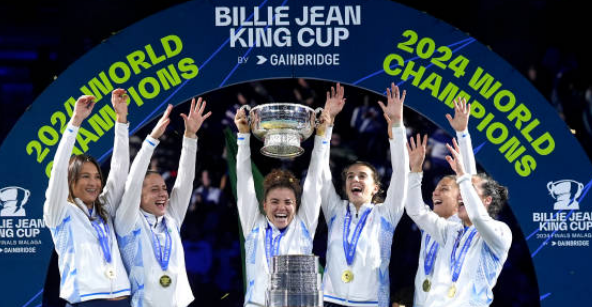
For most of the tennis season, the world’s best women compete for themselves.
Their ranking. Their prize money. Their titles.
Then comes the Billie Jean King Cup, where the equation changes.
Players compete for their countries, teammates watch from courtside and individual matches combine to decide something much bigger: which nation becomes women’s team world champion.
Formerly known as the Federation Cup and later the Fed Cup, the competition dates back to 1963 and has grown from 16 nations at its inaugural event to a record 148 nations entered across all levels in 2026.
It is essentially the women’s counterpart to the Davis Cup, but its history and format are its own.
So how does the Billie Jean King Cup actually work? What is a tie? How do countries qualify for the Finals? And why can doubles suddenly become one of the most important matches of the season?
What Is the Billie Jean King Cup?
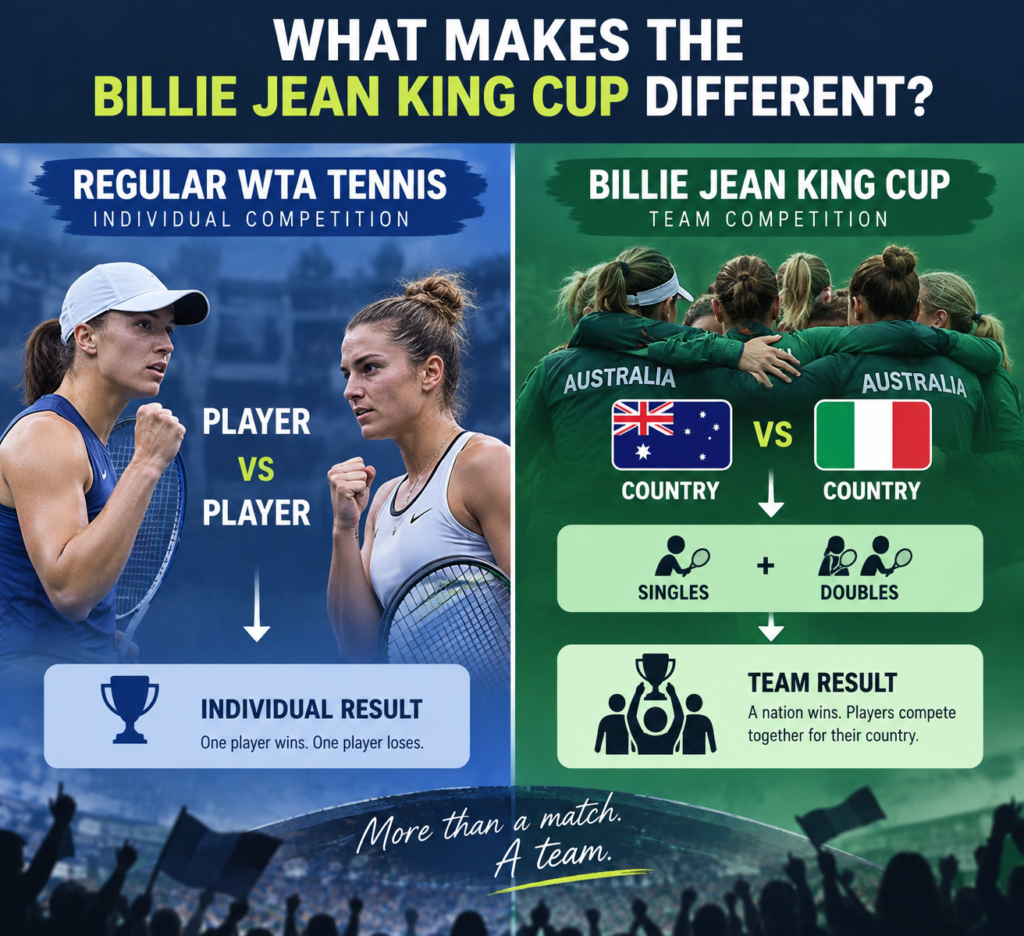
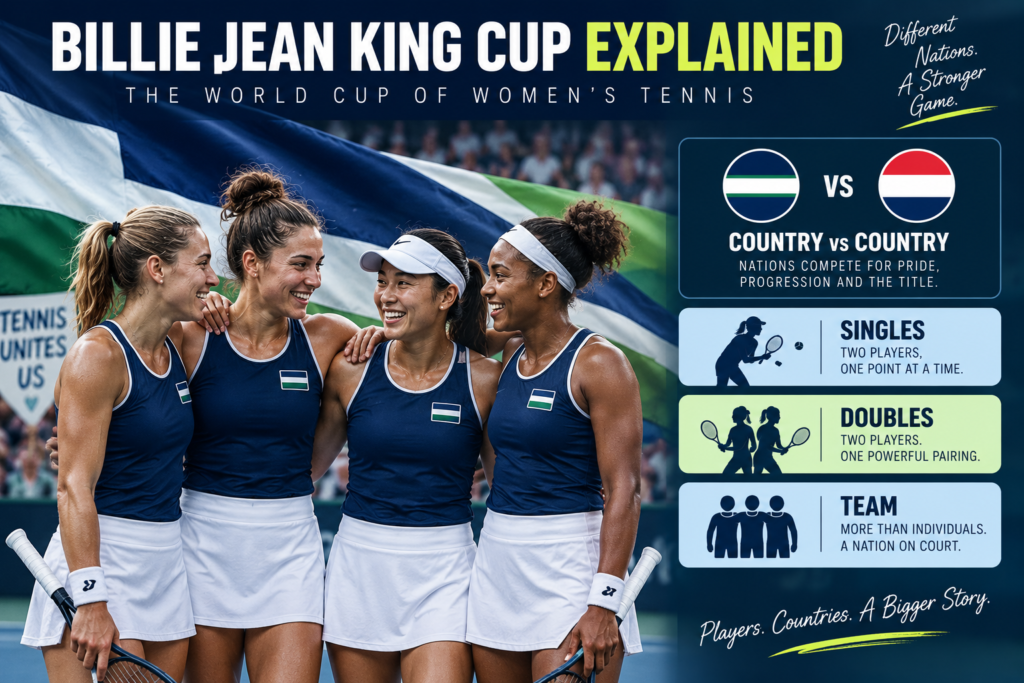
The Billie Jean King Cup is the leading international women’s team competition in tennis.
Rather than competing as individuals, players represent their countries.
So instead of:
Player vs Player
the competition is built around:
Country vs Country
Each meeting between two countries is called a tie.
That tie consists of a series of singles and doubles matches, with each individual match contributing towards the overall result.
At the highest level, countries progress through the Qualifiers before the eight remaining nations contest the season-ending Billie Jean King Cup Finals.
The 2026 Finals take place from September 22-27 at Shenzhen Bay Sports Centre Arena in Shenzhen, China.
How Does the Billie Jean King Cup Work?
At first glance, the structure can appear complicated because the Billie Jean King Cup is much bigger than the eight countries seen at the Finals.
A record 148 nations entered across all levels in 2026.
The simplified structure looks like this:
BILLIE JEAN KING CUP FINALS
8 countries
↑
QUALIFIERS
↑
PLAY-OFFS
↑
REGIONAL GROUPS
Countries move through different levels according to their results.
At the top, seven nations qualify for the Finals through the Qualifiers, where they join the host nation.
In 2026, China receives the host place, meaning seven other countries qualify to join them in Shenzhen.
What Is a Billie Jean King Cup Tie?
A tie is the overall contest between two countries.
This is an important distinction.
If Australia plays the United States, for example, Australia vs United States is the tie.
The individual singles and doubles contests within it are matches.
The format depends on the stage of the competition.
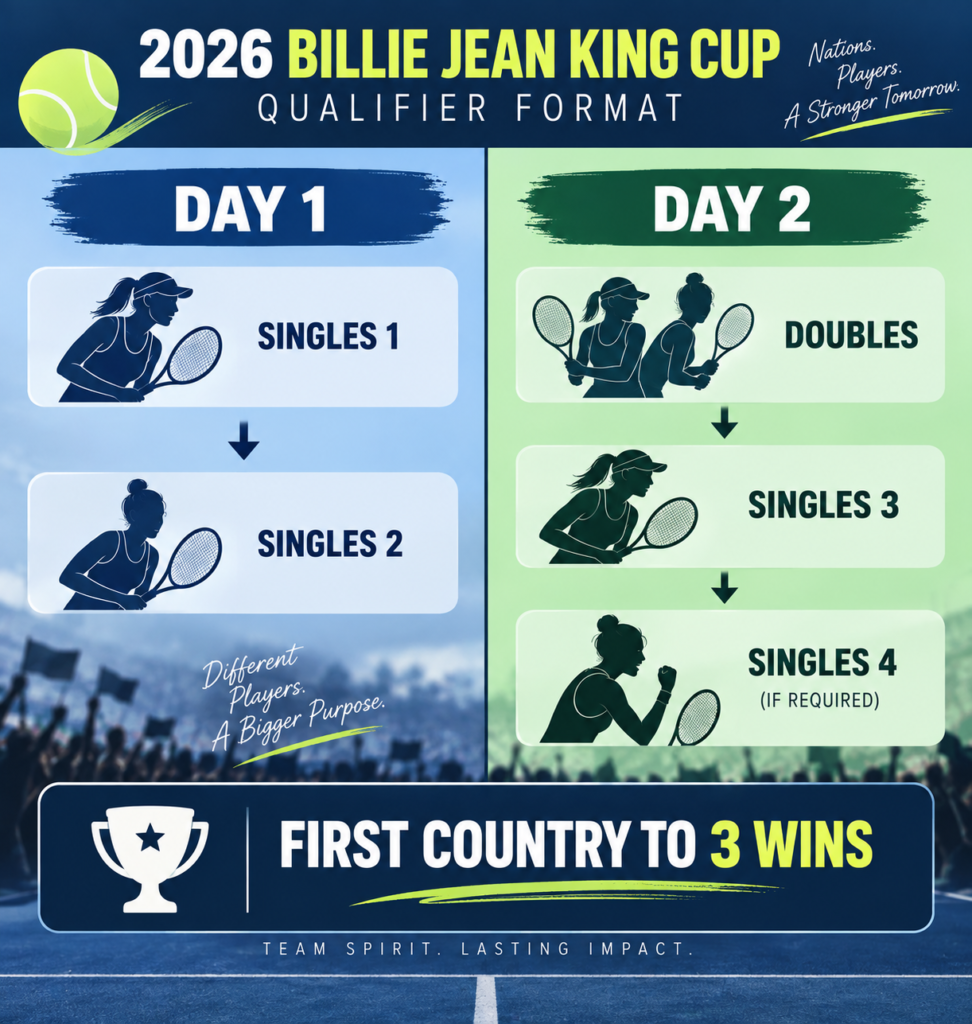
In the 2026 Qualifiers, a tie can contain five matches over two days.
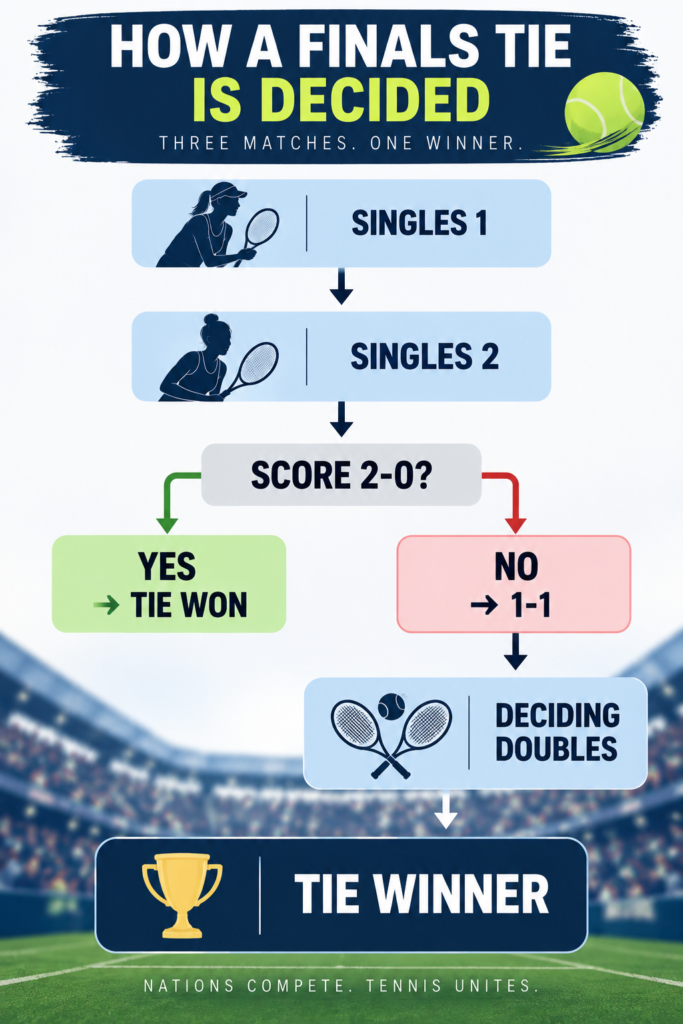
At the Finals, a tie contains up to three matches on one day.
So when somebody says a country “won its Billie Jean King Cup tie”, they mean it won enough individual matches to defeat the opposing nation overall.
How Do the 2026 Qualifiers Work?
This is one area where it’s particularly important to use current information.
The Billie Jean King Cup returned to home-or-away Qualifier ties in 2026 after using group-stage qualifying in 2025.
Fourteen nations contested seven Qualifier ties on April 10-11, 2026.
Each tie took place over two days.
Day One
Singles Match 1
↓
Singles Match 2
Day Two
Doubles
↓
Singles Match 3
↓
Singles Match 4 — if required
The first nation to win three matches wins the tie and qualifies for the Finals.
There is an interesting change here.
The doubles match is played first on Day Two.
That guarantees a live doubles match before the remaining singles are played — the first time in Billie Jean King Cup history that the format guarantees live doubles in this way.
Why Is Doubles So Important?
Doubles has always been capable of producing some of the competition’s most dramatic moments.
The 2026 Qualifier format gives it even greater prominence.
Imagine the score after Day One is:
Country A — 1
Country B — 1
The first match on Day Two is doubles.
Whoever wins immediately moves ahead 2-1 and needs only one of the remaining singles matches to take the tie.
Even if one country leads 2-0 after the opening day, the other can win the doubles and keep the tie alive.
That creates a different strategic challenge from normal WTA competition.
A country cannot simply think about its two best singles players.
A strong doubles combination matters too.
And a specialist doubles player who spends most of the year outside the singles spotlight can suddenly become central to her country’s chances.
How Do Countries Reach the Billie Jean King Cup Finals?
The route to the 2026 Finals was straightforward at the top level.
Fourteen countries contested seven Qualifier ties.
14 COUNTRIES
↓
7 QUALIFIER TIES
↓
7 WINNERS
↓
Join host nation CHINA
↓
8-TEAM FINALS
The seven losing Qualifier nations move into the 2026 Play-offs in November.
The Play-offs provide the link between the elite level and the broader regional competition.
This is why the Billie Jean King Cup should not be thought of as simply an eight-team tournament.
The Finals are the conclusion of a much larger international structure.
What Are the Billie Jean King Cup Finals?
The Finals are where the world champion is decided.
In 2026, eight countries compete in a straight knockout tournament at the Shenzhen Bay Sports Centre Arena in Shenzhen from September 22-27.
The structure is simple:
8 COUNTRIES
↓
4 QUARTERFINAL WINNERS
↓
2 SEMIFINAL WINNERS
↓
FINAL
↓
🏆 WORLD CHAMPION
There is no round-robin stage at the Finals.
Lose your tie and you’re out.
Win three consecutive ties — quarterfinal, semifinal and final — and your country becomes Billie Jean King Cup champion.
How Does a Finals Tie Work?
The Finals format is shorter than the Qualifiers.
Each tie consists of:
Singles Match 1
↓
Singles Match 2
↓
Doubles
The first nation to win two matches wins the tie.
That means doubles may not always be required.
If one country wins both singles matches, the tie has already been decided.
But if the countries split the singles 1-1, everything comes down to doubles.
One match.
Winner advances.
Loser goes home.
That’s one reason team selection can become so important.
A country with excellent singles players but relatively weak doubles options can suddenly find itself vulnerable if the tie reaches 1-1.
Are Billie Jean King Cup Matches Best of Three Sets?
Yes.
At the 2026 Finals, matches are played as best-of-three tiebreak sets with regular advantage scoring.
That means the individual matches largely resemble normal professional singles matches from a scoring perspective.
What changes is the context.
Winning doesn’t simply put one player into the next round.
It gives her country one of the victories needed to advance.
That can produce a very different atmosphere.
Players who are normally alone on court have teammates and a captain watching from nearby.
Crowds are often openly supporting one country.
The result belongs to the team.
Why Is It Called the Billie Jean King Cup?
The competition wasn’t always called the Billie Jean King Cup.
It began in 1963 as the Federation Cup.
In 1995, its name was shortened to Fed Cup.
Then, in 2020, it was renamed the Billie Jean King Cup in honour of American tennis great Billie Jean King.
Few names could be more closely connected with the competition.
King played in the inaugural Federation Cup in 1963, helping the United States win the first title. She went on to compete in 36 ties, appeared in nine finals and was part of seven championship teams.
Her significance goes well beyond results on court.
King won 39 Grand Slam titles across singles, doubles and mixed doubles, helped found the WTA in 1973 and became one of sport’s most influential advocates for gender equality.
Renaming the competition placed her name permanently alongside the women’s international team event she helped establish from its earliest days.
When Did the Billie Jean King Cup Begin?
The inaugural Federation Cup was staged in 1963 at Queen’s Club in London.
Sixteen countries participated.
The first final featured the United States and Australia, with a remarkable group of players including Billie Jean King, Darlene Hard, Margaret Court and Lesley Turner.
The United States won the title.
There wasn’t even prize money.
Teams were responsible for meeting their own expenses.
From those 16 countries, the competition expanded into a genuinely global event.
By 2026, 148 nations had entered across all levels.
Who Has Won the Most Billie Jean King Cups?
The United States is comfortably the most successful nation in competition history.
The leading countries through the end of 2025 are:
| Country | Titles |
|---|---|
| United States | 18 |
| Czechia* | 11 |
| Australia | 7 |
| Italy | 6 |
| Russia** | 5 |
| Spain | 5 |
| France | 3 |
| Germany | 2 |
Czechia’s historical record includes Czechoslovakia.
*Russia’s record includes the 2020/21 title won as the Russian Tennis Federation.
The United States has won 18 titles and reached 31 finals, both competition records.
Who Won the 2025 Billie Jean King Cup?
Italy entered 2026 as the defending champion.
The Italians defeated the United States in the 2025 final in Shenzhen, successfully defending the title they had won against Slovakia in 2024.
That gave Italy six championships overall:
2006
2009
2010
2013
2024
2025
It also meant Italy entered the 2026 competition having won the previous two editions.
Which Player Has Won the Most Billie Jean King Cup Titles?
That record belongs to Chris Evert.
Evert was part of eight United States championship teams.
Billie Jean King and Rosie Casals are next with seven each, while Petra Kvitova and Barbora Strycova won six.
This is another way in which team records differ from normal tennis statistics.
A player doesn’t “win” the Billie Jean King Cup entirely on her own.
The title belongs to the country and the nominated team.
But individual players can build extraordinary records across many years of representing their nation.
Do Players Earn WTA Ranking Points?
The Billie Jean King Cup sits outside the normal hierarchy we’ve been covering in this cluster.
It isn’t:
WTA 1000
↓
WTA 500
↓
WTA 250
↓
Billie Jean King Cup
That’s not how it works.
The competition is a national-team event rather than another standard WTA tournament category.
Countries have their own Billie Jean King Cup Nations Ranking, which is used within the competition for matters including seeding and participation structure.
So when thinking about the Billie Jean King Cup, the central objective isn’t an individual ranking-points reward.
It’s advancing your country through the competition and ultimately winning the title.
Who Can Play in the Billie Jean King Cup?
Countries nominate squads, with captains selecting players for individual matches.
That creates tactical decisions you don’t normally see on the WTA Tour.
Who plays the opening singles match?
Who plays second?
Does the captain select a doubles specialist?
Does one player compete in both singles and doubles?
Should the team be built around its highest-ranked player, or does a particular matchup favour someone else?
The best singles ranking doesn’t automatically answer every question.
And because conditions can vary between ties, team composition can become particularly important.
How Important Is Home Advantage?
In the Qualifiers, it can be significant.
The 2026 competition returned to a home-or-away format, with one nation hosting the tie and choosing the playing surface.
That means the host can potentially select conditions that suit its team.
Clay.
Hard court.
Indoor conditions.
Outdoor conditions.
The crowd can matter too.
Normal professional tennis crowds may support one player more than another, but national-team tennis can be much more partisan.
Every winner can be celebrated as a point for the country.
Every momentum swing affects the entire team.
That atmosphere is one of the characteristics the Billie Jean King Cup shares with Davis Cup.
Billie Jean King Cup vs Davis Cup
The easiest distinction is:
BILLIE JEAN KING CUP
Women’s national-team competition
DAVIS CUP
Men’s national-team competition
The two competitions now share some broad structural similarities, including an eight-team knockout Finals stage.
But they have separate histories, records and qualification systems.
Both also offer something relatively unusual in elite tennis: an opportunity for players who spend most of the year competing individually to become teammates.
Billie Jean King Cup vs United Cup
These competitions are also easy to confuse.
The Billie Jean King Cup is an international women’s team competition.
The United Cup is a mixed competition in which male and female players represent the same country.
There are also major differences in scheduling and structure.
United Cup is played in Australia at the beginning of the professional season.
The Billie Jean King Cup takes place across different stages of the year, with the 2026 Finals scheduled for September in Shenzhen.
We’ll cover the mixed competition separately in United Cup Explained.
Why the Billie Jean King Cup Matters
Professional tennis can be lonely.
Players travel with their own teams, enter tournaments under their own names and ultimately stand alone when the match begins.
The Billie Jean King Cup temporarily changes all of that.
A player can lose her singles match and still see her country advance.
A doubles specialist can decide a tie.
A young player can sit beside an experienced champion as part of the same team.
And a victory becomes something shared.
That’s what separates international team tennis from almost everything else on the professional calendar.
The competition has changed considerably since 16 countries gathered at Queen’s Club in 1963.
Its name has changed.
Its format has changed.
Its scale has changed.
But the central idea remains intact:
The player is competing for something bigger than herself.
Frequently Asked Questions
What is the Billie Jean King Cup?
The Billie Jean King Cup is the leading international women’s team tennis competition, with players representing their countries.
What was the Billie Jean King Cup previously called?
It began as the Federation Cup in 1963, became the Fed Cup in 1995 and was renamed the Billie Jean King Cup in 2020.
Why is it named after Billie Jean King?
King played in the inaugural competition and won seven titles with the United States. She was also a founder of the WTA and became one of the most influential advocates for equality in sport.
How many countries compete?
A record 148 nations entered across all levels of the competition in 2026.
How many countries reach the Finals?
Eight. Seven qualify through the Qualifiers and join the host nation.
Where are the 2026 Billie Jean King Cup Finals?
At Shenzhen Bay Sports Centre Arena in Shenzhen, China, from September 22-27.
How many matches are played in a Finals tie?
Up to three: two singles matches followed by doubles. The first country to win two matches wins the tie.
How do the Qualifiers work?
The 2026 Qualifiers use home-or-away, two-day ties. Two singles matches are played on Day One, followed by doubles and up to two further singles matches on Day Two. The first country to three victories wins.
Which country has won the most Billie Jean King Cup titles?
The United States, with 18.
Who won the Billie Jean King Cup in 2025?
Italy, which defeated the United States and won its second consecutive title.
Is Billie Jean King Cup the women’s Davis Cup?
It is the women’s equivalent in the broad sense that both are major international team competitions, although they are separate events with their own histories and formats.
Final Thoughts
The Billie Jean King Cup takes one of the world’s great individual sports and changes its meaning.
For most of the season, winning a match moves a player forward.
Here, it moves an entire country forward.
That difference can turn an ordinary singles match into one part of a two-day national contest. It can turn a doubles specialist into the most important player on the court. And at the Finals, it can reduce a country’s entire season to one deciding doubles match.
From 16 nations in 1963 to a record 148 entered in 2026, the scale has changed enormously.
But the idea remains wonderfully straightforward.
Represent your country.
Win your matches.
Help your teammates.
And eventually, perhaps, become world champion.
Continue Reading
Davis Cup Explained
Laver Cup Explained
Olympic Tennis Explained
United Cup Explained
The WTA Tour Explained
Grand Slams Explained
Tennis Ranking Points Explained
Read more of our instructional articles here.
Read more of our player focus articles here.
Follow The Tennis Site on X: @thetennissite
Follow Todd Scoullar on X: @toddscoullar

Comments are closed, but trackbacks and pingbacks are open.