

Immediately below the Grand Slams sits the most prestigious regular tournament category on the ATP Tour: the ATP Masters 1000.
There are nine Masters 1000 tournaments on the 2026 calendar, staged across North America, Europe and Asia. They bring together most of the leading men’s players and offer some of the largest ranking-point and prize-money opportunities outside the four majors.
Winning one earns 1,000 ATP ranking points.
That explains the name.
But the Masters 1000 category is more complicated than simply being a collection of tournaments worth 1,000 points.
Some last almost two weeks. Others retain shorter formats. Draw sizes vary. They are played on hard courts and clay. And while participation rules make Masters 1000 events an important part of the schedule for leading players, Monte-Carlo has a different status from the other eight.
So where exactly do Masters 1000 tournaments fit into professional tennis?
Quick Answer: What Is an ATP Masters 1000?
ATP Masters 1000 is the highest regular tournament category on the ATP Tour.
The hierarchy looks like this:
Grand Slams
2,000 points
↓
ATP Masters 1000
1,000 points
↓
ATP 500
500 points
↓
ATP 250
250 points
A Masters 1000 champion receives 1,000 PIF ATP Rankings points. The category has existed as a series since 1990, although its name and individual tournaments have evolved over time.
There are currently nine events.
The Nine ATP Masters 1000 Tournaments
| Tournament | Location | Surface |
|---|---|---|
| Indian Wells | California, USA | Hard |
| Miami | Florida, USA | Hard |
| Monte-Carlo | Monaco | Clay |
| Madrid | Spain | Clay |
| Rome | Italy | Clay |
| Canada | Canada | Hard |
| Cincinnati | Ohio, USA | Hard |
| Shanghai | China | Hard |
| Paris | France | Hard |
Together, they form one of the most important parts of the men’s professional season.

Why Are They Called Masters 1000 Tournaments?
The “1000” refers to the number of ATP ranking points awarded to the singles champion.
It does not refer to:
- Prize money
- Number of players
- Tournament attendance
- Number of matches
- Tournament value in dollars
Win the tournament and the player receives 1,000 ranking points.
That places Masters 1000 events halfway between a Grand Slam title worth 2,000 points and an ATP 500 title worth 500.
It is part of a relatively logical naming system:
Grand Slam: 2,000 points
Masters 1000: 1,000
ATP 500: 500
ATP 250: 250
For more on how those points affect a player’s position, see Tennis Ranking Points Explained
How Many ATP Masters 1000 Tournaments Are There?
There are nine ATP Masters 1000 tournaments on the 2026 calendar.
They are spread across the season rather than grouped into one continuous block.
The first two — Indian Wells and Miami — form a major North American hard-court swing.
Monte-Carlo, Madrid and Rome then form the Masters portion of the European clay season before Roland Garros.
Canada and Cincinnati are major hard-court events leading towards the US Open.
Shanghai follows during the Asian swing.
Paris is the ninth and final Masters 1000 of the season and provides one of the last major ranking opportunities before the ATP Finals.
This means Masters 1000 tournaments provide something resembling a backbone for the ATP calendar between the majors.
The ATP Masters 1000 Calendar
A simplified season looks like this:
MARCH
Indian Wells
↓
Miami
APRIL–MAY
Monte-Carlo
↓
Madrid
↓
Rome
JULY–AUGUST
Canada
↓
Cincinnati
OCTOBER–NOVEMBER
Shanghai
↓
Paris
The exact dates can change from year to year, but the basic sequence is well established.

Indian Wells
The BNP Paribas Open at Indian Wells is traditionally the first Masters 1000 tournament of the season.
It is played on outdoor hard courts in California.
Indian Wells has developed a reputation as one of the biggest tournaments outside the Grand Slams, helped by its large site, extensive facilities and expanded format.
Together with Miami, it forms the famous Sunshine Double.
Winning both tournaments in the same season is a significant achievement because players must maintain form across two major events in succession.
Miami
The Miami Open follows Indian Wells.
It is another outdoor hard-court Masters 1000 and completes the Sunshine Double.
The combination creates one of the most important stretches of the early season.
A player winning both tournaments earns 2,000 ranking points from the two titles — numerically equivalent to the champion’s points from one Grand Slam.
That doesn’t make the achievements historically equivalent, but it demonstrates just how valuable the Sunshine Double can be in the rankings.
Monte-Carlo
The Monte-Carlo Masters begins the clay-court Masters 1000 swing.
Played at the Monte-Carlo Country Club, it is one of the most visually distinctive tournaments in professional tennis.
It also has an important difference from the other Masters 1000 events.
Monte-Carlo is the exception within the Masters category when it comes to mandatory player participation rules.
This sometimes causes confusion because Monte-Carlo still awards a full 1,000 ranking points to its champion.
In competitive terms, it remains a Masters 1000.
Its participation status is what differs.
The 2026 tournament was scheduled for 5–12 April and was the first clay-court Masters 1000 of the season.
Madrid
The Madrid Open is the second clay-court Masters 1000 of the season.
Madrid’s conditions can differ noticeably from other European clay tournaments because the city is at altitude.
The thinner air can help the ball travel more quickly than at lower-altitude clay events.
That means simply labelling Madrid “a slow clay tournament” can be misleading.
It forms an important part of the preparation for Roland Garros, but players must adapt again when moving from Madrid to Rome and eventually Paris.
Rome
The Italian Open in Rome is the final Masters 1000 tournament before Roland Garros.
Played at the Foro Italico, it is one of the most historic and prestigious clay-court events on the ATP Tour.
Its position makes it particularly significant.
By this stage, the European clay season is well underway and Roland Garros is approaching.
For leading players, Rome can therefore be both an opportunity to collect 1,000 points and one of the final major tests before the second Grand Slam of the year.
Canada
The Canadian Masters is unusual because the men’s tournament alternates between Toronto and Montreal.
It is played on hard courts and traditionally begins the major North American hard-court stretch leading towards the US Open.
The event has long been one of the central stops of the summer season.
For players transitioning from European clay and grass, Canada signals another significant change in conditions.
Cincinnati
Cincinnati follows Canada and provides another major hard-court opportunity before the US Open.
Its place on the calendar makes it particularly important for players trying to find form ahead of New York.
Canada and Cincinnati together provide as many as 2,000 champion’s ranking points.
Again, that gives the North American summer Masters swing enormous influence over the rankings.
Shanghai
The Shanghai Masters is the only Masters 1000 tournament currently staged in Asia.
It forms the centrepiece of the ATP’s Asian swing.
Shanghai is played on hard courts and gives players another opportunity to collect 1,000 points late in the season, when qualification for the ATP Finals and year-end ranking positions can be increasingly important.
Paris
The Paris Masters is the ninth and final Masters 1000 tournament of the season.
In 2026, the event is scheduled for 2–8 November at Paris La Défense Arena, with a 56-player singles draw.
Its timing creates an unusual dynamic.
By this point in the season, some players are fighting for qualification for the ATP Finals, while others are trying to protect or improve their year-end ranking.
One deep run can therefore have major consequences.
How Many Ranking Points Do Players Earn?
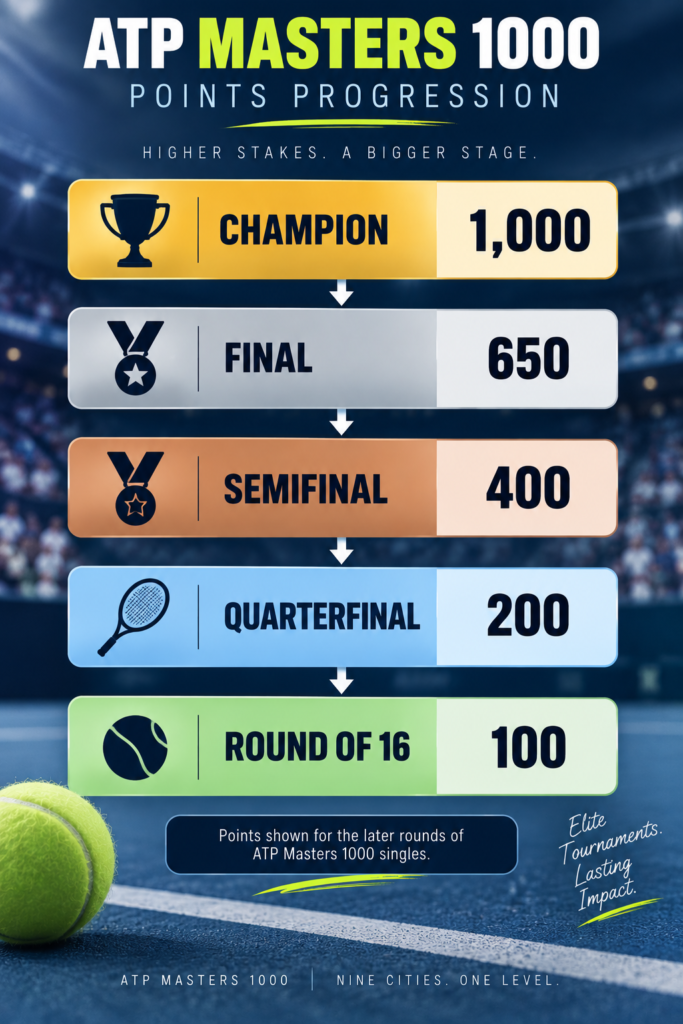
The champion receives 1,000 points.
Under the 2026 ATP ranking table, a Masters 1000 event with a 96-player draw awards:
| Result | Ranking Points |
|---|---|
| Champion | 1,000 |
| Finalist | 650 |
| Semifinal | 400 |
| Quarterfinal | 200 |
| Round of 16 | 100 |
| Round of 32 | 50 |
| Round of 64 | 30 |
| Round of 128 | 10 |
For 48/56-player Masters draws, the later-round points are the same — 1,000 for the champion, 650 for the finalist, 400 for a semifinalist, 200 for a quarterfinalist and 100 for the last 16 — while some earlier-round and qualifying allocations differ.
This is why losing a Masters 1000 final can still make a major difference to a player’s ranking.
650 points is more than the 500 points awarded for winning an ATP 500 title.
Are Masters 1000 Tournaments Mandatory?
For top ATP players, Masters 1000 tournaments form an important part of the ranking and participation structure.
However, saying simply that “all nine Masters 1000 tournaments are mandatory” isn’t accurate.
Monte-Carlo is the notable exception.
The distinction matters because people sometimes assume Monte-Carlo must be worth fewer ranking points as a result.
It isn’t.
The champion still earns 1,000.
The tournament remains an ATP Masters 1000.
The difference concerns its participation and ranking-treatment status rather than the value of the title itself.
There are also exemptions and detailed rules affecting individual players, so “mandatory” should not be interpreted as meaning every eligible player is physically required to appear at every relevant tournament regardless of circumstances.
Why Do Top Players Play Masters 1000 Events So Often?
There are three obvious reasons.
1. Ranking Points
A maximum of 1,000 points is an enormous opportunity.
Consider:
1 Masters 1000 title = 1,000 points
2 ATP 500 titles = 1,000 points
4 ATP 250 titles = 1,000 points
One exceptional week — or, increasingly, extended Masters run — can therefore have a major impact on a player’s ranking.
2. Strong Fields
Masters 1000 events attract most of the world’s leading players.
That makes them valuable preparation for Grand Slams and gives players the opportunity to test themselves against elite opposition.
3. Prize Money
Masters 1000 events offer significant prize money, although the exact amount varies between tournaments.
The “1000” does not refer to prize money.
See Tennis Prize Money Explained for more.
Are Masters 1000 Events Two Weeks Long?
This has changed significantly in recent years.
Many Masters 1000 tournaments have expanded from traditional one-week events into longer tournaments.
The 2026 ATP calendar contains seven Masters 1000 events using the enhanced 12-day format.
This gives many Masters tournaments a structure closer to the scale of a Grand Slam than the traditional week-long ATP event.
But not every Masters 1000 follows exactly the same format.
That is important.
“Masters 1000” defines the tournament category. It does not mean every event has an identical draw size, duration or schedule.

How Big Are Masters 1000 Draws?
There isn’t one universal Masters 1000 singles draw size.
Under the 2026 ATP rules, Masters events can use 96-player, 56-player or 48-player singles draws, with corresponding doubles draw structures.
This explains why the path to the title isn’t identical at every Masters event.
Some players may also receive first-round byes depending on the tournament format and seeding.
So although every Masters 1000 champion receives 1,000 ranking points, the tournament structure used to reach that title can differ.
What Is a First-Round Bye?
A bye allows a player to advance past the opening round without playing a match.
They are commonly awarded to seeded players in draws that don’t begin with a power-of-two number of competitors.
For example, a highly seeded player might enter a tournament in the second round while an unseeded player has already needed to win a first-round match.
That does not mean the seed has “won” the first round.
This distinction can matter for ranking points.
The ATP’s 2026 rules state that a player who receives a bye and then loses their first match is treated as having lost in the first round for ranking-point purposes.
Can Qualifiers Play Masters 1000 Events?
Yes.
Masters 1000 tournaments include qualifying opportunities.
Players whose ranking isn’t high enough for direct acceptance can attempt to earn a place in the main draw through qualifying.
There are also Wild Cards and potentially Lucky Loser opportunities.
This means a Masters 1000 can provide an enormous opportunity for a lower-ranked player.
A qualifier who makes a deep run can earn significant ranking points, prize money and victories over highly ranked opponents within one tournament.
Are Masters 1000 Tournaments Bigger Than Grand Slams?
No.
Grand Slams occupy the level above Masters 1000 events.
A major singles champion earns 2,000 ranking points, compared with 1,000 at a Masters.
Grand Slams also have 128-player singles draws and carry greater historical prestige.
On the men’s side, Grand Slam singles matches are played best-of-five sets, whereas Masters 1000 singles matches are generally best-of-three.
So the hierarchy is clear:
GRAND SLAM
↓
MASTERS 1000
But being one level below a major shouldn’t be confused with being an ordinary Tour event.
Masters 1000 tournaments are among the biggest competitions in men’s tennis.
See Grand Slams Explained for the differences.
Masters 1000 vs ATP 500
The biggest obvious difference is ranking points.
| Category | Champion | Finalist | Semifinalist |
|---|---|---|---|
| Masters 1000 | 1,000 | 650 | 400 |
| ATP 500 | 500 | 330 | 200 |
The ATP’s 2026 rankings table therefore gives exactly twice as many points to the champion and semifinalists at Masters 1000 level, with the finalist receiving 650 rather than 330.
Masters events also generally attract deeper elite fields because of their importance within the ATP calendar.
That doesn’t make an ATP 500 easy to win.
Far from it.
But the Masters 1000 category sits clearly above it.
Our next article, ATP 500 Explained, looks at that level in detail.
Masters 1000 vs ATP 250
The difference is larger again.
A Masters champion receives:
1,000 points
An ATP 250 champion receives:
250 points
So four ATP 250 titles would produce the same headline champion-point total as one Masters 1000 title.
Again, that doesn’t mean the achievements should be treated as perfectly interchangeable. Tournament-entry requirements, counting rules and the strength of individual draws complicate comparisons.
But the numbers show why Masters tournaments can have such a dramatic effect on the rankings.
Masters 1000 vs ATP Finals
This comparison is different.
The ATP Finals is the season-ending championship featuring the year’s leading qualifiers.
An undefeated ATP Finals champion can earn a maximum 1,500 ranking points.
That puts its maximum above a Masters 1000 but below a Grand Slam.
However, the ATP Finals uses a round-robin format rather than a conventional knockout draw and has a completely different qualification system.
It therefore sits outside the normal 250 → 500 → 1000 ladder.
What Is the Sunshine Double?
The Sunshine Double means winning Indian Wells and Miami in the same season.
Because the tournaments are played consecutively during the North American spring hard-court swing, winning both requires a player to sustain exceptional form over an extended period.
It is one of the best-known achievements outside the majors.
In 2026, Jannik Sinner became the eighth man to complete the Sunshine Double and the first since Roger Federer in 2017.
The achievement also delivers an enormous rankings return:
Indian Wells — 1,000
Miami — 1,000
=
2,000 ranking points

What Is the Career Golden Masters?
The Career Golden Masters means winning all nine current ATP Masters 1000 tournaments during a career.
It is an exceptionally difficult achievement because it requires success across different continents, court conditions and surfaces.
Novak Djokovic became the first player to complete the set in 2018.
In May 2026, Jannik Sinner joined him by winning Rome, becoming only the second man in series history to win all nine current Masters 1000 events.
That means, as of September 2026, only Djokovic and Sinner have completed the Career Golden Masters in the Masters 1000 era.
It is worth distinguishing this from the Career Grand Slam, which requires winning all four majors.
They are completely separate achievements.
Why Is Winning All Nine So Difficult?
The nine tournaments don’t reward exactly the same skills.
A player must succeed on outdoor and indoor hard courts as well as clay.
They encounter altitude in Madrid, different climatic conditions across North America and Europe, and varying tournament formats.
There is also simple probability.
Even a player who dominates for years has only limited opportunities to win each particular event.
One troublesome tournament can prevent completion of the set for an entire career.
That is why the Career Golden Masters remains so rare.
How Important Are Masters 1000 Titles Historically?
Grand Slam titles remain the most common benchmark when assessing elite careers.
But Masters 1000 titles provide another valuable measure.
They show sustained success against high-level fields across the regular ATP Tour.
The ATP includes Masters 1000 championships alongside Grand Slams, the ATP Finals and Olympic singles gold when discussing its broader “Big Titles” measure.
For players who spend years near the top of the rankings, Masters results can therefore tell us a great deal about their consistency outside the majors.
Do Masters 1000 Events Have Equal Prize Money?
No.
The tournament category determines the ranking points available, not a universal prize-money figure.
All Masters 1000 singles champions receive 1,000 ranking points.
But individual tournaments can have different prize purses.
For example, the ATP currently lists the 2026 Paris Masters prize money at €6,128,940. That figure belongs specifically to that tournament and season; it is not a universal Masters 1000 purse.
This is why our evergreen articles generally avoid presenting prize-money figures as though they define a tournament category.
Prize money changes.
The ranking-point structure is much more stable.
Why Masters 1000 Events Matter to the World No. 1 Race
Nine tournaments worth 1,000 champion’s points create enormous opportunities for movement in the rankings.
Imagine two players fighting for No. 1.
One loses early at a Masters.
The other wins it.
The difference between their results can amount to hundreds of ranking points in a single event.
Repeat that across Indian Wells, Miami, the European clay Masters and the later hard-court tournaments and the effect becomes substantial.
This is why the world No. 1 race isn’t determined only by Grand Slams.
The majors provide the largest individual prizes, but Masters 1000 performance can be critical to maintaining a high ranking throughout the year.
See Live Rankings Explained for how those points can affect rankings while tournaments are being played.
Frequently Asked Questions
What does ATP Masters 1000 mean?
It is the highest regular tournament category on the ATP Tour. The “1000” refers to the 1,000 ranking points awarded to the singles champion.
How many Masters 1000 tournaments are there?
There are nine ATP Masters 1000 tournaments on the 2026 calendar.
What are the nine Masters 1000 tournaments?
Indian Wells, Miami, Monte-Carlo, Madrid, Rome, Canada, Cincinnati, Shanghai and Paris.
How many points does a Masters 1000 winner receive?
The singles champion receives 1,000 ATP ranking points.
How many points does the runner-up receive?
A Masters 1000 singles finalist receives 650 ranking points under the 2026 ATP points table.
Are Masters 1000 tournaments mandatory?
The Masters category forms part of the ATP’s mandatory-event ranking structure for eligible leading players, subject to detailed participation rules and exemptions. Monte-Carlo is the notable exception to the standard mandatory Masters treatment.
Are Masters 1000 events bigger than ATP 500 tournaments?
Yes. Masters 1000 is the category above ATP 500. A Masters champion receives 1,000 ranking points compared with 500 for an ATP 500 champion.
Are Masters 1000 events Grand Slams?
No. Grand Slams are a separate and higher tournament level. A Grand Slam singles champion receives 2,000 ranking points.
Why is Monte-Carlo different?
Monte-Carlo is a full Masters 1000 tournament and awards 1,000 points to its champion, but it has different mandatory-participation treatment from the other eight Masters events. It is also run across only one week, where most others are now using an extended format.
What is the Sunshine Double?
Winning Indian Wells and Miami in the same season.
What is the Career Golden Masters?
Winning all nine current ATP Masters 1000 tournaments during a career. As of September 2026, Novak Djokovic and Jannik Sinner are the only men to have completed it in the Masters 1000 series era.
Final Thoughts
Grand Slams may define the biggest moments of a tennis season, but Masters 1000 tournaments help define everything that happens between them.
Nine times during the year, the ATP’s leading players are presented with one of the largest prizes available on the regular Tour.
One thousand ranking points.
Major prize money.
Elite fields.
And a title that sits immediately below a Grand Slam in the regular tournament hierarchy.
The variety is part of what makes the series important.
Indian Wells and Miami test players on North American hard courts. Monte-Carlo, Madrid and Rome shape the road to Roland Garros. Canada and Cincinnati form a crucial part of the build-up to the US Open. Shanghai and Paris can reshape the rankings late in the season.
Winning one is a major career achievement.
Winning several is evidence of sustained excellence.
Winning all nine is so difficult that, through September 2026, only two men have completed the set.
That tells you almost everything you need to know about the level.
Continue Reading
- Grand Slams Explained
- The ATP Tour Explained
- Tennis Ranking Points Explained
- Tennis Prize Money Explained
- Live Rankings Explained
- What Is a Qualifier in Tennis?
- What Is a Wild Card in Tennis?
- ATP 500 Explained
- ATP 250 Explained
Read more of our instructional articles here.
Read more of our player focus articles here.
Follow The Tennis Site on X: @thetennissite
Follow Todd Scoullar on X: @toddscoullar

Comments are closed, but trackbacks and pingbacks are open.