

When comparing tennis racquets, you’ll usually notice a specification that looks something like 16×19 or 18×20.
At first glance, these numbers don’t seem particularly important. However, they can have a noticeable impact on how a racquet performs.
A racquet’s string pattern influences how the strings move, how the ball leaves the string bed and how the racquet feels at impact. It can affect spin, control, power and durability, although not as dramatically as many players believe.
So, what do these numbers actually mean, and which string pattern is right for you?
Quick Answer
A 16×19 string pattern has 16 main strings and 19 cross strings.
An 18×20 string pattern has 18 main strings and 20 cross strings.
Generally:
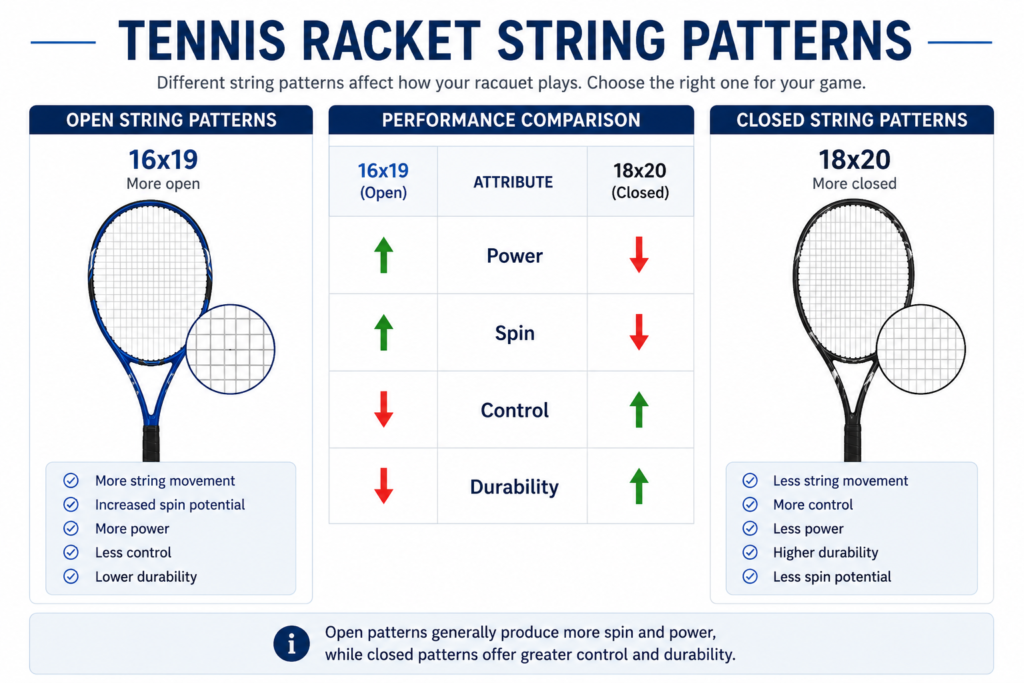
- 16×19 provides easier access to spin, slightly more power and a livelier feel.
- 18×20 offers greater control, a firmer string bed and improved durability.
Neither pattern is universally better. The right choice depends on your playing style and preferences.
What Is a String Pattern?
A string pattern describes the number of strings installed in a racquet.
The first number refers to the vertical (main) strings.
The second number refers to the horizontal (cross) strings.
For example:
- 16×19
- 16×20
- 18×20
Although other patterns exist, 16×19 and 18×20 are the two most common in modern tennis.
Open vs Closed String Patterns
String patterns are often described as either open or closed.
Open String Pattern
A 16×19 racquet has fewer strings.
This creates slightly larger gaps between the strings, allowing them to move more freely during impact.
Open patterns generally feel more lively and forgiving.
Closed String Pattern
An 18×20 racquet has more strings packed into the same head size.
The tighter spacing creates a firmer string bed that many players associate with precision and consistency.
16×19 String Pattern
The 16×19 pattern has become the most popular choice in modern tennis.
Many recreational players and professionals appreciate its balance of power, spin and forgiveness.
Advantages
- Easier access to topspin.
- Slightly more power.
- Larger effective sweet spot.
- More forgiving on off-centre shots.
- Livelier feel.
Disadvantages
- Slightly less control.
- Strings move more.
- Strings may wear out faster.
18×20 String Pattern
The 18×20 pattern has traditionally been associated with control-oriented racquets.
The denser string bed produces a firmer response that many advanced players enjoy.
Advantages
- Excellent control.
- Predictable response.
- Strings move less.
- Improved durability.
- Consistent ball trajectory.
Disadvantages
- Slightly less spin.
- Smaller effective sweet spot.
- Less free power.
- Firmer feel.
Side-by-Side Comparison
| Feature | 16×19 | 18×20 |
|---|---|---|
| Power | ⭐⭐⭐⭐☆ | ⭐⭐⭐☆☆ |
| Spin | ⭐⭐⭐⭐⭐ | ⭐⭐⭐⭐☆ |
| Control | ⭐⭐⭐⭐☆ | ⭐⭐⭐⭐⭐ |
| Comfort | ⭐⭐⭐⭐☆ | ⭐⭐⭐☆☆ |
| String Durability | ⭐⭐⭐☆☆ | ⭐⭐⭐⭐⭐ |
| Forgiveness | ⭐⭐⭐⭐☆ | ⭐⭐⭐☆☆ |
Does 16×19 Really Produce More Spin?
Generally, yes—but the difference is often smaller than many players expect.
Because the strings are spaced further apart, they can move and snap back more easily, helping create spin.
However, spin depends far more on:
- Swing path
- Racquet-head speed
- Technique
- String type
- String condition
A player with excellent technique using an 18×20 racquet will almost always generate more spin than someone with poor technique using a 16×19 racquet.
Does 18×20 Offer Better Control?
Many players think so.
The denser string bed produces a slightly lower launch angle and a more predictable response.
Players who hit aggressively often appreciate this consistency because they can swing confidently without feeling that the ball is launching unpredictably.
Which Pattern Lasts Longer?
In most cases, 18×20 string patterns are more durable.
Because the strings move less during play, they tend to notch and wear more slowly.
Players who frequently break strings may notice that an 18×20 pattern extends string life.
Which Pattern Is Better for Beginners?
For most beginners, a 16×19 string pattern is the better choice.
It offers:
- Easier power.
- Better access to spin.
- Greater forgiveness.
- A larger effective sweet spot.
These characteristics make learning the game slightly easier.
Which Pattern Do Professionals Use?
Most ATP and WTA professionals use 16×19 string patterns.
The modern game places a premium on racquet-head speed and topspin, making open string patterns popular at the highest level.
However, many elite players still use 18×20 racquets because they prefer the additional precision and control.
There is no single “professional” string pattern.
Should You Choose 16×19 or 18×20?
Ask yourself these questions.
Choose 16×19 if you want:
- Easier topspin.
- More free power.
- A livelier feel.
- Greater forgiveness.
- An all-round racquet.
Choose 18×20 if you want:
- Maximum control.
- Predictable ball flight.
- Longer string life.
- A firmer response.
- A precision-oriented racquet.
Common Myths
“18×20 racquets can’t generate spin.”
False.
Many professionals produce tremendous topspin using dense string patterns.
Technique remains far more important than string spacing.
“16×19 is only for beginners.”
False.
The majority of today’s professional players use 16×19 racquets.
“String pattern matters more than strings.”
No.
String type, tension and condition often have a greater impact on performance than string pattern alone.
“A denser pattern is always more accurate.”
Not necessarily.
Control depends on technique, timing and confidence as much as equipment.
Frequently Asked Questions
What does 16×19 mean?
It means the racquet has 16 main strings and 19 cross strings.
What does 18×20 mean?
It means the racquet has 18 main strings and 20 cross strings, creating a denser string bed.
Which string pattern produces more spin?
Generally, 16×19 offers easier access to spin because the strings move more freely.
Which string pattern lasts longer?
In most cases, 18×20 patterns provide better string durability because the strings move less during play.
Which string pattern do professionals use?
Most professionals use 16×19 patterns, although many successful players compete with 18×20 racquets.
Final Thoughts
Choosing between a 16×19 and an 18×20 string pattern isn’t about finding the “better” option—it’s about finding the one that complements your game.
A 16×19 racquet offers easier spin, more power and greater forgiveness, making it an excellent choice for many recreational players and professionals alike. An 18×20 pattern delivers a firmer, more controlled response that appeals to players who value precision and consistency.
Ultimately, string pattern is just one part of the equation. Head size, weight, balance, swingweight, stiffness, strings and string tension all work together to determine how a racquet performs. Looking at the complete package will help you choose a racquet that feels comfortable and performs consistently.
Continue Reading
- Tennis String Types Explained
- Tennis String Tension Explained
- Tennis Racquet Weight Explained
- Tennis Racquet Head Size Explained
Read more of our instructional articles here.
Read more of our player focus articles here.
Follow The Tennis Site on X: @thetennissite
Follow Todd Scoullar on X: @toddscoullar

Comments are closed, but trackbacks and pingbacks are open.