
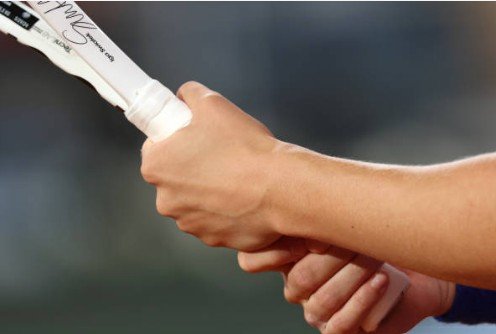
If you’ve started learning tennis, you’ve probably heard coaches or commentators mention grips such as the Continental, Eastern, Semi-Western or Western grip.
At first, these names can seem confusing. After all, they all involve holding the same racquet, so why does it matter where you place your hand?
The answer is simple: your grip determines how the racquet meets the ball. Even a small change in hand position affects the angle of the racquet face, influencing how much topspin you create, how much power you generate and how easily you can control different shots.
There isn’t one “perfect” grip in tennis. Instead, players use different grips for different situations. A grip that works brilliantly for a serve would be a poor choice for a heavy topspin forehand, while a grip that excels on high-bouncing clay courts might make low volleys much more difficult.
In this guide, you’ll learn what each major tennis grip is, how it works, its advantages and disadvantages, and when you should use it. By the end, you’ll understand why grip changes are one of the most important skills every tennis player develops.
Quick Answer
The four main tennis grips are the Continental, Eastern, Semi-Western and Western grips. Each positions your hand differently on the racquet handle, changing the angle of the racquet face and making certain shots easier to play. Most beginners start with an Eastern forehand grip for groundstrokes and learn the Continental grip for serves and volleys, while many modern professional players use a Semi-Western grip on their forehand.
Why Tennis Grips Matter
Imagine trying to use the same golf club for every shot on the course.
You could do it—but it wouldn’t be very effective.
Tennis grips work in a similar way.
Different grips allow the racquet to perform different jobs. Some grips make it easier to hit through the ball with control, while others help generate heavy topspin or allow you to react quickly at the net.
Your grip influences almost every aspect of your game, including:
- The amount of topspin or slice you can produce.
- How high or low you naturally strike the ball.
- Your ability to generate power.
- The consistency of your groundstrokes.
- How comfortable your wrist and forearm feel during play.
- How quickly you can adapt between different shots.
As your game develops, you’ll naturally change grips throughout a point. Professional players often switch grips several times in a single rally without even thinking about it.
If you’re new to tennis, don’t worry about mastering every grip immediately. Understanding why they exist is the first step.
Understanding the Racquet Handle
Before looking at the individual grips, it’s helpful to understand why a tennis racquet handle is shaped the way it is.
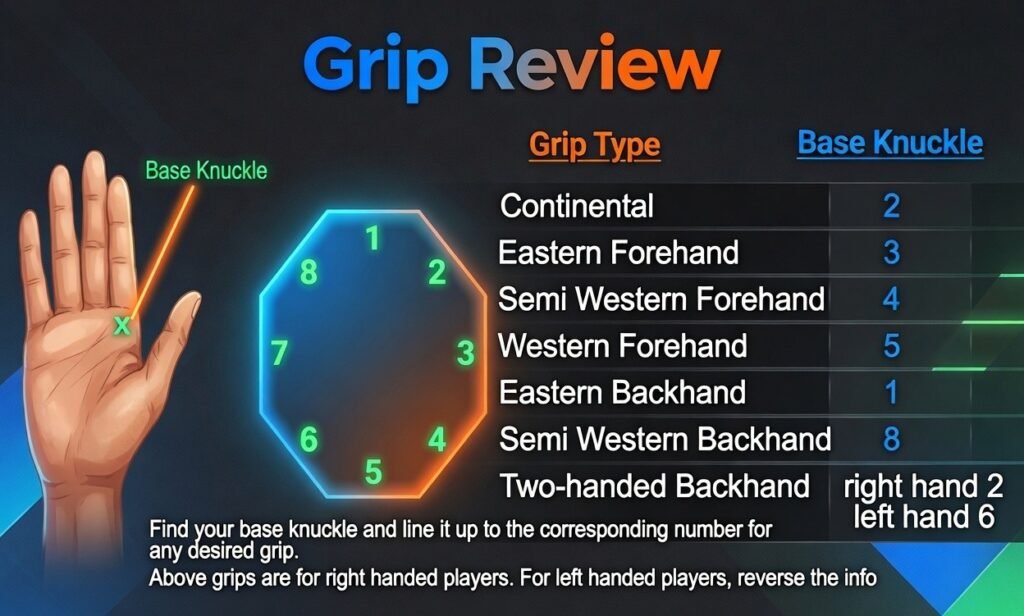
Unlike many sporting implements, a tennis racquet doesn’t have a perfectly round handle. Instead, it’s designed with eight flat sides, known as bevels.
These bevels serve two important purposes.
First, they give your hand reference points, making it easier to return to the same grip every time you pick up the racquet.
Second, they allow players to make small, consistent grip changes between shots. Moving your hand by just one bevel can noticeably alter the angle of the racquet face and the way the ball leaves the strings.
You don’t need to memorise every bevel number to become a good player, but understanding that the handle is intentionally shaped—not simply round—makes the different grips much easier to understand.
A Simple Way to Think About Tennis Grips
Many beginners assume that there are dozens of different grips to learn.
In reality, most players rely on just a handful of fundamental positions.
A useful way to think about them is as a progression.
As you rotate your hand gradually around the handle, the racquet face naturally closes, making it easier to generate more topspin but changing the types of shots that feel most comfortable.
The progression looks like this:
Continental → Eastern → Semi-Western → Western
Each grip moves your hand slightly further around the handle.
That small adjustment changes everything.
As you move through this guide, you’ll notice that every grip offers a trade-off. One may produce more spin but make low balls harder to handle. Another may feel natural for beginners but limit extreme topspin.
The best grip isn’t the one that creates the most spin or the most power—it’s the one that suits the shot you’re trying to play.
The Continental Grip
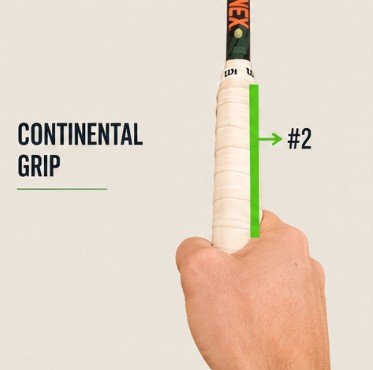
Often called the “hammer grip” or “chopper grip,” the Continental grip is one of the most versatile grips in tennis.
While it’s no longer the preferred forehand grip for most modern players, it remains essential because it’s used for many of the game’s most important shots.
Most players use a Continental grip for:
- Serves
- Volleys
- Overhead smashes
- Slice backhands
- Drop shots
- Half-volleys
One of its biggest strengths is versatility.
Because the racquet face stays relatively neutral, players can react quickly at the net without needing to make major grip adjustments. It also allows the wrist to move naturally during the serve, helping generate spin and racquet-head speed.
For these reasons, every player—from complete beginners to Grand Slam champions—needs to become comfortable using the Continental grip.
Advantages
- Extremely versatile.
- Essential for serves and volleys.
- Makes slice shots easier.
- Encourages smooth serving mechanics.
- Quick grip changes at the net.
Disadvantages
- Difficult to generate heavy topspin on forehands.
- Less suitable for modern baseline rallies.
- Can feel unusual for beginners hitting groundstrokes.
Is it good for beginners?
Absolutely, although it’s not the easiest to start with.
Every beginner should learn the Continental grip, even though it isn’t usually recommended as the primary forehand grip. It forms the foundation of serving, volleying and several other key strokes that you’ll use throughout your tennis journey.
The Eastern Forehand Grip
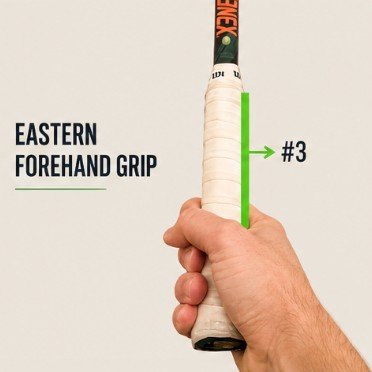
If the Continental grip is the foundation of serving and volleying, the Eastern forehand grip is often where a player’s forehand journey begins.
Many coaches describe it as the most natural forehand grip because it allows players to strike through the ball comfortably while maintaining excellent control.
Although modern professionals often use more extreme grips, the Eastern grip remains popular with beginners, recreational players and professionals who prefer to hit flatter, more penetrating groundstrokes.
For many players, it offers the ideal balance between simplicity and effectiveness.
Why use an Eastern grip?
The Eastern grip allows the racquet face to meet the ball in a relatively neutral position.
That makes timing easier and encourages players to swing through the ball rather than brushing excessively up the back of it.
As a result, players can develop consistent technique before worrying about generating heavy topspin.
Many coaches introduce this grip first because it rewards sound fundamentals rather than compensating for poor technique.
Advantages
- Natural and comfortable for beginners.
- Excellent balance of power and control.
- Easier to learn than more extreme grips.
- Works well on low and medium-bouncing balls.
- Encourages clean ball striking.
Disadvantages
- Produces less topspin than a Semi-Western or Western grip.
- Can be less effective against very high-bouncing shots.
- Offers less margin for error over the net when hitting aggressively.
Who should use it?
The Eastern grip is ideal for:
- Beginners.
- Junior players learning correct technique.
- Recreational players.
- Players who prefer flatter groundstrokes.
- Anyone developing a technically sound forehand.
Even if you eventually transition to a Semi-Western grip, learning with an Eastern grip often provides an excellent technical foundation.
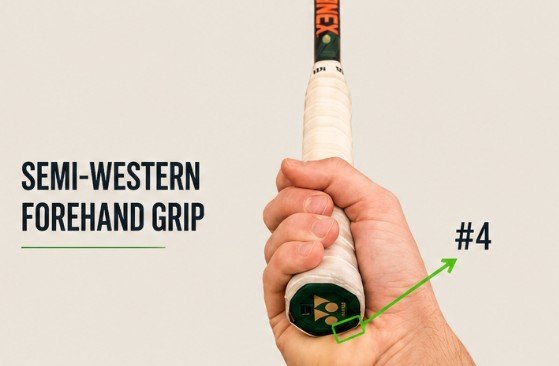
The Semi-Western Grip
If you watch today’s ATP or WTA Tour, the Semi-Western forehand grip is the grip you’ll see most often.
Over the past three decades, advances in racquet technology, polyester strings and slower court surfaces have encouraged players to generate greater topspin than ever before.
The Semi-Western grip evolved alongside these changes.
It allows players to swing aggressively while producing the heavy topspin that characterises the modern game.
Why use a Semi-Western grip?
Compared with an Eastern grip, the Semi-Western rotates the hand slightly further underneath the handle.
This naturally closes the racquet face, encouraging players to swing upward through the ball and generate significantly more topspin.
The additional spin helps bring powerful shots back down into the court, allowing players to hit with greater aggression while maintaining consistency.
It’s one of the reasons this grip has become the preferred choice of many elite players.
Advantages
- Generates excellent topspin.
- Allows aggressive baseline tennis.
- Creates greater net clearance while maintaining control.
- Well suited to modern hard courts and clay courts.
- Handles high-bouncing balls comfortably.
Disadvantages
- Less comfortable for very low balls.
- Requires good timing and footwork.
- Can feel awkward for complete beginners.
Who should use it?
The Semi-Western grip suits:
- Intermediate and advanced players.
- Baseline players.
- Players looking to develop heavier topspin.
- Competitors who regularly play on hard or clay courts.
Many players naturally progress from an Eastern grip to a Semi-Western grip as their technique develops.
The Western Grip
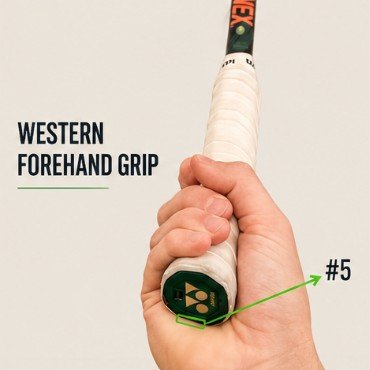
The Western grip is the most extreme of the four major forehand grips.
By rotating the hand even further underneath the handle, players can create tremendous topspin and strike aggressively at balls that bounce well above shoulder height.
However, every advantage comes with a compromise.
While the Western grip excels on high-bouncing courts, it becomes significantly more difficult to play low balls, slices and quick transition shots.
For that reason, relatively few players use a full Western grip throughout their careers.
Why use a Western grip?
The Western grip naturally closes the racquet face more than any other common forehand grip.
To square the strings to the ball, players must accelerate the racquet sharply upwards, producing exceptional topspin.
This makes it possible to hit with enormous racket-head speed while still bringing the ball safely down inside the baseline.
Advantages
- Produces maximum topspin.
- Excellent on high-bouncing clay courts.
- Encourages aggressive baseline play.
- Allows heavy passing shots and dipping groundstrokes.
Disadvantages
- Difficult on low-bouncing balls.
- Less versatile than other forehand grips.
- Makes transition shots and volleys harder.
- Demands excellent timing and athleticism.
Who should use it?
The Western grip is generally best suited to:
- Advanced players.
- Heavy topspin baseliners.
- Players who compete regularly on clay courts.
- Those with well-developed forehand technique.
For most beginners and recreational players, the Eastern or Semi-Western grip provides a more practical starting point.
The Eastern Backhand Grip
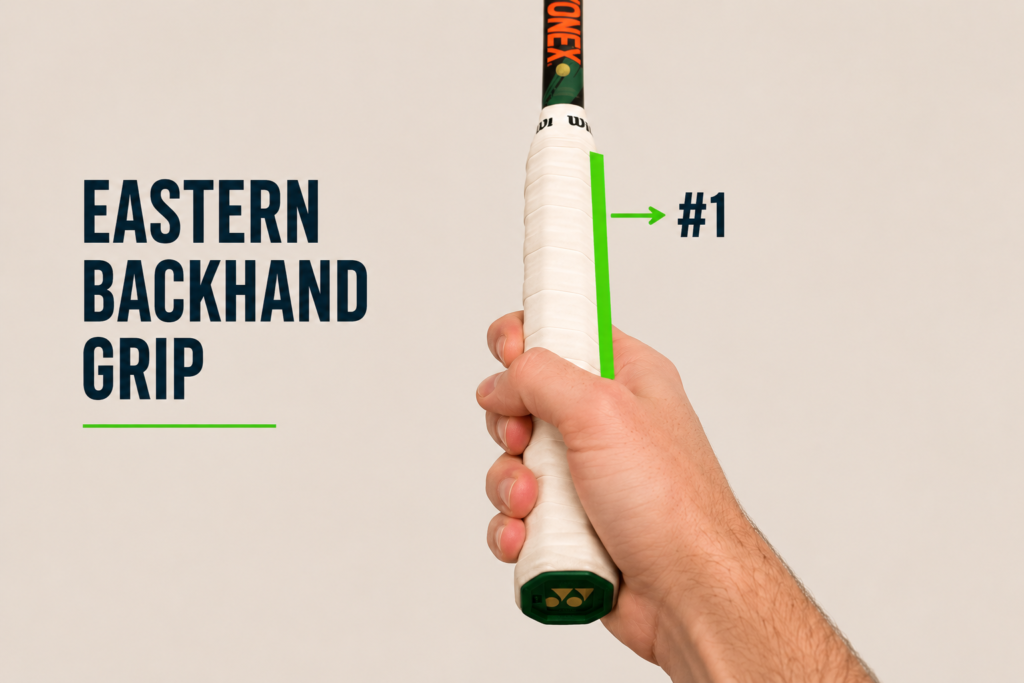
Although forehand grips receive most of the attention, the Eastern backhand grip is equally important.
For players with a one-handed backhand, it’s widely regarded as the standard grip because it allows the racquet face to remain stable through contact while making it easier to generate topspin and slice.
Unlike the forehand grips we’ve discussed, the Eastern backhand grip is specifically designed to support the mechanics of the one-handed backhand stroke.
Advantages
- Excellent for one-handed backhands.
- Generates topspin and slice effectively.
- Promotes a stable contact point.
- Comfortable for transition between drive and slice.
Disadvantages
- Requires good timing.
- Can be demanding against heavy topspin.
- Less forgiving than a two-handed backhand.
The Semi-Western Backhand Grip
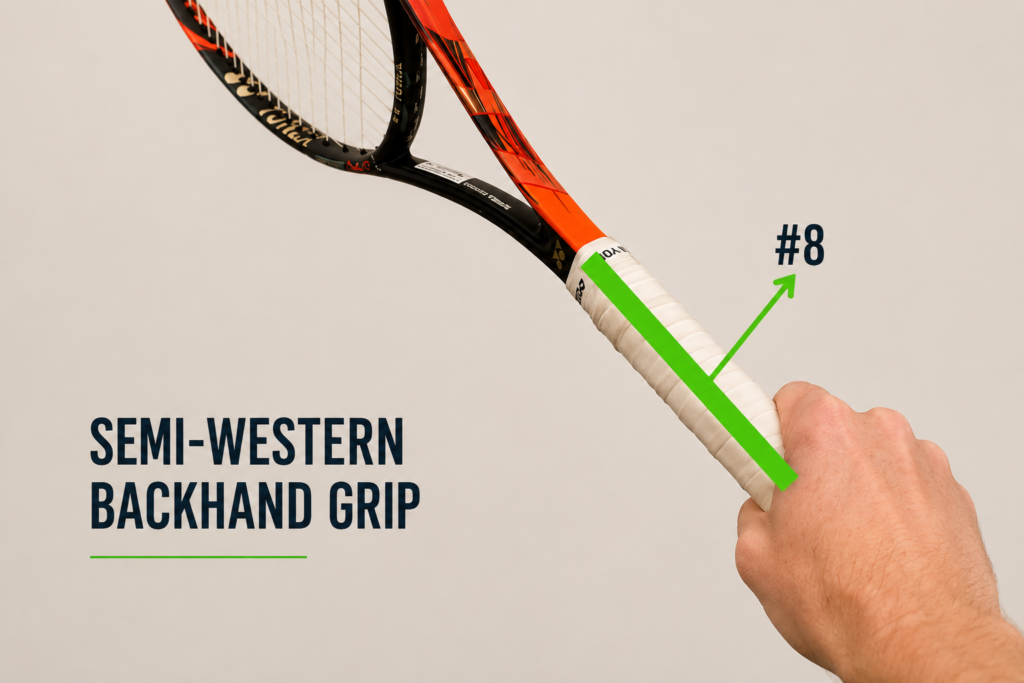
The Semi-Western Backhand Grip is a more advanced variation of the traditional one-handed backhand grip.
By rotating the hand slightly further underneath the racquet handle than an Eastern Backhand grip, players can generate greater topspin and cope more comfortably with higher-bouncing balls. However, this comes at the expense of versatility and can make lower balls more difficult to strike cleanly.
For most recreational players, the Eastern Backhand Grip remains the more practical option, but some advanced competitors choose the Semi-Western variation to suit their playing style.
Why use a Semi-Western Backhand Grip?
The Semi-Western Backhand Grip naturally closes the racquet face slightly more than the Eastern Backhand Grip.
This encourages a steeper, more upward swing path, allowing players to create heavier topspin while maintaining control over high-bouncing balls.
It is most commonly seen on clay courts, where the higher bounce gives players more time to swing through the shot.
Advantages
- Produces more topspin than the Eastern Backhand Grip.
- Handles high-bouncing balls more comfortably.
- Suits aggressive one-handed backhand players.
- Particularly effective on clay courts.
Disadvantages
- More difficult on low-bouncing balls.
- Less versatile than the Eastern Backhand Grip.
- Requires excellent timing and technique.
- Not recommended for beginners.
Who should use it?
The Semi-Western Backhand Grip is best suited to:
- Advanced one-handed backhand players.
- Players who like to attack with topspin from the backhand wing.
- Competitors who regularly play on clay courts.
- Those who are comfortable experimenting with more specialised grips.
For most players, the Eastern Backhand Grip remains the better all-round choice. The Semi-Western variation is a useful option, but it’s generally considered a specialist grip rather than a standard one.
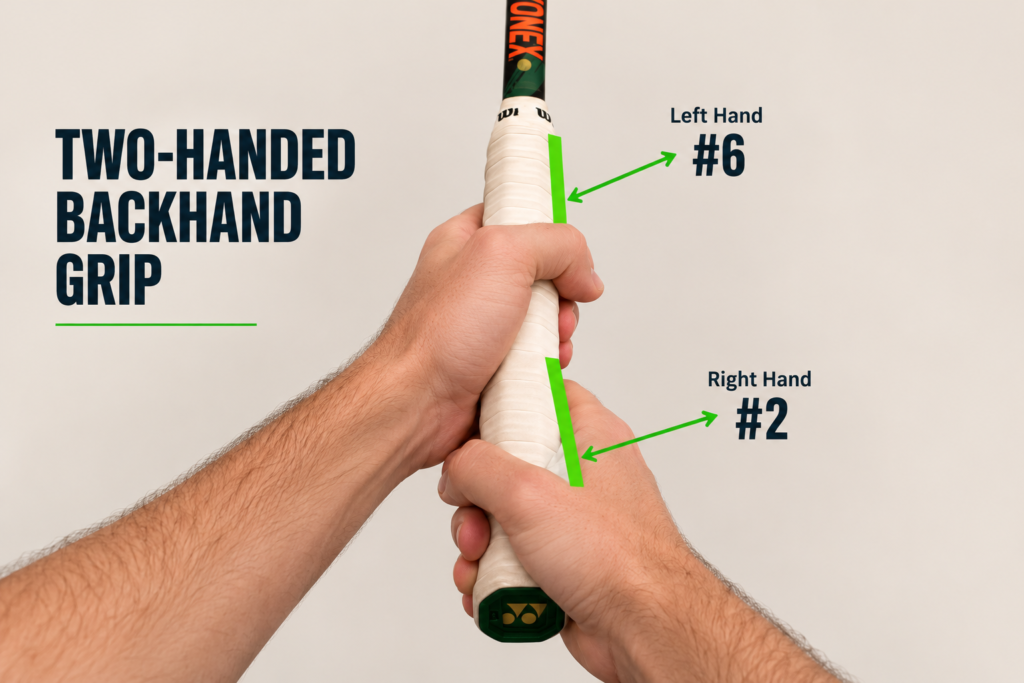
The Two-Handed Backhand Grip
Today, the majority of professional players use a two-handed backhand.
Rather than relying on a single grip, this stroke combines two different hand positions.
For a right-handed player, the dominant (right) hand usually adopts a Continental or Eastern backhand grip, while the non-dominant (left) hand is commonly positioned in an Eastern forehand grip.
Together, the two hands provide additional stability, power and control.
This combination also makes it easier to handle high-bouncing balls and return fast serves.
Advantages
- Excellent stability.
- Easier to learn than a one-handed backhand.
- Handles pace effectively.
- Strong return of serve.
- Consistent under pressure.
Disadvantages
- Reduced reach compared with a one-handed backhand.
- Requires both hands to remain on the racquet during most shots.
- Makes certain stretched defensive shots more difficult.
Which backhand grip should you choose?
There isn’t a universally correct answer.
A one-handed backhand offers greater reach, variety and aesthetic appeal, while a two-handed backhand generally provides more stability and consistency.
The right choice depends on your athleticism, coaching, personal preference and long-term playing style.
You might also find these beginner guides helpful:
- How to Play Tennis: The Essential Rules Explained
- Tennis Scoring Explained
- Tennis Terms Explained: The Ultimate Glossary
Read more of our instructional articles here.
Read more of our player focus articles here.
Follow The Tennis Site on X: @thetennissite
Follow Todd Scoullar on X: @toddscoullar

Comments are closed, but trackbacks and pingbacks are open.