
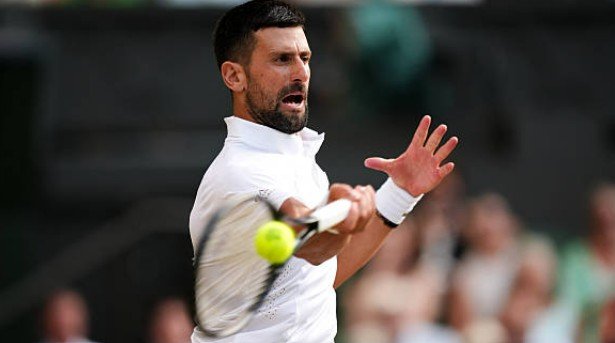
One of the first questions every new tennis player asks is:
“Which forehand grip should I use?”
It’s a great question because your grip has a huge influence on the way you hit the ball.
A small adjustment in your hand position can completely change the angle of the racquet face, affecting your topspin, power, control and even the height at which you’re most comfortable striking the ball.
If you’ve watched professional tennis, you’ve probably noticed that players don’t all hold the racquet the same way. Rafael Nadal’s forehand grip looked very different from Roger Federer’s, and both were different again from Novak Djokovic’s.
So who’s right?
The answer is that they all are.
Different grips suit different playing styles, court surfaces and skill levels. There’s no universally “best” forehand grip—only the grip that’s best for your game.
In this guide, we’ll compare the three main forehand grips used in modern tennis:
- Eastern Forehand Grip
- Semi-Western Forehand Grip
- Western Forehand Grip
We’ll explain the strengths and weaknesses of each, who they’re best suited to, and help you decide which one is right for you.
Quick Answer
For most beginners, the Eastern Forehand Grip is the easiest grip to learn because it offers an excellent balance of comfort, control and power.
As players improve, many transition to a Semi-Western Grip, which generates more topspin and has become the most common forehand grip in professional tennis.
The Western Grip produces the greatest topspin but is generally best suited to advanced players who regularly face high-bouncing balls.
Why Your Forehand Grip Matters
The forehand is the most frequently used shot in tennis.
For many players, it’s also their biggest weapon.
Whether you’re rallying from the baseline, attacking short balls or passing an opponent at the net, your forehand is likely to decide more points than any other stroke.
That’s why choosing the right grip is so important.
Your grip influences:
- how much topspin you can generate
- how much power you can produce
- your ability to control the ball
- your ideal contact point
- how comfortably you handle low and high balls
- how naturally your swing develops
Many players assume they need to copy the grip of their favourite professional.
In reality, that’s rarely the best approach.
Professional players spend years refining their technique to suit their bodies, movement and tactical style.
Beginners should focus on developing sound fundamentals before worrying about copying elite players.
The Three Main Forehand Grips
Although there are dozens of slight grip variations, almost every forehand in modern tennis falls into one of three categories.
These grips form a natural progression.
As you rotate your hand further underneath the handle, you generate more topspin—but you’ll also find some shots become more difficult.
Think of the grips like this:
Eastern → Semi-Western → Western
Each step increases the amount of topspin available while changing the type of forehand that feels most natural.
Let’s look at each one in detail.
Eastern Forehand Grip
If you’re learning tennis for the first time, the Eastern Forehand Grip is often the best place to begin.
It’s simple, natural and forgiving.
Many coaches introduce this grip first because it encourages players to strike cleanly through the ball without relying on excessive topspin.
The Eastern grip has been used by countless great players throughout tennis history and remains an excellent choice for recreational players today.
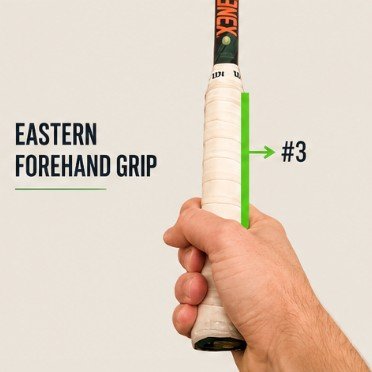
What does it feel like?
The Eastern grip feels very similar to shaking hands with the racquet.
Because the racquet face sits in a relatively neutral position, many beginners find it intuitive from their very first lesson.
It allows players to swing forward through the ball while still producing moderate topspin when needed.
Advantages
- Easy to learn.
- Natural hand position.
- Excellent balance of power and control.
- Comfortable on low and medium-height balls.
- Encourages technically sound stroke production.
Disadvantages
- Produces less topspin than more modern grips.
- Offers slightly less net clearance on aggressive shots.
- Can become less effective against very high-bouncing balls.
Best suited to
The Eastern Grip is ideal for:
- Beginners.
- Junior players.
- Recreational players.
- Players who enjoy flatter, more penetrating groundstrokes.
- Anyone building sound forehand technique.
Semi-Western Forehand Grip
If the Eastern Grip is the traditional forehand grip, the Semi-Western Grip is the modern standard.
Today, it’s the most common forehand grip on both the ATP and WTA Tours.
As racquet technology and polyester strings evolved, players discovered they could swing faster while using topspin to bring the ball safely back into the court.
The Semi-Western Grip makes that style of tennis possible.
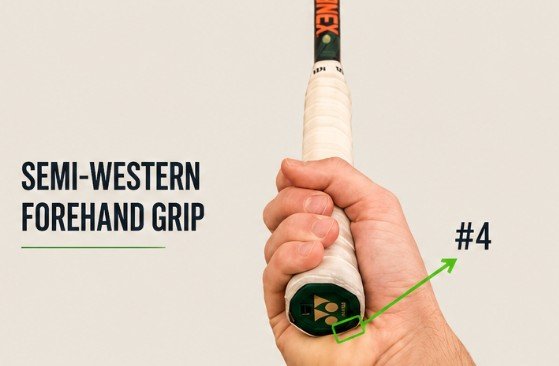
What does it feel like?
Compared with the Eastern Grip, your hand rotates slightly further underneath the racquet handle.
This closes the racquet face slightly, encouraging an upward swing path that naturally generates more topspin.
At first, it can feel unusual if you’ve only ever used an Eastern Grip.
However, most players adapt surprisingly quickly once they understand the mechanics.
Advantages
- Excellent topspin.
- Powerful baseline game.
- Greater margin over the net.
- Ideal for modern hard courts.
- Comfortable on high-bouncing balls.
Disadvantages
- Slightly harder to learn.
- Requires good timing.
- Less effective on very low balls.
- Demands better footwork than an Eastern Grip.
Best suited to
The Semi-Western Grip is ideal for:
- Intermediate players.
- Advanced competitors.
- Heavy topspin hitters.
- Aggressive baseliners.
- Players developing a modern forehand.
Western Forehand Grip
The Western Forehand Grip is the most extreme of the three major forehand grips.
By rotating your hand even further underneath the racquet handle, the strings naturally close more than they do with either an Eastern or Semi-Western Grip. This encourages an even steeper upward swing path, allowing players to generate exceptional topspin.
It’s one of the most recognisable grips in modern tennis and has been used by several world-class clay-court specialists.
However, more topspin doesn’t automatically mean a better forehand.
Like every grip, the Western Grip involves compromises.
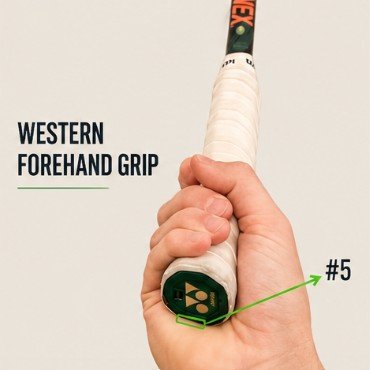
What does it feel like?
The Western Grip feels noticeably different from both the Eastern and Semi-Western Grips.
Many players describe it as though the palm sits almost underneath the handle.
At first, this can feel awkward—particularly if you’ve spent years using an Eastern Grip. It requires a different contact point and a more aggressive upward swing to produce clean, consistent shots.
For players who commit to it, though, the reward is heavy topspin that allows them to hit aggressively while still keeping the ball inside the baseline.
Advantages
- Produces maximum topspin.
- Excellent on high-bouncing balls.
- Ideal for heavy clay-court tennis.
- Creates excellent margin over the net.
- Makes it easier to attack balls above shoulder height.
Disadvantages
- Difficult on low-bouncing balls.
- Less effective on grass courts.
- Makes transition shots more challenging.
- Can feel uncomfortable for beginners.
- Requires excellent timing and footwork.
Best suited to
The Western Grip suits:
- Advanced players.
- Heavy topspin baseliners.
- Players who regularly compete on clay courts.
- Those with fast racquet-head speed and sound technique.
For the vast majority of club players, however, the Eastern or Semi-Western Grip will usually provide a better balance between versatility and performance.
Eastern vs Semi-Western vs Western
Now that we’ve looked at each grip individually, let’s compare them side by side.
| Feature | Eastern | Semi-Western | Western |
|---|---|---|---|
| Beginner friendly | ⭐⭐⭐⭐⭐ | ⭐⭐⭐ | ⭐ |
| Topspin potential | ⭐⭐⭐ | ⭐⭐⭐⭐ | ⭐⭐⭐⭐⭐ |
| Power | ⭐⭐⭐⭐ | ⭐⭐⭐⭐ | ⭐⭐⭐⭐ |
| Control | ⭐⭐⭐⭐⭐ | ⭐⭐⭐⭐ | ⭐⭐⭐ |
| High balls | ⭐⭐⭐ | ⭐⭐⭐⭐⭐ | ⭐⭐⭐⭐⭐ |
| Low balls | ⭐⭐⭐⭐⭐ | ⭐⭐⭐ | ⭐ |
| Clay courts | ⭐⭐⭐ | ⭐⭐⭐⭐⭐ | ⭐⭐⭐⭐⭐ |
| Grass courts | ⭐⭐⭐⭐⭐ | ⭐⭐⭐ | ⭐⭐ |
| Overall versatility | ⭐⭐⭐⭐⭐ | ⭐⭐⭐⭐ | ⭐⭐ |
Although tables are useful, they never tell the whole story.
Each grip has strengths because it’s designed for a different style of tennis.
The key is choosing the one that matches your current ability and the type of game you want to develop.
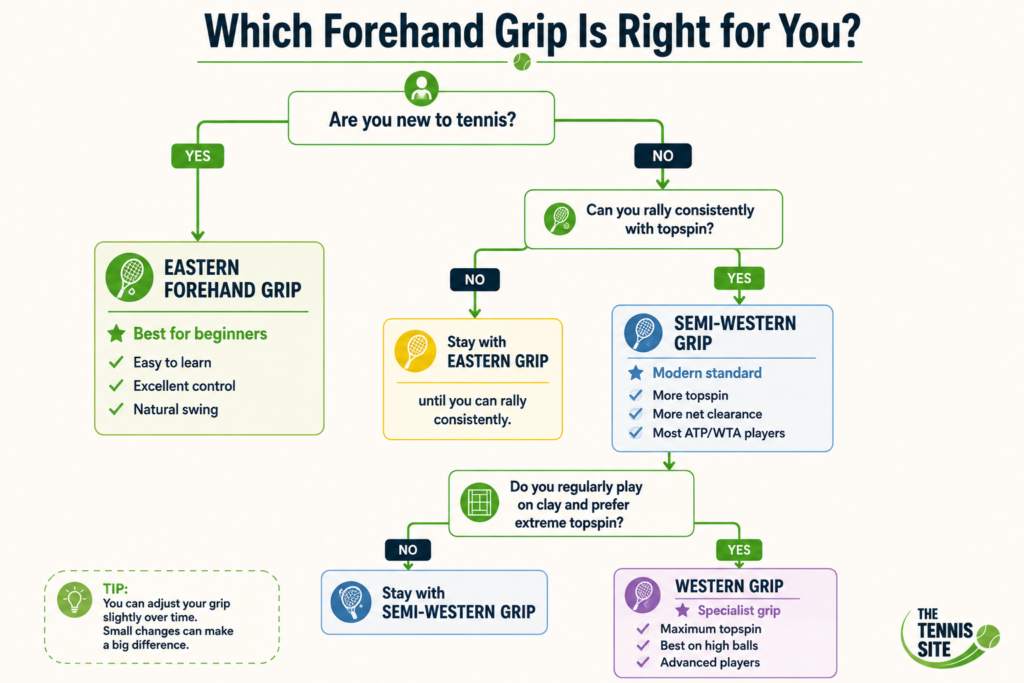
Which Grip Should Beginners Use?
For almost every beginner, the answer is simple.
Start with the Eastern Grip.
It provides the easiest learning curve while encouraging excellent fundamentals.
With an Eastern Grip, you’ll develop:
- cleaner ball striking
- better timing
- improved control
- a more natural swing path
Once you’ve become comfortable rallying consistently, you can always experiment with a Semi-Western Grip if you decide you’d like to generate more topspin.
Trying to copy an advanced professional too early often makes the game more difficult than it needs to be.
Remember, learning solid technique is far more important than choosing the most fashionable grip.
Which Grip Do Professional Players Use?
There isn’t one grip that every professional uses.
However, the Semi-Western Grip is by far the most common forehand grip in today’s professional game.
It offers an outstanding balance between:
- power
- topspin
- consistency
- versatility
Some players favour a slightly more Eastern position to flatten out their forehand, while others move closer to a Western Grip to maximise topspin.
Rather than fitting neatly into one category, many elite players actually use grips that sit somewhere between the recognised positions.
That’s an important reminder that grip names are guides rather than rigid rules.
Should You Change Your Grip?
Absolutely—but only when you’re ready.
If you’ve played with the same grip for years, changing it overnight can temporarily make your forehand feel worse before it improves.
That’s completely normal.
If you decide to change grips:
- Make one adjustment at a time.
- Practise without worrying about power.
- Expect an adaptation period.
- Focus on clean contact before adding spin.
Many players discover that even a small adjustment—rather than a complete grip change—is enough to improve their forehand significantly.
Common Mistakes
Choosing a grip because a professional uses it
Roger Federer, Rafael Nadal and Novak Djokovic all had outstanding forehands.
They also had different grips.
Rather than copying a favourite player, choose the grip that suits your own game.
Believing more topspin is always better
Topspin is valuable—but only if you can control it.
A player with an Eastern Grip and excellent technique will usually hit a better forehand than someone using a Western Grip without understanding how it works.
Constantly changing grips
Some players switch grips every few weeks after watching coaching videos online.
Improvement comes from practising one grip consistently rather than constantly searching for a “perfect” solution.
Frequently Asked Questions
What is the best forehand grip in tennis?
There isn’t a single best forehand grip.
For beginners, the Eastern Grip is usually the easiest to learn.
For many intermediate and advanced players, the Semi-Western Grip offers the best balance of topspin, power and control.
Do most professional players use a Semi-Western Grip?
Yes.
While there are exceptions, the Semi-Western Grip has become the most common forehand grip on both the ATP and WTA Tours because it suits the demands of the modern game.
Is the Western Grip only for clay courts?
No.
The Western Grip can be used on any surface.
However, it tends to be most effective on clay and slower hard courts where the ball bounces higher.
Can I change my forehand grip?
Absolutely.
Many players evolve their grip as their technique improves.
It’s common for players to begin with an Eastern Grip before gradually moving towards a Semi-Western Grip as they become more comfortable generating topspin.
Final Thought
Choosing the right forehand grip isn’t about copying your favourite professional or finding a single “perfect” technique.
It’s about selecting a grip that matches your current ability, complements your playing style and gives you the confidence to swing freely.
For most players, that journey begins with the Eastern Grip, progresses naturally towards the Semi-Western Grip, and may eventually involve experimenting with more specialised options.
The grip itself won’t make you a great player—but the right grip will make it much easier to develop a great forehand.
Where to Go Next
Now that you’ve chosen the forehand grip that’s right for you, it’s time to learn how to use it.
Coming soon:
- How to Hit a Tennis Forehand: Step-by-Step Guide
- Topspin Explained
- How to Generate More Power on Your Forehand
- Ready Position Explained
- Tennis Footwork Basics
Read more of our instructional articles here.
Read more of our player focus articles here.
Follow The Tennis Site on X: @thetennissite
Follow Todd Scoullar on X: @toddscoullar

Comments are closed, but trackbacks and pingbacks are open.