
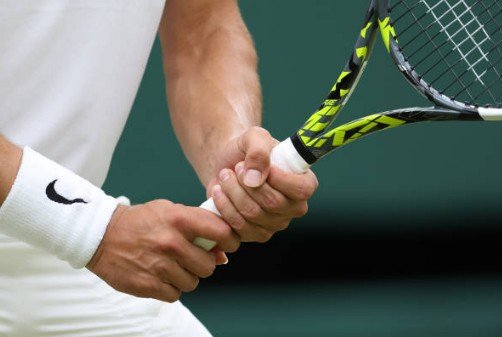
Every tennis player, from a complete beginner to a Grand Slam champion, starts with the same fundamental skill: learning how to hold the racquet correctly.
It might seem like a small detail, but your grip influences every shot you hit. The way you hold the racquet affects your control, power, spin and comfort, making it one of the most important fundamentals in tennis.
The good news is that you don’t need to memorise complicated grip names or understand every technical detail on your first day. Before you learn about Eastern, Continental or Semi-Western grips, you simply need to know how to hold the racquet naturally and confidently.
This guide explains exactly how to hold a tennis racquet, why your grip matters, and how it forms the foundation for every forehand, backhand, serve and volley you’ll learn in the future.
Quick answer
The easiest way to hold a tennis racquet is to imagine you’re shaking hands with it. Wrap your dominant hand comfortably around the handle so your wrist feels relaxed and the racquet sits securely in your hand without needing to be squeezed tightly. As your game develops, you’ll learn different grips for different shots, but every player begins with this simple, balanced starting position.
Why your grip matters
Every shot in tennis begins before the ball is even struck.
The moment you pick up the racquet, you’ve already influenced how easily you’ll be able to control the ball.
A good grip allows you to:
- control the direction of your shots
- generate power efficiently rather than relying on strength alone
- produce topspin and slice more easily
- react quickly during fast rallies
- reduce unnecessary strain on your wrist, forearm and elbow
Many beginners think they need a bigger swing to hit the ball harder. In reality, a comfortable, technically sound grip often improves a player’s consistency far more than swinging faster ever will.
Step 1: Pick up the racquet naturally
If you’ve never played tennis before, forget about grip names for a moment.
Instead, imagine the racquet is another person’s hand.
Reach out and “shake hands” with it.
Your hand should wrap comfortably around the handle without twisting your wrist into an awkward position. The racquet should feel balanced in your hand, not forced into a position that feels uncomfortable or unnatural.
This handshake position isn’t a specific tennis grip. Rather, it’s an easy way to develop a relaxed, athletic hold that many players naturally adopt before refining their technique.
If holding the racquet feels awkward from the very beginning, it’s worth resetting your hand and trying again. Starting with a comfortable grip makes learning every future stroke much easier.
Step 2: Hold the racquet firmly—but stay relaxed
One of the most common mistakes beginners make is gripping the racquet far too tightly.
It’s understandable. When you’re learning a new sport, your instinct is often to squeeze harder because it feels more secure.
In reality, excessive tension works against you.
A tight grip reduces the natural movement of your wrist and forearm, making it harder to generate racquet-head speed and control the ball. It can also lead to fatigue more quickly during longer hitting sessions.
Instead, think about holding the racquet firmly enough that it won’t slip from your hand, but lightly enough that your arm remains relaxed.
A useful guide is to imagine your grip pressure on a scale from 1 to 10.
- 1 would barely hold the racquet.
- 10 would mean squeezing as hard as possible.
For most groundstrokes, aim for around 4 or 5.
Your grip will naturally tighten slightly at the moment you strike the ball before relaxing again as you prepare for the next shot. Experienced players do this instinctively, but it’s a helpful habit to develop from the beginning.
Step 3: Let your hand sit naturally
Once you’ve wrapped your hand around the handle, avoid trying to force your fingers into an exact position.
Your fingers should rest comfortably around the grip without being pressed tightly together or stretched unnaturally apart.
The exact spacing of your fingers will vary slightly depending on the grip you’re using and even from player to player. That’s perfectly normal.
What’s more important is that the racquet feels secure while still allowing your hand and wrist to move freely.
If you find yourself constantly readjusting your grip during a rally because the racquet feels unstable, you’re probably either gripping too loosely or using the wrong grip size.
Comfort and control should always come before trying to copy the hand position of a professional player.
Step 4: Understand why the handle has eight sides
One feature that surprises many new players is that a tennis racquet handle isn’t perfectly round.
Instead, it’s shaped with eight flat sides, known as bevels.
This design isn’t accidental.
The bevels make it easier to place your hand in the same position every time you pick up the racquet. They also allow players to make small adjustments between different shots without having to guess where their hand should go.
As your technique develops, coaches often refer to these bevels when teaching different grips. For now, though, you don’t need to memorise them. Simply understand that the shape of the handle is designed to help you hold the racquet consistently.
In our next guide, Tennis Grips Explained, we’ll explore the bevels in detail and show how they influence every major stroke in the game.
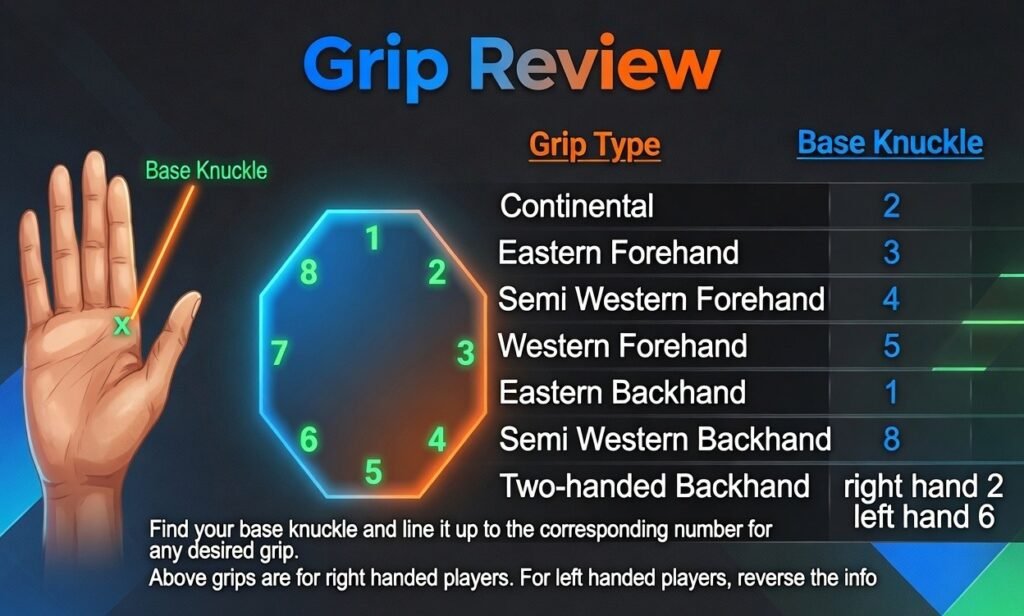
Step 5: Learn the four main tennis grips
Although there are several recognised tennis grips, almost every player relies on four fundamental positions.
At this stage, you don’t need to master them. It’s simply helpful to understand what they are and when they’re used.
Continental Grip
Often called the most versatile grip in tennis, the Continental grip is primarily used for serves, volleys, overhead smashes and many slice shots.
Because it keeps the racquet face relatively neutral, it allows players to react quickly and comfortably at the net while also generating different types of spin on the serve.
Every beginner should become familiar with the Continental grip because it forms the foundation of several essential shots.
Eastern Forehand Grip
The Eastern forehand grip is one of the easiest grips for beginners to learn.
It provides an excellent balance of control, comfort and power, making it ideal for players developing their first consistent forehand.
Many coaches recommend the Eastern grip because it encourages solid technique without requiring extreme wrist positions.
Semi-Western Grip
The Semi-Western grip is the most common forehand grip in modern professional tennis.
By placing the hand slightly further underneath the handle than an Eastern grip, players can generate greater topspin while still producing excellent power. This makes it particularly effective on today’s higher-bouncing hard and clay courts.
Although it can feel unusual when you first try it, the Semi-Western grip has become the preferred forehand grip for many coaches and advanced players because it offers an excellent balance between spin, control and power.
Western Grip
The Western grip places the hand even further underneath the handle.
Its biggest advantage is the amount of topspin it can generate, especially on high-bouncing balls. However, it also makes low balls and volleys more difficult to handle.
While some professional players use a Western grip very successfully, it is generally not recommended as a starting point for beginners. Most players develop a stronger foundation with an Eastern or Semi-Western grip before deciding whether the Western grip suits their game.
Do you use the same grip for every shot?
No.
One of the biggest surprises for new players is that there isn’t a single “correct” grip for every situation.
As your skills improve, you’ll naturally change grips depending on the shot you’re about to play.
For example:
| Shot | Most Common Grip |
|---|---|
| Forehand | Eastern or Semi-Western |
| One-handed backhand | Eastern Backhand |
| Two-handed backhand | Combination of Eastern Backhand (dominant hand) and Eastern Forehand (non-dominant hand) |
| Serve | Continental |
| Volley | Continental |
| Overhead smash | Continental |
| Slice backhand | Continental |
Don’t worry if this seems like a lot to remember.
Every experienced player changes grips almost automatically, often several times during a single rally. With practice, these adjustments become second nature.
Choosing the correct grip size
Holding the racquet correctly isn’t only about where you place your hand. The size of the handle also plays an important role.
If the grip is too small, many players instinctively squeeze the handle more tightly, which can reduce control and place additional strain on the wrist and forearm.
If the grip is too large, changing grips quickly becomes more difficult and the racquet may feel cumbersome during fast exchanges.
A simple way to check your grip size is to hold the racquet normally. There should be approximately enough space to fit the index finger of your opposite hand between your fingertips and the base of your thumb.
Don’t worry if your grip size isn’t absolutely perfect. Overgrips can slightly increase the thickness of a handle, and most recreational players can comfortably use a grip that’s one size either side of their ideal fit.
If you’re buying your first racquet, comfort is far more important than chasing an exact measurement.
Common mistakes beginners make
Learning to hold a tennis racquet is straightforward, but there are a few mistakes that almost every beginner makes at some stage.
Recognising them early can save you from developing habits that are difficult to correct later.
Gripping the racquet too tightly
This is by far the most common mistake.
A tight grip creates tension throughout the arm, reducing both power and control. It can also make your strokes feel rushed and increase fatigue during longer practice sessions.
Whenever you notice your forearm becoming tense, remind yourself to relax your hand between shots.
Using one grip for every shot
Many beginners assume that once they’ve found a comfortable grip, they should use it for every stroke.
In reality, different shots are played far more effectively with different grips.
You don’t need to master every grip immediately, but becoming comfortable with changing grips is an important part of improving your game.
Trying to copy professional players
Watching the world’s best players is a fantastic way to learn, but remember that their grips have developed through years of coaching and thousands of hours of practice.
Rather than trying to imitate your favourite professional exactly, focus on building sound fundamentals first.
As your technique improves, your grip will naturally evolve to suit your style of play.
Ignoring comfort
Your grip should never feel forced.
If your wrist feels strained or your hand becomes uncomfortable after only a short period of hitting, it’s worth checking both your hand position and your grip size.
A comfortable grip encourages relaxed, repeatable strokes—exactly what every beginner should be aiming for.
Frequently asked questions
What is the best tennis grip for beginners?
For most beginners, the Eastern forehand grip is an excellent place to start for groundstrokes because it provides a natural balance of control and power.
At the same time, it’s worth becoming familiar with the Continental grip, which is used for serves, volleys and overhead smashes.
Should I hold the racquet differently for my backhand?
Usually, yes.
Most players use a different grip for their backhand than for their forehand. Players with a two-handed backhand also position each hand slightly differently on the handle.
You’ll learn these grip changes gradually as you develop each stroke.
Can I change my grip during a rally?
Absolutely.
In fact, experienced players change grips constantly throughout a point.
These adjustments happen naturally as they prepare for different shots and eventually become automatic through repetition.
Do professional players all use the same grip?
No.
Although many modern professionals use a Semi-Western forehand grip, grip choice varies between players and often changes depending on the shot they are hitting.
There is no single grip that is considered “correct” for every player.
Final thought
Learning how to hold a tennis racquet isn’t about finding the perfect grip on your first day.
It’s about developing a comfortable, balanced hold that allows you to swing freely, stay relaxed and build good habits from the very beginning.
As your technique improves, your grip will naturally evolve alongside it. Every forehand, backhand, serve and volley you’ll learn in the future begins with the way your hand meets the handle.
Master this simple foundation now, and every new skill becomes easier to learn.
Where to go next
Now that you know how to hold a tennis racquet, the next step is understanding why different grips are used for different shots.
Coming soon:
- Tennis Grips Explained: Eastern, Semi-Western, Western & Continental
- How to Hit a Forehand
- How to Hit a Tennis Backhand
- Tennis Serve Basics
You’ll also find these beginner guides helpful:
- How to Play Tennis: The Essential Rules Explained
- Tennis Scoring Explained
- Tennis Terms Explained: The Ultimate Glossary
Read more of our instructional articles here.
Read more of our player focus articles here.
Follow The Tennis Site on X: @thetennissite
Follow Todd Scoullar on X: @toddscoullar

Comments are closed, but trackbacks and pingbacks are open.