
Quick Answer
Not all tennis balls are the same.
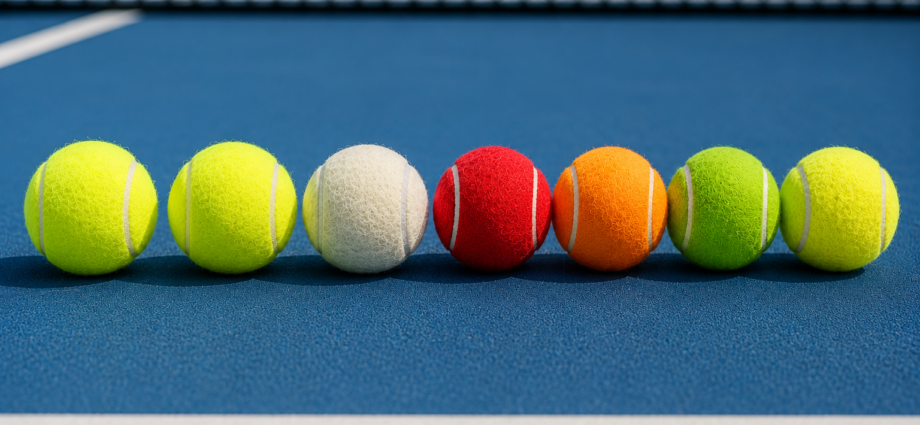
The main types include:
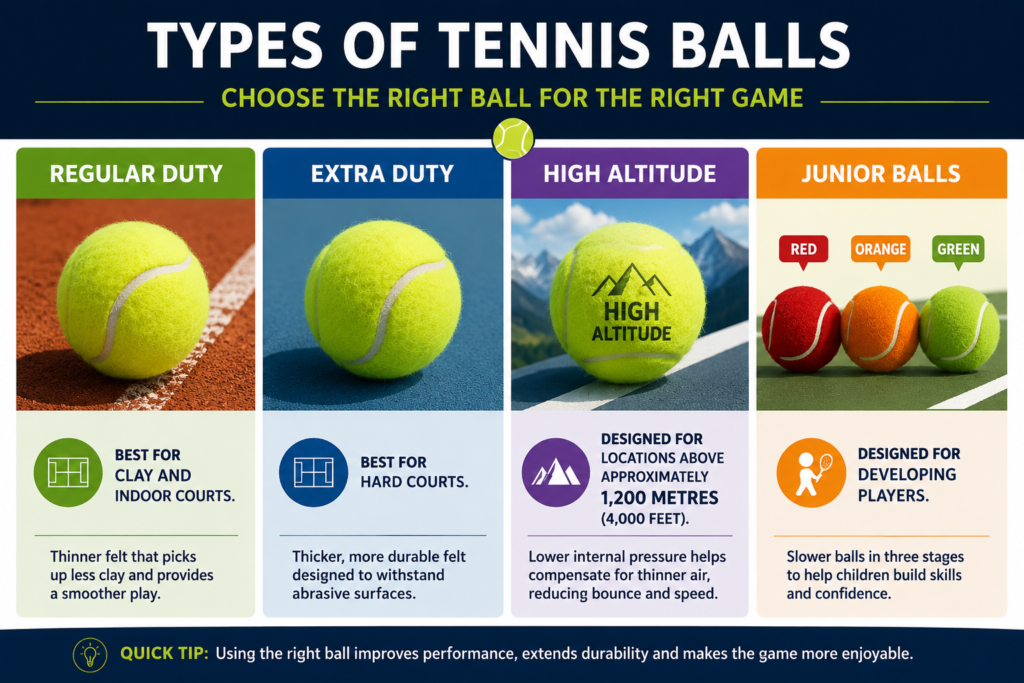
- Regular Duty – Best for clay and indoor courts.
- Extra Duty – Best for hard courts.
- High Altitude – Designed for locations above approximately 1,200 metres (4,000 feet).
- Junior Balls – Red, orange and green balls designed for developing players.
Choosing the right ball helps improve consistency, durability and overall performance.
Why Are There Different Types of Tennis Balls?
Different courts and different players place different demands on a tennis ball.
For example:
- Hard courts wear felt much faster than clay courts.
- Young children need slower balls that are easier to control.
- High-altitude conditions cause balls to bounce higher.
Manufacturers therefore produce several types of balls to suit these conditions.
If you’re unfamiliar with tennis ball construction, start with Tennis Balls Explained.
Regular Duty Tennis Balls
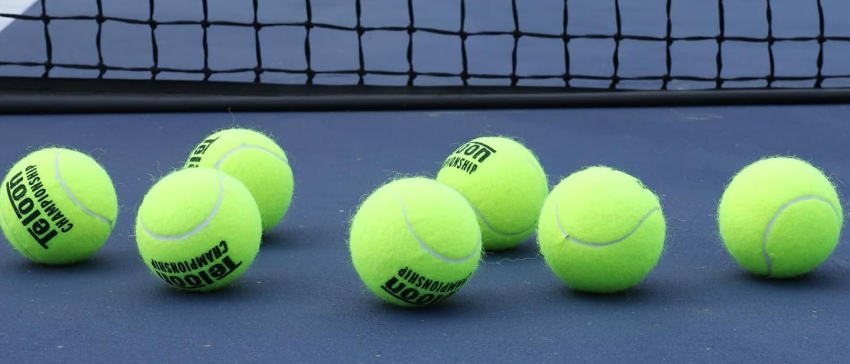
Regular duty balls are designed primarily for:
- Clay courts
- Indoor courts
- Artificial grass courts
They use a slightly thinner felt that collects less clay and provides a smoother playing experience on softer surfaces.
Best for
✔ Clay courts
✔ Indoor courts
✔ Artificial grass
Not ideal for
✘ Outdoor hard courts
Because the felt is thinner, regular duty balls wear out more quickly on abrasive hard courts.
Extra Duty Tennis Balls
Extra duty balls are the most common choice for recreational players.
They feature a thicker, more durable felt designed to withstand abrasive hard court surfaces.
Most players who play on public tennis courts should buy extra duty balls.
Best for
✔ Hard courts
✔ Outdoor play
✔ Club competition
Advantages
- Longer-lasting felt
- Better durability
- Excellent all-round performance
High Altitude Tennis Balls
At higher elevations, air resistance decreases.
As a result, ordinary tennis balls travel faster and bounce higher.
High altitude balls are designed with slightly lower internal pressure to compensate.
They are generally recommended for locations above 1,200 metres (4,000 feet).
Unless you regularly play in mountainous regions, you probably won’t need them.
Junior Tennis Balls
Junior balls are specifically designed to help children develop proper technique.
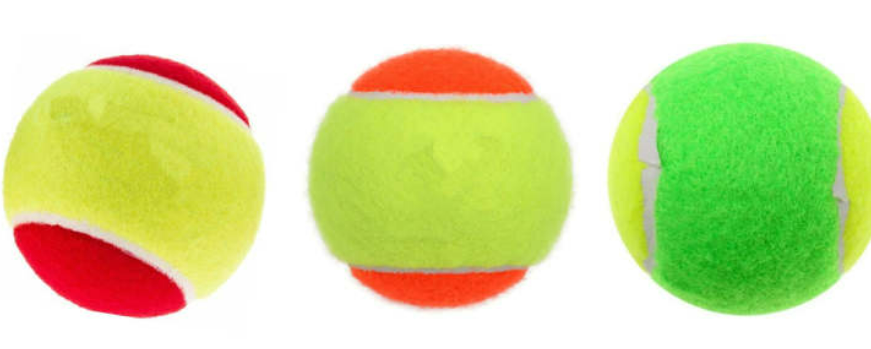
Instead of using full-speed yellow balls immediately, young players progress through three stages.
Red Balls
- Largest size
- Approximately 75% slower
- Recommended for beginners aged 5–8
Orange Balls
- Around 50% slower
- Suitable for ages 8–10
Green Balls
- Around 25% slower
- Bridge the gap to standard yellow balls
- Suitable for ages 9–12
These stages are part of the ITF’s Tennis10s development pathway.
Pressurized vs Pressureless
Another important distinction is whether a ball is:
- Pressurized
- Pressureless
This isn’t a separate category of court ball but rather a difference in construction.
Pressureless balls are commonly used for:
- Coaching
- Ball machines
- Practice
You can read more in Pressurized vs Pressureless Tennis Balls
Which Tennis Ball Should You Buy?
Recreational Players
Extra duty balls are usually the best choice because most recreational tennis is played on hard courts.
Clay Court Players
Regular duty balls generally perform better because their thinner felt doesn’t collect as much clay.
Junior Players
Children should always use the appropriate red, orange or green stage ball for their age and ability.
These slower balls make learning much easier and encourage proper technique.
Coaches
Many coaches use pressureless balls for feeding drills because they maintain consistent bounce for much longer.
Common Myths
“All yellow tennis balls are the same.”
False.
Even though they look similar, different tennis balls are designed for different surfaces and playing conditions.
“Extra duty balls bounce higher.”
No.
The main difference is the durability of the felt rather than the bounce.
“Junior balls are simply smaller.”
No.
Junior balls are generally the same size as standard balls (with the exception of some red balls) but have lower compression, making them slower and easier to hit.
Frequently Asked Questions
What type of tennis ball is best for hard courts?
Extra duty tennis balls are generally the best choice because they have thicker felt that resists wear.
What type of tennis ball is best for clay courts?
Regular duty balls perform well on clay because their thinner felt picks up less clay.
What are green dot tennis balls?
Green balls are low-compression balls that bounce approximately 25% lower than standard yellow balls, helping junior players transition to the full game.
Can adults use junior tennis balls?
Yes.
Green balls are often used by beginners, coaches and players working on technique.
Do professionals use extra duty or regular duty balls?
It depends on the tournament surface.
Hard court tournaments typically use extra duty balls, while clay court tournaments generally use regular duty balls supplied by the tournament’s official ball partner.
Final Thoughts
Choosing the right tennis ball isn’t just about buying the most popular brand. The type of court, your experience level and even your location can all influence which ball performs best.
For most recreational players, extra duty balls are the safest choice because they handle hard courts well and last longer. Players on clay courts may prefer regular duty balls, while junior players should always use the appropriate stage ball to support their development.
Selecting the right ball will make every practice session and match more enjoyable—and help you get the most from your game.
Continue Reading
- Tennis Balls Explained
- Pressurized vs Pressureless Tennis Balls
- When Should You Replace Tennis Balls?
- Why Are Tennis Balls Yellow?
- Tennis Balls: The Complete Guide
Read more of our instructional articles here.
Read more of our news articles here.
Follow The Tennis Site on X: @thetennissite
Follow Todd Scoullar on X: @toddscoullar

Comments are closed, but trackbacks and pingbacks are open.