
Quick answer
For beginners, tennis can seem hard to understand. But it’s really not.
Tennis is played by hitting the ball over a net and into the opponent’s court. A point begins with a serve and continues until one player fails to make a legal return, with points building games, games building sets, and sets deciding the match.
The scoring system is unique, there are lines all over the court, and players seem to follow an unwritten routine between every point. But beneath those traditions is a surprisingly simple game.
This guide explains the essential rules every beginner should know.
The objective of tennis
The aim of tennis is straightforward.
Your goal is to hit the ball into your opponent’s side of the court in a way that prevents them from making a legal return.
You can win a point if your opponent:
- hits the ball into the net
- hits the ball outside the court
- allows the ball to bounce twice
- commits a double fault on their serve
Although professional players may strike the ball harder, have incredible speed, fitness, and skill, the basic objective never changes.
Understanding the tennis court
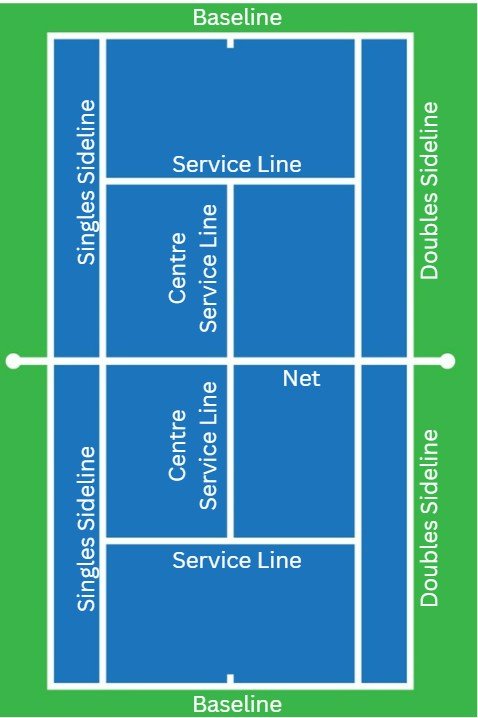
A tennis court is divided by a net and marked with different lines for singles and doubles play.
The most important areas are:
Baseline
The line at the back of the court where most rallies begin.
Service boxes
The two rectangles nearest the net. Every serve must land in the correct service box.
Service Line
The line half-way up the court where the players serves must land before.
Centre service line
Divides the service boxes into left and right sides.
Singles sidelines
The outer boundaries used during singles matches.
Doubles sidelines
A doubles court is wider than a singles court. The extra space between the singles and doubles sidelines is only used in doubles.
The net
The net divides the court into two equal halves. Every shot must travel over it to remain in play.
How a point begins
Every point starts with a serve.
The server stands behind the baseline and hits the ball diagonally into the opponent’s service box.
A player alternates serving to each side after each point.
Players alternate serving games throughout the match.
Each server receives two attempts to make a legal serve.
If the first serve misses, they are given a second serve.
If both serves miss, it is called a double fault, and the receiver wins the point immediately.
What makes a legal serve?
For a serve to be legal:
- the server must stand behind the baseline until after they have struck the ball
- the serve must land in the correct diagonal service box
- the ball must clear the net
If a serve touches the net but still lands inside the correct service box, it is called a let, and the serve is simply replayed.
The server is not penalised.
How a rally works
Once the serve lands legally, the rally begins.
Players take turns returning the ball across the net.
The ball may bounce once before it is returned, or it can be hit before it bounces at all (known as a volley).
The rally continues until one player wins the point.
When is the ball in?
One of the simplest but most misunderstood rules in tennis concerns the lines.
A ball is in if any part of it touches any part of the line.
The line itself is considered part of the court.
Even if only a tiny portion of the ball clips the line, the shot is still good.
Embed from Getty ImagesWhen is the ball out?
A ball is out if it lands completely outside the relevant boundary line. If no part of the ball touches the line, the shot is out.
Professional tournaments use electronic line-calling technology, while recreational matches rely on players making their own calls honestly.
How do you win a point?
A point can end in several ways.
You win the point if your opponent:
- hits the ball into the net
- hits the ball outside the court
- allows the ball to bounce twice
- double faults
- touches the net with their racket or body before the point is over
Every point, no matter how spectacular or ordinary, counts exactly the same on the scoreboard.
Can the ball hit the net?
Yes.
During a rally, the ball may touch the net and still remain in play provided it lands inside the court.
Many lucky winners have trickled over the net after barely clipping the tape.
The only exception involves the serve.
If a serve touches the net and lands inside the correct service box, it is replayed as a let.
If it lands outside the service box, it is simply a fault.
Embed from Getty ImagesCan you touch the net?
No.
A player loses the point if they touch the net with:
- their body
- their racquet
- their clothing
This rule applies while the point is still in progress.
Once the point has finished, touching the net is no problem.
Can you reach over the net?
Generally, no.
A player may not strike the ball before it has crossed onto their side of the net. However, if a ball spins back over the net after bouncing, a player may legally reach across and hit it, provided they do not touch the net.
There are rare exceptions when a ball spins back over the net without being touched, but these situations are extremely uncommon.
What happens if the ball hits a player?
If a live ball touches a player or anything they are wearing before bouncing twice, that player loses the point.
It does not matter whether the contact was intentional.
Singles vs doubles
The rules are almost identical.
The biggest differences are:
- doubles uses a wider court
- each team has two players
- many doubles competitions use a match tiebreak instead of a full deciding set
Apart from those differences, the game is played in exactly the same way – although tactically very different
Common beginner questions
Can the ball bounce twice?
No. A player must return the ball before the second bounce.
Do I have to let the ball bounce?
No. You can volley the ball before it bounces, provided you remain on your side of the net.
Does the ball have to land completely inside the line?
No. If any part of the ball touches the line, it is in.
What is a let?
A let is most commonly called when a serve touches the net but still lands correctly in the service box. The serve is replayed without penalty.
Can I step on the baseline when serving?
No. The server must not touch or cross the baseline before striking the ball. Doing so is called a foot fault.
Final thought
This has obviously been a basic overview, and there are a number of other more obscure rules in the sport. However, by following this guide, you will be totally fine for 99% of situations on the court.
One of the reasons tennis remains so popular is that the basic rules are surprisingly simple: start the point with a serve, keep the ball inside the lines, and win the rally.
Everything else—the scoring, the tactics, the momentum swings, and the drama of professional matches—is built on those few foundations. Once you understand them, tennis becomes much easier to follow and far more enjoyable to watch.
Where to go next
Now that you understand the basic rules of play, you might also enjoy:
- Tennis Scoring Explained
- Tennis Sets Explained
- Tennis Tiebreak Rules Explained
- Why is tennis scored 15,30,40?
Read more of our instructional articles here.
Read more of our player focus articles here.
Follow The Tennis Site on X: @thetennissite
Follow Todd Scoullar on X: @toddscoullar

Comments are closed, but trackbacks and pingbacks are open.