
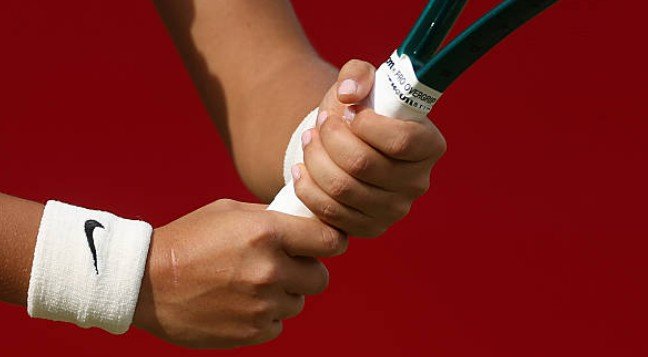
Choosing the right backhand grip is just as important as choosing the right forehand grip.
Whether you play with one hand or two, your grip influences the amount of topspin you can create, how easily you handle high balls, and how comfortable the stroke feels.
Unlike the forehand, where players commonly choose between Eastern, Semi-Western and Western grips, backhand grips are far more standardised. Most players use one of three grips depending on their backhand style.
In this guide, we’ll explain the three main backhand grips, how they’re held and who they’re best suited to.
Quick Answer
Most players use one of these three backhand grips:
- Eastern Backhand Grip – the standard grip for one-handed backhands.
- Semi-Western Backhand Grip – a more extreme one-handed grip that helps generate additional topspin.
- Two-Handed Backhand Grip – combines an Eastern Backhand Grip with a Continental Grip to provide maximum stability and control.
For most beginners learning a two-handed backhand, the standard two-handed grip is the best place to start.
Eastern Backhand Grip
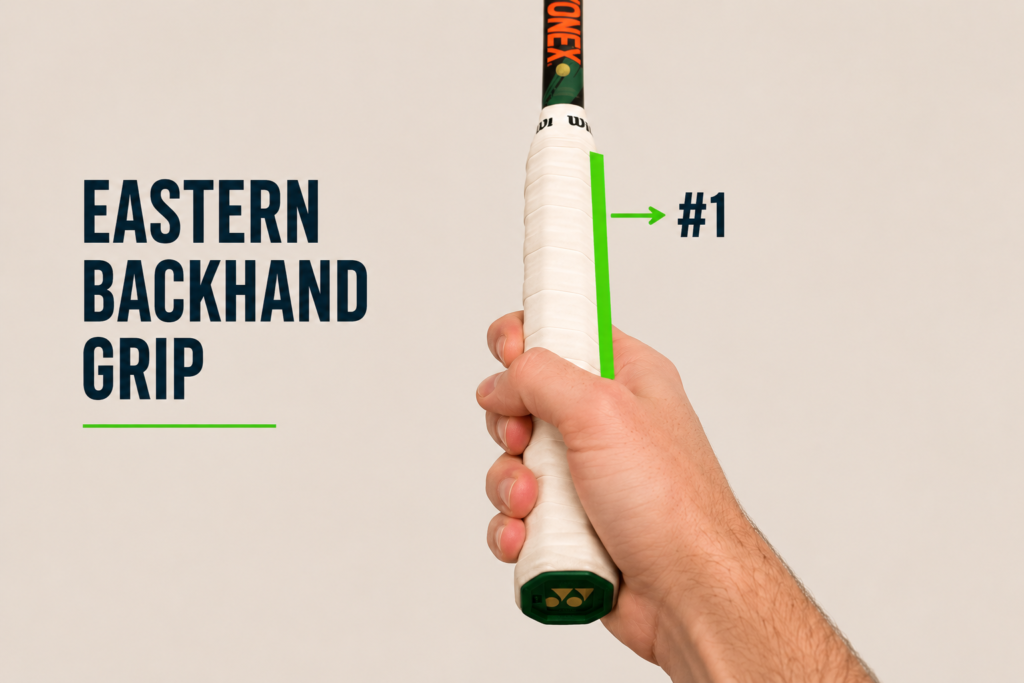
The Eastern Backhand Grip is the classic grip for a one-handed backhand.
It places the palm comfortably behind the handle, allowing players to drive through the ball while still producing topspin and slice.
Many coaches teach this grip first because it provides an excellent balance between control, power and versatility.
Advantages
- Easy to learn.
- Excellent control.
- Comfortable for slice and topspin.
- Works well on low balls.
- Used by many professional players.
Best for
- One-handed backhands.
- All-court players.
- Intermediate and advanced players.
Semi-Western Backhand Grip
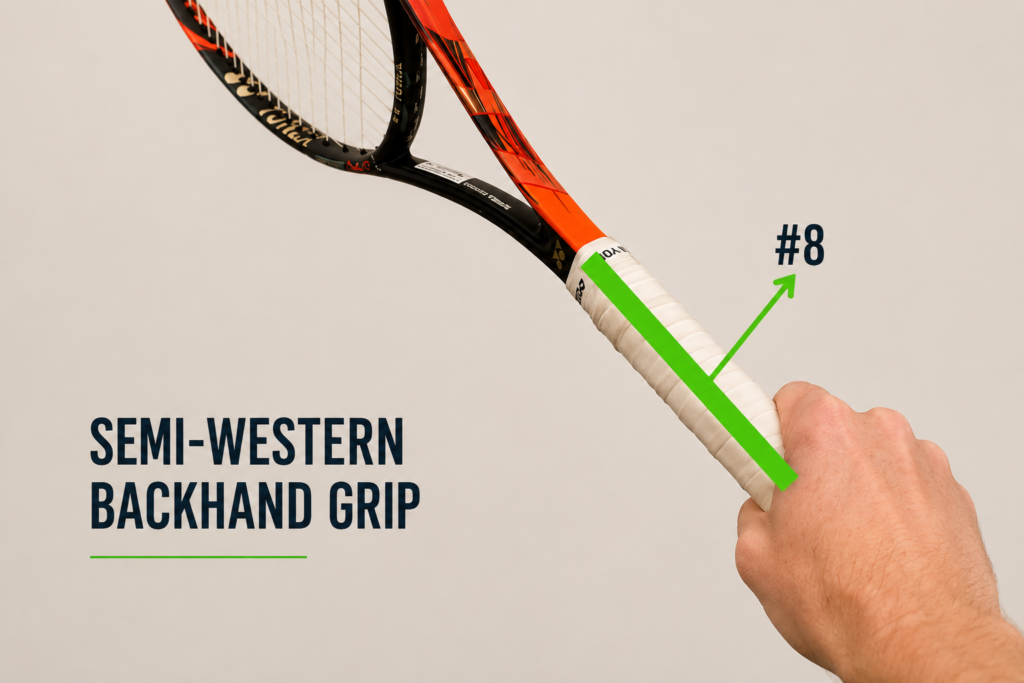
The Semi-Western Backhand Grip rotates the hand slightly further underneath the racquet handle.
This allows players to generate heavier topspin, particularly from the baseline.
The trade-off is that flatter shots and slice backhands become slightly more difficult.
Although less common than the Eastern Backhand Grip, some professional players use variations of this grip to produce explosive topspin.
Advantages
- Generates more topspin.
- Excellent for baseline rallies.
- Comfortable on higher balls.
Disadvantages
- Less versatile.
- Harder to flatten out shots.
- Can feel unusual for beginners.
Best for
- Aggressive baseliners.
- Players who prefer heavy topspin.
Two-Handed Backhand Grip
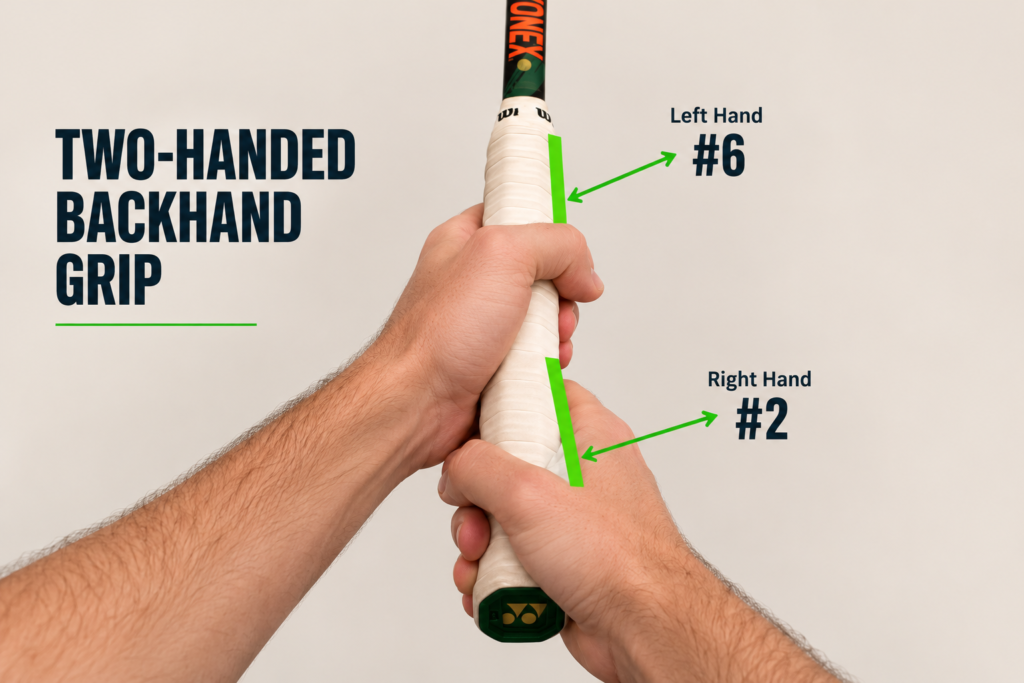
Despite its name, the two-handed backhand doesn’t rely on just one grip.
The dominant hand usually holds the racquet in a Continental Grip, while the non-dominant hand adopts an Eastern Forehand Grip.
Working together, these grips provide excellent stability while allowing both hands to contribute to the swing.
This combination explains why the two-handed backhand is so popular among beginners and professionals alike.
Advantages
- Maximum stability.
- Easier to generate power.
- Excellent return of serve.
- Comfortable on high-bouncing balls.
Best for
- Beginners.
- Junior players.
- Modern baseline tennis.
Comparison
| Grip | Topspin | Power | Control | Best For |
|---|---|---|---|---|
| Eastern Backhand | ⭐⭐⭐⭐☆ | ⭐⭐⭐⭐☆ | ⭐⭐⭐⭐⭐ | Classic one-handed backhand |
| Semi-Western Backhand | ⭐⭐⭐⭐⭐ | ⭐⭐⭐⭐☆ | ⭐⭐⭐⭐☆ | Heavy topspin |
| Two-Handed Backhand | ⭐⭐⭐⭐☆ | ⭐⭐⭐⭐⭐ | ⭐⭐⭐⭐⭐ | Stability and consistency |
Which Grip Should Beginners Use?
For beginners learning a one-handed backhand, the Eastern Backhand Grip is the best choice.
It is comfortable, forgiving and allows players to develop both topspin and slice.
If you’re learning a two-handed backhand, use the standard combination of a Continental Grip with your dominant hand and an Eastern Forehand Grip with your non-dominant hand.
This is the grip combination used by the vast majority of professional players.
Common Mistakes
Holding the grip too tightly
A relaxed grip helps generate better racquet-head speed and improves feel.
Changing grips too late
Experienced players change grips while moving to the ball rather than just before contact.
Using a forehand grip
Many beginners accidentally keep their forehand grip for backhands, making the stroke awkward and difficult to control.
Frequently Asked Questions
Which backhand grip do most professionals use?
For one-handed backhands, the Eastern Backhand Grip is the most common.
For two-handed backhands, professionals typically use a Continental Grip with the dominant hand and an Eastern Forehand Grip with the non-dominant hand.
Which grip creates the most topspin?
The Semi-Western Backhand Grip generally produces the most topspin among one-handed backhand grips.
Can I switch between one-handed and two-handed backhands?
Yes. Some players occasionally use one hand when stretched wide, but most competitive players commit to one primary backhand style.
Is there a Western backhand grip?
Not really.
Unlike the forehand, a true Western Grip is extremely rare on the backhand because it makes clean contact difficult and offers few practical advantages.
Final Thoughts
Backhand grips are much simpler than forehand grips, but choosing the right one still makes a significant difference.
For one-handed players, the Eastern Backhand Grip remains the most versatile option, while the Semi-Western Backhand Grip offers extra topspin for players who prefer an aggressive baseline game.
If you use a two-handed backhand, the standard combination of a Continental Grip and an Eastern Forehand Grip provides the balance of power, control and consistency that has made it the dominant choice in modern tennis.
Where to Go Next
- One-handed vs two-handed backhand
- Tennis grips explained
- How to hold a tennis racket
- Ready Position Explained
- Tennis Footwork Basics
Read more of our instructional articles here.
Read more of our player focus articles here.
Follow The Tennis Site on X: @thetennissite
Follow Todd Scoullar on X: @toddscoullar

Comments are closed, but trackbacks and pingbacks are open.