
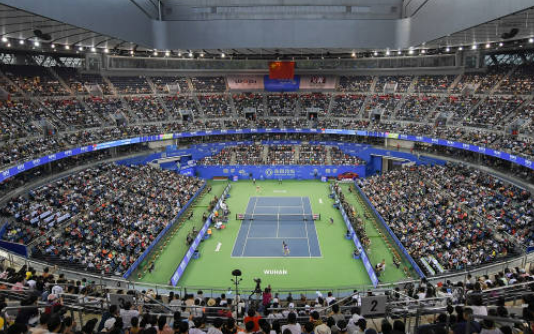
World No. 170 Sonay Kartal faces French Open finalist Maja Chwalińska in an unlikely Wuhan championship match, with both players chasing their first WTA 1000 title.
Few would have predicted a Wuhan Open final between Sonay Kartal and Maja Chwalińska when the tournament began.
One entered the event ranked World No. 170, having only recently returned from a six-month injury absence. The other was attempting to build on a remarkable breakthrough season that had already taken her to the Roland Garros final.
Yet on Sunday, 18 October, they will meet for one of the biggest titles in women’s tennis.
Kartal defeated Jelena Ostapenko 7–6(9), 7–6(5) in Saturday’s first semifinal, while Chwalińska overcame an injury-affected Iga Świątek 7–5, 6–1 in an all-Polish encounter.
The results guarantee a first-time WTA 1000 champion in Wuhan and create a very different final between two players who began the tournament outside the world’s Top 20.
For Kartal, it is another unbelievable step in a comeback that has gathered momentum far more quickly than expected. For Chwalińska, it is an opportunity to build on a breakout season, and claim the first WTA Tour singles title of her career.
Embed from Getty ImagesKartal’s Remarkable Return From Injury
Six months ago, Sonay Kartal was unable to compete.
A back injury had interrupted her season and sent her ranking tumbling from No. 54 to No. 170. By the time she returned to the WTA Tour during the Asian swing, the immediate priority was to regain match fitness and competitive rhythm.
Instead, she has produced the most outstanding tournament run of her career.
The 24-year-old British player began Wuhan with a 7–5, 6–3 victory over Anhelina Kalinina before delivering an emphatic performance against ninth seed Belinda Bencic, winning 6–0, 7–5.
She followed that result with an even more convincing victory over Jasmine Paolini, defeating the Italian 6–2, 6–0.
Her quarterfinal against Elina Svitolina was a different challenge. Kartal lost the opening set 2–6 before recovering to win the next two 6–2, 6–4.
Embed from Getty ImagesThen came Ostapenko.
The Latvian’s aggressive shot-making presented problems throughout Saturday’s semifinal. Kartal fell behind 4–1 in both sets but recovered on each occasion, eventually prevailing in two tiebreaks.
It was the kind of performance that requires more than good shot-making. Kartal had to remain composed while facing an opponent capable of producing winners from almost anywhere on the court.
Afterwards, she reflected on the scale of her achievement.
“Todays was a dream come true,” Kartal told the WTA.
The British player also spoke about the confidence she has developed during her return.
“I’m playing with so much confidence now,” she said.
Embed from Getty ImagesThat confidence has been evident throughout the tournament. Kartal has now beaten four seeded opponents in succession and reached her first WTA 1000 final.
She becomes only the second British woman to reach a WTA 1000 final since the category was introduced in 2009, following Johanna Konta.
Among ranked players, Kartal is also the lowest-ranked finalist at this level since the equivalent tournament format began in 1990.
Chwalińska Continues Her Breakthrough Season
Maja Chwalińska’s route to the final has been equally impressive, although her circumstances are very different.
The 25-year-old Polish player arrived in Wuhan ranked No. 22 after establishing herself as one of the season’s most interesting emerging contenders.
Her breakthrough came at Roland Garros, where she reached the final as a qualifier.
That performance demonstrated her ability to compete against leading opponents on clay. Wuhan has provided compelling evidence that her varied game can be equally effective on hard courts.
Embed from Getty ImagesChwalińska began the tournament with a 6–3, 6–2 victory over Mayar Sherif.
She then recovered from a set down to defeat Marie Bouzková 1–6, 6–1, 6–1 before eliminating Iva Jović 6–4, 6–1.
A demanding quarterfinal against Maria Sakkari followed.
Chwalińska won the opening set 6–0, lost the second 3–6 and eventually prevailed 7–5 in the decider.
The victory set up a meeting with childhood friend and former junior doubles partner Iga Świątek.
Embed from Getty ImagesIt was a significant occasion for Polish tennis, bringing together two players who had known one another since their junior careers.
Świątek initially appeared to be taking control, moving ahead 5–3 in the opening set and holding two set points.
Chwalińska saved both.
The match subsequently changed when Świątek required treatment for a left-leg injury. She continued playing with her thigh bandaged but appeared restricted in her movement.
Chwalińska capitalised, completing a 7–5, 6–1 victory to reach her first WTA 1000 final.
Afterwards, she acknowledged the significance of defeating a player she had admired for so long.
“She is a great champion, living legend, she won everything,” Chwalińska said.
Embed from Getty ImagesThe result was undoubtedly influenced by Świątek’s physical difficulties, but Chwalińska had already demonstrated considerable resilience by recovering from 5–3 down and saving two set points.
She now has an opportunity to add a major title to a season that has transformed her professional career.
Two Different Playing Styles
Sunday’s final promises an intriguing contrast.
Kartal has impressed with her ability to defend, absorb pressure and remain competitive against aggressive opponents.
Her semifinal victory over Ostapenko was a particularly good example. Despite repeatedly falling behind, she refused to allow the Latvian’s powerful hitting to dictate the outcome.
Chwalińska presents a different challenge.
The Polish left-hander relies heavily on variation, intelligent placement and changes of pace. Her ability to disrupt an opponent’s rhythm has been a defining feature of her breakthrough season.
Świątek acknowledged those qualities after their semifinal.
Embed from Getty Images“Great defense,” she said when discussing Chwalińska’s performance.
That assessment is particularly relevant to Sunday’s matchup.
Kartal has already demonstrated her ability to handle powerful baseline hitters. Chwalińska will test her patience and court positioning in different ways.
The two players have not previously met in a WTA Tour singles match, so neither can draw on experience of competing against the other at that level.
There is also the question of physical freshness.
Kartal has lost only one set in five matches at Wuhan. Chwalińska has been taken to three sets twice and has spent considerably more time on court.
Whether that becomes significant will depend on the length and intensity of Sunday’s rallies.
A Historic Final for Wuhan
Embed from Getty ImagesThe matchup is unusual even by the standards of a tournament that has produced its share of surprises.
According to the WTA, this is the first time since Wuhan joined the calendar in 2014 that both singles finalists have been ranked outside the world’s Top 20.
Chwalińska entered the event at No. 22, while Kartal began at No. 170.
Both are now guaranteed substantial ranking rewards.
The champion will receive 1,000 ranking points and US$665,000 in prize money, while the runner-up earns 650 points and US$385,001.
Kartal is projected to return towards the world’s Top 50, while Chwalińska is expected to move into the Top 15.
The precise rankings will depend on the final result and the official calculations.
For Kartal, winning would mean adding a WTA 1000 championship to the tour-level title she claimed in Monastir in 2024.
For Chwalińska, it would mean finally securing her first WTA Tour singles trophy after already reaching a Grand Slam final.
Either outcome would represent a defining moment in the winner’s career.
Who Has the Advantage?
There is a reasonable case for either player.
Kartal arrives with enormous confidence and has shown an ability to survive difficult moments against established opponents.
Her victories over Bencic, Paolini, Svitolina and Ostapenko suggest that she is capable of adapting to different challenges.
Chwalińska has demonstrated similar resilience.
Her comeback against Bouzková, three-set victory over Sakkari and recovery from 5–3 down against Świątek show that she is comfortable competing under pressure.
The Pole also has experience of a Grand Slam final, although she is still searching for her first tour-level title.
Kartal has already experienced winning a WTA championship, but Sunday’s occasion will be considerably bigger than her previous final in Monastir.
The outcome may depend on which player can impose her preferred style without becoming frustrated by the other’s strengths.
For Kartal, that could mean maintaining the consistency and patience that carried her through the Ostapenko semifinal.
For Chwalińska, it may involve using variation to prevent the British player from settling into comfortable baseline exchanges.
Neither approach guarantees success.
What is certain is that both have earned their place in the final through an exceptional week of tennis.
Continue Reading
- The WTA Tour Explained
- WTA 1000 Explained
- Tennis Ranking Points Explained
- Live Tennis Rankings Explained
Read more of our exclusive feature articles here.
Read more of our player focus articles here.
Follow The Tennis Site on X: @thetennissite
Follow Todd Scoullar on X: @toddscoullar

Comments are closed, but trackbacks and pingbacks are open.