
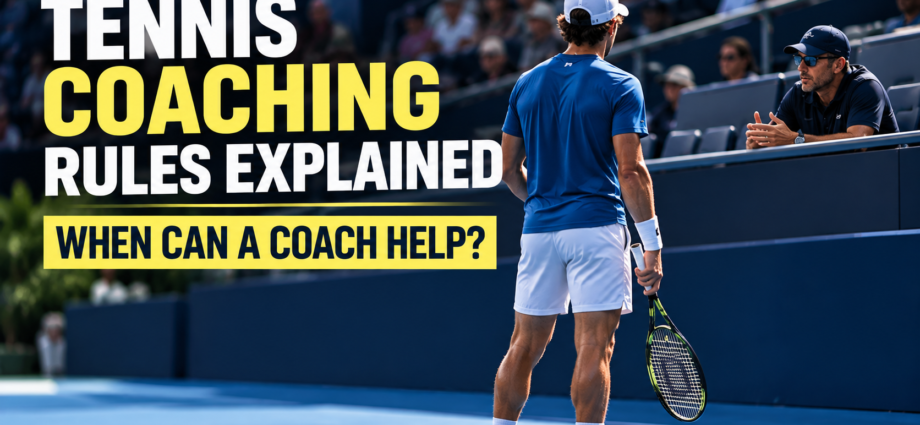
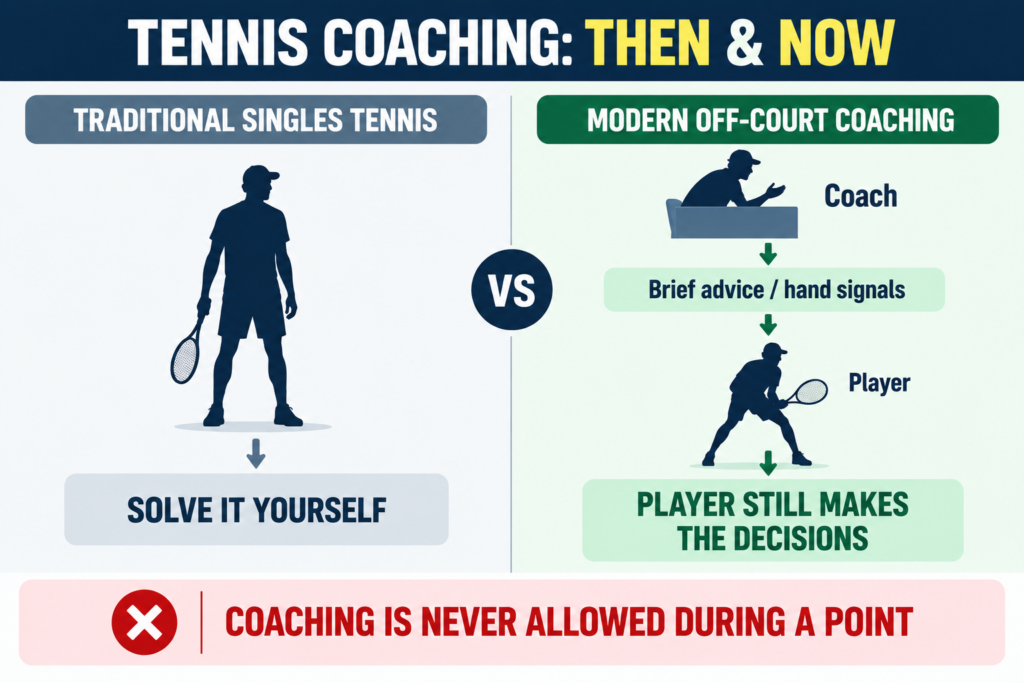
For generations, one of tennis’s defining characteristics was simple: once a singles player walked onto court, they were largely on their own.
A football manager could shout instructions from the sideline. A basketball coach could call a timeout. A boxer returned to a corner full of advice between rounds.
A tennis player had to solve problems independently.
That tradition has changed.
After years of trials across professional tennis, the Rules of Tennis were formally amended from January 1, 2025 to allow sanctioning bodies to permit off-court coaching during matches. The change followed trials involving the ATP, WTA, Grand Slams and other international competitions.
That does not mean coaches can now talk to players whenever they want.
The modern rules carefully control where the coach is, when communication occurs and how that communication is delivered.
Most importantly, coaching is still prohibited while a point is being played.
So what exactly can a coach do?
Quick Answer: Is Coaching Allowed in Tennis?
Yes — off-court coaching can now be permitted by the organisation running the competition.
Under Rule 30 of the 2026 Rules of Tennis, coaching means advice or instruction of any kind and by any means to a player. The rules allow the relevant sanctioning body to permit coaching from an off-court location.
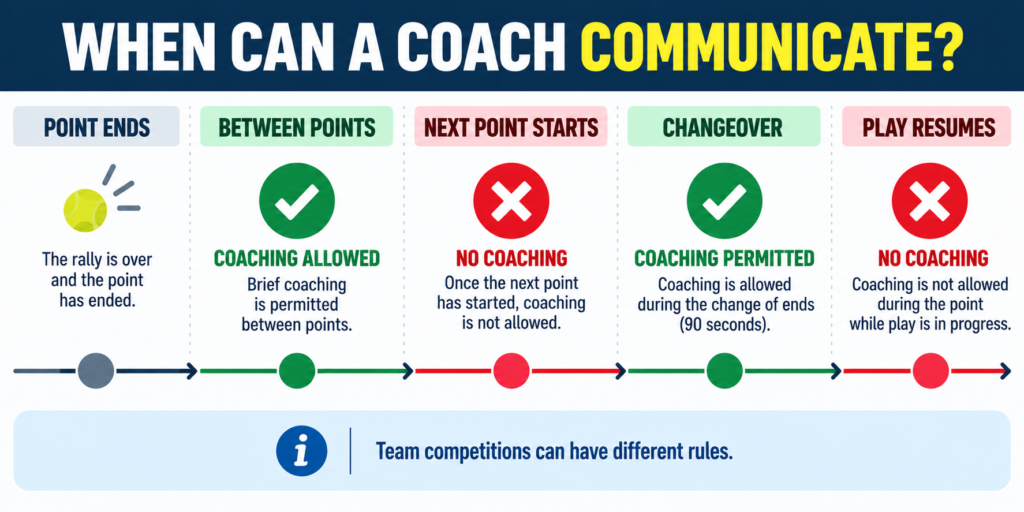
Where coaching is permitted, it can generally take place:
Between points ✓
During changeovers ✓
During set breaks ✓
During the playing of a point ✕
The important word, however, is may.
The Rules of Tennis give sanctioning bodies the power to allow off-court coaching. They do not require every tennis competition at every level to offer it.
That distinction matters enormously.
What Is Off-Court Coaching?
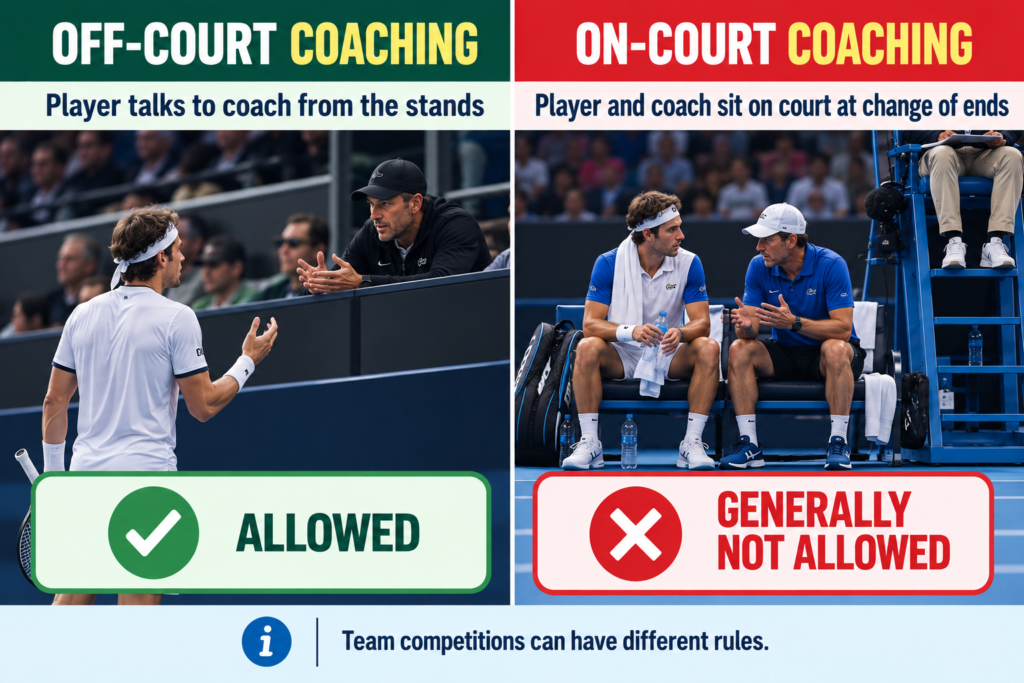
Off-court coaching means the coach remains off the playing court while communicating with the player.
At professional events, coaches are typically positioned in designated player or coach boxes.
The coach does not walk onto the court after every few games and conduct a conventional coaching session.
Instead, communication happens from outside the court while the match continues.
The 2026 Rules of Tennis specify that, when coaching is permitted, it can occur between points, during changeovers and set breaks, and at other times authorised by the sanctioning body — but never while the point itself is being played.
That distinction between off-court and on-court coaching is fundamental to understanding the modern rule.
Off-Court Coaching vs On-Court Coaching
These terms sound similar, but they mean different things.
Off-court coaching means the coach communicates from outside the playing court.
On-court coaching means an authorised coach or captain is physically positioned courtside/on court under a competition format that permits it.
Under Rule 30, on-court coaching is permitted only in team events where a team captain sits on court, and only at times authorised by the sanctioning body.
In other competitions, on-court coaching is not permitted.
So the modern rule has not turned ordinary singles tennis into a sport where coaches routinely walk onto court to speak with players.
What changed was primarily the acceptance of controlled communication from off court.
When Can a Coach Talk to a Tennis Player?
Where off-court coaching is permitted, timing is critical.
The Rules of Tennis allow coaching between points, during changes of ends and set breaks, as well as at other times specifically authorised by the sanctioning body.
But the communication cannot simply turn every gap between points into a long tactical discussion.
Off-court coaching between points must be brief and discreet, except during permitted breaks in play.
That preserves an important element of tennis.
The player can receive information.
The coach cannot take control of the match.
Can Coaches Talk During a Point?
No.
This is the clearest part of the rule.
The 2026 Rules of Tennis state that:
“Coaching is not permitted during the playing of a point.”
A coach therefore cannot provide a running commentary as a rally unfolds.
They cannot shout tactical instructions as the opponent prepares to hit.
They cannot tell the player where to serve after the service motion has effectively begun as part of the point.
Once play is underway, the players must play the point themselves.
Can Coaches Talk Between Points?
Yes, where the competition permits off-court coaching — but verbal communication is subject to an important restriction.
Under the Rules of Tennis, verbal coaching between points is permitted when the coach and player are at the same end of the court.
If the player is at the opposite end, the coach cannot simply shout instructions across the entire stadium.
This is where hand signals become important.
Are Hand Signals Allowed?
Yes.
When coaching is permitted, hand signals can be used at any permitted coaching time, regardless of whether the player is at the same or opposite end of the court.
That creates two basic communication methods:
Same end of court: brief verbal coaching or hand signals.
Opposite end: hand signals.
This can produce an interesting tactical language between player and coach.
A simple gesture might communicate information about serving location, return position, court positioning or another pre-arranged tactical idea.
But communication must remain within the rules and cannot become disruptive.
Can a Coach Shout Instructions Across the Court?
Not under the normal off-court coaching provisions.
Verbal coaching is permitted when the player and coach are at the same end of the court.
The ITF has specifically addressed whether a coach can move to the other end when players change ends simply to continue giving verbal advice.
The answer is no.
This prevents coaches from effectively following their player around the stadium to maintain a continuous conversation.
The coach remains in the designated location.
Can Players Have Long Conversations With Their Coaches?
Not during ordinary play.
The rules specify that off-court coaching between points must be brief and discreet.
The ITF’s guidance explicitly says that a coach cannot engage in a long conversation with a player during normal off-court coaching.
That is an important difference between coaching in tennis and a conventional timeout in many team sports.
The player does not stop the match and spend several minutes drawing up a tactical plan with the coach.
The match continues according to its normal timing rules.
Coaching has to fit within that structure.
Does Coaching Give Players More Time Between Points?
No.
Permitted coaching is not an excuse to delay play.
Players still have to comply with the normal timing requirements of the competition.
The conversation or hand signal has to fit into the time already available.
A player cannot repeatedly tell the chair umpire that they are not ready because their coach has not finished explaining the next tactic.
This also means the modern coaching rule has not created traditional timeouts.
Tennis remains a continuous sport.
For related penalties and timing issues, see Tennis Code Violations Explained
Can a Player Walk Over to Their Coach?
Not simply whenever they want.
The basic concept of off-court coaching is that communication takes place while the coach remains in the designated coaching location and the player remains within the normal structure of the match.
For example, WTA off-court coaching procedures permit coaching from the designated player/coach box and do not allow the player to turn ordinary coaching opportunities into unrestricted conversations with the coach.
Different rules can apply during authorised interruptions.
That distinction is important because a normal 25-second gap between points is not the same thing as a medical timeout or another extended stoppage.
What Happens During a Changeover?
Changeovers provide a more natural opportunity for communication.
When coaching is permitted, the Rules of Tennis allow coaching during changes of ends and set breaks.
The coach still remains off court in ordinary individual competition.
But because the player is seated and play has already stopped for the authorised changeover, communication can be easier than during the brief period between individual points.
Players can therefore receive tactical information while drinking, changing racquets or preparing for the next game.
The coach does not gain additional time simply because coaching is taking place.
Can Players Receive Coaching During Medical Timeouts?
Potentially, yes — depending on the competition’s rules.
The Rules of Tennis give sanctioning bodies discretion over whether coaching is allowed during additional stoppages such as medical timeouts, toilet breaks, changes of attire or weather delays.
This is one area where simply knowing the general Rules of Tennis is not enough.
The specific tour or tournament procedures matter.
For example, WTA procedures allow a player to approach and communicate with a coach during certain authorised breaks when the opponent has taken a medical timeout, toilet/change-of-attire break or another approved break while the players remain on court.
The ATP’s new heat rule for 2026 also expressly permits coaching during the applicable 10-minute cooling break.
Who Decides Whether Coaching Is Allowed?
The sanctioning body.
This is perhaps the most important concept in the entire rule.
The ITF’s Rules of Tennis provide the framework, but the organisation responsible for the competition decides whether off-court coaching is permitted and how it is implemented.
The sanctioning body can determine details such as:
- whether coaching is permitted at all
- where coaches must sit
- how many people may coach
- who qualifies as a coach
- whether a chair umpire must be present
- whether both players need access to a coach
- how coaching is monitored
- what happens during unusual stoppages
- what penalties apply when the coaching rules are broken
This is why there is no completely universal answer to every coaching situation.
The Rules of Tennis create the framework.
The competition determines the implementation.
Why Did Tennis Change Its Coaching Rules?
The formal change followed years of experimentation.
Off-court coaching trials had been taking place since 2017. By 2023, trials were being conducted across the major international sanctioning bodies, including the four Grand Slams, ATP Tour, WTA Tour and ITF competitions.
The ITF identified several reasons for making the change permanent from 2025.
It said the change could align coaching approaches across international tennis, reduce the burden on chair umpires policing coaching, reduce subjectivity in enforcement, support player development and potentially make matches more entertaining.
There was also a practical reality.
For decades, coaches and players had developed ways of communicating from the stands despite restrictions.
The dividing line between encouragement and coaching could be difficult to police.
Was a coach clapping?
Was that gesture tactical?
Did shouting “Come on!” become coaching if the player understood it as a pre-arranged signal?
The new framework attempted to replace some of that ambiguity with explicit rules.
When Did Tennis Start Allowing Coaching?
The answer depends on what level of tennis you mean.
Coaching had long existed in certain team competitions, while the WTA had previously experimented with forms of on-court coaching.
The modern move towards widespread off-court coaching developed through trials beginning in 2017. The ATP introduced its own off-court coaching trial during the second half of 2022.
Trials then became increasingly widespread across international professional tennis.
The major change arrived on January 1, 2025, when the Rules of Tennis were amended to allow sanctioning bodies to permit off-court coaching permanently.
That date is important for anyone researching the subject online.
Articles written before 2025 may describe rules that are no longer current.
Is Coaching Allowed at Grand Slams?
Grand Slam tournaments participated in the off-court coaching trials before the permanent 2025 Rules of Tennis change.
The Grand Slams operate under their own Grand Slam Rule Book, which is implemented and enforced by the Grand Slam Board. The current 2026 rule book is published through the ITF’s official rules and regulations portal.
The broader point is that Grand Slam coaching should not be understood through an old blanket statement that “coaching is banned in tennis.”
Modern professional tennis uses controlled off-court coaching under competition-specific procedures.
Is Coaching Allowed on the ATP Tour?
Yes, the ATP has incorporated the modern coaching framework into its rules.
The ATP’s 2026 rulebook reproduces the Rules of Tennis coaching provisions: coaching can be permitted between points, during changes of ends and set breaks, while off-court coaching between points must be brief and discreet.
The ATP had already been experimenting with off-court coaching before the Rules of Tennis formally changed, having introduced a Tour trial in 2022.
Is Coaching Allowed on the WTA Tour?
Yes.
The WTA permits off-court coaching under defined procedures.
Its coaching rules require coaching to take place from designated player/coach box seats. Brief verbal coaching is permitted when the player is at the same end of the court as the coach box, while subtle non-verbal hand signals or gestures can be used when the player is at either end.
The WTA also specifies that coaching must not become a distraction or hindrance to the opponent.
The current 2026 WTA Rulebook is published on the WTA’s official rules page.
What About Davis Cup and Billie Jean King Cup?
Team tennis has historically treated coaching differently from ordinary individual competition.
The Rules of Tennis specifically allow on-court coaching in team events where a team captain sits on court, at times permitted by the relevant sanctioning body.
That is why team competitions can look noticeably different.
A captain sitting courtside and talking directly to a player would look highly unusual in a conventional individual tournament.
In a team competition, it can be part of the format.
For more on how those competitions work, see Davis Cup Explained and Billie Jean King Cup Explained
What About the United Cup?
The United Cup is another example of how team competitions can differ.
Under the 2026 ATP rules for the competition, players could use a personal coach during matches, with coaches sitting in designated areas. The rules permitted coaching during changeovers and set breaks and during play provided it did not interrupt play.
This reinforces an important lesson:
Do not assume that the coaching procedures at one tennis competition automatically apply to another.
For the event format itself, see United Cup Explained
Can Players Use Technology for Coaching?
Potentially.
Rule 30 allows sanctioning bodies to permit players to access approved Player Analysis Technology at times when coaching is permitted.
Player Analysis Technology can perform functions including recording, storing, transmitting and analysing performance information and communicating information to a player.
That opens another fascinating development in modern tennis.
Coaching no longer necessarily means a coach simply saying, “Attack the backhand.”
Modern teams can work with sophisticated match data, patterns and performance analysis.
The Rules of Tennis nevertheless control when a player may access such information.
Technology does not eliminate the restrictions on coaching.
What Happens if a Coach Breaks the Rules?
Permitted coaching still has boundaries.
A coach cannot interfere with play, create a hindrance or use the existence of coaching rules as permission to behave however they want.
WTA procedures, for example, state that if verbal coaching, gestures or hand signals begin interrupting play or hindering an opponent, officials can intervene and the player may ultimately face coaching penalties and fines.
The sanctioning body determines the applicable penalties for coaching that occurs in an unauthorised manner or at an unauthorised time.
For an explanation of the wider penalty system, see Tennis Code Violations Explained.
Can a Player Who Has No Coach Be Disadvantaged?
This was one of the obvious questions raised by allowing coaching.
Not every player travels with the same size support team.
A leading professional may have a full player box containing coaches, trainers and specialists. A lower-ranked player may travel with far fewer resources.
The Rules of Tennis therefore allow sanctioning bodies to determine whether both players must have a coach for coaching to be permitted in a particular competition.
This illustrates why the ITF did not simply write one rigid coaching procedure covering every tennis event worldwide.
Professional tennis, junior tennis, recreational tournaments and team competitions can have very different circumstances.
Does Coaching Destroy Tennis’s Individual Nature?
That is ultimately a matter of opinion.
Supporters of the traditional system argue that tactical problem-solving under pressure has always been one of tennis’s defining skills. A player who cannot work out why they are losing should have to solve the problem themselves.
Supporters of coaching argue that coaches were already communicating from the stands, that the old rules could be inconsistently enforced, and that allowing controlled coaching creates clearer and fairer boundaries.
The ITF cited feedback from players, coaches and chair umpires as part of the decision to make the rule change.
What is objectively clear is that coaching remains much more restricted than in many other sports.
There are no conventional tactical timeouts after every few games.
The coach cannot interrupt a point.
The player still has to execute every serve, make every tactical decision in real time and deal with pressure personally.
The player may receive more information than in the past.
They still have to play the match.
Coaching Rules at a Glance
The modern framework can be reduced to a few principles:
Off-court coaching may be allowed — the sanctioning body decides.
Between points: coaching may be permitted.
Changeovers: coaching may be permitted.
Set breaks: coaching may be permitted.
During a point: coaching is prohibited.
Verbal coaching: generally permitted when coach and player are at the same end.
Hand signals: permitted at authorised coaching times.
Long conversations during ordinary play: not permitted.
On-court coaching: generally limited to qualifying team-event situations.
Medical and other breaks: competition-specific rules apply.
Technology: approved Player Analysis Technology may be accessible where authorised.
Frequently Asked Questions
Is coaching allowed during tennis matches?
Yes, off-court coaching may be permitted by the organisation sanctioning the event. Since January 1, 2025, the Rules of Tennis have formally allowed sanctioning bodies to permit off-court coaching.
Can a tennis player talk to their coach during a match?
Yes, where off-court coaching is permitted, but communication must follow the competition’s rules. Verbal coaching between points is generally permitted when the player and coach are at the same end of the court.
Can a coach give hand signals in tennis?
Yes. When coaching is permitted, hand signals can be used at authorised coaching times, including when the player is at the opposite end of the court.
Can coaches talk while a point is being played?
No. The Rules of Tennis explicitly prohibit coaching during the playing of a point.
Can a tennis coach come onto the court?
Not in ordinary individual competition. On-court coaching is permitted under the Rules of Tennis in team events where a team captain sits on court and the sanctioning body allows it.
Can a player talk to their coach during a medical timeout?
It depends on the competition. Sanctioning bodies determine whether coaching is permitted during certain additional breaks in play.
Is coaching allowed at Grand Slams?
Modern Grand Slam tennis permits controlled off-court coaching under its competition rules. The Grand Slams were among the competitions that participated in the coaching trials preceding the permanent 2025 rule change.
When did tennis change the coaching rule?
The Rules of Tennis were formally amended from January 1, 2025 to allow sanctioning bodies to permit off-court coaching. Trials had taken place for several years beforehand.
Can coaching delay the match?
No. Coaching has to take place within the permitted structure of play and cannot be used as a reason to extend the normal time available.
Can tennis players use data during matches?
Approved Player Analysis Technology can be accessed at authorised coaching times if the sanctioning body permits it.
Final Thoughts
For much of tennis history, the principle was simple:
Once the match began, the player was on their own.
Modern tennis has moved away from that absolute position.
Since 2025, the Rules of Tennis have formally recognised off-court coaching, allowing tournament organisers and governing bodies to decide when and how it can be used.
But the change is narrower than the phrase “coaching is now allowed” might suggest.
A coach cannot provide instructions during a point.
Verbal communication is restricted.
Between-point coaching must remain brief.
Players cannot turn every changeover into an unlimited tactical meeting.
And conventional on-court coaching remains largely confined to particular team-event situations.
The result is something of a compromise between tennis’s individual tradition and the realities of the modern professional game.
The coach can provide information.
The player still has to solve the match.
Continue Reading
- Tennis Code Violations Explained
- Tennis Etiquette
- Tennis Dress Code
- Davis Cup Explained
- Billie Jean King Cup Explained
- United Cup Explained
For the current governing framework, see the World Tennis Rules and Regulations and the 2026 WTA Rules.
Read more of our instructional articles here.
Read more of our player focus articles here.
Follow The Tennis Site on X: @thetennissite
Follow Todd Scoullar on X: @toddscoullar

Comments are closed, but trackbacks and pingbacks are open.