
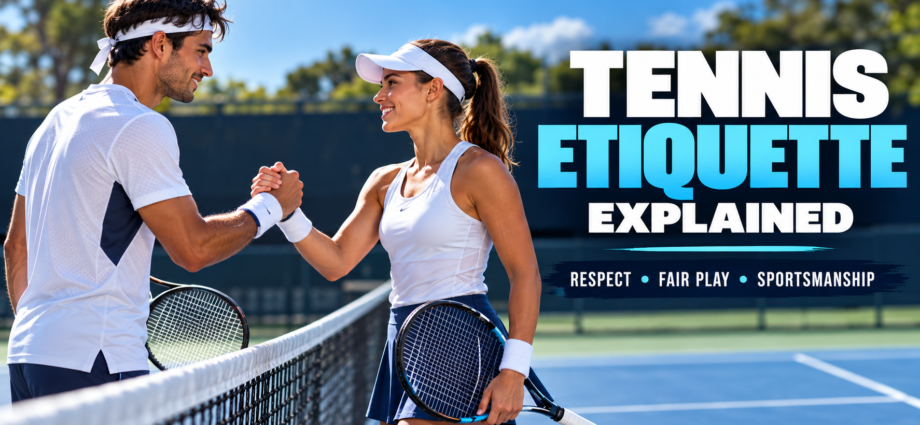
Tennis has an unusually large number of traditions that are not immediately obvious from reading the rulebook.
You can learn how to serve, understand the scoring system and know whether a ball landed in or out, yet still step onto a court without knowing how players are expected to behave.
Should you apologise when the ball clips the net and drops over? Who collects the balls after a game? Can you celebrate an opponent’s double fault? Who makes the line calls when there is no umpire?
This is where tennis etiquette comes in.
Some elements of etiquette are simply traditions. Others overlap with the official rules of tennis and can affect the outcome of a point or match. Together, they form a code of behaviour built around one central principle: respect the opponent, the court and the game.
Quick Answer: What Is Tennis Etiquette?
Tennis etiquette is the set of accepted behaviours and traditions players follow before, during and after a match.
It includes making honest line calls, announcing the score clearly, avoiding unnecessary delays, respecting players on neighbouring courts, returning balls appropriately and behaving respectfully towards opponents and officials.
Some are genuine rules. Others are customs that have developed over generations of tennis.
The distinction matters. Failing to shake hands after a recreational match may be considered poor etiquette, for example, but it does not change the score. Deliberately distracting an opponent during a point is a very different matter because the official rules deal with hindrance.
For the actual laws governing a match, see How to Play Tennis: Rules Explained for Beginners
1. Arrive Ready to Play
Good tennis etiquette begins before the first point.
If a court is booked for a particular time, players should arrive early enough to be ready when their session begins. Turning up late does not simply inconvenience an opponent; on busy public or club courts, it can eat directly into the available playing time.
Bring the equipment you need, including racquets, balls, appropriate shoes and water.
For organised competition, players should also check the tournament’s reporting requirements. Competitive events can have formal rules covering when players must check in and what happens when somebody is late.
Recreational tennis is less formal, but the principle remains the same: respect everyone else’s time.
2. Wait Until the Court Is Free
One of the simplest pieces of court etiquette is also one of the most frequently ignored.
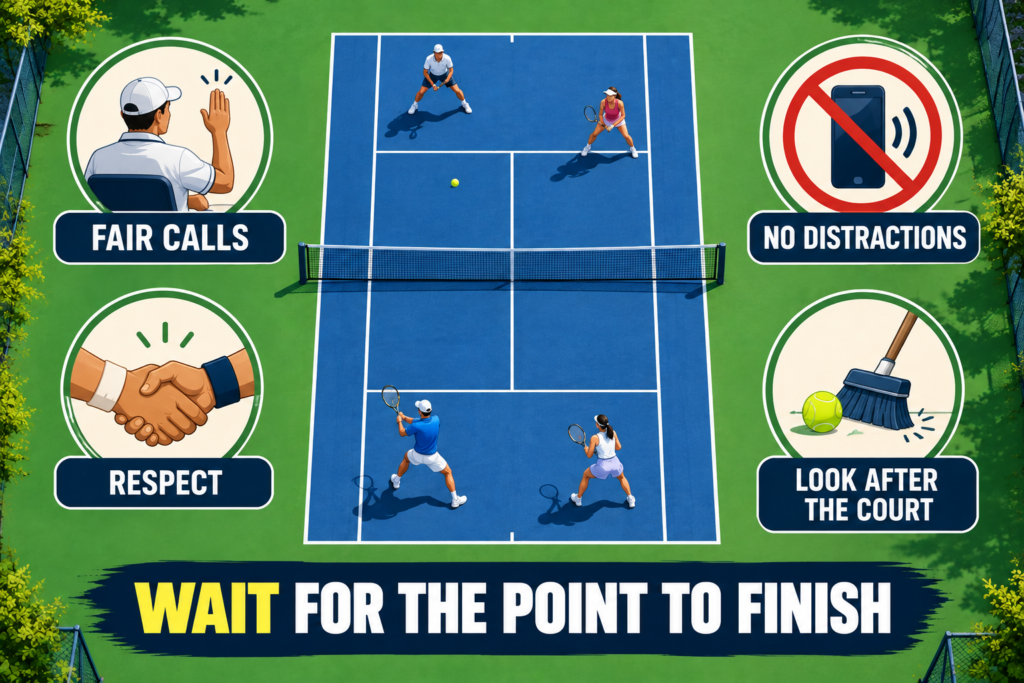
If players are still using a court, don’t walk onto it while their point is in progress.
The same applies when crossing behind another court to reach your own. Wait for the point to finish and then move quickly across.
Walking behind a baseline while someone is preparing to serve can be extremely distracting.
On facilities with several courts side-by-side, a few seconds of patience makes an enormous difference.
3. The Warm-Up Is a Warm-Up
The pre-match warm-up is not a miniature competition.
Its purpose is to allow both players to prepare.
Hit balls reasonably towards your opponent rather than trying to win points. Give them opportunities to practise forehands, backhands, volleys, overheads and serves where appropriate.
The official Rules of Tennis provide for a maximum five-minute warm-up unless the event organiser decides otherwise.
In social tennis, warm-up length may be less formal, but monopolising the balls or deliberately hitting everything beyond your opponent’s reach rather defeats the purpose.
4. Make Fair Line Calls
This is arguably the most important piece of etiquette in matches without officials.
Players generally make calls on their own side of the court. If you clearly see your opponent’s shot land out, call it out promptly.
If you are uncertain, the opponent receives the benefit of the doubt.
The USTA’s The Code, a widely used guide to unofficiated matches, states that a ball should not be called out unless the player clearly sees space between the ball’s landing point and the line. A ball touching any part of the line is good.
That last point is not merely etiquette. Under the official Rules of Tennis, a ball touching a line is considered to have touched the court bounded by that line.
In other words, there is no such thing as “mostly out.”
If it touches the line, it is in.
And if you realise that you have made an incorrect call, correct it.
Honesty is more important than protecting a point.
5. Call the Score Clearly
The server should announce the score before beginning each point.
That sounds trivial until two players reach the middle of a game and suddenly disagree over whether the score is 30-30 or 40-30.
Calling the score loudly enough for the opponent to hear dramatically reduces those disputes and is specifically recommended in USTA sportsmanship guidance.
Remember that the server’s score is announced first.
For example:
15-30 means the server has 15 and the receiver has 30.
If tennis scoring still seems unnecessarily mysterious, see Tennis Scoring Explained.
6. Don’t Serve Until Your Opponent Is Ready
A server should not deliberately rush an opponent.
Before serving, check that the receiver is reasonably ready to play. USTA sportsmanship guidance explicitly advises players not to serve until their opponent is ready.
That courtesy works both ways.
The receiver should not deliberately slow the match by repeatedly making the server wait.
Tennis is designed to be played continuously. Under the official rules, play should remain continuous from the beginning of the match until its conclusion, with prescribed time limits applying between points and at changes of ends.
Good etiquette therefore requires cooperation from both players: don’t rush your opponent, but don’t unnecessarily delay them either.
7. Keep Track of the Balls
Ball management is a surprisingly important part of tennis etiquette.
Before serving, make sure the server has convenient access to the balls. If you have a ball and the server needs it, send it towards them rather than making them walk across the court unnecessarily.
But don’t smash a ball at them.
Roll it, gently hit it or send it in a way that is easy to collect.
Loose balls can also become a safety issue. If a ball is lying somewhere that could interfere with play, clear it before the point begins.
Under USTA guidance for unofficiated matches, a player must honour an opponent’s reasonable request to remove a ball that is not in play from the court or from an area close to the lines.
8. Don’t Interrupt Other Courts to Retrieve a Ball
Sooner or later, your ball will roll onto another court.
Don’t immediately run after it.
If the neighbouring players are in the middle of a point, wait until their point finishes. Then ask for the ball or retrieve it safely.
Likewise, if somebody else’s ball enters your court and creates a danger or distraction, stop play when appropriate and return it.
USTA guidance specifically advises players to wait until a neighbouring court has completed its point before retrieving or returning a ball.
Running behind someone during their serve to retrieve a $4 tennis ball is rarely worth it.
9. Respect Your Opponent’s Good Shots
You don’t need to applaud every winner your opponent hits.
But acknowledging an exceptional shot is one of tennis’s longest-standing sporting traditions.
A simple “good shot” or racquet clap is enough.
This becomes particularly noticeable in social and club tennis, where the contest is competitive but the atmosphere should still be enjoyable.
USTA sportsmanship guidance encourages players to acknowledge or congratulate opponents for good shots.
Respecting good tennis does not mean you want to lose.
It means recognising when somebody played the game well.
10. Should You Apologise for a Net Cord?
A player hits the ball, it clips the top of the net and somehow trickles over for an unreachable winner.
Then comes one of tennis’s most familiar gestures: the player raises a hand towards the opponent.
It is effectively an apology.
You haven’t actually done anything wrong. The shot is perfectly legal.
The gesture simply acknowledges that luck, rather than intention, played a significant role in winning the point.
The same custom sometimes appears after an accidental framed winner or another particularly fortunate point.
It is tradition rather than a requirement.
And despite raising a hand to apologise, the player generally still accepts the point.
11. Don’t Celebrate an Opponent’s Mistake Excessively
Celebrating your own success is part of sport.
There is, however, a difference between celebrating the point you won and celebrating your opponent’s embarrassment.
A fist pump after hitting a brilliant passing shot? Completely normal.
A huge celebration directly at an opponent after they double fault? Very different.
Context matters.
Professional players routinely celebrate important points that finish with an opponent’s error because the importance of the point itself creates emotion. Tennis etiquette does not require players to remain expressionless.
The issue is whether the celebration becomes deliberately disrespectful, intimidating or taunting.
Compete hard.
You don’t need to humiliate the person standing across the net.
12. Keep Your Temper Under Control
Tennis can be infuriating.
That does not give players permission to throw racquets towards other people, scream abuse, deliberately hit balls away or intimidate opponents.
At recreational level, this is basic sportsmanship.
At professional and sanctioned tournament level, some behaviour can move beyond etiquette and become a formal code violation.
That distinction is important enough to deserve its own guide, which we cover in Tennis Code Violations Explained.
USTA sportsmanship guidance similarly advises players to avoid throwing racquets or shouting in frustration and to remain respectful towards opponents, officials, spectators and tournament staff.
13. Don’t Deliberately Distract Your Opponent
This is another area where etiquette overlaps with the rules.
Making deliberate noises, waving your arms purely to distract an opponent or intentionally creating another disturbance during a point is not clever gamesmanship.
Under the Rules of Tennis, if a player is deliberately hindered by an opponent, the hindered player wins the point. If the hindrance is unintentional, the point may instead be replayed.
Normal movement during doubles is different. Players can move, communicate with their partner and position themselves strategically.
The line is deliberate distraction.
14. Respect Changeovers and the Pace of Play
Changeovers are not open-ended rest periods.
Under the standard Rules of Tennis, players may have a maximum of 90 seconds when changing ends and 120 seconds at the end of a set. After the first game of each set and during a tiebreak, players change ends without a rest.
For recreational players, nobody needs to sit with a stopwatch.
The etiquette is simpler: take the break you reasonably need, then continue playing.
Don’t use every changeover to send messages, make a phone call or disappear for an extended conversation.
15. Be Considerate With Noise
Tennis does not have to be played in silence.
Players communicate, spectators react and neighbouring courts generate noise.
But unnecessary noise while somebody is serving or playing a point should be avoided.
This is particularly important when courts are close together.
If you’re having a conversation beside a court, consider whether the players can hear every word. If somebody is beginning their service motion, that is probably not the ideal moment to shout across three courts to a friend.
16. Understand Doubles Etiquette
Most singles etiquette applies equally to doubles, but playing with a partner adds another layer.
Communicate clearly, particularly over balls through the middle. Avoid blaming your partner for errors. Decide service and receiving arrangements before they become confusing.
Line calls also require cooperation.
In an unofficiated match, either doubles partner may make calls. If partners disagree about whether an opponent’s shot was out, the doubt should favour the opponents rather than the team awarding itself the point. The underlying principle remains the same: uncertain balls are treated as good.
17. Respect the Court
Tennis etiquette extends to the facility itself.
Don’t leave bottles, ball cans, grips or other rubbish behind. Avoid damaging the net, fence, benches or court surface.
On clay, local customs may include sweeping or brushing the court after play. Some clubs also ask players to clean lines or follow particular court-care procedures.
Follow the rules of the facility you are using.
The next players should inherit the court in at least as good a condition as you found it.
18. Finish the Match With Respect
One of tennis’s most recognisable traditions happens after the final point.
The players meet at the net.
Traditionally they shake hands, although racquet taps and fist bumps have also become common.
USTA guidance recommends meeting at the net after a match and acknowledging the opponent positively, regardless of the result.
You don’t have to pretend you enjoyed losing.
You don’t need to deliver a speech.
A simple “good match” is enough.
The significance is that once the final point is over, the contest is over too.
Tennis Etiquette for Spectators
Etiquette does not apply only to the people holding racquets.
Spectators should avoid moving around or making unnecessary noise at moments when it could distract players, particularly during the serve and while a point is being played.
In organised competition, follow the venue’s instructions about when spectators can enter or leave seating areas.
At junior and recreational events, another important principle applies: let the players play.
Parents and supporters should not attempt to make line calls from outside the court or continually intervene in disagreements. USTA sportsmanship guidance specifically encourages parents, friends and coaches to allow players to make their own calls and work through disagreements, with officials available when necessary.
Supporting someone is very different from participating in the match from behind the fence.
Embed from Getty ImagesTennis Etiquette vs Tennis Rules
The two are closely connected, but they are not identical.
Rules determine how tennis is played.
Etiquette determines how players are generally expected to conduct themselves while playing it.
Some behaviour belongs clearly to one category. Shaking hands after a match is etiquette. Serving from behind the baseline is governed by the rules.
Others overlap.
Making an honest line call is good sportsmanship, but whether a ball touching the line is in or out is also explicitly governed by the Rules of Tennis. Likewise, deliberately distracting an opponent is poor etiquette but can also constitute a hindrance under the rules.
This is why good tennis etiquette is more than simply being polite.
It helps matches function properly, particularly at the enormous number of levels where players compete without an official watching every line.
Tennis Etiquette Checklist
Before playing, arrive on time, bring the necessary equipment and wait until the court is available.
During the warm-up, cooperate rather than trying to win points.
During the match, make honest calls, give your opponent the benefit of genuine doubt, announce the score clearly, don’t rush or deliberately delay the opponent, keep loose balls under control and respect neighbouring courts.
Compete intensely without deliberately distracting, taunting or intimidating anyone.
When the match finishes, acknowledge your opponent and leave the court ready for the next players.
That is most of tennis etiquette in one idea:
Compete for every point without forgetting there is another person on the other side of the net.
Frequently Asked Questions
Who makes line calls in tennis without an umpire?
Players generally make calls on their own side of the court. When a player is genuinely uncertain whether an opponent’s ball was out, the benefit of the doubt should go to the opponent.
Is a tennis ball on the line in or out?
In. Under the Rules of Tennis, a ball touching a line is considered to have touched the court bounded by that line.
Who calls the score in tennis?
The server should announce the score clearly before each point. This helps both players keep track of the game and reduces disputes.
Should you apologise when the ball hits the net?
Players commonly raise a hand in apology when a fortunate net cord produces a winner. It is a tennis tradition rather than a requirement of the rules.
Is it rude to celebrate in tennis?
No. Celebrating points is normal. Etiquette becomes an issue when celebrations are deliberately directed at an opponent in a taunting, intimidating or disrespectful manner.
Can you walk behind a tennis court during a point?
You should wait until the point has finished whenever crossing behind a court would distract the players. The same principle applies when retrieving balls from neighbouring courts.
Do tennis players have to shake hands after a match?
Meeting at the net and acknowledging your opponent is a deeply established tennis tradition and an important sign of sportsmanship, although the precise gesture — handshake, racquet tap or fist bump — can vary.
Can spectators make line calls?
In an unofficiated match, players are responsible for their calls. Spectators should not become unofficial line judges from outside the court. USTA guidance encourages supporters to allow players to resolve calls themselves or seek assistance from an official where available.
Final Thoughts
Tennis etiquette has survived because the sport depends unusually heavily on cooperation between opponents.
At professional tournaments, officials and electronic systems can decide close calls and enforce the rules. On club and public courts around the world, players often have to do much of that themselves.
That only works when both sides compete honestly.
You can want desperately to win and still give an opponent the benefit of the doubt. You can celebrate a great point and still respect the person who lost it. You can play aggressively without turning the match hostile.
The best summary of tennis etiquette is therefore remarkably simple:
Play hard. Call fairly. Respect the game.
Continue Reading
- How to Play Tennis: Tennis Rules Explained for Beginners
- Tennis Scoring Explained
- The Ultimate Tennis Glossary
- Tennis Code Violations Explained
- On-Court Coaching Rules Explained
Read more of our instructional articles here.
Read more of our player focus articles here.
Follow The Tennis Site on X: @thetennissite
Follow Todd Scoullar on X: @toddscoullar

Comments are closed, but trackbacks and pingbacks are open.