
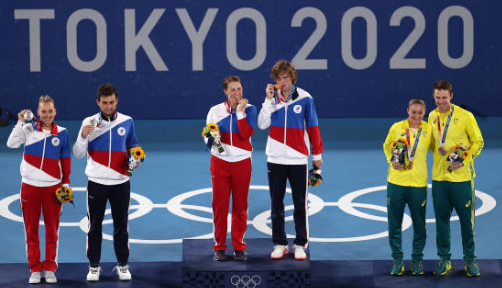
For most of their careers, professional tennis players compete for themselves.
At the Olympic Games, everything changes.
Players compete under their national flag. Doubles partners must represent the same country. Rankings can get a player into the tournament, but a high enough ranking doesn’t necessarily guarantee a place. And losing a semifinal doesn’t always mean the tournament is over.
There is still a bronze medal to win.
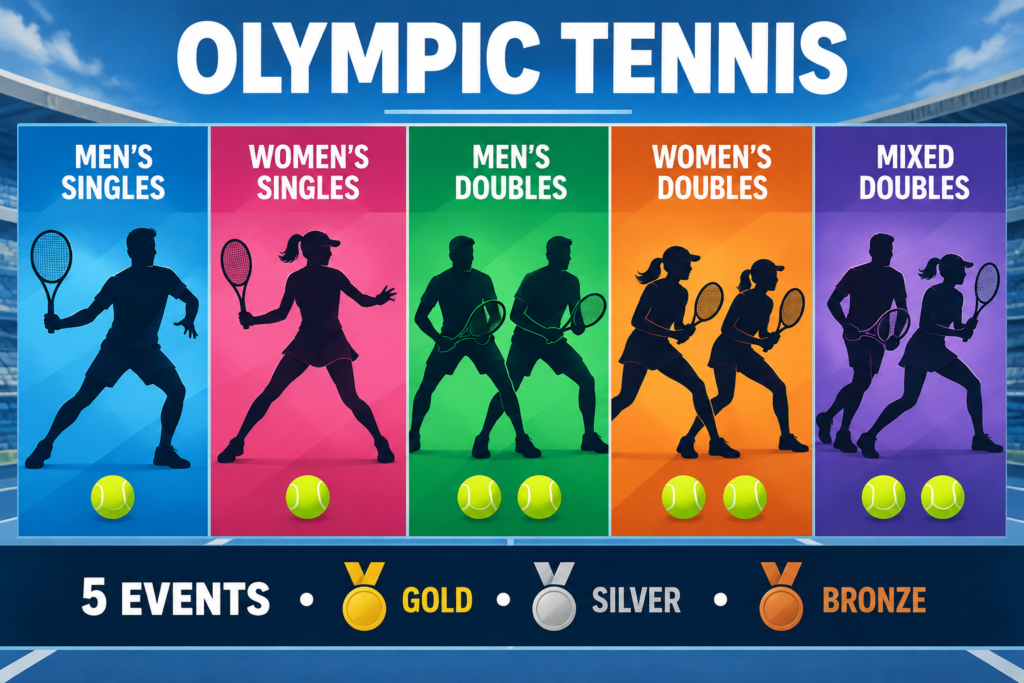
Olympic tennis brings together many of the world’s leading players for five medal events: men’s singles, women’s singles, men’s doubles, women’s doubles and mixed doubles.
The tennis itself is familiar. The way players get there — and what they’re playing for — is quite different.
Here’s how Olympic tennis works.
Is Tennis an Olympic Sport?
Yes — and its Olympic history goes back almost as far as the modern Games themselves.
Men’s tennis was contested at the first modern Olympics in Athens in 1896, while women’s singles was added in Paris four years later.
Tennis remained part of the Olympic programme through 1924 before disappearing as a medal sport for more than six decades.
It appeared in demonstration form during that absence, including in 1968 and 1984, before returning as a full medal sport at the 1988 Seoul Olympics. It has remained on the programme ever since.
That return produced one of the most famous seasons in tennis history, with Steffi Graf adding Olympic singles gold to all four Grand Slam titles in 1988.
More on that later, but for a quick history lesson, read our Tennis at the Olympics article.
What Tennis Events Are Played at the Olympics?
There are five:
Men’s Singles
Women’s Singles
Men’s Doubles
Women’s Doubles
Mixed Doubles
Each event produces a gold, silver and bronze medallist or medal-winning team.
At Los Angeles 2028, the draw sizes will be:
| Event | Draw |
|---|---|
| Men’s Singles | 64 players |
| Women’s Singles | 64 players |
| Men’s Doubles | 32 teams |
| Women’s Doubles | 32 teams |
| Mixed Doubles | 16 teams |
Those draw sizes remain unchanged from Paris 2024.
How Does Olympic Tennis Work?
Olympic tennis is essentially a knockout tournament.
Win and you advance.
Lose and, in most rounds, you’re out.
A 64-player singles draw progresses like this:
64 — First Round
↓
32 — Second Round
↓
16 — Third Round
↓
8 — Quarterfinals
↓
4 — Semifinals
↓
2 — Gold Medal Match
There is, however, an important difference from a normal ATP or WTA tournament.
The two losing semifinalists play again.
Instead of being eliminated entirely, they contest the bronze-medal match.
So:
Semifinal winners → Gold-medal match
Semifinal losers → Bronze-medal match
The final determines gold and silver.
The bronze-medal match determines who leaves the Olympics with the third medal.
That creates an unusual situation in professional tennis: a player can lose a match late in the tournament and still finish the event with a victory and an Olympic medal.
How Many Matches Does It Take to Win Olympic Singles Gold?
With 64 players in each singles draw, the champion needs six victories:
First Round
↓
Second Round
↓
Third Round
↓
Quarterfinal
↓
Semifinal
↓
GOLD-MEDAL MATCH
Six wins.
One gold medal.
That is half the size of a Grand Slam singles draw, where 128 players begin and the champion needs seven victories.
How Do Players Qualify for Olympic Tennis?
This is where Olympic tennis becomes more complicated than an ordinary professional tournament.
For Los Angeles 2028, the ATP and WTA rankings published on 12 June 2028 will form the foundation of qualification.
But ranking is only one part of the system.
Each 64-player men’s and women’s singles draw is allocated as follows:
| Qualification Route | Places |
|---|---|
| Direct Acceptance through ranking | 56 |
| Host Country Place | 1 |
| ITF Places | 6 |
| Universality Place | 1 |
| Total | 64 |
Every quota place remains subject to the player satisfying the relevant Olympic and tennis eligibility criteria.
So the basic equation isn’t simply:
High ranking = Olympics
Instead, it is closer to:
Ranking
National quota
Eligibility
Qualification pathway
=
OLYMPIC ENTRY
What Is Direct Acceptance?
The largest part of the singles field comes from the rankings.
For LA28, 56 places in each singles draw are designated as Direct Acceptance places based on the ATP or WTA singles rankings published on 12 June 2028.
But there is an important restriction.
A country cannot simply send every highly ranked player it has.
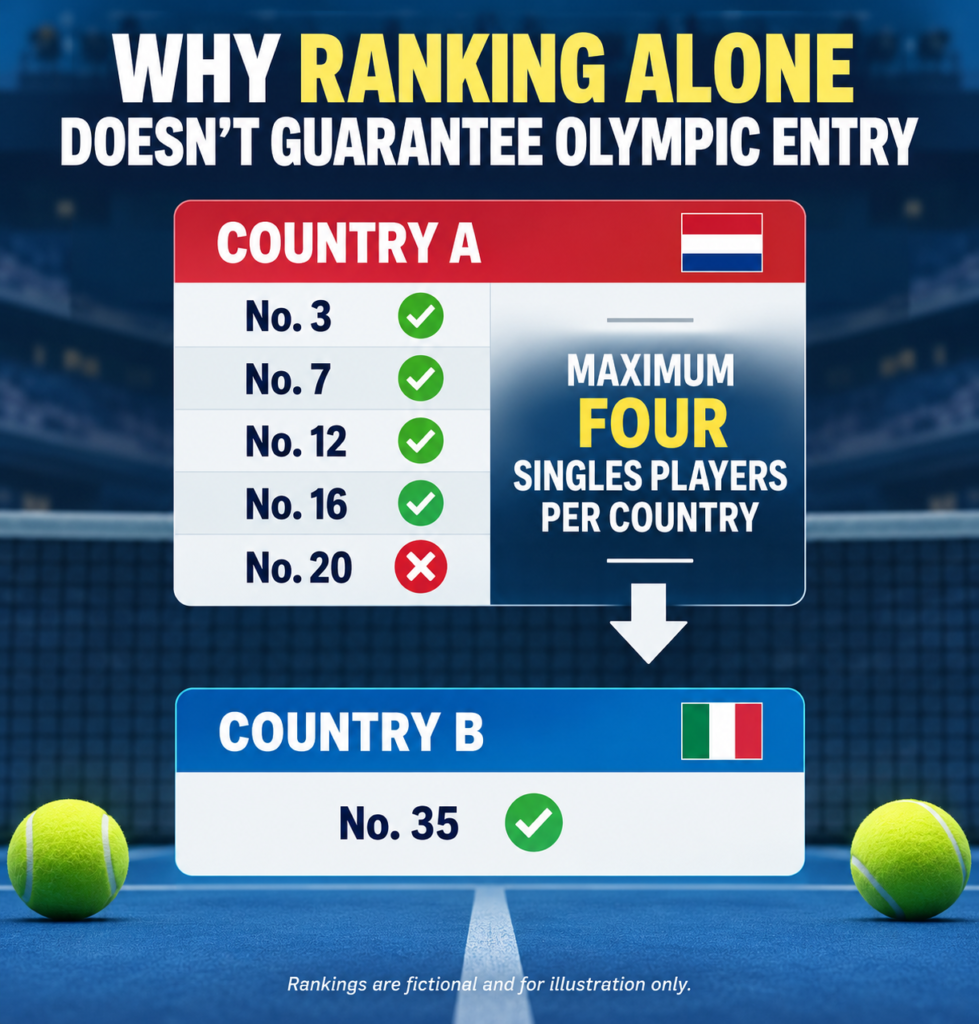
What Is the Four-Player Country Limit?
Each country can have a maximum of four players in each singles draw.
This can produce a situation that looks strange if you only look at the rankings.
Imagine:
No. 3 — Country A ✓
No. 7 — Country A ✓
No. 12 — Country A ✓
No. 16 — Country A ✓
No. 20 — Country A ✕
That fifth player could potentially miss out even though someone ranked substantially lower from another country gains entry.
Why?
Country A has already filled its four singles places.
This rule is one reason the Olympic field isn’t simply the world’s top 64 players. The official LA28 qualification system specifies a 64-player singles draw with a maximum of four athletes per National Olympic Committee.
What Are the Six ITF Places?
Ranking isn’t the only way to qualify for Olympic singles.
LA28 has six ITF Places in both the men’s and women’s singles draws.
Four are connected to designated continental multi-sport events:
2026 Asian Games
2027 African Games
2027 Pan American Games
2027 Pacific Games
The Pacific Games are part of the Olympic tennis qualification pathway for the first time.
The men’s and women’s singles champions at those four events can secure an ITF Place provided they satisfy the relevant requirements.
One important condition is ranking: the player must be inside the Top 500. The country’s four-player singles quota must also not already have been filled through direct acceptance.
The remaining two ITF Places are available through a pathway for eligible former Olympic singles gold medallists or Grand Slam singles champions who haven’t qualified directly.
Equivalent places helped Andy Murray and Stan Wawrinka enter Paris 2024.
There are further eligibility conditions, so these aren’t simply automatic invitations for any former major champion outside the direct-entry places.
What Is the Host Country Place?
Each LA28 singles draw also includes one Host Country Place within its 64-player allocation.
Because Los Angeles is hosting the Games, this provides a route for the United States to receive representation where the conditions of the host-country allocation apply.
Across all five tennis events, the LA28 qualification system contains host-country provisions rather than simply assuming the United States will qualify every entry through ranking.
In practice, a strong tennis nation such as the United States may secure many places directly.
But the host provision remains part of the official qualification architecture.
What Is a Universality Place?
The final singles position is a Universality Place.
There is one in men’s singles and one in women’s singles.
Universality Places exist within the wider Olympic system to help provide participation opportunities for eligible National Olympic Committees that have traditionally had limited representation at the Games.
Players still need to meet the applicable requirements.
This is another reason a 64-player Olympic field should never simply be described as “the top 64 players in the rankings.”
It isn’t.
Do Players Have to Play Davis Cup or Billie Jean King Cup?
There is a national-team participation requirement for LA28.
Under the current eligibility rules, a player generally must have been part of the final nominated Davis Cup or Billie Jean King Cup team and present at the tie or event on at least two occasions during the Olympic cycle, with at least one of those occasions occurring in 2027 or 2028.
However, this isn’t an absolute rule without exceptions.
The regulations allow consideration of special circumstances, including:
Injury or illness
A player becoming eligible for national-team selection only later in the Olympic cycle
The strength and depth of a country limiting selection opportunities
There are other eligibility requirements as well, including nationality and good-standing provisions.
For a full explanation of those team competitions, see Davis Cup Explained and Billie Jean King Cup Explained.
How Does Olympic Doubles Work?
Olympic doubles introduces one rule that dramatically changes potential partnerships:
Both players must represent the same country.
On the regular ATP and WTA Tours, doubles partners can come from completely different nations.
At the Olympics, they cannot.
At LA28 there will be:
32 men’s doubles teams
32 women’s doubles teams
Each country can enter a maximum of two teams in each doubles event.
This can create partnerships rarely seen during the rest of the season.
Two singles stars may decide to play together.
A leading singles player might join an established doubles specialist.
Meanwhile, regular Tour partners representing different countries must separate for the Olympics.
That national element makes Olympic doubles fundamentally different from most professional doubles tournaments.
How Does Mixed Doubles Work?
Mixed doubles features one man and one woman representing the same country.
The LA28 mixed doubles field contains 16 teams, with a maximum of one team per nation.
And Los Angeles is introducing an interesting scheduling change.
The entire mixed doubles tournament will be played during the first two days of Olympic tennis.
On July 19, the opening rounds will be played.
On July 20, the semifinals and medal matches will be completed.
Even more unusually, the opening day of the Olympic tennis programme will be devoted exclusively to mixed doubles, with men’s and women’s singles beginning on Day Two.
That gives mixed doubles a prominent place at the beginning of the event rather than fitting it around the singles tournaments.
How Are Olympic Tennis Matches Scored?
Olympic tennis uses familiar professional tennis scoring rather than creating an entirely separate Olympic scoring system.
The precise match regulations are published for each Games.
In the modern Olympics, matches have been played as best-of-three-set contests, although deciding-set procedures can differ by event.
For the purposes of understanding Olympic tennis, the important distinction isn’t really the scoring.
It’s everything surrounding it.
Players represent countries.
Entry is controlled by Olympic qualification rules.
There are medal matches.
And a bronze-medal playoff exists after the semifinals.
Do Players Earn ATP or WTA Ranking Points at the Olympics?
No.
Olympic tennis currently does not award ATP or WTA ranking points.
That means it doesn’t fit into the professional tournament hierarchy we’ve been covering elsewhere:
Grand Slam
↓
ATP Masters 1000 / WTA 1000
↓
ATP 500 / WTA 500
↓
ATP 250 / WTA 250
Olympic tennis sits outside that structure.
There is no equivalent:
Olympics = X ranking points
The reward is different.
🥇 Gold
🥈 Silver
🥉 Bronze
For many players, an Olympic medal is an achievement that stands separately from rankings and Tour titles.
Who Won Olympic Tennis Gold at Paris 2024?
Paris 2024 produced two memorable singles champions.
Novak Djokovic — Men’s Singles
Novak Djokovic defeated Carlos Alcaraz 7-6(3), 7-6(2) in the gold-medal match at Roland Garros.
It was Djokovic’s first Olympic gold medal and completed his career Golden Slam: winning all four Grand Slam singles tournaments and Olympic singles gold during his career.
Zheng Qinwen — Women’s Singles
Zheng Qinwen defeated Donna Vekic 6-2, 6-3 in the women’s final.
The victory made Zheng China’s first Olympic singles tennis champion.
Paris 2024 was also unusual because Olympic tennis was staged on the clay courts of Roland Garros rather than on hard courts.
What Is a Golden Slam?
A Golden Slam combines the four Grand Slam singles titles with Olympic singles gold.
There are two different concepts.
Career Golden Slam
Win:
Australian Open
Roland Garros
Wimbledon
US Open
Olympic singles gold
at some point during a career.
Calendar Golden Slam
Win all five during the same calendar year.
That is extraordinarily rare.
In singles, Steffi Graf achieved the calendar Golden Slam in 1988, winning all four majors and Olympic gold at Seoul in the same season.
No other singles player has matched that achievement.
Who Has Won Consecutive Olympic Singles Gold Medals?
Andy Murray achieved something else unique in Olympic singles tennis.
He won men’s singles gold at:
London 2012
and
Rio 2016
That made him the first player to successfully defend an Olympic singles title in the modern era and the only singles player to have won gold at consecutive Games.
His London victory came against Roger Federer, while he defeated Juan Martin del Potro in the 2016 final.
What Surface Is Olympic Tennis Played On?
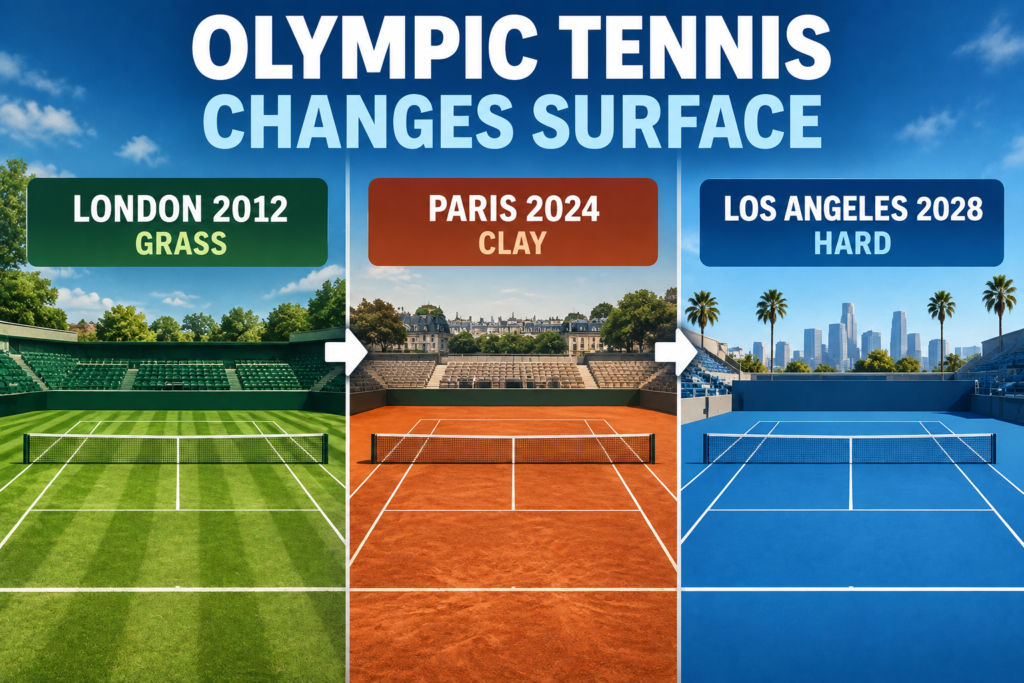
Unlike the Grand Slams, Olympic tennis doesn’t have a permanent home or surface.
The venue changes with the host city.
That can produce dramatically different conditions.
London 2012
Grass — Wimbledon
Paris 2024
Clay — Roland Garros
Los Angeles 2028
Hard court — Carson Courts
So Olympic tennis can effectively become a completely different tournament from one Games to another.
A player competing across several Olympic cycles could encounter grass, hard and clay courts.
Where Will Olympic Tennis Be Played in 2028?
The next Olympic tennis tournament takes place in Los Angeles.
Competition is scheduled for:
July 19-28, 2028
at:
Carson Courts
The venue contains 11 outdoor hard courts being used for the competition, including a permanent 10,000-seat centre court, two temporary show courts and eight additional courts.
LA28 will also mark the first time the Olympic tennis tournament has been scheduled across 10 days, expanding from nine.
The tournament will begin the week after Wimbledon.
That creates a rapid transition from grass-court Grand Slam tennis in London to Olympic hard-court tennis in California.
Olympic Tennis vs Grand Slams
The two can feature many of the same players, but they are fundamentally different competitions.
| Olympic Tennis | Grand Slam | |
|---|---|---|
| Frequency | Every four years | Four per year |
| Singles draw | 64 | 128 |
| Represents | Country | Individual |
| Maximum singles players per country | 4 | None |
| Bronze-medal match | Yes | No |
| ATP/WTA ranking points | No | Yes |
| Main prize | Olympic medal | Grand Slam title |
| Doubles partners | Same country | Any nationality |
| Surface | Changes by host | Fixed for each Slam |
Neither needs to be considered a replacement for the other.
Grand Slams remain the four major championships at the heart of professional tennis.
Olympic tennis offers something different: a rare opportunity to compete for a country and an Olympic medal.
Why Does Olympic Tennis Matter?
One reason is scarcity.
A Grand Slam is played four times every year.
An Olympics arrives once every four years.
A player with a 12-year career might have only three realistic opportunities to compete at the Games.
An injury at the wrong moment can eliminate one of them entirely.
There are also circumstances that simply don’t occur on the regular Tour.
A player ranked No. 20 might miss the singles tournament because four compatriots are ranked above them.
Two successful doubles partners can be forced onto different teams because they represent different countries.
A semifinal defeat doesn’t necessarily end the tournament because there is still a bronze medal to play for.
And after winning the final, the champion doesn’t receive 1,000 or 2,000 ranking points.
They receive an Olympic gold medal.
That is why Olympic tennis doesn’t need to fit neatly into the ATP or WTA tournament hierarchy.
It offers something the regular Tours cannot.
Frequently Asked Questions
Is tennis an Olympic sport?
Yes. Tennis appeared at the first modern Olympics in Athens in 1896 and returned permanently as a full medal sport at Seoul 1988.
How many tennis events are at the Olympics?
Five: men’s singles, women’s singles, men’s doubles, women’s doubles and mixed doubles.
How many players are in Olympic singles?
The men’s and women’s singles draws each contain 64 players.
How many players can one country enter in Olympic singles?
A maximum of four players from one country can compete in each singles event.
How many players qualify directly through the rankings for LA28?
There are 56 Direct Acceptance places in each singles draw based on the ATP and WTA singles rankings of June 12, 2028.
What are the other eight singles places?
Each LA28 singles draw also contains one Host Country Place, six ITF Places and one Universality Place. All allocations remain subject to the relevant eligibility criteria.
Can doubles partners represent different countries?
No. Olympic doubles partners must represent the same country.
How many doubles teams can one country enter?
At LA28, each country can enter up to two men’s doubles teams and two women’s doubles teams, subject to qualification requirements. A country can have a maximum of one mixed doubles team.
Do Olympic tennis players earn ATP or WTA ranking points?
No. Olympic tennis currently does not award ATP or WTA ranking points.
Is there a bronze-medal match?
Yes. The singles semifinal losers play for bronze.
Who won men’s singles gold at Paris 2024?
Novak Djokovic, who defeated Carlos Alcaraz 7-6(3), 7-6(2).
Who won women’s singles gold at Paris 2024?
Zheng Qinwen, who defeated Donna Vekic 6-2, 6-3.
Where will Olympic tennis be played in 2028?
At Carson Courts in Los Angeles, on outdoor hard courts, from July 19-28, 2028.
Final Thoughts
Olympic tennis looks familiar until you examine how it actually works.
The scoring is recognisable.
The players are familiar.
The court is still 78 feet long.
But almost everything surrounding the match changes.
Rankings help determine who gets in, but national quotas mean they don’t tell the whole story.
Players who spend the season competing as individuals suddenly represent their countries.
Regular doubles partners can be separated by nationality.
Semifinal losers receive another opportunity to win a medal.
And the champion receives no ATP or WTA ranking points.
Instead, there is something available only once every four years.
Olympic gold.
For a sport built around rankings, points and weekly tournaments, that makes Olympic tennis genuinely different.
Continue Reading
Laver Cup Explained
Davis Cup Explained
Billie Jean King Cup Explained
United Cup Explained
Grand Slams Explained
Tennis Ranking Points Explained
The ATP Tour Explained
The WTA Tour Explained
Read more of our instructional articles here.
Read more of our player focus articles here.
Follow The Tennis Site on X: @thetennissite
Follow Todd Scoullar on X: @toddscoullar

Comments are closed, but trackbacks and pingbacks are open.