
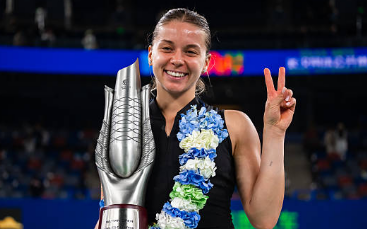
The Polish left-hander recovered from a set and a break down to defeat Sonay Kartal and claim her first WTA Tour title, adding a WTA 1000 championship to a season already defined by an extraordinary run to the Roland Garros final.
Maja Chwalińska’s remarkable season has delivered another extraordinary chapter.
The 25-year-old Polish player claimed the first WTA Tour singles title of her career on Sunday, recovering from a set and a break down to defeat Britain’s Sonay Kartal 2–6, 6–4, 6–2 in the Wuhan Open final.
The victory completed a memorable week in China, during which Chwalińska demonstrated that her stunning run to the Roland Garros final earlier this year was no isolated achievement.
It also delivered one of the more unusual milestones in modern women’s tennis.
Chwalińska became just the fourth player since the introduction of the WTA 1000 format in 2009 to claim her first tour-level singles title at this level, joining Naomi Osaka, Bianca Andreescu and Victoria Mboko.
For a player who began 2026 ranked outside the world’s Top 100, it’s fair to say she’s been a surprise packet.
And after Sunday’s victory, she is projected to climb to a career-high No. 11.
Kartal Takes Control of the Final
The opening stages suggested that Sonay Kartal might complete her own remarkable comeback story.
The British player, who entered Wuhan ranked World No. 170 after spending six months away from competition with a back injury, had already enjoyed the most successful tournament of her career.
Victories over Belinda Bencic, Jasmine Paolini, Elina Svitolina and Jelena Ostapenko had carried her into a first WTA 1000 final.
She began Sunday’s championship match with the same confidence that had characterised those performances.
Kartal attacked Chwalińska’s serve, struck aggressively from the baseline and prevented the Pole from establishing the varied patterns of play that had troubled her previous opponents.
Chwalińska’s attempts to change the pace with slices and drop shots initially proved ineffective, allowing Kartal to take control of the rallies.
The British player secured the opening set 6–2 and then broke serve immediately at the beginning of the second.
At that stage, the biggest title of Kartal’s career appeared within reach.
But Chwalińska had already demonstrated throughout the tournament that she was capable of recovering from difficult positions.
And the final was about to change.
Chwalińska Finds a Way Back
Trailing by a set and a break, Chwalińska began adjusting her approach.
Rather than relying exclusively on changes of pace, she started hitting with greater depth and finding more aggressive court positions.
Kartal continued to produce powerful groundstrokes, but the Pole’s improved consistency began forcing her opponent to play additional shots.
Kartal saved four break points in one second-set service game before Chwalińska eventually converted another opportunity to recover the early break.
The match became increasingly physical, with longer exchanges and fewer straightforward points.
At 4–3, Chwalińska secured another important break of serve, giving herself the opportunity to serve for the second set.
She eventually completed the turnaround 6–4 after a demanding set lasting 71 minutes.
The momentum shift was obvious.
Chwalińska later acknowledged that her level had been well below its best during the opening stages.
Speaking to the WTA after the match, she explained that her improved shot depth had helped her become more competitive.
More importantly, she identified the quality that had carried her through the difficult moments.
“What I’m proud of is the fighting spirit,” she said.
The assessment was consistent with her performances throughout the week. Chwalińska had repeatedly found solutions against opponents with different strengths, and Sunday’s final provided another example.
A Decisive Third Set
The deciding set initially remained competitive.
Both players continued to exchange powerful groundstrokes, but Chwalińska increasingly appeared comfortable extending rallies and varying their direction.
Her left-handed patterns, changes of pace and defensive skills began creating problems for Kartal.
The Pole secured a crucial break to lead 3–2.
From there, she gradually took control.
Kartal’s consistency deteriorated as the match progressed, with the British player committing 11 unforced errors during the deciding set.
Chwalińska continued to apply pressure, mixing defensive lobs with aggressive groundstrokes and repeatedly forcing her opponent into uncomfortable positions.
Serving for the championship, Chwalińska still had to overcome three break points before finally securing victory.
When Kartal’s final return sailed long, the Polish player dropped to the court in celebration.
After a difficult opening set and a lengthy battle to regain control, she had claimed the biggest title of her career.
Kartal was understandably disappointed but acknowledged the quality of the contest.
“That was one heck of a battle,” she said afterwards.
From Roland Garros Qualifier to WTA 1000 Champion
Chwalińska’s Wuhan victory becomes even more remarkable when considered alongside the events of the previous few months.
At Roland Garros in June, she produced one of the most unexpected runs in recent Grand Slam history.
Entering through qualifying, the Pole progressed all the way to the women’s singles final.
She became the first qualifier to reach the Roland Garros women’s singles championship match in the Open Era.
Her journey eventually ended against Mirra Andreeva, but the performance changed expectations surrounding her career.
Chwalińska had shown that she possessed the tactical variety, defensive ability and composure required to compete against the world’s leading players.
What remained uncertain was whether she could reproduce that level consistently.
Her success on outdoor hard courts demonstrates that her game is not dependent on the slower clay-court conditions that helped her breakthrough in Paris.
Throughout the week, Chwalińska used changes of pace, court positioning and intelligent shot selection to disrupt opponents who often possessed greater outright power.
The result was another appearance in a major final. This time, she finished the job.
A Difficult Road to the Wuhan Title
Chwalińska’s route through the Wuhan draw was far from straightforward.
After defeating Mayar Sherif in the opening round, she recovered from losing the first set against Marie Bouzková.
She then eliminated Iva Jović before surviving a demanding three-set quarterfinal against Maria Sakkari.
That victory set up an intriguing semifinal against childhood friend and former junior doubles partner Iga Świątek.
The all-Polish encounter carried considerable significance, particularly given the contrasting trajectories of the two players.
Świątek had already established herself among the sport’s most successful competitors, while Chwalińska was still attempting to convert her breakthrough season into a first tour-level championship.
The semifinal was complicated by a left-leg injury suffered by Świątek.
The former World No. 1 had led 5–3 in the opening set and held two set points before requiring medical treatment.
Chwalińska recovered to take the opening set and eventually completed a 7–5, 6–1 victory.
Although Świątek’s injury clearly affected the contest, Chwalińska had already shown resilience by saving those two set points.
The victory sent her into the Wuhan final and presented another opportunity to claim a major championship.
Kartal’s Extraordinary Comeback Deserves Recognition
While Chwalińska leaves Wuhan with the trophy, Kartal’s achievement should not be overlooked.
The British player had only recently returned to competition following a prolonged absence caused by a back injury.
Her ranking had fallen to No. 170, leaving her facing the difficult task of rebuilding her position on the WTA Tour.
Her performances against established opponents made it clear that she had retained the aggressive baseline game and competitive determination that previously carried her into the world’s Top 60.
Kartal also showed considerable composure in difficult moments, particularly during her semifinal against Ostapenko.
Although she was unable to maintain her advantage in the final, the tournament is absolutely a major step forward in her comeback.
She is projected to climb to World No. 50, a rise of 120 places from her ranking entering Wuhan.
What Wuhan Means for Chwalińska’s Future
Winning a WTA 1000 title changes a player’s career in several ways.
The ranking points can dramatically improve tournament entry and seeding opportunities, while the financial rewards provide greater security and flexibility.
Perhaps most importantly, a title at this level establishes a player as someone capable of winning against strong opposition over an entire tournament.
Chwalińska has now proven that ability on different surfaces and under very different circumstances.
Her Roland Garros campaign showed that she could compete at Grand Slam level, and now Wuhan has shown that she can convert a major opportunity into a championship.
The Pole will also leave China with a projected career-high ranking of No. 11, placing her close to the world’s Top 10 for the first time.
Afterwards, Chwalińska acknowledged the significance of the achievement.
“It tastes very sweet,” she told the WTA.
There was also a sense that the success had arrived after a demanding period of adjustment following her French Open breakthrough.
Chwalińska explained that she had faced difficult moments after Paris but continued working towards further improvement.
Her reward has been the biggest title of her career.
Whether she can maintain that momentum remains to be seen, but the evidence from 2026 suggests that she has established herself as a genuine contender at the highest level.
Continue Reading
- Sonay Kartal and Maja Chwalińska — Wuhan Final Preview
- WTA 1000 Explained: Tournaments, Ranking Points and How They Work
- The WTA Tour Explained: Tournaments, Rankings and Structure
- Live Tennis Rankings Explained
Read more of our exclusive feature articles here.
Read more of our player focus articles here.
Follow The Tennis Site on X: @thetennissite
Follow Todd Scoullar on X: @toddscoullar

Comments are closed, but trackbacks and pingbacks are open.