
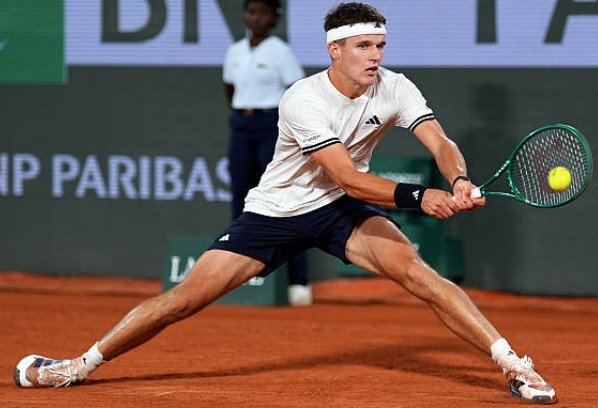
The first four Roland Garros quarterfinals didn’t quite match the epic matches we’ve seen in the previous 9 days, but there were still plenty of interesting storylines. Rain forced the roof closed over Court Philippe-Chatrier for parts of the afternoon, altering the atmosphere and slowing the conditions down considerably. What emerged were a couple of very different narratives: youthful breakthroughs on one hand, and the weight of expectation on the other.
In the standout men’s quarterfinal, 20-year-old Czech Jakub Mensik ended the spectacular run of 19-year-old Brazilian Joao Fonseca, winning 6-4, 6-3, 7-6(3) in straight sets during the night session on Philippe-Chatrier. Mensik, who had collapsed with severe cramps and dehydration after his second-round match against Mariano Navone — requiring a wheelchair to leave the court — showed impressive physical recovery and tactical maturity. He attacked effectively throughout, winning 13 of 15 serve-and-volley points compared to Fonseca’s lone attempt.
“It was one of my best performances so far,” Mensik said afterward. “I knew it was going to be a tough one. In the end of the match there were some incredible shots.” The tall Czech saved six match points in the third set before dominating the tiebreak, maintaining his composure when the match could have easily taken another turn.
Fonseca’s run had been one of the (many) stories of the tournament. The 28th seed had defeated Novak Djokovic in five sets in the third round and then knocked out two-time finalist Casper Ruud. While there has been plenty of hype around him over the last 18 months, the last week has seen it hit a new high. However, Mensik remains a step ahead having a Masters1000 title already under his belt. He now finds himself in his first Grand Slam semifinal where he will face second seed Alexander Zverev.
Zverev reached his fifth Roland Garros semifinal in the last six years with a commanding performance against 19-year-old Spaniard Rafael Jodar. After a competitive first set that reached a tiebreak, the German took complete control, winning 7-6(7), 6-1, 6-3. Zverev has dropped just one set in the entire tournament up to this point and looked increasingly comfortable dictating play from the baseline while serving with authority.
“As I said before, I don’t particularly care (about being the favourite),” Zverev told reporters. “I focus on next match, and I focus on the opponent as they cross the net, and that’s the only thing that I can control.” He acknowledged the draw had opened following the early exits of Jannik Sinner and Novak Djokovic but refused to look beyond Mensik. Jodar, who had climbed from outside the top 700 a year ago, and has deservedly received praise and hype within the tennis world, paid tribute to the German afterward, admitting his experience on the big stage as a major advantage in pressure moments.
The women’s quarterfinals carried significant emotional weight. Fifteenth seed Marta Kostyuk defeated fellow Ukrainian Elina Svitolina 6-3, 2-6, 6-2 in a high-intensity battle to reach her first major semifinal. At 2-2 in the third set, the match was as evenly poised as it could be. Then Kostyuk appeared to flick a switch, as she absolutely destroyed Svitolina in the last four games of the match. This was the first all-Ukrainian quarterfinal at a Grand Slam in the professional era. Kostyuk improved her remarkable 2026 clay-court record to 17-0 and became the first Ukrainian woman to reach the French Open semifinals.
Speaking after the match, Kostyuk fought back tears while addressing events back home. “We had a very difficult night again in Ukraine, especially in Kyiv, so many people dead,” she said. “I want to give this match to Ukrainian people and to their resilience. Glory to Ukraine!” She has been outspoken about the ongoing war and explained how she tries to separate the news from her performance: “I will change absolutely nothing, and I will just not get any sleep… I’m here to represent Ukraine and to enjoy.”
Svitolina, who has now fallen at the French Open quarterfinal stage for the sixth time, expressed support for her compatriot moving forward. “I will be watching the match and definitely cheering for her, hopefully that she can get the title,” Svitolina said. “It’s going to be massive for Ukraine.”
Kostyuk will face eighth seed Mirra Andreeva in the semifinals. The 19-year-old Russian produced the most dominant performances of the day, defeating retiring Romanian veteran Sorana Cirstea 6-0, 6-3 under the closed roof. Andreeva was relentless from the baseline and effective at the net, finishing with 18 winners.
“I felt like it was one of my best matches so far this tournament,” Andreeva said. “Super happy to be back in semis.” This will be a rematch of the Madrid final, which Kostyuk won in straight sets. When asked about facing a Ukrainian opponent during wartime, Andreeva stayed diplomatic: “For me it doesn’t matter who I play. I really try to play against the ball that is coming at me.”
Cirstea, playing what is expected to be her final Roland Garros, reflected on her long career. “I’m sticking to my decision. Nothing changed in my mind,” the 36-year-old said. “I’m just very grateful… the longevity of my career is one of the things I’m the most proud of.”
Day 10 showed just how much a tennis tournament can change within the two weeks. After the first 9 days of heat and oppressive conditions, players had to deal with indoor, cooler conditions. We also had epic match after epic match, but the first batch of quarterfinals were somewhat less dramatic. But there’s still four to go on day 11.
Read more of our exclusive feature articles here.
Read more of our player focus articles here.
Follow The Tennis Site on X: @thetennissite
Follow Todd Scoullar on X: @toddscoullar

Comments are closed, but trackbacks and pingbacks are open.