
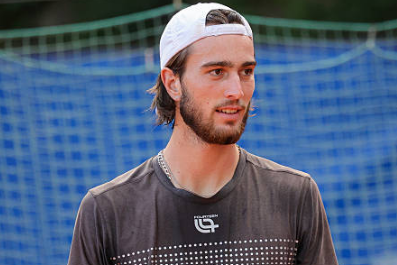
Kilian Feldbausch had unfinished business with Marvin Möller when the pair met in the final of the Monastir Challenger on 15 November.
Four months earlier, the German had beaten Feldbausch in the final at Troyes, denying the Swiss youngster a second ATP Challenger title. A week before their meeting in Tunisia, Feldbausch had also fallen short in the Taranto final, losing to France’s Matteo Martineau.
This time, Feldbausch made the most of his opportunity.
The 21-year-old defeated Möller 6–1, 6–2 in just over an hour to claim his second Challenger title and complete a fortnight in which he reached consecutive finals on hard courts.
The victory lifted him 43 places to a career-high No. 195 in the ATP rankings published on 16 November, taking him inside the world’s top 200 for the first time.
For a player whose early professional career has been interrupted by injury, including hip surgery in 2024, it was a welcome result in his efforts to establish himself on the Challenger circuit.
Tennis runs in the family
Feldbausch was born in Geneva into a family with considerable professional tennis experience.
His mother, Cathy Caverzasio, reached a career-high WTA singles ranking of No. 34 in 1990. His father, Michael Feldbausch, competed professionally and reached No. 706 in the ATP rankings, while his grandfather, Franz Feldbausch, represented Germany in the Davis Cup in 1956.
Both parents have played an important role in his development, providing coaching and support as he progressed through junior tennis and into the professional ranks.
As a junior, Feldbausch found himself among the leading players of his generation, reaching No. 5 in the ITF junior rankings.
His best Grand Slam result came at the 2022 Australian Open, where he reached the boys’ singles semi-finals. He would lose in three sets to a young man named Jakub Mensik. He also made the quarter-finals at Wimbledon and the US Open that year.
Those performances suggested he was a young man with the potential to make a successful transition to professional tennis, but injuries complicated his progress.
Feldbausch underwent preventative hip surgery in April 2024, following a period in which physical problems had repeatedly interrupted his development.
He returned to competition later that year, although rebuilding his confidence proved difficult.
Speaking to Tennis.com during a Challenger tournament in the Canary Islands in 2025, Feldbausch recalled the frustration of his early results following surgery.
“That was a tough time. I lost almost every match when I came back. But later I was able to regain some confidence.”
His family remained closely involved throughout the recovery.
“Both of my parents coach me. My uncle is also sometimes with me when my mother has to work back home. It helps me a lot to have my family around.”
Feldbausch had returned to winning ways on the ITF World Tennis Tour towards the end of 2024, claiming an ITF title in Antalya, Turkey. However, he was still ranked outside the top 400 when interviewed in 2025 and frequently needed to compete in qualifying to enter Challenger main draws.
The obvious challenge was to establish enough consistency to lift his ranking to a level where he could compete regularly at the next level.
The breakthrough in Košice
Feldbausch’s first major success on the Challenger circuit arrived in May 2026 at the Košice Open in Slovakia. He defeated Czech player Martin Krumich 6–0, 4–6, 6–4 in the final to claim his maiden Challenger singles title.
The result earned him 50 ranking points and secured his first appearance inside the world’s top 300.
It was a big confidence boost for Feldbausch, who had spent much of the previous two seasons trying to recover his fitness and prove to himself and the tennis world that he could match it against stronger professional opposition.
The following months brought further progress.
In July, he reached the final of the Troyes Challenger in France, where Möller defeated him 7–6(5), 6–3. He also gained experience at ATP Tour level, recording a main-draw victory over Paraguayan Adolfo Daniel Vallejo at Kitzbühel.
By August, Feldbausch had climbed to No. 230 in the rankings, but breaking into the top 200 remained an obvious target.
The last few weeks of season 2026 have seen that target eclipsed in decisive style.
A productive fortnight in November
Feldbausch began November at the Taranto Challenger in Italy, where he progressed through four rounds to reach his third Challenger final of the season.
Among his victories was a tough quarter-final against former top-100 player Sumit Nagal. Feldbausch won the opening set but was pushed into a deciding tiebreak before completing a 6–3, 5–7, 7–6(4) victory.
He followed that performance by defeating Italian Carlo Alberto Caniato 6–4, 6–4 in the semi-finals.
Martineau proved too strong in the championship match, winning 6–3, 6–2, but Feldbausch had accumulated another valuable week of ranking points and match experience.
He travelled to Tunisia for the Monastir Challenger without much of a rest break between tournaments.
His opening two matches would test that fitness.
Against Portugal’s Tiago Pereira, Feldbausch recovered from losing the first set to win 3–6, 6–4, 7–5.
He then faced French qualifier Maé Malige, again dropping the opening set before recovering to win 5–7, 7–5, 6–2.
Having survived those encounters, Feldbausch progressed through the quarter-finals and semi-finals without dropping another set.
That brought him into a rematch with Möller, who had defeated him in the Troyes final four months earlier.
Feldbausch dominated their second Challenger final meeting, winning 80 per cent of his service points and 55 per cent of points played on Möller’s serve.
The 6–1, 6–2 victory gave him his second Challenger title and completed a run of nine wins from ten matches across Taranto and Monastir.
He also proved to himself that he absolutely has the ability to maintain a high level of performance through consecutive tournaments, something that had previously been difficult during his injury-interrupted development.

What the top 200 means
Feldbausch’s Monastir victory earned him 50 ranking points and lifted him from No. 238 to No. 195 in the ATP rankings published on 16 November.
The improvement has practical implications beyond just a number itself.
At Challenger level, direct entry into tournaments depends largely on a player’s ranking and the strength of the field. A place inside the top 200 can provide greater access to main draws of the larger Challengers, reducing the need to compete in qualifying and allowing players to plan their schedules with more certainty.
It will also guarantee opportunities to enter Grand Slam qualifying tournaments, where a player like Feldbausch can earn a substantial amount of money to help fund the season.
For Feldbausch, implications like that are particularly relevant after several seasons in which injuries disrupted his ability to compete consistently.
His results in 2026 have also shown that he can perform on different surfaces.
The Košice title came on clay, while his consecutive finals in Taranto and Monastir were played on hard courts. With more and more ATP events moving to the hard-court, being able to adapt to both surfaces will be vital as he makes his way through the ranks.
There is still a considerable difference between winning Challenger 50 events and establishing oneself against top-100 opposition, but Feldbausch is now in a stronger position to pursue those opportunities.
For more on how tournament categories affect a player’s ranking and progression, see our complete guide to the ATP Challenger Tour.
Looking towards 2027
Feldbausch’s progress over the past six months has been substantial.
He began the season ranked #383, entered the world’s top 300 after winning in Košice, reached another Challenger final in Troyes and finished the autumn with consecutive finals and a second title, breaking into the top 200.
Perhaps most encouragingly, he has been able to build momentum through regular competition, something that was difficult during his recovery from hip surgery.
As a former world No. 5 junior, Feldbausch has long been regarded as a promising Swiss prospect. His task now is to demonstrate that he can produce consistent results against increasingly strong professional fields.
After spending much of his early professional career managing injuries and rebuilding confidence, he will approach the new season with two Challenger titles, a career-high ranking and considerably more experience against established professional opposition.
He might not be the heir to Roger Federer, but at age 21, the Swiss tennis fans might see a lot more of him over the next decade.
Continue Reading
- ATP Challenger Tour Explained: Levels, Ranking Points and How It Works
- ATP Challenger Results: Virtanen, Harris and Feldbausch Win — 9–15 November 2026
- ITF World Tennis Tour Explained: Levels, Ranking Points and How It Works
Read more of our exclusive feature articles here.
Read more of our player focus articles here.
Follow The Tennis Site on X: @thetennissite
Follow Todd Scoullar on X: @toddscoullar

Comments are closed, but trackbacks and pingbacks are open.