

Why can a player win a tournament and barely move in the rankings, while another jumps 30 places after one exceptional week?
Why can someone lose in the first round and still move higher?
And why does a player sometimes fall dramatically in the rankings exactly one year after producing one of the best results of their career?
The answer is ranking points.
Professional tennis uses ranking points to measure players’ results over time. The further a player progresses at a tournament — and the more important that tournament is — the more points are generally available.
Those points determine the ATP and WTA world rankings, which in turn affect tournament entry, seedings and a player’s pathway through professional tennis.
The basic idea is straightforward.
The details are considerably more complicated.
Quick Answer: How Do Tennis Ranking Points Work?
Professional tennis players earn ranking points according to their results at eligible tournaments.
The number of points available depends primarily on:
- The level of the tournament
- How far the player progresses
- The ranking rules governing which results count towards their total
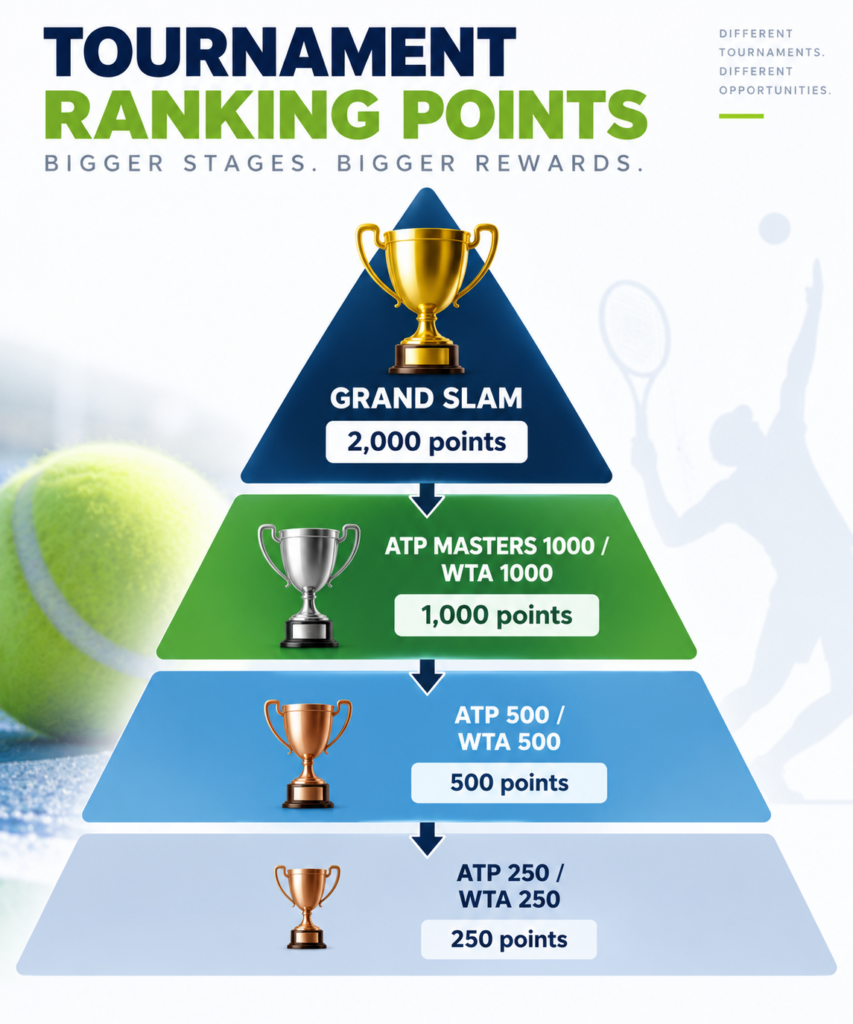
At the highest level, a Grand Slam singles champion earns 2,000 ranking points.
A WTA 1000 or ATP Masters 1000 champion earns 1,000.
A WTA or ATP 500 champion earns 500.
A WTA or ATP 250 champion earns 250.
Points are also available at lower professional levels.
However, a player’s official ranking isn’t simply every point they’ve ever earned added together. ATP and WTA rankings operate using defined ranking periods and rules determining which tournament results contribute to the player’s total.
Why Does Tennis Have Ranking Points?
Professional tennis doesn’t have a single league table where every player competes against every other player.
Thousands of players compete at different tournaments in different countries throughout the year.
A ranking system is therefore needed to compare their results.
Ranking points provide that common measure.
A player who consistently reaches the later rounds of major tournaments accumulates considerably more points than someone regularly losing in early rounds.
Those totals are then used to create the official world rankings.
At the time of writing, for example, the ATP and WTA both publish ranking tables based on points accumulated under their respective systems.
How Do Players Earn Ranking Points?
The fundamental rule is:
The further you progress, the more points you earn.
Consider the current ATP points available at a Grand Slam:
| Result | ATP Ranking Points |
|---|---|
| Champion | 2,000 |
| Finalist | 1,300 |
| Semifinal | 800 |
| Quarterfinal | 400 |
| Round of 16 | 200 |
| Round of 32 | 100 |
| Round of 64 | 50 |
| First round | 10 |
The champion therefore receives considerably more than simply twice the points of a semifinalist.
That weighting rewards players heavily for winning tournaments and reaching the very final stages of the biggest events.
How Many Ranking Points Does a Grand Slam Winner Get?
A Grand Slam singles champion receives 2,000 ranking points.
That applies to both the ATP and WTA rankings.
The four Grand Slams are:
- Australian Open
- Roland Garros
- Wimbledon
- US Open
They offer the largest number of ranking points available from a single standard knockout tournament.
Winning one Grand Slam therefore provides the same headline number of ranking points as winning two 1000-level tournaments or four 500-level tournaments.
That comparison helps explain why Grand Slam results can have such an enormous influence on the rankings.
See Grand Slams Explained for more on where the majors fit into professional tennis.

ATP Ranking Points by Tournament Level
At ATP level, the name of the tournament category usually provides an immediate clue to the maximum number of points available to the champion.
| Tournament | Champion |
|---|---|
| Grand Slam | 2,000 |
| ATP Finals | Up to 1,500 |
| ATP Masters 1000 | 1,000 |
| ATP 500 | 500 |
| ATP 250 | 250 |
The ATP Finals are unusual because they use a round-robin format before the semifinals and final. An undefeated champion can collect a maximum of 1,500 points.
Below the main ATP Tour, ranking points are also awarded at ATP Challenger and eligible ITF World Tennis Tour events.
For the complete men’s professional structure, see The ATP Tour Explained.
WTA Ranking Points by Tournament Level
The main WTA categories follow a similar structure:
| Tournament | Champion |
|---|---|
| Grand Slam | 2,000 |
| WTA Finals | Up to 1,500 |
| WTA 1000 | 1,000 |
| WTA 500 | 500 |
| WTA 250 | 250 |
| WTA 125 | 125 |
The alignment between tournament names and winners’ ranking points makes the basic hierarchy much easier to understand than it once was.
A recent WTA 500 points breakdown, for example, awarded 500 points to the champion, 325 to the finalist, 195 to semifinalists and 108 to quarterfinalists.
For more on the women’s professional circuit, see The WTA Tour Explained.
Do ATP and WTA Players Receive the Same Number of Points?
At the headline level, many of the major tournament categories now align.
Both men’s and women’s singles champions receive:
Grand Slam: 2,000
1000 level: 1,000
500 level: 500
250 level: 250
But that does not mean the entire ATP and WTA ranking systems are identical.
Points awarded in earlier rounds, rules governing which results count and other ranking regulations can differ between the tours.
It is therefore better to think of the ATP and WTA as separate ranking systems with increasingly similar tournament-category structures, rather than one universal tennis ranking system.
Do You Get Ranking Points for Losing?
Yes — depending on the tournament and the round reached.
You don’t have to win a tournament to earn ranking points.
At a Grand Slam, for example, substantial points are available simply for progressing through the draw.
A semifinalist receives hundreds of points despite losing before the final.
At some levels, however, a first-round main-draw loss earns no ranking points.
Under the current ATP system, for example, no ranking points are awarded for a first-round loss at ATP 500, ATP 250, ATP Challenger or ITF Men’s World Tennis Tour events. Grand Slam first-round losers receive points under the ATP table.
The precise allocation therefore depends on the competition.
Do Qualifiers Earn Ranking Points?
Yes.
Qualifying can itself produce ranking points.
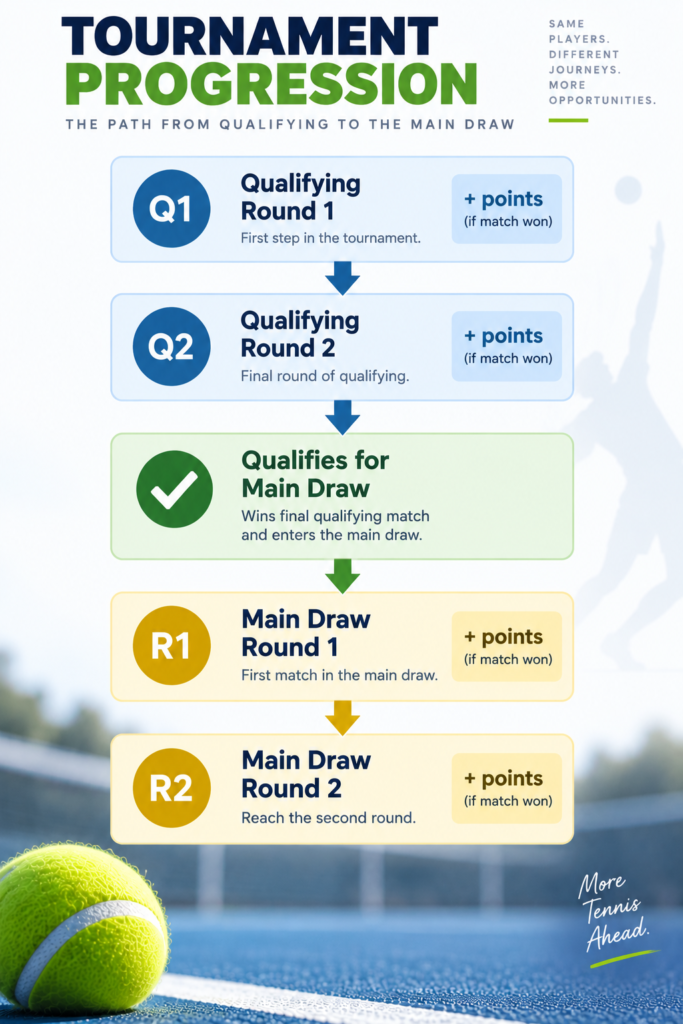
Under the ATP system, players who successfully qualify for a main draw can receive qualifying points in addition to points earned through their subsequent main-draw performance.
Players who lose during qualifying can also receive points at certain tournament levels depending on how far they progress.
This can be particularly important for players outside the world’s elite.
A player might enter qualifying, win several matches, reach the main draw and then win another match.
Even without reaching the later stages of the main tournament, that week could produce a meaningful ranking improvement.
See What Is a Qualifier in Tennis? for a full explanation of qualifying.
What Happens to Ranking Points After a Tournament?
This is where tennis rankings become more difficult to understand.
Ranking points aren’t permanent.
ATP and WTA rankings generally operate across a rolling ranking period, meaning older results eventually leave the player’s ranking calculation as new results are added.
That produces the familiar tennis expression:
“The player has points to defend.”
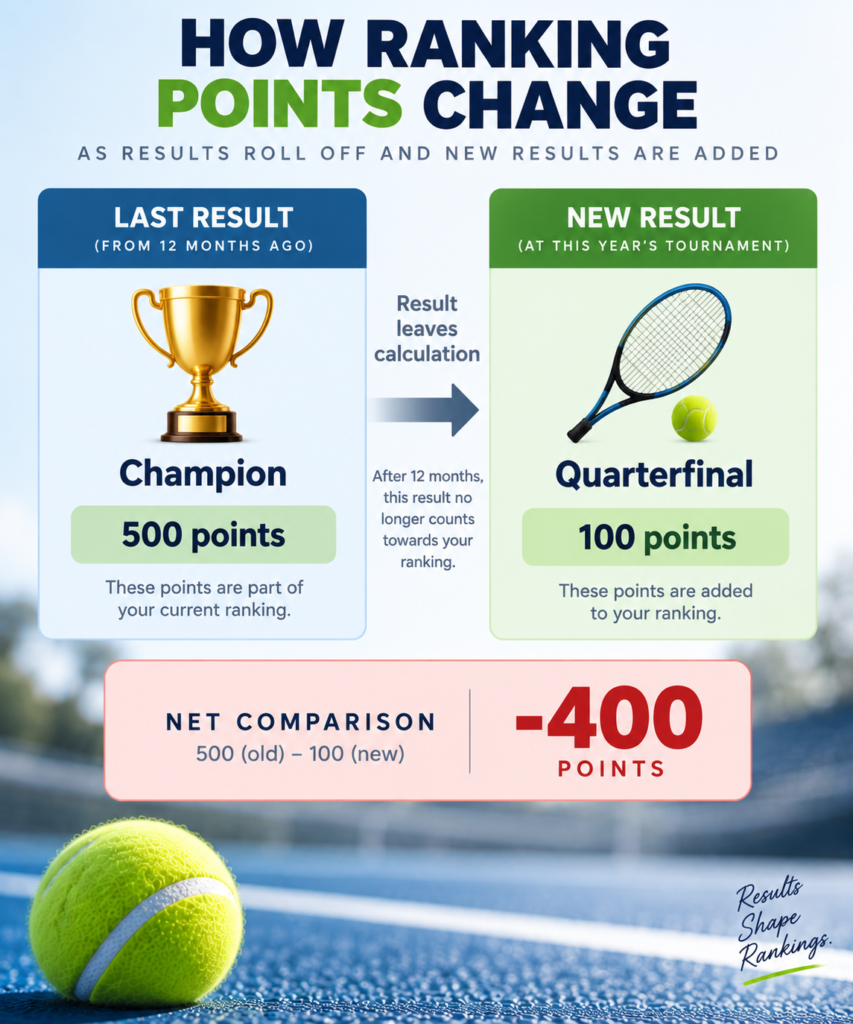
Suppose a player wins a tournament and earns 500 points.
Around the corresponding period the following year, that previous result will cease contributing in the same way to the ranking calculation.
The player therefore needs new results to maintain their overall total.
What Does “Defending Ranking Points” Mean?
Imagine a player won a 500-level tournament during the relevant period last year.
That result was worth:
500 points
This time, they lose in the quarterfinals and earn:
100 points, using a hypothetical round allocation for simplicity.
Once the previous result leaves the ranking calculation and the new result is reflected, the player could effectively be 400 points worse off from those corresponding results.
That doesn’t mean the Tour has punished them or physically deducted 400 newly earned points.
It means a valuable old result is no longer contributing and has been replaced by a less valuable one.
This is why players can reach the quarterfinals of a tournament and still fall significantly in the rankings.
Can a Player Gain Points Without Improving Their Ranking?
Yes.
Ranking points and ranking positions are related, but they aren’t the same thing.
Suppose Player A has:
3,000 points – ranked No. 15
They then increase their total to:
3,150 points
But the players immediately above them also have strong tournaments and increase their totals.
Player A might remain No. 15 despite earning another 150 points.
The opposite can also happen.
A player’s points total might remain unchanged while they move higher because players above them lose points.
Rankings are relative.
Your position depends on your total compared with everyone else’s.
Can a Player Lose Points After Winning Matches?
Yes.
This often confuses newer tennis fans.
Suppose a player is defending 1,000 points from winning a tournament during the corresponding previous ranking period.
This year they reach the semifinal.
They’ve won several matches and produced an excellent result.
But if the new result contributes only 400 points where a 1,000-point result previously contributed, their overall ranking total can still fall.
Winning matches does not necessarily mean gaining net ranking points.
The old result being replaced matters enormously.
Why Do Some Results Not Count?
This is one of the areas where the ranking system becomes more technical.
A player’s ranking isn’t necessarily the simple total of every tournament they play.
ATP and WTA regulations determine which results are included in the player’s ranking calculation, including requirements surrounding particular tournament categories and limits on counting results.
The WTA singles ranking, for example, operates under rules governing the player’s eligible results across the previous 52-week period, while the ATP has its own rules determining the tournaments included in a player’s ranking breakdown.
This means playing more tournaments doesn’t automatically guarantee a higher ranking.
A player needs better counting results, not simply more results.
What Is a “Best Result”?
Imagine a simplified system where only five tournament results counted.
A player has results worth:
500
300
250
100
80
Their total would be:
1,230 points
Now suppose they play another tournament and earn only 50 points.
If only the best five results count, that 50-point result wouldn’t improve the ranking because it is worse than the existing 80-point fifth result.
But if they earn 200 points, the 200 could replace the 80.
Their new total becomes:
500 + 300 + 250 + 200 + 100 = 1,350
The real ATP and WTA systems are more complicated than this example, particularly because of mandatory and other counting requirements, but the principle helps explain why not every tournament result necessarily increases a player’s ranking total.
Why Can’t Players Just Play More Tournaments to Get a Higher Ranking?
Because ranking systems aren’t designed simply to reward volume.
If every tournament counted equally towards an unlimited total, players who competed almost every week could potentially gain an enormous advantage simply by playing more frequently.
Instead, the ranking systems place limits and requirements around which results form the player’s ranking.
That means quality matters.
A player who produces strong results at major tournaments can rank considerably higher than someone who plays many more events but consistently earns small numbers of points.
This also helps protect players from feeling they must compete every week purely to accumulate ranking points.
What Are Live Ranking Points?
During tournaments, ranking calculations can change before the next official ranking list is published.
This is where Live Rankings Explained becomes relevant.
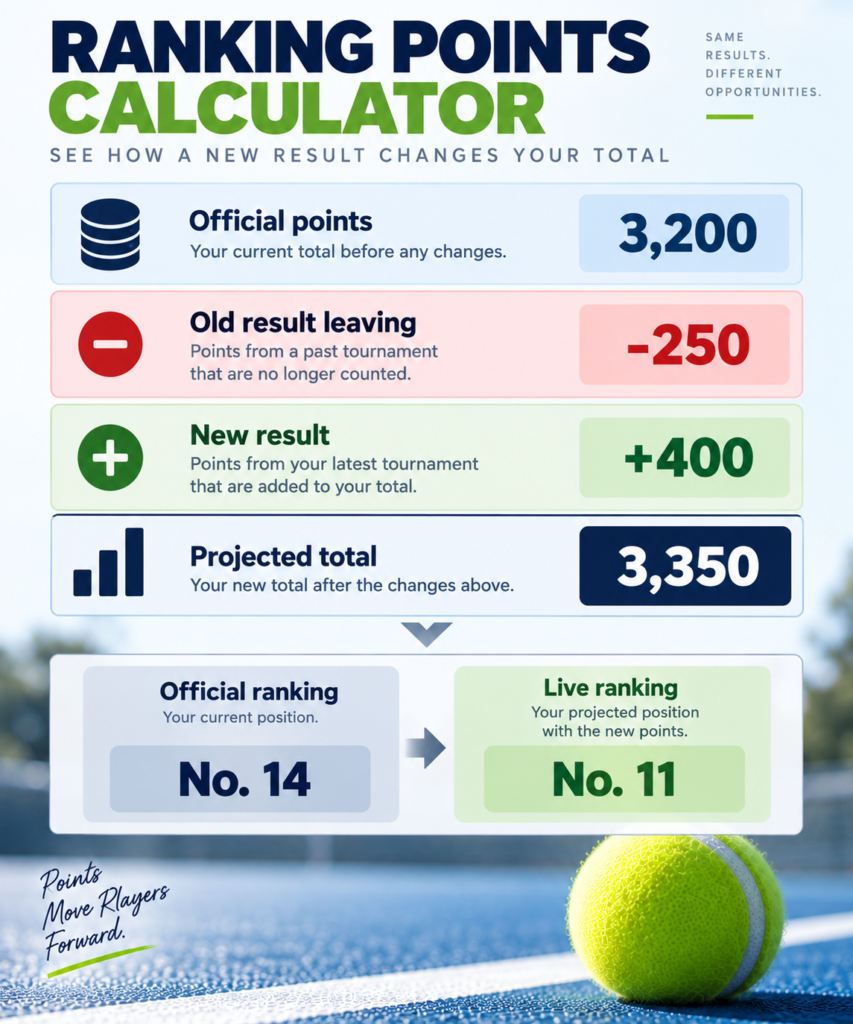
Live ranking services calculate how players’ points totals and ranking positions are projected to look based on current tournament results.
For example:
Official points: 3,200
Points dropping: 250
Points earned this week: 400
Projected live total:
3,350
That projected total may then move the player above competitors in the live rankings.
Ranking Points vs the ATP and WTA Race
The official world rankings shouldn’t be confused with the Race.
The normal rankings use a rolling ranking period.
The ATP Race to Turin and the Race to the WTA Finals focus on qualifying results from the current season.
This is why a player’s normal ranking and Race position can look very different early in the year.
Imagine a player produced outstanding results late last season but starts the new year poorly.
Their world ranking may remain high because some of those previous results are still contributing.
But their Race position could be much lower because the Race is concerned with the current season.
As the year progresses, the Race becomes increasingly important because it determines qualification for the season-ending ATP and WTA Finals.
How Many Points Are Needed to Be World No. 1?
There is no fixed number.
This is critical.
A player does not become world No. 1 by reaching a predetermined total such as 10,000 points.
They become No. 1 by having more ranking points than every other eligible player.
In one era, 8,000 points might be enough.
At another time, a player may need considerably more.
It depends entirely on the results being produced by the leading players.
The same applies to every ranking position.
There is no fixed number of points required to become No. 10, No. 50 or No. 100.
How Many Points Do You Need to Reach the Top 100?
Again, there is no fixed threshold.
The number changes continually.
To reach the Top 100, a player simply needs a ranking total high enough to exceed the player currently occupying approximately the 100th position.
This makes the lower reaches of the rankings particularly dynamic.
Players competing on the Challenger Tour, WTA 125 circuit and ITF World Tennis Tour are constantly trying to accumulate enough points to reach ranking thresholds that provide access to bigger tournaments.
That is why a Challenger title or strong series of ITF results can be career-changing even though the points involved are much smaller than those available at a Grand Slam.
Why Is the Top 100 So Important?
Being around the Top 100 can significantly change a professional player’s career.
Higher rankings can provide improved access to:
- Grand Slam main draws
- ATP and WTA Tour events
- Qualifying competitions at larger tournaments
- Better positions on tournament entry lists
A player ranked No. 250 may spend much of the year competing at Challenger or ITF level.
Move towards the Top 100 and suddenly the opportunities can look very different.
This creates a powerful cycle:
Better results → more ranking points → higher ranking → access to bigger tournaments → opportunity to earn more points.
The reverse can also occur when a player loses ranking points and drops into lower tournament levels.
Do Wild Cards Earn Ranking Points?
Yes.
A player’s method of entry doesn’t normally prevent them from earning ranking points from subsequent results.
A Wild Card who progresses through a tournament can earn ranking points according to the applicable rules.
However, there can be specific provisions affecting points at particular stages. For example, the ATP’s current rules state that wild cards at Grand Slams and ATP Masters 1000 events receive points only from the second round.
Once a wild-card player produces a deep run, however, those points can dramatically improve their ranking.
This is one reason wild cards can be so valuable to promising young players or established players returning from extended absences.
Does a Protected Ranking Give You Points?
No.
This is an important distinction from the previous article.
A Protected Ranking doesn’t give a player ranking points.
It can allow an eligible player to use a previous ranking position for tournament-entry purposes.
Once they enter the tournament, they must earn new ranking points through results like everyone else.
A player might therefore have:
Official ranking: No. 180
Protected ranking: No. 45
The No. 45 protected position may help them enter a tournament.
But their actual ranking points remain those associated with their current ranking and counting results.
What Happens When a Player Doesn’t Compete for Months?
Their ranking doesn’t normally disappear immediately.
Instead, existing results continue contributing until they cease to count under the relevant ranking rules.
Over time, however, points associated with older results leave the calculation.
If the player isn’t competing and earning replacement points, their total can gradually decline.
That is why a player sidelined by a long-term injury can fall hundreds of ranking positions without losing a match.
Eventually, eligible players may need a Protected Ranking or WTA Special Ranking to help them return to appropriate tournament levels.
Why Ranking Points Matter Beyond the Rankings
Ranking points determine far more than whether someone’s name appears at No. 17 or No. 18 on a list.
They influence a player’s entire professional career.
Ranking position can affect:
Tournament entry — whether a player gains direct acceptance or needs qualifying.
Seeding — whether a player is protected from facing other seeds in the early rounds.
Grand Slam access — one of the most financially and competitively important milestones in professional tennis.
Tournament scheduling — which level of events a player can realistically enter.
Career opportunities — higher rankings provide access to tournaments offering greater prize money and points.
This makes ranking points one of the most valuable currencies in professional tennis.
Not because the points themselves have monetary value, but because of the opportunities they unlock.
Frequently Asked Questions
How do tennis players earn ranking points?
Players earn ranking points by progressing through eligible professional tournaments. The number available depends on the tournament category and the round reached.
How many ranking points does a Grand Slam winner get?
A Grand Slam singles champion receives 2,000 ranking points in both the ATP and WTA systems.
How many points does an ATP Masters 1000 or WTA 1000 winner get?
The champion receives 1,000 ranking points.
How many ranking points does an ATP or WTA 500 winner get?
The champion receives 500 points.
How many ranking points does an ATP or WTA 250 winner get?
The champion receives 250 points.
Do players get ranking points for qualifying?
Yes. Ranking points can be available through qualifying, although the exact allocation depends on the tournament and Tour rules.
Can a player win matches and lose ranking points?
Yes. If a valuable previous result leaves the ranking calculation and the player’s new result is worth fewer points, their overall total can decline despite winning matches.
How many points are needed to become world No. 1?
There is no fixed total. A player becomes world No. 1 by having more ranking points than every other player in the rankings.
Do protected rankings give players free ranking points?
No. Protected rankings are primarily an entry mechanism. Players must earn ranking points through tournament results.
Do ATP and WTA ranking points work exactly the same way?
No. Although many headline tournament categories now award the same number of points to champions, the ATP and WTA maintain separate ranking systems and rules.
Final Thoughts
Tennis ranking points are essentially the currency of professional competition.
Every significant result has a value.
Win a Grand Slam and you receive 2,000 points. Win a 1000-level tournament and you receive 1,000. Go deep at a smaller event and the points may be fewer, but for a player trying to reach the Top 100, they can be every bit as important.
The crucial thing to understand is that rankings are constantly moving.
Players earn new points. Old results cease to count. Better results can replace weaker ones. Rivals gain and lose points at the same time.
That’s why a tennis ranking is never simply a record of what a player has achieved throughout their career.
It is a continually changing measure of their recent results relative to everyone else.
And once you understand ranking points, much of professional tennis suddenly makes more sense — from why players enter particular tournaments to why a seemingly ordinary first-round match can have enormous consequences for someone’s career.
Continue Reading
- Live Rankings Explained
- Protected Ranking Explained
- Tennis Prize Money Explained
- The ATP Tour Explained
- The WTA Tour Explained
- What Is a Qualifier in Tennis?
- What Is a Wild Card in Tennis?
- Grand Slams Explained
Read more of our instructional articles here.
Read more of our player focus articles here.
Follow The Tennis Site on X: @thetennissite
Follow Todd Scoullar on X: @toddscoullar

Comments are closed, but trackbacks and pingbacks are open.