
Quick Answer
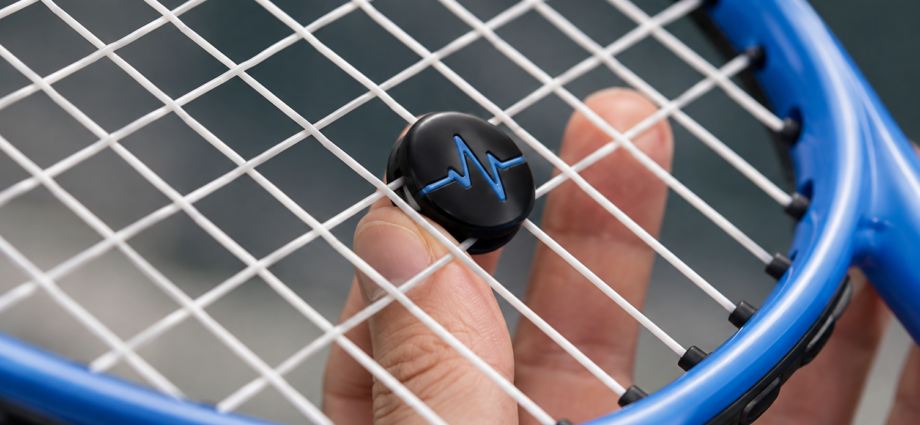
A tennis vibration dampener is a small rubber or silicone accessory fitted between the main strings near the bottom of the string bed.
Despite what many players believe, a dampener does not significantly reduce the shock that reaches your arm. Instead, it reduces the high-frequency vibrations of the strings after the ball is struck, creating a quieter and softer sound and feel.
Many players use dampeners because they prefer the sensation they provide, while others choose not to use one at all.
What Is a Tennis Vibration Dampener?
A vibration dampener is a small accessory attached to the strings of a tennis racquet.
They come in many different:
- Shapes
- Colours
- Materials
- Sizes
Some are simple circular rubber buttons, while others feature novelty designs or manufacturer logos.
Regardless of their appearance, they all serve the same basic purpose—reducing string vibration after impact.
How Does a Vibration Dampener Work?
When the ball strikes the strings, the string bed vibrates rapidly.
A vibration dampener absorbs some of these string vibrations before they continue travelling through the strings.
The result is:
- A quieter sound.
- A softer feel.
- Less string “ping.”
Importantly, the dampener works only on the strings themselves. It does not stop the racquet frame from vibrating.
Does a Dampener Improve Performance?
For most players, no.
Scientific testing has consistently shown that a vibration dampener has little or no measurable effect on:
- Power
- Spin
- Ball speed
- Control
- Accuracy
The ball leaves the strings in just a few milliseconds—before the dampener has any meaningful influence on ball flight.
The biggest difference is simply how the shot feels and sounds.
Does a Dampener Reduce Arm Pain?
This is probably the biggest misconception in tennis.
Many players believe a dampener helps prevent:
- Tennis elbow
- Wrist pain
- Shoulder discomfort
However, research has shown that dampeners primarily reduce string vibration, not the impact shock travelling through the racquet into your arm.
If you’re experiencing arm discomfort, factors such as:
- Racquet stiffness
- String type
- String tension
- Grip size
- Technique
are generally much more important.
You can learn more in:
Why Do So Many Professionals Use Dampeners?
Many professional players choose to use vibration dampeners.
Not because they improve performance, but because they prefer:
- The quieter sound.
- The softer feel.
- The familiar feedback.
Others don’t use one at all.
It’s largely a matter of personal preference.

Different Types of Dampeners
Although they all perform a similar function, dampeners come in several styles.
Button Dampeners
The most common design.
Small, lightweight and easy to install.
Worm Dampeners
A long flexible strip woven through several main strings.
They reduce more string vibration than smaller button-style dampeners.
Novelty Dampeners
Manufacturers also produce dampeners in countless novelty shapes, including:
- Tennis balls
- Emoji faces
- Animals
- Brand logos
Their function remains essentially the same.
Are Dampeners Legal?
Yes.
Under the Rules of Tennis, vibration dampeners are legal provided they are fitted outside the pattern of crossed strings.
This is why almost all dampeners are installed just above the throat of the racquet.
Should You Use a Dampener?
There isn’t a right or wrong answer.
Consider Using One If You:
- Prefer a quieter sound.
- Like a softer feel.
- Find the string “ping” distracting.
- Simply enjoy the feedback.
You May Not Need One If You:
- Like hearing the strings.
- Prefer maximum feedback.
- Already like how your racquet feels.
Many players try one for a few sessions before deciding whether they prefer it.
Common Myths
“A dampener prevents tennis elbow.”
False.
It reduces string vibration but has little effect on the impact forces that contribute to arm injuries.
“A dampener increases control.”
No.
Scientific studies have found virtually no measurable difference in shot performance.
“Professionals all use dampeners.”
No.
Some professionals do, while others choose not to.
Frequently Asked Questions
What does a tennis vibration dampener do?
It reduces the vibration of the strings after impact, creating a quieter and softer feel.
Does a dampener improve power?
No.
It has virtually no effect on power or ball speed.
Does a vibration dampener help tennis elbow?
Not significantly.
Factors such as racquet stiffness, strings and technique play a much larger role.
Where should a vibration dampener be placed?
It should be fitted between the main strings just above the throat of the racquet, outside the crossed string area.
Should beginners use a dampener?
It’s entirely optional.
Some beginners enjoy the softer feel, while others prefer playing without one.
Final Thoughts
Tennis vibration dampeners are one of the most popular racquet accessories, but they’re also one of the most misunderstood.
Rather than improving power or preventing injury, their main purpose is to change how the racquet feels and sounds after contact with the ball. For many players, that softer, quieter feedback makes the game more enjoyable. For others, the natural feel of the strings is preferable.
Ultimately, using a dampener is a matter of personal preference. They’re inexpensive, easy to install and simple to remove, making them one of the easiest pieces of equipment to experiment with.
Continue Reading
- Tennis Overgrip vs Replacement Grip
- Tennis Overgrips Explained
- Replacement Tennis Grips Explained
- Tennis Racquet Stiffness (RA) Explained
- Tennis String Tension Explained
- The Complete Guide to Tennis Equipment
Read more of our instructional articles here.
Read more of our player focus articles here.
Follow The Tennis Site on X: @thetennissite
Follow Todd Scoullar on X: @toddscoullar

Comments are closed, but trackbacks and pingbacks are open.