
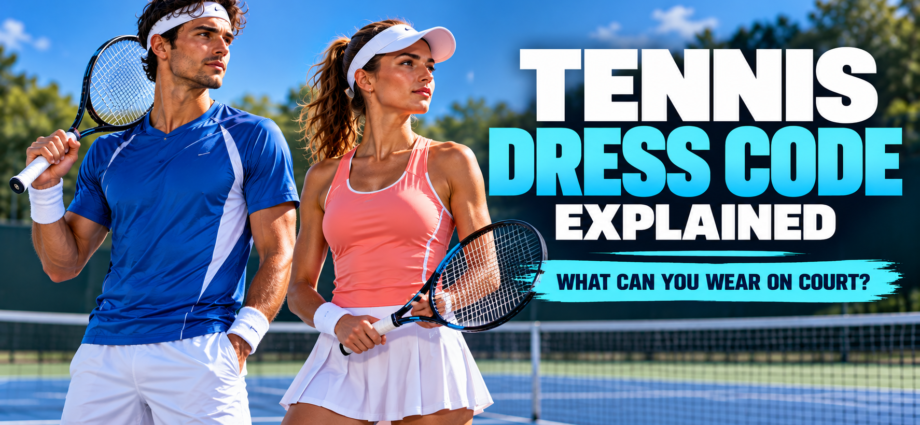
Tennis has changed considerably since players stepped onto grass courts wearing long trousers, dresses and almost exclusively white clothing.
Modern professional tennis can feature bright colours, sleeveless shirts, dresses, skirts, shorts, leggings, compression clothing, hats and outfits specifically designed for individual players.
So does tennis actually have a dress code?
The answer depends heavily on where you are playing.
For somebody playing at a public tennis court, there may be virtually no clothing rules beyond wearing safe footwear and appropriate sports clothing. Private clubs can impose their own requirements. Professional tournaments operate under considerably more detailed regulations.
And then there is Wimbledon.
Its famous white-clothing policy makes it an exception even within professional tennis.
Understanding the tennis dress code therefore means separating the traditions of the sport from the rules that actually apply.
Quick Answer: Is There a Dress Code in Tennis?
There is no single dress code that applies to every tennis court in the world.
Recreational players can generally wear comfortable athletic clothing that allows them to move freely, although individual clubs and facilities may have their own rules.
Professional tennis is more regulated. The ATP requires players to wear clean and customarily acceptable tennis attire and present themselves professionally, while the WTA similarly requires appropriate tennis attire and a professional appearance. Both tours also regulate commercial identification and logos on players’ clothing and equipment.
Wimbledon goes significantly further by requiring players to wear almost entirely white clothing.
In other words:
Public court: usually very relaxed.
Tennis club: check the club’s rules.
Professional tournament: formal clothing regulations apply.
Wimbledon: predominantly white.
What Should You Wear to Play Tennis?
For most recreational players, choosing tennis clothing is more about practicality than rules.
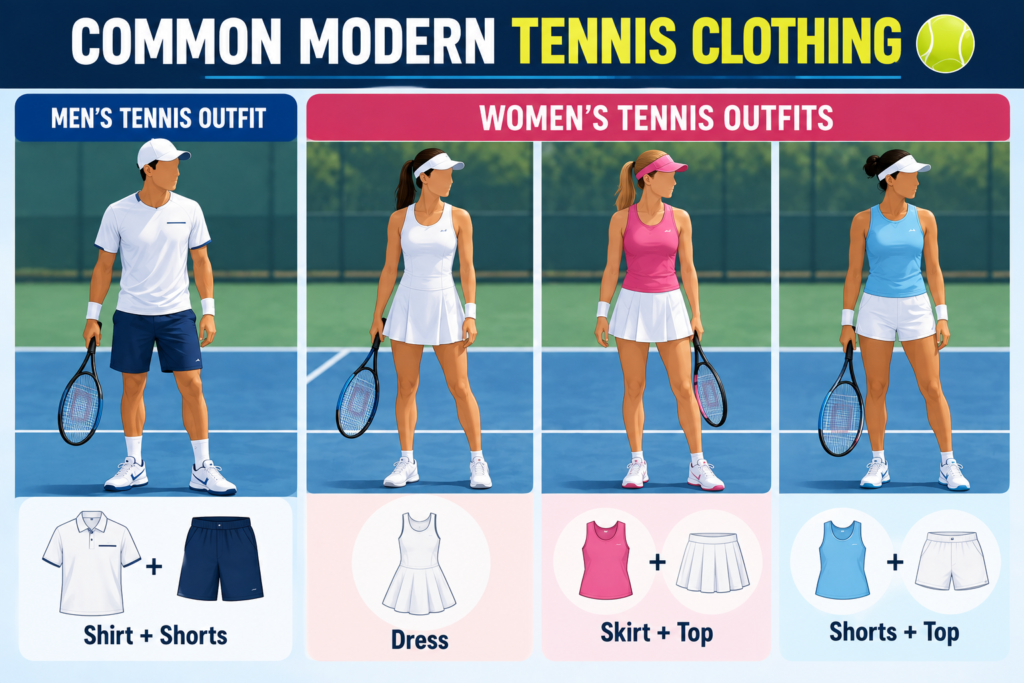
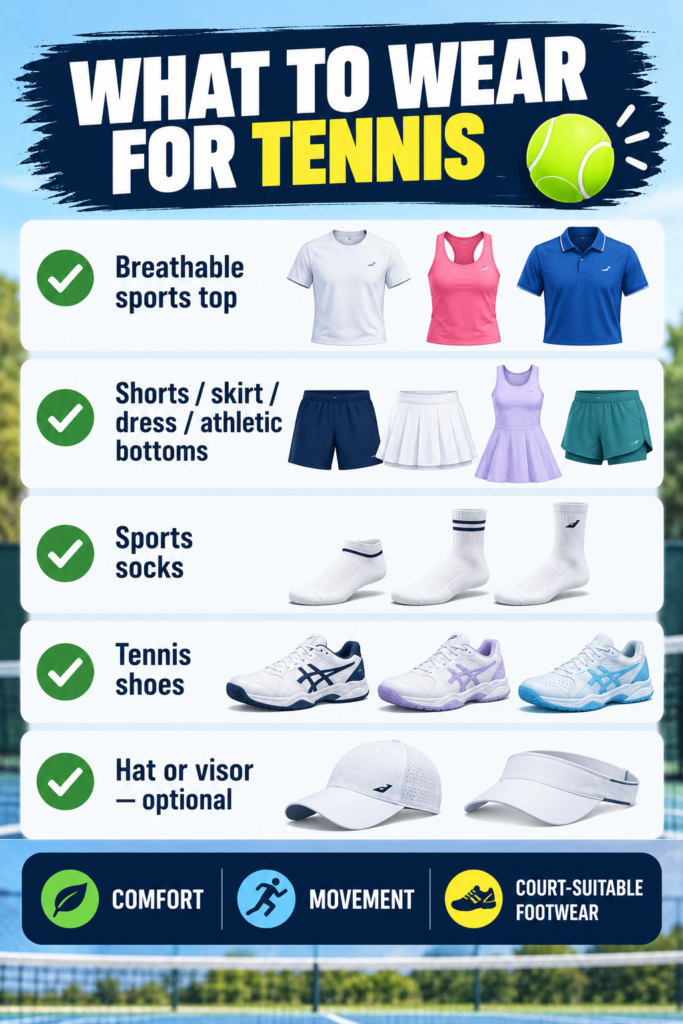
A basic tennis outfit usually consists of a sports shirt or top, shorts, skirt, dress or similar athletic bottoms, socks and suitable tennis shoes.
The most important consideration is movement.
Tennis requires players to sprint, stop, change direction, rotate, stretch and repeatedly move laterally. Clothing needs to allow those movements without becoming restrictive.
Modern tennis clothing is generally made from lightweight synthetic materials designed to manage sweat and dry quickly.
But there is no requirement for the average recreational player to purchase an entire tennis-specific wardrobe before stepping onto a court.
A comfortable sports shirt and shorts can be perfectly adequate.
Footwear deserves more consideration.
For a detailed explanation, see Tennis Shoes Explained
Do You Have to Wear Tennis Clothes to Play Tennis?
Usually, no.
If you are hitting casually at a public court, there is generally nothing preventing you from wearing ordinary athletic clothing.
“Tennis clothing” is largely clothing designed specifically around the demands of the sport rather than an entirely separate category required by the rules.
Tennis shorts, for example, often include pockets suitable for holding spare balls. Women’s tennis skirts and dresses are commonly designed to work with fitted shorts underneath. Shirts and tops are constructed to allow unrestricted shoulder and upper-body movement.
Those features are useful.
They are not normally compulsory for recreational tennis.
The major exception is when the venue itself has a dress policy.
Some private tennis clubs maintain clothing standards, and players should check those before arriving.
Why Do Tennis Players Wear Shorts and Skirts?
Modern tennis clothing is built around freedom of movement.
Shorts allow unrestricted movement through the legs and make it easy for players to carry spare balls in their pockets.
Women’s professional tennis includes a much wider range of options. Players can compete in shorts, skirts, dresses and other approved athletic clothing.
There is no rule requiring female tennis players to wear skirts.
That distinction is worth making because the tennis skirt has become so closely associated with the sport that it is sometimes mistaken for a requirement rather than a clothing choice.
Professional regulations focus instead on whether the clothing constitutes appropriate tennis attire and complies with the competition’s rules.
The WTA’s 2026 regulations state that a player must present herself professionally and wear appropriate tennis attire during practice, warm-up and matches. A tournament Supervisor or Referee can require a player to change if necessary.
Can You Wear Leggings to Play Tennis?
For recreational tennis, leggings are generally fine unless the facility has a specific clothing policy.
Professional regulations are more detailed and can change between tours and competitions, but modern professional tennis includes compression garments and leggings in various forms.
The broader principle remains that clothing must satisfy the regulations of the competition.
This is an important theme throughout tennis dress codes: something being perfectly acceptable at your local court does not automatically mean it complies with every professional tournament’s regulations.
Can You Wear a T-Shirt to Play Tennis?
Yes.
For casual tennis, a normal athletic T-shirt is one of the simplest options.
Professional players also commonly compete in short-sleeved shirts, although professional clothing is subject to tour requirements governing appearance, manufacturer identification, sponsorship and other commercial markings.
The ATP’s 2026 regulations state that players must wear clean, customarily acceptable tennis attire approved by the ATP. A Chair Umpire or Supervisor can order a player to change clothing or equipment that violates the rule. Failure to comply can ultimately result in default.
So the issue at professional level is not simply whether something looks like a T-shirt.
It is whether the entire garment complies with the relevant regulations.
Can Tennis Players Wear Any Colour?
In most tennis tournaments, yes.
Professional tennis has become extremely colourful.
Players routinely wear blue, red, green, yellow, orange, pink, purple, black and countless combinations of colours.
There is no general rule requiring professional tennis players to wear white.
That misconception largely comes from one tournament:
Wimbledon.
Its clothing policy is a tournament-specific tradition rather than the universal dress code of tennis.
Why Do Tennis Players Wear White at Wimbledon?
Wimbledon’s white clothing tradition stretches back to the Victorian era.
The tournament explains that white clothing became associated with lawn tennis partly because lighter fabrics were considered more suitable than darker clothing. While tennis fashion changed dramatically over subsequent generations, Wimbledon retained the tradition.
Today, the policy is one of the most recognisable visual characteristics in sport.
Players entering the court at Wimbledon are expected to be dressed almost entirely in white.
Importantly, Wimbledon means white, not simply very pale colours.
The tournament’s published guidance has also restricted large panels of colour while permitting limited trim within specified dimensions.
That creates an extraordinary contrast with the rest of professional tennis.
A player might compete in a bright orange or black outfit at another major tournament and then appear almost entirely in white at Wimbledon.
The tennis has the same fundamental rules.
The clothing regulations do not.
Is Wimbledon’s Dress Code Completely White?
It is extremely strict, but “completely white” slightly oversimplifies the policy.
Wimbledon permits limited colour in specified circumstances rather than banning every non-white millimetre of an outfit.
For example, its published clothing guidance permits a single trim of colour in designated areas of a shirt, dress or sweater, with the trim no wider than one centimetre.
The detailed regulations have evolved over time, so the current Championships rules should always be checked when precise compliance matters.
For spectators, however, the important point is much simpler:
Wimbledon’s all-white rule applies to the competitors, not generally to spectators attending the tournament.
You do not need to dress like a Wimbledon player simply because you have a ticket.
What Are the ATP Clothing Rules?
Professional men’s tennis has much more detailed clothing regulations than most fans ever need to think about.
The ATP’s 2026 rulebook requires players to dress and present themselves professionally and to wear clean, customarily acceptable tennis attire approved by the ATP.
The regulations then go considerably further.
They govern where manufacturer and commercial identifications can appear, how large they can be, and which types of commercial identification are prohibited or restricted.
The ATP even publishes a clothing-logo diagram showing permitted locations and dimensions for identifications on hats, headbands, shirts, shorts, compression clothing, wristbands, socks, shoes, racquets, strings and bags.
For viewers, this means an outfit that looks like nothing more than a shirt, shorts and shoes can actually be governed by pages of commercial regulations.
What Are the WTA Clothing Rules?
The WTA takes a similar approach.
Its 2026 rulebook requires players to present themselves professionally and wear appropriate tennis attire during practice, warm-up and matches. The Supervisor or Referee has discretion to determine whether a change is necessary.
The WTA also regulates identification appearing on clothing and equipment, including manufacturer and commercial branding.
These rules explain why professional tennis clothing is not simply a fashion decision.
Players and their clothing sponsors have to work within the regulations of the tour and, in some cases, additional tournament-specific requirements.
Why Are Logos Regulated in Tennis?
Professional players are walking advertising spaces.
A highly ranked player may have agreements with clothing manufacturers, racquet companies and other sponsors, while tournaments and tours have commercial relationships of their own.
Without regulation, professional outfits could potentially become covered with competing advertisements.
Tour rules therefore control the placement, size and type of commercial identification players can display.
For example, the ATP’s 2026 rules prohibit certain identifications and establish specific size and placement limits across clothing and equipment. They also prohibit endorsements involving tobacco and companies associated with tennis gambling on player clothing.
The WTA likewise regulates commercial and manufacturer identification through its official rulebook.
This is one of the clearest differences between recreational and professional tennis.
Your local club probably doesn’t care about the dimensions of the logo on your shirt.
The professional tours do.
Are There Rules About Tennis Shoes?
Yes — particularly in organised and professional competition.
The ATP requires players to wear tennis shoes generally accepted as proper tennis attire. Shoes must not damage the playing surface beyond what would normally be expected during play.
Surface matters too.
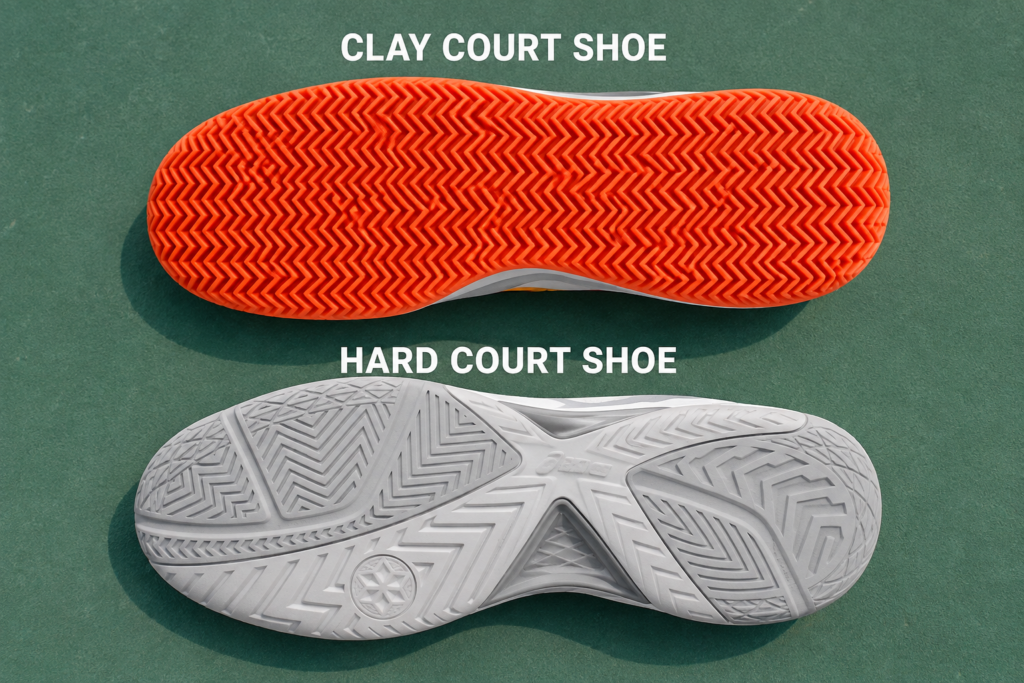
On ATP clay courts, players must wear shoes considered suitable for clay or granular surfaces, and the Supervisor can prohibit a shoe if its sole is inappropriate.
Grass has its own restrictions. ATP rules state that, at grass-court tournaments, players must generally use rubber-soled shoes without heels, ribs, studs or coverings, with special grass-court shoes subject to approval.
This is not simply about appearance.
Different soles interact with tennis surfaces differently.
For more on that distinction, see Clay Court vs Hard Court Tennis Shoes
Can You Wear Running Shoes for Tennis?
You can physically play tennis in running shoes, but they are not usually the best choice.
Running shoes are primarily designed around forward movement. Tennis involves frequent lateral changes of direction, sudden stops and repeated side-to-side loading.
Tennis shoes are constructed with those movements and court surfaces in mind.
For an occasional casual hit, somebody may use the athletic shoes they already own. For regular play, proper tennis shoes are generally the more suitable option.
Some facilities — particularly those with specialist surfaces — may also have footwear requirements intended to protect the court.
Do Tennis Clubs Have Dress Codes?
Some do.
There is no universal club tennis dress code.
A public municipal court might have almost no clothing restrictions. A traditional private club may specify acceptable tennis attire, footwear or even colours.
Rules can also differ between the clubhouse and the tennis courts.
If you are visiting an unfamiliar club, particularly as somebody’s guest, checking the dress policy beforehand can avoid an awkward arrival.
The more traditional the venue, the less safe it is to assume that ordinary gym clothing will automatically satisfy its rules.
Does Tennis Have an All-White Tradition Outside Wimbledon?
Yes.
White clothing has deep historical connections with tennis, and some traditional clubs continue to maintain predominantly white or all-white clothing policies.
That does not make whites a requirement of the sport itself.
The distinction is similar to other aspects of Tennis Etiquette: traditions can be extremely influential without being universal laws of tennis.
A particular club is entitled to establish clothing rules for people using its facilities.
Another club may have no comparable restriction at all.
What Should Beginners Wear for Tennis?
A beginner does not need an expensive outfit.
Start with clothing that is comfortable, breathable and allows unrestricted movement.
A simple setup might include:
- lightweight athletic shirt or top
- sports shorts, skirt or similar athletic bottoms
- comfortable sports socks
- suitable tennis shoes
- hat or visor for outdoor play if needed
The shoes are arguably the piece worth paying the most attention to if you intend to play regularly.
Everything else can evolve as you discover what feels comfortable.
There is little point spending heavily on specialised clothing before you know whether you prefer a loose shirt, fitted top, shorts, skirt, dress or another option.
What Should You Avoid Wearing for Tennis?
The answer depends partly on the venue, but practicality provides a useful guide.
Very restrictive clothing can interfere with movement. Heavy fabrics can become uncomfortable when soaked with sweat. Shoes with inappropriate soles can reduce stability or damage a court.
Loose accessories can also become irritating or distracting during repeated movement.
And if you are playing at a club, clothing that violates its dress policy may prevent you from taking the court regardless of how practical it otherwise seems.
The best tennis clothing tends to disappear from your thoughts once the match begins.
If you are constantly adjusting it, pulling at it or worrying about it, it probably isn’t helping.
Does Clothing Affect Tennis Performance?
It can.
Clothing will not transform someone’s forehand, but poorly chosen clothing can certainly make playing less comfortable.
Professional tennis clothing is designed around heat, sweat and movement because players may spend several hours competing in difficult conditions.
Even the ability to change clothing can matter. The ATP’s new heat regulations for 2026, for example, allow players to use cooling measures, hydrate, shower and change clothing during an applicable 10-minute cooling break in best-of-three singles matches.
For recreational players, the same basic logic applies without the rulebook.
Lightweight clothing, appropriate footwear and protection from outdoor conditions can make a long session considerably more comfortable.
Tennis Fashion Has Changed Dramatically
Tennis clothing also tells the story of how the sport has changed.
Early competitive tennis was associated with formal clothing that would appear extraordinary on a modern court.
As sporting clothing developed, outfits became lighter and more practical. Hemlines changed. Shorts became standard. Synthetic performance fabrics replaced heavier materials. Colours became commonplace.
Modern players can also use clothing to create a distinctive identity.
In fact, the ATP leaned further into the relationship between tennis and fashion in 2026 by launching its “Athlete Arrivals” initiative, giving players a platform to showcase personal style when arriving at tournaments.
That creates an interesting contrast.
Off court, professional tennis is increasingly embracing fashion and individual expression.
On court, the clothing still has to comply with detailed regulations.
And at Wimbledon, more than a century of tradition remains immediately visible every time a player walks onto the grass dressed in white.
Tennis Dress Code vs Tennis Etiquette
Dress code and etiquette sometimes overlap, but they are not the same thing.
A dress code tells you what clothing or footwear a tournament, club or facility permits.
Etiquette concerns how players are expected to behave.
Wearing prohibited shoes at a club is a dress-code issue.
Walking behind somebody while they are serving is an etiquette issue.
Professional tennis adds a third layer: the formal regulations imposed by governing bodies and tours.
That is why there is no useful answer to “What is the tennis dress code?” without first asking where the tennis is being played.
For more on expected court behaviour, see Tennis Etiquette
Frequently Asked Questions
Does tennis have a dress code?
There is no universal dress code covering every tennis court. Recreational requirements depend on the facility, while professional tours and tournaments have formal clothing regulations.
Do you have to wear white to play tennis?
No. Most tennis competitions allow coloured clothing. Wimbledon is famous for requiring competitors to wear almost entirely white, and some traditional private clubs maintain their own white-clothing rules.
Can women wear shorts in tennis?
Yes. Women can and regularly do compete in shorts. Tennis skirts and dresses are traditional and popular options, not universal requirements.
Can you wear leggings for tennis?
Generally yes for recreational tennis unless a particular club or facility prohibits them. Professional players must comply with the clothing regulations applicable to their competition.
Can you wear a normal T-shirt for tennis?
For recreational tennis, usually yes. Comfortable athletic clothing is generally sufficient unless the venue has a specific dress code.
Can you wear running shoes for tennis?
They may be acceptable for an occasional recreational hit, but tennis shoes are specifically designed for the lateral movement and court surfaces involved in tennis. Some venues and competitions also regulate footwear.
Why does Wimbledon make players wear white?
The tradition dates back to the early history of lawn tennis and the Victorian era. Wimbledon retained the white-clothing tradition even as coloured outfits became commonplace elsewhere in professional tennis.
Can professional tennis players wear whatever they want?
No. The ATP and WTA regulate player appearance, appropriate tennis attire, commercial identification and other aspects of clothing and equipment.
Can a tennis player be forced to change clothes?
Yes, in professional competition. ATP and WTA regulations allow tournament officials to require a player to change clothing that does not comply with applicable requirements. Failure to comply can lead to further penalties, including potential default.
Final Thoughts
Tennis has a dress code — but not one dress code.
For most people playing recreationally, the requirements are straightforward: wear comfortable athletic clothing, suitable shoes and anything else the facility requires.
Move into organised competition and the regulations become more important.
Move into professional tennis and clothing is governed not only by practicality but by tour regulations covering appearance, footwear, logos and commercial identification.
Then arrive at Wimbledon and another layer of tradition appears.
That variety is part of what makes tennis clothing interesting. The sport has moved from long dresses and trousers to highly technical modern sportswear, yet traces of its traditional image remain.
For the average player, however, the rule is much simpler:
Wear something comfortable, make sure you can move, and check the rules of the court you’re about to play on.
For the current professional regulations, see the ATP Official Rulebook, WTA Official Rules and World Tennis rules and regulations.
Continue Reading
- Tennis Etiquette Explained
- Tennis Shoes Explained
- Clay Court vs Hard Court Tennis Shoes
- Tennis Code Violations Explained
- On-Court Coaching Rules Explained
Read more of our exclusive feature articles here.
Read more of our player focus articles here.
Follow The Tennis Site on X: @thetennissite
Follow Todd Scoullar on X: @toddscoullar

Comments are closed, but trackbacks and pingbacks are open.