
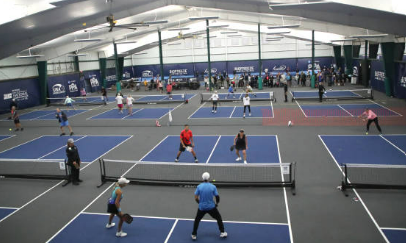
Introduction
Do you have an interest in playing pickleball? If so, the first thing you need to do is learn the pickleball rules for beginners.
Most beginner players step onto the court without really knowing the basics. Small mistakes start popping up during play, and those minor errors can take the fun right out of the game.
Don’t worry about it. Learning the basics isn’t nearly as hard as it first seems. Once you get the official pickleball rules down, the game suddenly feels a lot easier. You start playing with real confidence, and your game improves pretty quickly too.
This article targets beginner pickleball players. It’ll help you avoid common mistakes, understand how the game actually works, and walk onto the court ready to play with more confidence.
Embed from Getty ImagesCourt Dimensions
The standard dimensions of a pickleball court are 44 feet in length and 20 feet in width, and these measurements apply to both indoor and outdoor courts. The net stands 36 inches high at the sidelines, while its height is 34 inches at the center.
What is the pickleball kitchen?
In pickleball, the kitchen is the 7-foot area of the court on both sides of the net. Its official name is the non-volley zone.
- You may not volley the ball while standing in the kitchen or while touching the kitchen line.
- Contacting the kitchen line with any part of your body, clothing, paddle, or equipment is a fault.
- After the ball has bounced, you may enter the kitchen to play a shot.
- You may lean over the kitchen line to volley the ball, as long as you do not touch the zone itself.
- Momentum that carries you into the kitchen after a volley is still a fault.
- Even if the ball is already dead, entering the kitchen can cost you the point.
- When playing near the net, maintain your balance and step back behind the kitchen line immediately after the shot.
Equipment Needed to Play
You don’t need a lot of complicated gear to play pickleball. A paddle and a special perforated plastic ball are all it takes.
Outdoor balls are harder. They have around 40 small holes. These holes reduce wind effects. Indoor balls are lighter and softer. The Indoor ball has 26 larger holes. These holes work better indoors.
Scoring System
In pickleball, side-out scoring is the usual approach. Only the serving team can score points.
Players usually play games to 11 points, with a team needing to secure a two-point lead to win. Some matches run to 15 or 21 points, and the same two-point margin still applies.
In doubles, the announcer states the score using three numbers: the serving team’s score first, followed by the opposing team’s score, and lastly the server number (1 or 2).
There’s also rally scoring. In that system, you get a point for every rally, regardless of which side is serving.
How to Serve in Pickleball
Every point begins with a serve. The serve must always be underhand. On a volley serve, the arm swings upward from below, the server strikes the ball below the waist, and the highest point of the paddle head cannot rise above the wrist. Keep at least one foot on the ground behind the baseline when hitting the ball.
Embed from Getty ImagesA drop serve is also legal. In a drop serve, the player simply releases the ball (without tossing it upward), lets it bounce once on the court, and then hits it. The arm and paddle restrictions that apply to a volley serve do not apply to a drop serve.
The serve must travel diagonally into the opponent’s service box. The ball has to clear the kitchen (non-volley zone) and its line before landing in the correct box. If the ball clips the net but still lands in the proper service box, the point continues.
Players get only one serve attempt per point. A fault (hitting the net and failing to clear it into the correct box, landing out of bounds, landing in the kitchen, etc.) ends the serve. There is no second serve.
Two-Bounce Rule
The two-bounce rule is a basic principle in pickleball. After the serve, the receiving team has to let the ball bounce once on the ground before they can return it. Then the serving team must also let that return bounce once. Only after both bounces have happened is anyone allowed to volley the ball (hit it out of the air). Volleying before both bounces is a fault.
It’s called the two-bounce rule because the rally can’t really begin until those two mandatory bounces take place—one on the receiving side and one on the serving side.
Embed from Getty ImagesCommon Mistakes for Beginner Players
When learning pickleball rules for beginners, these are the mistakes that show up most often:
- Beginner players frequently volley the return instead of letting it bounce.
- They carry their momentum straight into the kitchen.
- They serve from the wrong side of the court.
- They call “out” too late.
- After returning serve, they stay planted on the baseline.
Each of these errors gives away easy points.
Before you serve, double-check the score, set both feet correctly, recover behind the kitchen line after every volley, and move forward only once your return safely clears the net.
Conclusion
Learning the pickleball rules for beginners isn’t nearly as hard as it first seems. The court size, the kitchen zone, a solid serve, the two-bounce rule, and how scoring works these are the core pieces that build the entire game. Once those click, everything else tends to feel a lot more manageable.
If you’re just starting, there’s no reason to worry. Every player began somewhere. Hold on to these basics, get out on the court, and keep playing. With time, your confidence will rise, and so will the fun you get out of the game.

Comments are closed, but trackbacks and pingbacks are open.