
By Sumit Kapoor, Founder, LyfSkills
A child’s first tennis class can feel more significant to the parent than it does to the child. We arrive wondering whether they will listen to the coach, hold the racket correctly or show some natural ability. The child may be thinking about something much simpler: Will I know anyone? Will I be able to hit the ball? What happens if I miss?
I find it helpful to treat the first class as an introduction, not an assessment. The purpose is not to decide whether the child is good at tennis. It is to see whether the setting makes them comfortable enough to try again.
Embed from Getty ImagesSet a small expectation before you arrive
Parents can unintentionally make the first class feel like a test by talking too much about performance. Telling a child to listen carefully, hit properly and impress the coach gives them several things to worry about before they have even stepped onto the court.
I prefer one simple expectation: take part and see how it feels. For a young beginner, joining the warm-up, trying a few activities and staying with the group may be a perfectly successful first session.
If the child is nervous, explain what they are likely to see—a coach, other children, rackets, balls and some games. Avoid promising that they will love it. Give them permission to be unsure while they learn what the class is like.
Embed from Getty ImagesExpect movement and play, not a miniature professional lesson
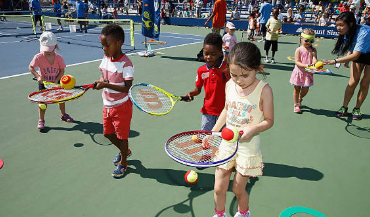
A good beginner class for children may not look like the tennis coaching adults remember. Young children usually need movement, short demonstrations and frequent chances to participate. They may run, balance, throw, catch or guide a ball before they begin anything that resembles a full rally.
This is useful preparation. Tennis asks a child to judge distance, move into position, coordinate the eyes and hands, and control a racket while the ball is moving. Those abilities develop through simple games as well as formal strokes.
I would not worry if the first class contains more play than technical instruction. I would look at whether the games have a purpose, whether the children remain involved and whether the coach can move between activity and explanation without losing the group.
Watch how the coach brings the child into the class
The coach-child connection matters more than the number of balls the child hits in the first hour. A good coach notices a new child, uses their name and explains the next activity in language they can follow. They demonstrate briefly, then let the children try.
Correction should feel useful rather than embarrassing. A beginner will miss the ball, stand in the wrong place and forget an instruction. I look for a coach who responds calmly, gives one manageable cue and recognises effort without praising everything automatically.
Also notice how the coach handles different confidence levels. Some children will rush to the front. Others will watch before joining. A class can have structure while still allowing a hesitant child a little time to settle.
Embed from Getty ImagesNotice how much of the lesson is spent waiting
Some waiting is unavoidable in a group class. Too much of it makes the experience harder for a young beginner. Long queues and one-child-at-a-time drills can leave children distracted before their turn arrives.
I would look for small groups, several activity stations or drills in which more than one child can move at once. The children do not need to hit hundreds of balls, but they should have enough contact with the activity to understand what they are trying to do.
Group size alone does not decide quality. A skilled coach may manage a larger class well, while a smaller class can still feel disorganised. The useful question is whether each child remains seen, safe and involved.
Do not use the first class to judge talent
Tennis is difficult at the beginning. The racket extends the hand, the ball rarely arrives where expected, and a child is trying to coordinate several unfamiliar movements at once. Missing is normal.
Parents can easily focus on visible outcomes: how many balls crossed the net, whether the child followed every instruction, or how they compared with another beginner. I would pay more attention to less obvious signs. Did the child keep trying after a miss? Did they understand at least part of the activity? Did they become more relaxed as the class went on?
Embed from Getty ImagesAt this stage, comfort and curiosity are better indicators than technique. Skill can be taught over time. A child who feels watched or judged may decide much earlier that tennis is not for them.
Check whether the class is designed for children
The court and equipment should help beginners participate rather than make the game unnecessarily difficult. Depending on the child’s age, that may mean a smaller playing area, slower balls and appropriately sized rackets. These adjustments give children an early feel for movement, control and exchanging the ball without adult-sized conditions working against them.
The tone of the class matters too. Rules should be clear, especially around rackets, moving balls and personal space. Children should know where to stand and when to swing. A safe class usually looks organised without becoming rigid.
When comparing nearby beginner programmes through LyfSkills Discover, I encourage parents to look beyond the class label. Age grouping, session length, group size, coach experience and travel time all affect whether the child can attend consistently and arrive with enough energy to participate.
Embed from Getty ImagesRead your child’s comfort carefully
A child does not have to look confident throughout the first class for it to be a good fit. They may stay close to the edge at first, miss a parent who is watching, or become frustrated when the ball does not cooperate. Mild discomfort is part of trying something new.
I become more concerned when a child appears persistently excluded, frightened of making a mistake, confused for most of the session, or unable to get the coach’s attention when they need help. The difference is whether the child gradually settles or becomes more withdrawn as the class continues.
Parents should also account for temperament. One child will announce an opinion as soon as the class ends. Another may need a meal, a quiet ride home and some time before talking about it.
Ask about moments, not verdicts
“Did you like tennis?” asks the child to decide the entire sport after one experience. More specific questions give us better information:
- What was the easiest part of the class?
- What felt difficult?
- Did the coach help when you were unsure?
- Was there one game you would like to play again?
- Would you like to try another class?
The last question is useful because returning once does not commit the family forever. Unless something clearly felt wrong, two or three sessions often give a fairer picture. The child understands the routine, recognises the coach and begins the next class with less uncertainty.
Keep the ride home light
The conversation after class shapes how the child remembers the experience. I try not to provide an instant list of corrections from the sidelines. The coach is responsible for teaching tennis. My role as a parent is to help the child make sense of how the experience felt.
A simple observation such as “I saw you keep trying when the ball rolled away” is often more helpful than technical advice. It recognises something the child controlled without turning the ride home into another lesson.
If the child did not enjoy the class, listen before persuading them otherwise. The issue may be tennis, but it may also be the timing, the group, the coach or the unfamiliar setting. Understanding the reason helps the family decide whether to return, try a different programme or pause for now.
The first class needs to answer only one question
A child’s first tennis class does not need to reveal future potential. It needs to offer a safe, active and encouraging introduction to the sport.
For me, the most useful question at the end is not “Were you good at it?” It is “Do you feel like trying again?” A child who wants to return has already taken the most important first step.
About the author: Sumit Kapoor is the founder of LyfSkills, a platform that helps parents discover and evaluate activities, classes and learning experiences for children.
Read more of our instructional articles here.
Read more of our player focus articles here.
Follow The Tennis Site on X: @thetennissite

Comments are closed, but trackbacks and pingbacks are open.