

A tennis player can be ranked inside the world’s Top 200 and still find themselves waiting for a place in a professional tournament.
Another player might initially appear in qualifying, only to move into the main draw without playing a match. Someone further down the rankings could travel to a tournament without knowing whether they’ll get to compete at all.
These situations are common across professional tennis, particularly on the ATP Challenger Tour and ITF World Tennis Tour.
The explanation lies in the tournament entry list — the system that determines which players are accepted, which must compete in qualifying and which are left waiting for an opportunity.
Understanding how these lists work helps explain why tournament fields can change considerably between the initial announcement and the first ball being struck.
What Is a Tennis Tournament Entry List?
A tennis tournament entry list, often called an acceptance list, identifies the players who have entered an event and their initial acceptance status.
Players are generally placed into categories according to their eligibility, ranking and the tournament’s entry regulations.
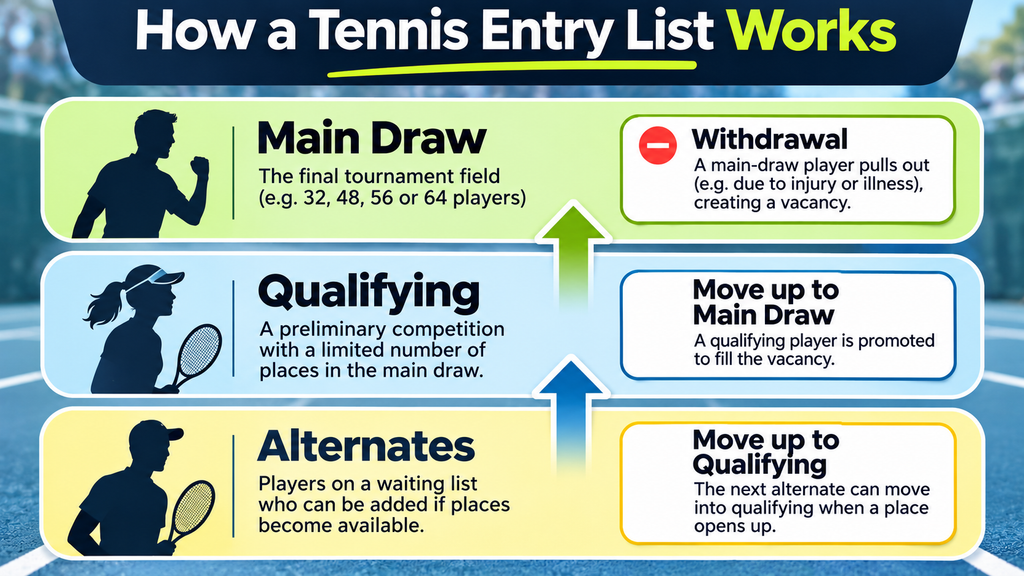
The three main categories are:
- Main draw: Players accepted directly into the tournament’s principal competition.
- Qualifying: Players accepted into a preliminary competition for the remaining main-draw places.
- Alternates: Players waiting for an opening in the main draw or qualifying competition.
Entry lists are not the same as tournament draws.
An entry list establishes who has been accepted. The draw determines who plays whom, and where players are positioned in the competition.
A player can therefore be confirmed in a tournament’s main draw without knowing their first-round opponent.
What Does Direct Acceptance Mean in Tennis?
Direct acceptance, often abbreviated to DA, means a player has earned entry through the applicable tournament acceptance system, normally using their ranking.
It is the standard route into professional tennis tournaments.
For example, imagine an ATP Challenger tournament with a limited number of main-draw positions available through direct acceptance.
If the final player accepted directly is ranked No. 238, a player ranked No. 225 may receive a main-draw place, while someone ranked No. 245 might initially be placed in qualifying.
However, the precise cut-off depends on which players have entered the tournament and which ranking or other permitted acceptance criteria apply.
A Challenger tournament attracting several Top 100 players may have a considerably stronger entry list than another event in the same category.
This is why a player’s ranking does not guarantee entry into a particular tournament.
Why Do Tennis Tournament Entry Lists Change?
One of the most confusing aspects of professional tennis is that a player may appear on an alternate list when entries close but later receive a main-draw place.
This usually happens because other players withdraw.
Players may withdraw because of injury, illness, scheduling changes, fatigue or commitments at another tournament.
When an accepted player withdraws, the vacancy is filled according to the relevant tour’s entry rules.
Depending on the timing and circumstances, the next eligible player on the acceptance list may move into the available position.
That can create a chain reaction.
A player moves from qualifying into the main draw. Someone previously listed as an alternate moves into qualifying. Another player moves closer to receiving an opportunity.
The original acceptance list can therefore look substantially different from the final tournament field.
What Is an Alternate in Tennis?
An alternate is a player who has entered a tournament but has not initially secured a place in the relevant draw.
Alternates are placed in an order determined by the applicable entry rules.
For example, a player listed as Alternate No. 3 is third in the waiting order at that point, not necessarily three withdrawals away from playing in every circumstance.
Other entry provisions, including reserved places, withdrawals and sign-in requirements, can affect the final allocation.
Some players remain on an alternate list until shortly before the tournament begins. Others are accepted several days earlier.
For lower-ranked professionals, this uncertainty can make scheduling and travel particularly difficult.
A player might need to decide whether to travel to a tournament in the hope of gaining entry or commit to another event where a place is more secure.
How Players Move From Qualifying Into the Main Draw
Consider a fictional ATP Challenger tournament.
For simplicity, imagine its current acceptance list contains the following players:
| Player | Ranking | Initial status |
|---|---|---|
| Player A | 210 | Main draw |
| Player B | 225 | Main draw |
| Player C | 238 | Last direct acceptance |
| Player D | 242 | Qualifying |
| Player E | 251 | Qualifying |
| Player F | 265 | Qualifying |
| Player G | 278 | Alternate |
Now imagine two main-draw players withdraw before qualifying begins.
Under the applicable acceptance rules, the next eligible players can move into the vacant positions.
Player D and Player E might be promoted into the main draw, while Player G moves closer to — or into — qualifying.
Neither Player D nor Player E has won a match. Their tournament status has changed because places became available.
This example is illustrative rather than an exact allocation for a particular Challenger event. Actual movement depends on the timing of withdrawals and the ATP’s rules for filling each type of vacancy.
What Happens When a Player Withdraws After Qualifying?
The timing of a withdrawal is important.
Before qualifying begins, a vacant main-draw position may be filled through the tournament’s acceptance-list procedures.
Once qualifying is underway or completed, different replacement rules can apply.
One of the most familiar is the lucky loser.
A lucky loser is a player who loses in qualifying but subsequently enters the main draw because another player withdraws.
The player does not need to win an additional qualifying match to receive the replacement position.
However, lucky-loser selection is governed by tournament regulations, including eligibility, ranking-based priority and, in some circumstances, random selection.
It is not simply a case of tournament organisers choosing whichever losing player they prefer.
For a detailed explanation, see What Is a Lucky Loser in Tennis?.
What Do Entry Deadlines, Withdrawal Deadlines and Freeze Deadlines Mean?
Professional tennis tournaments have formal deadlines governing when players can enter, withdraw or change their tournament commitments.
The procedures differ between the ATP, WTA and ITF circuits.
The ITF World Tennis Tour provides a particularly useful example because its system has three distinct deadlines.
Entry Deadline
The entry deadline is the final time by which players must submit their entry under the normal process.
Once it passes, the initial acceptance lists are established according to the applicable entry criteria.
For ITF professional tournaments, the standard singles entry deadline is 18 days before the Monday of tournament week.
Withdrawal Deadline
The withdrawal deadline determines when players become committed to a tournament under the applicable regulations.
Before this deadline, players can generally withdraw without the penalties associated with a late withdrawal.
Afterwards, a player accepted into the main draw or qualifying may face sanctions for withdrawing, unless an exemption or permitted withdrawal provision applies.
The standard ITF professional singles withdrawal deadline is 13 days before the Monday of tournament week.
Freeze Deadline
The freeze deadline is particularly important for alternates.
Before the deadline, acceptance lists can continue changing as players withdraw and others move into available positions.
At the freeze deadline, the ITF applies rules governing which acceptance lists players remain on and how their entries are prioritised.
The standard ITF professional singles freeze deadline is four days before the Monday of tournament week.
These deadlines are subject to official adjustments, including holiday-related changes, and should not be assumed to apply identically to ATP or WTA tournaments.
For the current procedures, players should consult the ITF’s official tournament-entry guidance.
Can Players Enter Several Tournaments in the Same Week?
Yes, within the limits of the relevant tour’s entry regulations.
On the ITF World Tennis Tour, players can enter up to six tournaments scheduled for the same week through the IPIN system.
They must indicate their tournament preferences, and the ITF’s procedures determine which acceptance lists they remain on as deadlines pass.
For example, a player might initially enter tournaments in Spain, France and Portugal.
They could be accepted into qualifying in Spain, listed as an alternate in France and receive main-draw acceptance in Portugal.
As the withdrawal deadline approaches, the player must ensure their entries reflect where they intend — or are required under the rules — to compete.
The ITF uses established priority criteria when resolving multiple acceptances. Players cannot simply remain committed to several tournaments in the same week and choose between them at the last moment.
This is another reason entry lists change even when nobody has suffered an injury.
What Is a Special Exempt in Tennis?
A special exempt, usually shown as SE, is a reserved main-draw entry available to certain players who are still competing in another qualifying tournament or event at a time that prevents them from taking part in the next tournament’s qualifying competition.
The most common situation involves a player who advances deep into a tournament one week and is unable to play qualifying at another tournament the following week.
Under the applicable ATP rules, the player may be eligible for a special-exempt position.
This allows them to enter the next tournament’s main draw without playing its qualifying competition.
However, special exempts are not automatic.
Players must meet specific eligibility requirements, and only a limited number of positions are available.
For ATP Challenger tournaments, the regulations provide for two special-exempt positions, subject to the applicable rules.
If those places are not required, they can be reassigned through the tournament’s acceptance procedures.
This system helps prevent players from being disadvantaged simply because they are still winning matches at the previous week’s tournament.
What About Wild Cards and Protected Rankings?
Not every player enters through the ordinary ranking-based acceptance list.
Professional tournaments also have special entry mechanisms.
Wild Cards
A wild card is a tournament entry awarded at the discretion of the authorised organisers.
It may be used to support a promising junior, a local player, a returning professional or another eligible competitor.
Wild cards can be awarded into either qualifying or the main draw, depending on the tournament’s rules.
Unlike direct acceptance, a wild card does not depend solely on the player’s ranking position.
Read more: What Is a Wild Card in Tennis?.
Protected Rankings
A protected ranking allows certain players returning from a qualifying period of injury or other permitted absence to enter tournaments using a ranking calculated under the relevant tour’s rules.
This can allow a player whose current ranking has fallen substantially to gain entry to tournaments they would otherwise struggle to enter.
Protected rankings are subject to eligibility conditions and limits on their use.
They are not the same as wild cards, and they do not determine a player’s seeding.
Read more: What is a protected ranking?
Accelerator Entries
There are also development pathways that provide reserved opportunities to eligible emerging players.
The ATP Next Gen Accelerator, for example, offers qualifying junior, college and young professional players access to selected ATP Challenger and ATP Tour events.
These positions are governed by separate eligibility and allocation rules.
Read more: ATP Next Gen Accelerator Explained.
Why a Player’s Ranking Might Not Match Their Entry Position
A common mistake is to assume that the highest-ranked players on a tournament entry list must always be the first players accepted.
Ranking is central to the process, but several factors can affect the published list.
A player may have entered using a protected ranking. Another might hold a wild card or a reserved entry position.
The ranking used for acceptance may also be different from the player’s current live ranking.
For example, a player could be ranked No. 260 when a tournament’s entries are determined, then climb to No. 225 after a strong run at another event.
The original acceptance decision does not necessarily change simply because their ranking has improved.
This is particularly relevant on the Challenger Tour, where a title or deep tournament run can produce a substantial rankings movement.
It also explains why looking only at the current rankings may not reveal how a particular player entered an event.
How to Read a Tennis Tournament Entry List
When examining a professional tournament’s entry list, the most useful information is usually the player’s name, ranking or entry-ranking reference, acceptance status and any special entry designation.
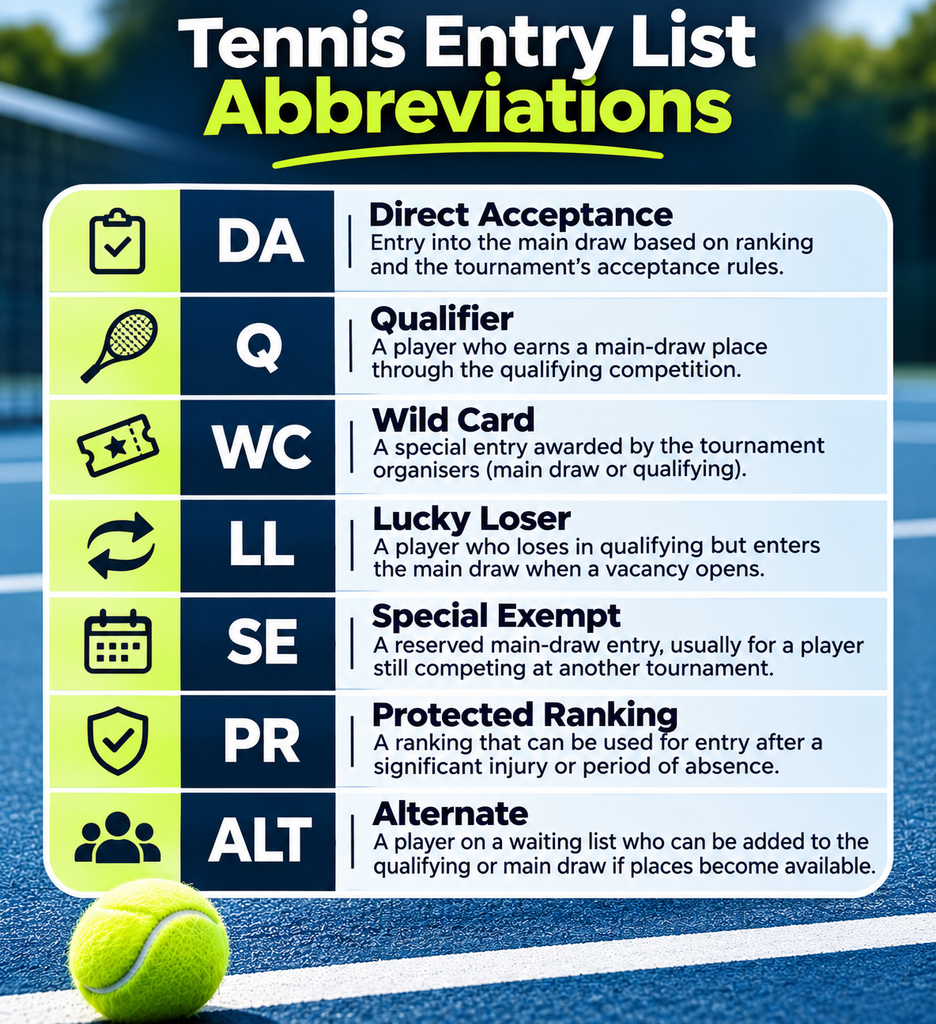
Common abbreviations include:
| Abbreviation | Meaning |
|---|---|
| DA | Direct Acceptance |
| Q | Qualifier |
| WC | Wild Card |
| LL | Lucky Loser |
| SE | Special Exempt |
| PR | Protected Ranking (ATP terminology) |
| A / ALT | Alternate |
Some designations appear on the final draw rather than the initial entry list, and the exact abbreviations can vary between tours.
A player listed as a qualifier on the final draw has earned their place through qualifying matches.
A player listed as a lucky loser has entered through the applicable replacement procedure after losing in qualifying.
A player shown as a direct acceptance received their place through the relevant acceptance system.
Why Entry Lists Matter on the Challenger and ITF Tours
For the biggest stars in tennis, tournament entry is rarely a major concern.
A highly ranked player will generally have access to most events their ranking and eligibility allow them to enter.
For someone ranked No. 300, No. 500 or No. 900, the situation can be very different.
Their schedule may depend on whether they receive a main-draw place, must compete in qualifying or remain on an alternate list.
A single withdrawal can open an opportunity. A tournament with an unusually strong field can force a player into qualifying when they might have received direct acceptance elsewhere.
Those decisions also have financial consequences.
Travelling to an event without guaranteed acceptance can involve accommodation and transport costs with no certainty of playing a match.
For players competing on tight budgets, understanding entry lists is an essential part of managing a professional career.
And for tennis fans following emerging players, the entry list can sometimes be as interesting as the draw itself.
It reveals who is attempting to move up a level, who is returning from injury and which young players are close to receiving their next significant opportunity.
Continue Reading
- ATP Challenger Tour Explained: Levels, Ranking Points and How It Works
- ITF World Tennis Tour Explained
- What Is a Qualifier in Tennis?
- What Is a Lucky Loser in Tennis?
- What Is a Wild Card in Tennis?
- ATP Next Gen Accelerator Explained
- Tennis Ranking Points Explained
Read more of our exclusive feature articles here.
Read more of our player focus articles here.
Follow The Tennis Site on X: @thetennissite
Follow Todd Scoullar on X: @toddscoullar

Comments are closed, but trackbacks and pingbacks are open.