

Before the packed stadiums, Grand Slam main draws and million-dollar prize cheques, professional tennis often looks very different.
A few spectators might stand beside an outside court. There may be no television cameras. Players can be responsible for their own travel, accommodation and coaching expenses while competing for relatively modest prize money.
Yet the matches still count.
Ranking points are available.
And the players on court are professionals trying to climb exactly the same rankings as the stars at Wimbledon and the US Open.
This is the World Tennis Tour, historically known as the ITF World Tennis Tour.
It is the entry point to international professional tennis for thousands of players and provides the bridge between junior competition and the higher levels of the ATP and WTA systems.
For many future stars, this is where a professional career really begins.
What Is the ITF World Tennis Tour?
The World Tennis Tour is a global circuit of professional tournaments sanctioned by tennis’s international governing body, formerly universally known as the International Tennis Federation or ITF.
The men’s and women’s tours provide professional opportunities below the ATP Tour and WTA Tour.
A simplified men’s pathway looks like:
GRAND SLAMS
↓
ATP TOUR
↓
ATP CHALLENGER TOUR
↓
MEN’S WORLD TENNIS TOUR
↓
JUNIOR TENNIS
The women’s structure is slightly different:
GRAND SLAMS
↓
WTA TOUR
↓
WTA 125
↓
WOMEN’S WORLD TENNIS TOUR
↓
JUNIOR TENNIS
Results at these tournaments feed into the ATP and WTA ranking systems, allowing successful players to gradually earn access to higher-level events.
There is no formal promotion.
Players move upwards by winning matches, earning ranking points and improving their rankings.

Is the ITF World Tennis Tour Professional Tennis?
Yes.
This is one of the most important misconceptions to clear up.
These aren’t junior tournaments.
They aren’t recreational tournaments.
They are professional international tennis events.
The players can earn prize money and ATP or WTA ranking points depending on their results and the tournament category.
The surroundings may look very different from a Grand Slam, but a player competing at an M15 or W15 is already playing professional tennis.
That’s why the Tour is so important.
The jump from being a successful junior or college player to competing regularly on the ATP or WTA Tour would otherwise be enormous.
The World Tennis Tour provides the first rungs on that ladder.
What Are the Men’s World Tennis Tour Levels?
The men’s structure is relatively simple.
There are two categories:
M15
Prize-money level: $15,000
M25
Despite the name, the current 2026 regulations specify $30,000 in prize money for this category.
The labels M15 and M25 remain the tournament-category names.
That is a useful detail because it’s easy to assume “M25” must currently mean exactly $25,000.
It doesn’t.
The men’s Tour currently offers approximately 600 tournaments across 70 countries, according to the governing body’s overview.
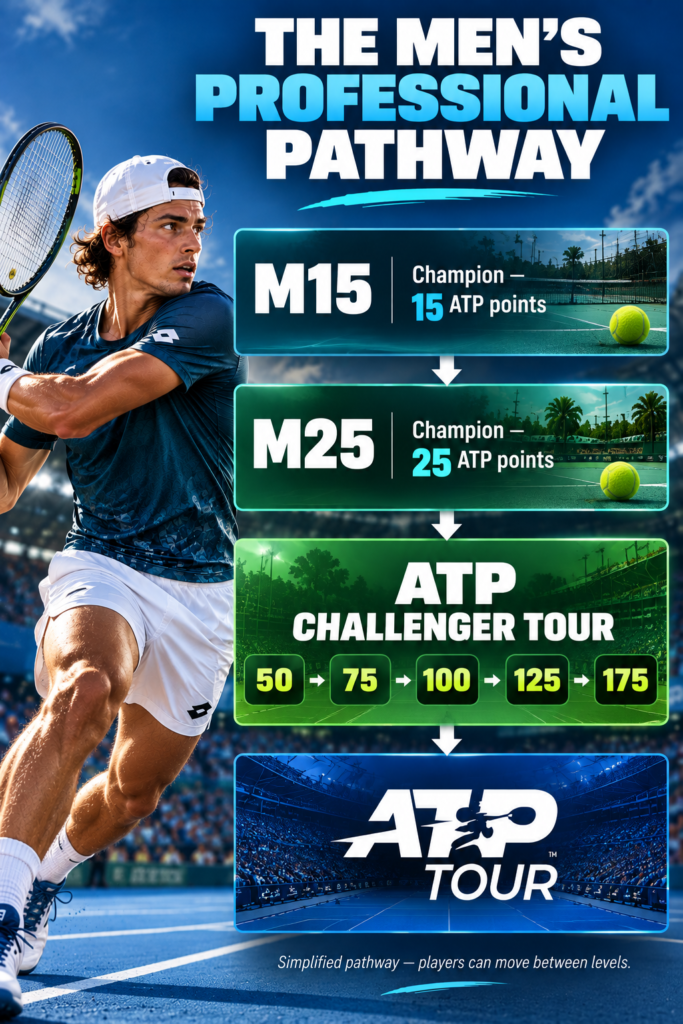
For players beginning their professional careers, M15 events are often the first step.
Success there can lead to M25 tournaments, then ATP Challenger events and eventually the main ATP Tour.
How Many ATP Ranking Points Can Men Earn?
Men’s World Tennis Tour results count towards the ATP rankings.
The 2026 singles points are:
| Result | M25 | M15 |
|---|---|---|
| Champion | 25 | 15 |
| Finalist | 14 | 8 |
| Semifinal | 7 | 4 |
| Quarterfinal | 3 | 2 |
| Round of 16 | 1 | 1 |
At first glance, 15 or 25 points may not sound like much.
Compare them with a Grand Slam title worth 2,000 points and they look tiny.
But for a player starting without an ATP ranking, those points can be enormously important.
They can establish a ranking.
Then improve it.
Then help the player gain entry to stronger tournaments.
The pathway might look like:
Win matches at M15
↓
Earn ATP points
↓
Improve ranking
↓
Gain better entry opportunities
↓
Compete successfully at M25
↓
Reach ATP Challenger level
↓
Move towards the ATP Tour
That process can take months or years.
There are no guarantees.
But ranking points are effectively the currency that allows a player to climb.
What Are the Women’s World Tennis Tour Levels?
The women’s system contains more categories.
In 2026 there are five:
| Category | Prize-Money Level |
|---|---|
| W15 | $15,000 |
| W35 | $30,000 |
| W50 | $40,000 |
| W75 | $60,000 |
| W100 | $100,000 |
The women’s Tour currently offers approximately 600 tournaments across 65 countries.
This creates a more graduated pathway than the men’s system.
A player can potentially move through:
W15
↓
W35
↓
W50
↓
W75
↓
W100
↓
WTA 125
↓
WTA Tour
Again, careers don’t necessarily progress in such a perfectly straight line.
A player might compete at W75 one week and W35 the next.
A highly ranked junior could move rapidly through the lower categories.
A player whose ranking has fallen might return to ITF-level events after previously competing regularly on the WTA Tour.
The ranking determines much of what becomes possible.
Why Are They Called W15, W35, W50, W75 and W100?
The letters are straightforward:
M = Men’s
W = Women’s
Historically, the numbers were closely associated with tournament prize-money levels.
But changes in prize money mean the label and current purse don’t always match numerically.
For example:
W35 = $30,000
W50 = $40,000
W75 = $60,000
The category names have been retained even as minimum prize-money levels have increased.
This is an important difference from ATP 250, ATP 500 or WTA 1000.
At those levels, the number refers to the ranking points awarded to the singles champion.
At World Tennis Tour level, the category label comes from the tournament classification system and should not be interpreted in the same way.
A W100 champion does not simply receive 100 WTA ranking points because the tournament is called W100.
What Does +H Mean?
Occasionally you may see a tournament written as:
W35+H
or historically similar designations.
The +H means hospitality.
Under the 2026 women’s regulations, hospitality at applicable W15 and W35 tournaments includes accommodation in a twin room with another player plus breakfast, subject to the Tour’s detailed rules.
For players competing at the lower levels of professional tennis, this can matter enormously.
Accommodation is one of the major costs of travelling internationally.
Reducing that expense can make the difference between a tournament being financially viable or not.
How Do Women’s ITF Tournaments Lead to the WTA Tour?
The basic mechanism is the same as on the men’s side.
Ranking points.
Results from eligible women’s World Tennis Tour tournaments are incorporated into the WTA rankings.
As a player’s ranking improves, so do her tournament opportunities.
Someone beginning at W15 level may eventually become strong enough to enter W35 and W50 events more consistently.
Continued success can lead to W75 and W100 tournaments.
Then WTA 125.
Eventually, the player may be able to enter WTA 250 tournaments — perhaps initially through qualifying before later gaining direct acceptance.
There is no moment when somebody officially declares:
“You have graduated from ITF tennis.”
The ranking does the work.
Once a player’s ranking is high enough to spend most weeks competing at WTA level, the lower-level tournaments naturally become a smaller part of her schedule.

Who Plays World Tennis Tour Events?
Almost every type of professional player imaginable.
Young Players Leaving Juniors
This is one of the most common pathways.
A successful junior needs somewhere to begin competing against adults.
The Tour provides that transition.
At $15,000-level men’s and women’s tournaments, main-draw places are specifically reserved for highly ranked juniors, helping leading young players move into professional competition.
College Players
Players leaving college tennis often begin or continue their professional careers at this level.
Established Professionals
A player doesn’t stop being eligible simply because she has previously competed at a higher level.
Rankings rise and fall.
Players returning from injury or struggling for form can find themselves competing at World Tennis Tour events again.
Local Players
These tournaments also create valuable opportunities for players in the host country.
Travelling internationally is expensive, so having professional events at home can provide access to ranking points without the same travel burden.
Do Future Stars Really Play These Tournaments?
Very often.
The Tour is filled with players who will later become familiar names.
The governing body’s own examples include Stefanos Tsitsipas, who won his first five professional titles at ITF events before progressing through Challengers to the ATP Tour.
On the women’s side, Emma Raducanu won her first professional titles at ITF events before eventually winning the US Open.
The point isn’t that every successful M15 or W15 player will become a Grand Slam champion.
Most won’t.
Rather, it’s that even Grand Slam champions often need somewhere to begin.
For tennis fans who enjoy following young prospects, that makes this level particularly interesting.
You may be watching a player several years before the wider tennis world knows their name.
How Much Money Do Players Make?
This is where the reality of lower-level professional tennis becomes particularly stark.
Consider the men’s circuit.
Under the current structure, M15 tournaments offer $15,000 total prize money, while M25 tournaments have increased to $30,000.
That money isn’t all going to the champion.
It is distributed throughout singles and doubles draws.
Meanwhile, players can still face expenses including:
Flights
Accommodation
Food
Coaching
Stringing
Equipment
Physiotherapy
Visas
Ground transport
A player can therefore win matches at professional tournaments and still struggle to make the economics work.
That is one of the great divides in tennis.
At the top of the sport, prize money can reach millions.
Near the bottom of the professional pyramid, players are often investing heavily in themselves in the hope that their ranking will eventually take them somewhere more lucrative.
See Tennis Prize Money Explained
How Big Are World Tennis Tour Draws?
Tournament structures vary, but 32-player singles main draws are common.
The men’s 2026 regulations govern M15 and M25 events, while the women’s regulations cover W15 through W100.
Qualifying is also a major part of these tournaments.
That matters because even reaching an ITF main draw isn’t automatic for many players.
Someone early in their career may need to:
Enter qualifying
↓
Win qualifying matches
↓
Reach the main draw
↓
Win main-draw matches
↓
Earn ranking points
The climb can therefore begin before the player has even earned their first ATP or WTA point.
Are There Qualifying Tournaments?
Yes.
Qualifying is central to the World Tennis Tour.
A player whose ranking isn’t high enough for direct acceptance can enter qualifying and attempt to earn a main-draw place.
There are also wild cards and other entry provisions under Tour regulations.
This makes the lower levels of professional tennis extremely competitive.
A player may travel internationally, pay the costs associated with competing and still lose before reaching the main draw.
That reality helps explain why climbing the professional rankings is so difficult.
There are talented players fighting for opportunities at every level.
What Surfaces Are World Tennis Tour Events Played On?
One of the advantages of having hundreds of tournaments around the world is enormous surface variety.
Events can be played on:
Hard courts
Clay
Grass
Carpet
The 2026 women’s calendar, for example, includes tournaments on clay, hard courts and carpet in the same period.
Players therefore need to adapt not only to different opponents but also to different conditions, climates and surfaces as they travel.
This can become an important part of a young professional’s development.
ITF World Tennis Tour vs ATP Challenger Tour
On the men’s side, the Challenger Tour is the next major level above.
The ranking-points comparison makes the progression clear:
| Tournament | Champion’s ATP Points |
|---|---|
| ATP 250 | 250 |
| Challenger 175 | 175 |
| Challenger 125 | 125 |
| Challenger 100 | 100 |
| Challenger 75 | 75 |
| Challenger 50 | 50 |
| M25 | 25 |
| M15 | 15 |
That is why winning repeatedly at M15 and M25 level matters.
A player needs those results to build a ranking capable of gaining entry to Challengers.
Once they establish themselves there, considerably more points become available.
See ATP Challenger Tour Explained.
ITF World Tennis Tour vs WTA 125
The women’s pathway works slightly differently.
There is no separate women’s equivalent carrying the “Challenger Tour” name.
Instead, WTA 125 sits between the World Tennis Tour and the main WTA categories.
So the upper part of the pathway is:
W100
↓
WTA 125
↓
WTA 250
↓
WTA 500
↓
WTA 1000
↓
Grand Slams
Again, players don’t have to tick every box in order.
A rapidly improving player can move through levels quickly if her ranking rises fast enough.
Why the World Tennis Tour Matters
The Tour is easy to overlook because most of professional tennis’s media coverage occurs much higher up the pyramid.
But remove it and the pathway becomes extremely difficult.
Where does an 18-year-old junior play her first professional tournaments?
Where does an unranked player earn his first ATP points?
Where does somebody ranked No. 500 compete consistently enough to improve?
This is what the World Tennis Tour provides.
The scale is enormous. The governing body currently describes approximately 600 men’s tournaments across 70 countries and 600 women’s tournaments across 65 countries.
Thousands of matches are played far away from the spotlight.
Most won’t make international sports news.
But every week, rankings are being built.
Careers are beginning.
And somewhere on an outside court, a player almost nobody has heard of may be taking the first steps towards becoming one of the best in the world.
Frequently Asked Questions
What is the ITF World Tennis Tour?
The World Tennis Tour provides entry-level and mid-level international professional tournaments and creates a pathway towards the ATP and WTA Tours.
Is ITF tennis professional?
Yes. Men’s and women’s World Tennis Tour tournaments are professional events offering prize money and ranking opportunities.
What are the men’s ITF levels?
The men’s Tour has M15 and M25 categories. In 2026, these carry prize-money levels of $15,000 and $30,000 respectively.
How many ATP points does an M15 winner earn?
15 ATP ranking points.
How many ATP points does an M25 winner earn?
25 ATP ranking points.
What are the women’s World Tennis Tour levels?
The current categories are W15, W35, W50, W75 and W100.
Is the World Tennis Tour below the ATP Challenger Tour?
On the men’s side, yes. M15 and M25 events sit below the ATP Challenger Tour.
Is the World Tennis Tour below WTA 125?
Yes. On the women’s pathway, WTA 125 sits above the World Tennis Tour and below the main WTA Tour categories.
What does +H mean in ITF tennis?
It means the tournament provides hospitality under specified Tour regulations. At applicable W15 and W35 events, this includes accommodation and breakfast.
Can junior players compete in professional events?
Yes, subject to applicable age and eligibility rules. The $15,000 tournament level also reserves certain main-draw opportunities for highly ranked juniors.
Final Thoughts
The World Tennis Tour is where professional tennis becomes a reality for thousands of players.
There may be no Centre Court.
No enormous crowd.
No million-dollar winner’s cheque.
But the basic objective is exactly the same as it is at Wimbledon:
Win matches.
Those victories create ranking points.
Ranking points create better tournament access.
Better tournaments create opportunities for more points.
And slowly, a player can climb.
For men, that journey can lead from M15 and M25 tournaments into the ATP Challenger Tour and eventually the ATP Tour.
For women, it can lead through W15, W35, W50, W75 and W100 events towards WTA 125 and the main WTA Tour.
Only a tiny percentage will reach the very top.
But virtually everyone needs somewhere to start.
And for many professional players, this is it.
Continue Reading
ATP Challenger Tour Explained
ATP 250 Explained
WTA 250 Explained
The ATP Tour Explained
The WTA Tour Explained
Tennis Ranking Points Explained
Tennis Prize Money Explained
Read more of our instructional articles here.
Read more of our player focus articles here.
Follow The Tennis Site on X: @thetennissite
Follow Todd Scoullar on X: @toddscoullar

Comments are closed, but trackbacks and pingbacks are open.