
Before a tennis tournament begins, players discover their opening opponents and the possible route they must take to reach the final.
Some are drawn against highly ranked opponents immediately. Others receive more favourable matchups, while certain seeded players advance directly to the second round without playing a match.
These outcomes are determined by the tournament draw.
Although there is an element of chance, professional tennis draws are not completely random. Established rules govern where seeded players are placed, how byes are allocated and how the remaining competitors are distributed.
Understanding those rules makes it easier to follow a tournament from the moment the draw is released.
What Is a Tennis Tournament Draw?
A tennis tournament draw is the arrangement of players or teams into a competition bracket.
It determines who plays whom in each round and how the winners progress towards the championship.
Most professional tournaments use a single-elimination format. The winner of each match advances, while the loser is eliminated.
For example, a 32-player singles draw progresses through five rounds.
| Round | Players competing |
|---|---|
| First round | 32 |
| Round of 16 | 16 |
| Quarterfinals | 8 |
| Semifinals | 4 |
| Final | 2 |
The champion must win five matches.
A tournament draw should not be confused with a tournament entry list.
The entry list determines which players have been accepted into the competition. The draw determines where those players are placed and who they will face.
A player can therefore know they have secured a main-draw place several weeks before discovering their first opponent.
For more information, read How Tennis Tournament Entry Lists Work.
How Are Tennis Tournament Draws Made?
Professional tournament draws follow procedures established by the relevant governing body, including the ATP, WTA and Grand Slam authorities.
The process generally involves three stages.
First, the tournament identifies its seeded players according to the applicable rankings and seeding regulations.
Second, those seeds are allocated to designated positions in the draw.
Finally, the remaining players are drawn into the available positions.
This means the highest seeds are deliberately separated, while the other competitors are generally placed through a random draw.
The precise procedures depend on the tournament, the size of its field and the rules governing that competition.
What Does Seeding Mean in Tennis?
Seeding is the system used to distribute leading players throughout a tournament draw.
Its purpose is to reduce the likelihood of the highest-ranked competitors meeting in the opening rounds.
A seeded player is given a protected position in the bracket, but this does not guarantee an easy opponent.
At a Grand Slam with 32 seeds in a 128-player singles draw:
- The No. 1 and No. 2 seeds are placed in opposite halves and cannot meet before the final.
- The top four seeds occupy separate quarters and cannot meet before the semifinals.
- The top eight seeds occupy separate eighths and cannot meet before the quarterfinals.
- The 32 seeds are distributed so that no two seeded players can meet before the third round.
These protections apply to the original draw. Subsequent withdrawals and replacements can change the players occupying particular positions.
How Are Seeds Chosen?
Seedings are generally based on official player rankings, subject to the regulations of the relevant competition.
At Grand Slam tournaments, the ranking list dated approximately seven days before the event is used as the basis for selecting seeds.
ATP and WTA Tour events have their own seeding regulations, which also establish the ranking information and procedures to be used.
A player’s seeding may therefore differ from their live ranking when the tournament begins.
Protected rankings and special rankings can help eligible players gain tournament entry, but they do not automatically give those players an equivalent seeded position.
How Are Seeded Players Placed in the Draw?
A Grand Slam singles draw provides a useful example.
The No. 1 seed is placed at the top of the bracket, while the No. 2 seed is placed at the bottom.
The No. 3 and No. 4 seeds are then drawn into the two remaining designated quarter positions.
The next group, seeds five through eight, is distributed among the remaining designated positions at the top or bottom of a quarter.
Further groups of seeds are allocated until all 32 have been placed.
The unseeded players are then drawn into the vacant positions.
This process prevents the leading seeds from being concentrated in one section of the tournament.
Does the No. 1 Seed Always Face the No. 4 Seed in the Semifinals?
No.
The No. 3 and No. 4 seeds are drawn into their designated positions rather than automatically assigned to a particular half.
Consequently, the No. 1 seed could face either the No. 3 or No. 4 seed in the semifinals.
Similarly, the No. 1 seed is not automatically scheduled to meet the No. 8 seed in the quarterfinals.
The seeding system separates groups of leading players. It does not arrange every possible matchup strictly according to ranking.
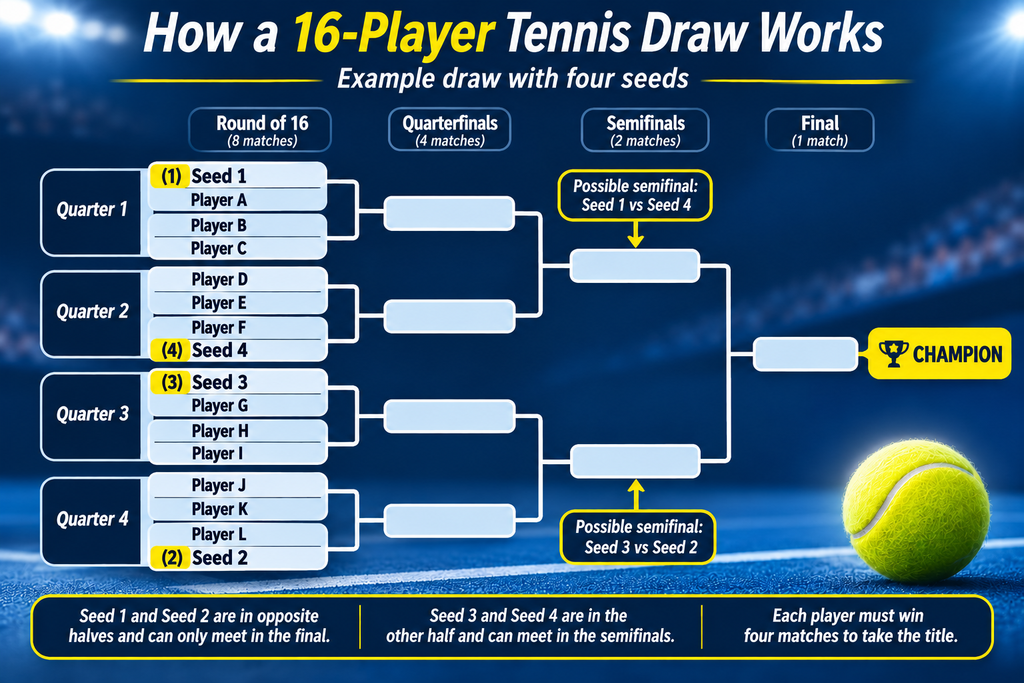
Example: How a 16-Player Tennis Draw Works
A smaller draw makes the seeding process easier to understand.
Imagine a fictional tournament featuring 16 players, including four seeds.
The No. 1 and No. 2 seeds are placed at opposite ends of the bracket.
Seeds No. 3 and No. 4 are then drawn into the two remaining quarters.
The other 12 players are allocated to the available positions.
An illustrative draw could look like this:
| Quarter | Players |
|---|---|
| Quarter 1 | Seed 1, Player A, Player B, Player C |
| Quarter 2 | Seed 4, Player D, Player E, Player F |
| Quarter 3 | Seed 3, Player G, Player H, Player I |
| Quarter 4 | Seed 2, Player J, Player K, Player L |
This is a simplified illustration of the protected seed positions, not a complete first-round match schedule.
In this example, the No. 1 seed could face the No. 4 seed in the semifinals, while the No. 2 and No. 3 seeds could meet in the other semifinal.
However, the No. 3 and No. 4 seeds could just as easily have been placed in the opposite halves.
The top two seeds cannot meet until the final.
How Many Players Are in a Tennis Tournament Draw?
Professional tournaments use different draw sizes depending on the event.
Some brackets are completely filled, while others contain byes.
| Main-draw size | Bracket positions | First-round byes | Match wins required by a player without a bye |
|---|---|---|---|
| 128 | 128 | 0 | 7 |
| 96 | 128 | 32 | 7 |
| 64 | 64 | 0 | 6 |
| 56 | 64 | 8 | 6 |
| 48 | 64 | 16 | 6 |
| 32 | 32 | 0 | 5 |
| 28 | 32 | 4 | 5 |
These figures describe conventional single-elimination brackets. A player receiving a first-round bye needs one fewer match victory.
For example, a 96-player tournament uses a 128-position bracket.
A player entering in the first round needs seven match victories to win the title. A seeded player receiving a first-round bye needs only six.
The bracket still progresses through seven rounds, but the player with the bye does not contest the opening round.
Grand Slam singles tournaments use 128-player main draws. ATP and WTA tournaments use several smaller formats depending on the event.
What Is a Bye in a Tennis Draw?
A bye allows a player to advance to the next round without contesting an opening-round match.
Byes are used when the number of competitors does not fill a standard knockout bracket.
Consider a 28-player tournament.
A conventional bracket requires 32 positions, leaving four places unoccupied.
Under the standard ATP 28-player main-draw procedure, the top four seeds receive those byes.
The remaining 24 players compete in 12 first-round matches.
Those 12 winners join the four players who received byes, creating a Round of 16.
How Do Byes Work in a 96-Player Draw?
A 96-player draw uses a 128-position bracket.
There are 32 vacant first-round positions.
In the standard 96-player ATP Masters 1000 format, the 32 seeds receive those byes.
The other 64 players contest the opening round, producing 32 winners.
Those winners then join the 32 seeded players in the second round.
The result is a 64-player field.
Is a Bye the Same as a Walkover?
No.
A bye is an allocated position in the original draw that allows a player to advance without playing the opening round.
A walkover occurs when a scheduled match cannot be played because one competitor is unable to participate.
The two situations may produce the same immediate outcome — a player advancing without contesting a match — but they arise for different reasons.
How Are Qualifiers Placed in the Main Draw?
Qualifying competitions determine which additional players earn places in the main tournament.
They are usually held shortly before the main draw begins.
At a Grand Slam, the conventional singles qualifying format features 128 players competing for 16 main-draw places.
A player must win three qualifying matches to secure one of those positions.
However, the main draw may be conducted before qualifying has finished.
When that happens, the tournament includes reserved positions marked Qualifier or Q.
These positions are distributed through the main draw under the normal drawing procedures.
Once qualifying finishes, the successful qualifiers are drawn into the reserved positions.
Does Winning a Particular Qualifying Section Determine the Main-Draw Opponent?
No.
Winning a qualifying section earns a main-draw place, but it does not automatically assign the player to a particular main-draw position.
For example, suppose a tournament has four qualifying sections and four reserved places in the main draw.
The winners of those sections qualify for the tournament.
After qualifying concludes, the four successful players are allocated to the reserved positions by draw.
One could face a seeded player, while another might meet an unseeded opponent.
This is why a qualifier may complete their final qualifying match without yet knowing their first main-draw opponent.
What Happens When a Player Withdraws After the Draw?
A tournament draw can change after it has been published.
The replacement procedure depends on when the withdrawal occurs, whether the player was seeded and which regulations govern the competition.
The distinction is particularly important because withdrawals do not always result in a straightforward replacement.
Before Qualifying Begins
At Grand Slam tournaments, vacancies created by unseeded players withdrawing after the draw but before qualifying begins are generally filled using the next eligible players on the original entry list.
The relevant acceptance rules determine who receives the available place.
After Qualifying Begins
Once qualifying has commenced, vacancies may be filled by eligible lucky losers.
A lucky loser is a player who has lost in qualifying but subsequently receives a main-draw place under the applicable replacement rules.
Lucky losers are not chosen arbitrarily.
The regulations establish eligibility requirements and selection procedures involving rankings and, in certain circumstances, random draws.
What Happens If a Seeded Player Withdraws?
A seeded withdrawal can trigger additional changes.
At Grand Slams, the rules distinguish between withdrawals occurring before and after the first day’s order of play has been released.
Before that order of play is released, another eligible seeded player may move into the vacant position, with further adjustments made elsewhere in the draw.
For example, under the 2026 Grand Slam regulations, the withdrawal of a seed ranked between No. 1 and No. 4 can result in the No. 5 seed moving into the vacated position, followed by other specified replacements.
After the first day’s order of play has been released, the regulations provide for eligible lucky losers to fill seeded vacancies.
ATP and WTA tournaments have their own procedures, so the Grand Slam example should not be treated as a universal rule.
In certain circumstances, the regulations may also permit a draw to be remade.
The timing of a withdrawal therefore matters almost as much as the identity of the player withdrawing.
Can Two Top Players Meet in the First Round?
Yes, if one or both are unseeded.
The seeding system protects designated seeded positions. It does not guarantee that every highly ranked or well-known player avoids a difficult opening match.
A former Grand Slam champion returning from injury might be ranked too low to receive a seed.
A rapidly improving young player could also be outside the seeded positions despite having recently beaten leading opponents.
Either could be drawn against a top seed in the first round.
A player using a protected ranking to gain entry is another example. Their entry status does not automatically give them a seed corresponding to that protected ranking.
This explains why major tournaments occasionally feature high-profile first-round matches despite having a structured seeding system.
How Do Doubles Tournament Draws Work?
Doubles tournaments follow many of the same principles as singles competitions.
The difference is that each entry consists of a team of two players.
Teams are seeded according to the applicable doubles regulations, and the remaining pairs are drawn into the vacant positions.
The 2026 ATP regulations provide for doubles main draws containing 16, 24 or 32 teams.
A 16-team knockout draw requires four match victories to win the title, while a 32-team draw requires five for a team without a bye.
A 24-team draw uses a 32-position bracket and includes eight byes under the applicable allocation rules.
Doubles seeding generally uses a team-ranking calculation rather than simply relying on one player’s singles ranking.
The precise procedures vary between the ATP, WTA and Grand Slam competitions.
Do All Tennis Tournaments Use Knockout Draws?
No.
Most regular ATP, WTA, Challenger, ITF and Grand Slam singles tournaments use single-elimination brackets.
However, some important competitions use round-robin formats.
The ATP Finals and WTA Finals are prominent examples.
In their standard eight-player singles formats, the competitors are divided into two groups of four.
Each player contests three group matches.
The top two players from each group then advance to the semifinals.
Unlike a conventional knockout tournament, a player can lose during the group stage and still win the title.
The Next Gen ATP Finals also uses a round-robin group stage followed by knockout semifinals and a final.
These tournaments therefore have draws, but their progression rules differ from those of a standard elimination bracket.
How to Read a Tennis Tournament Draw
Published tennis draws use several common abbreviations and designations.
| Marking | Meaning |
|---|---|
| (1), (2), (3), etc. | Seed number |
| Q | Qualifier |
| WC | Wild card |
| LL | Lucky loser |
| SE | Special exempt |
| PR | Protected ranking, where applicable |
| BYE | Player advances without an opening-round match |
The exact markings can vary between tours and tournament publications.
When examining a draw, start with the player’s opening opponent.
Then identify the seeded players in the same section and the potential opponents in the quarterfinals and semifinals.
Remember that the bracket shows possible matchups, not guaranteed ones.
A seeded player can lose in the opening round, completely changing the route for everyone else in that section.
Why Tennis Tournament Draws Matter
A draw can have a significant influence on a player’s prospects before the tournament begins.
Two competitors with similar rankings might receive very different opening opponents.
One could face a qualifier, while another draws a former Grand Slam champion returning from injury.
A player might also find themselves in a section containing several opponents who have historically caused them difficulties.
Seeding reduces the likelihood of the leading players meeting too early, but it does not remove difficult matchups.
For lower-ranked professionals, the draw can be especially important.
A manageable opening match may provide an opportunity to earn valuable ranking points and prize money. Drawing a leading seed immediately can make that task much harder.
For spectators, the draw provides an early indication of how the tournament might develop.
It reveals potential quarterfinals, semifinals and finals while leaving plenty of room for unexpected results.
The draw establishes the possible route to the title. The players determine what happens along the way.
Continue Reading
- How Tennis Tournament Entry Lists Work — How direct acceptance, alternates and withdrawals determine who enters a tournament.
- What Is a Lucky Loser in Tennis? — How players can enter the main draw after losing in qualifying.
- ATP 500 Tournaments Explained — Tournament formats, ranking points and entry pathways at ATP 500 level.
- WTA 1000 Tournaments Explained — How the leading regular-season WTA events are organised.
Read more of our exclusive feature articles here.
Read more of our player focus articles here.
Follow The Tennis Site on X: @thetennissite
Follow Todd Scoullar on X: @toddscoullar

Comments are closed, but trackbacks and pingbacks are open.