
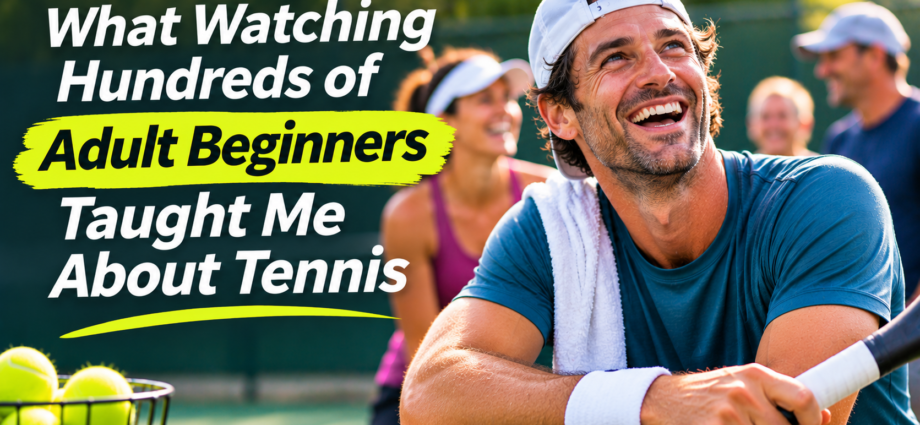
While our coaches spend their days on the court feeding balls and fixing backhands, I sit on the other side of the desk handling digital operations for Golden Racket Academy. That role gives me a unique front-row seat to the grassroots side of the sport. Before a new student ever steps onto the court for their first private lesson, I am the one reading their initial inquiries, hearing their expectations, and watching hundreds of adults discover tennis later in life.
And if there is one thing I have learned, it is that walking onto a tennis court for the first time as an adult is a wildly humbling, hilarious, and addictive experience.
Who Actually Shows Up to the Court?
When you read hundreds of beginner messages before they ever pick up a racket, you quickly realize there is almost no middle ground. Adult first-timers tend to fall into one of two extreme camps.
On one end of the extreme is the Overconfident Prodigy. Usually, they are decent at another sport, they have watched a few Grand Slam highlights on TV, and they are quietly convinced that Roger Federer isn’t really all that. Now, they aren’t completely delusional. They know they wouldn’t beat him right away. By their math, they will need a solid hour or two of practice to get the hang of things before they can start collecting trophies.
On the exact opposite end is the Excuse-Maker. This player starts apologizing before they have even booked a lesson. Their intake notes read like courtroom disclaimers: “I have always had terrible hand-eye coordination,” or “I’ve never really liked tennis, but my fiancé/coworkers/friends won’t stop bugging me to play with them.” They show up expecting the ball to personally embarrass them.
The Inescapable Truth
Before an overconfident student realizes just how steep the hill of skill in tennis truly is, and before the excuse-maker can rattle off their rehearsed on-court disclaimers, the very first thing new players feel and notice is just how much fun tennis actually is.
If you play the sport often, you already know this feeling by heart. You know how good a proper swing feels, how effortless it is to hit the ball cleanly on the sweet spot, or the magic of a day when your backhand simply refuses to miss.
But first-timers? Well, it’s in the name. They aren’t just getting to know the skills of the sport; they are getting to know the sport itself. Frankly, this is the main reason why I love what I do so much. It’s that sudden, unfiltered joy you catch on people’s faces ten minutes into a lesson. At the risk of sounding overly poetic, it is the kind of feeling you thought you abandoned in your childhood, only for it to somehow come back and find you on a tennis court.
More than natural athleticism or early technique, how deeply someone connects with that feeling is the single biggest factor in whether they will stick with their lessons and with tennis as a whole.
Getting to Actually Play
Every now and then, a total newbie will step up and do something completely right purely by mistake. The ball clips the baseline, everyone cheers, and for about ten seconds, they think they have mastered the game.
Once that beginner’s luck wears off, however, the real struggle begins. I often read tennis blogs about what new players struggle with the most, and for the most part, they are spot on. Once the rallying starts, almost every adult beginner runs into the exact same wall of hurdles:
1. The “T-Rex Arm”: Judging the bounce of a spinning tennis ball is much harder than it looks from the stands. Instead of staying to the side of the ball, beginners naturally run straight at it. By the time the ball bounces, it is right in their ribs, forcing them to tuck their elbow into their side and swat at the ball with a cramped, awkward “T-Rex arm.”
2. The “Frying Pan” Grip and Home-Run Swing: Left to their own devices, almost every first-timer grabs the racket like a frying pan, squeezes the handle with a white-knuckle death grip, and swings for the fences. Without topspin to bring the ball down, combining a flat racket face with full adult strength has only one outcome: launching five straight balls over the back fence.
3. Cement Shoes in “No-Man’s Land”: Beginners almost always hit a shot, plant their heels flat on the concrete to admire where the ball went, and freeze. Worse, they wander two steps inside the baseline into “No-Man’s Land,” that dead middle zone of the court where the next ball inevitably lands right at their shoelaces.
4. The Runaway Serve Toss: Everyone assumes the hardest part of the serve is the overhead swing. Then they try the toss. Suddenly, throwing a ball three feet straight into the air feels like juggling in a wind tunnel, and looking up too early sends a loud clank off the metal frame.
5. Our Pick: The Cardio Shocker: This is the one I notice shocking our new players more than anything else. People look at a tennis court, see a surface that is much smaller than a soccer pitch or a football field, and assume tennis isn’t a cardio-heavy sport. Even regular gym-goers and 5K runners expect a casual stroll on concrete. Then the coach pulls out a basket of 100 balls. Because beginners can’t read the bounce early yet, every shot turns into a frantic, last-second panic sprint while subconsciously holding their breath on every swing. Going back to our extreme scale from earlier, there is nothing quite like watching the overconfident player end up with their hands on their knees, completely out of breath ten minutes into their first drill. It is quite the humbling experience.
Why It Hooks Us (My Unscientific Theory)
Despite the sore calves, the bruised egos, and the surprise cardio, almost everyone comes back. And from watching so many students go through that first hour, I think it comes down to two things.
First, tennis is one of the ultimate adult escapes. We have very few spaces left in modern life that demand 100% of our attention. Even on a treadmill, your mind wanders back to work and errands. You cannot think about your inbox when a yellow ball is flying toward you. For an hour, your entire world shrinks down to the court.
Second, although this is just a hunch with zero scientific backing behind it, I am convinced there is something almost reptilian that makes tennis such a uniquely human experience. We have evolved for hundreds of thousands of years to hold tools in our hands to get things done. After spending all week tapping flat glass screens, wrapping your hand around a racket, tracking a moving object, and striking it cleanly scratches an ancient evolutionary itch.
By the time the lesson wraps up, you can’t tell the overconfident prodigy and the excuse-maker apart anymore. They are both exhausted, grinning from ear to ear, and asking the exact same question on their way to the car: “So, same time next week?”
Guest contribution from Golden Racket Academy. The views expressed are those of the author.
Continue Reading
- Tennis Scoring Explained: A Complete Guide — Understand points, games, sets and tiebreaks before your first match.
- Tennis Etiquette: The Unwritten Rules Every Player Should Know — Essential advice for anyone stepping onto a tennis court for the first time.
- Tennis Dress Code: What Can You Wear on a Tennis Court? — What beginners should wear, from suitable shoes to comfortable clothing.
Read more of our exclusive feature articles here.
Read more of our player focus articles here.
Follow The Tennis Site on X: @thetennissite

Comments are closed, but trackbacks and pingbacks are open.