
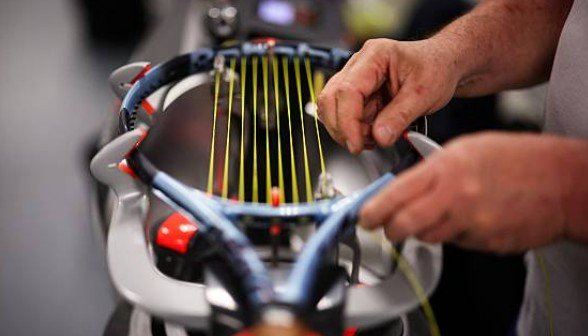
When players buy a new tennis racquet, they often spend hours comparing weights, balance points and head sizes.
Then they hand it to the stringer and simply say, “Whatever tension you recommend.”
That decision matters far more than many players realise.
String tension can change how a racquet feels, how much power it produces, how much control you have and even how comfortable it is on your arm. Two identical racquets strung at different tensions can play like completely different pieces of equipment.
Fortunately, understanding string tension isn’t complicated.
In this guide, we’ll explain what string tension is, why it matters and how to choose the right tension for your game.
Quick Answer
String tension refers to how tightly the strings are pulled when they’re installed in a tennis racquet.
- Lower tensions generally provide more power, a larger sweet spot and greater comfort.
- Higher tensions generally provide more control and a firmer feel.
For most recreational players, a tension between 22–25 kg (48–55 lbs) is an excellent starting point.
What Is Tennis String Tension?
String tension is the force used to pull each string before it is secured in the racquet.
It is usually measured in:
- Kilograms (kg) – used in most countries.
- Pounds (lbs) – commonly used in the United States.
For example:
- 23 kg
- 51 lbs
Both measurements describe the same tension using different units.
Why Does String Tension Matter?
The strings are the only part of the racquet that actually makes contact with the ball.
Changing their tension changes how they behave during impact.
String tension affects:
- Power
- Control
- Feel
- Comfort
- Ball launch angle
- Sweet spot
- Spin potential
Although many players focus on buying a new racquet, changing the string tension is often a cheaper and more effective way to improve how their equipment performs.
Low String Tension
Lower string tension allows the strings to stretch more when the ball hits them.
The ball stays on the strings fractionally longer before rebounding.
This creates a softer, more forgiving response.
Advantages
- More power.
- Larger sweet spot.
- Greater comfort.
- Less shock and vibration.
- Easier depth on groundstrokes.
Disadvantages
- Less control.
- Higher launch angle.
- Some players may feel the ball “flies” too much.
- Softer response may feel less precise.
High String Tension
Higher tension creates a firmer string bed.
The strings move less during impact, producing a more controlled response.
Many advanced players prefer higher tensions because they generate their own power and value accuracy.
Advantages
- Greater control.
- Lower launch angle.
- Firmer feel.
- More predictable response.
- Improved confidence when swinging aggressively.
Disadvantages
- Smaller sweet spot.
- Less free power.
- Harsher feel.
- Greater shock on off-centre hits.
Does Lower Tension Really Produce More Power?
Generally, yes.
A looser string bed deforms more during impact and returns more energy to the ball.
For most recreational players, this means the ball leaves the strings with slightly more speed and requires less effort to reach the baseline.
However, there’s a balance to be found.
If the tension is too low, some players may struggle to keep the ball inside the court because the launch angle increases.
Does Higher Tension Provide More Control?
Yes—but not because the strings grip the ball more tightly.
Instead, the firmer string bed reduces the trampoline effect, making the ball leave the racquet on a lower, more predictable trajectory.
Players who generate plenty of their own racquet-head speed often prefer this extra control.
What About Spin?
One of the biggest myths in tennis is that tighter strings automatically produce more spin.
In reality, the relationship is more complicated.
Modern research suggests that string type, racquet-head speed and how freely the strings move and snap back have a greater influence on spin than tension alone.
Changing the tension by a few kilograms may slightly alter spin, but technique remains the biggest factor.
Does String Tension Affect Comfort?
Absolutely.
Lower tensions generally absorb more impact, reducing the amount of shock transmitted to the arm.
This is one reason players experiencing arm discomfort often lower their string tension or switch to a softer string.
Higher tensions create a firmer impact and may feel harsher, particularly when combined with stiff polyester strings.
What Tension Do Professionals Use?
Professional players use a surprisingly wide range of tensions.
Some prefer relatively low tensions to maximise power and spin, while others favour higher tensions for control.
Many professionals also adjust their tension depending on:
- Court surface
- Weather
- Temperature
- Altitude
- Type of tennis ball
- Opponent
Because professionals have highly refined techniques and often restring multiple racquets before every match, their preferred tension isn’t necessarily suitable for recreational players.
Recommended Tension Guide
| Player Type | Recommended Tension |
|---|---|
| Beginner | 22–24 kg (48–53 lbs) |
| Recreational | 23–25 kg (51–55 lbs) |
| Intermediate | 24–26 kg (53–57 lbs) |
| Advanced | 24–27 kg (53–60 lbs) |
These ranges are only starting points.
The ideal tension depends on your strings, racquet and personal preference.
Should You String at the Top or Bottom of the Recommended Range?
Every racquet has a recommended tension range printed on the frame.
For example:
Recommended: 23–27 kg
As a general guide:
- Choose the lower end if you want more power and comfort.
- Choose the middle if you’re unsure.
- Choose the upper end if you prioritise control.
Unless you have a specific reason, there’s rarely a need to exceed the manufacturer’s recommended range.
How Often Should You Restring?
Even if strings don’t break, they gradually lose tension over time.
As tension drops, the racquet will begin to feel different.
A common guideline is to restring as many times each year as you play each week.
For example:
- Play once a week → restring once a year.
- Play twice a week → restring twice a year.
Competitive players often restring much more frequently to maintain consistent performance.
Common Myths
“Higher tension creates more spin.”
Not necessarily.
Technique and racquet-head speed play a much larger role.
“Professionals all use high tensions.”
False.
Professional players use a wide variety of tensions depending on their equipment, playing style and conditions.
“More tension is always better.”
No.
The best tension is the one that gives you the right balance of power, control and comfort.
“Strings only matter if they break.”
False.
Strings gradually lose tension long before they snap, meaning your racquet’s performance changes over time.
Frequently Asked Questions
What is the best tennis string tension?
For most recreational players, 22–25 kg (48–55 lbs) provides an excellent balance of power, control and comfort.
Should beginners use lower string tension?
Yes.
Lower tensions generally offer more power, a larger sweet spot and a more forgiving feel.
Does lower string tension increase power?
Yes.
Lower tension allows the strings to stretch more during impact, helping return more energy to the ball.
Does higher string tension improve control?
Generally, yes.
Higher tension creates a firmer string bed that produces a more predictable ball flight.
How do I know if my tension is too high?
If your shots feel harsh, lack depth or your arm becomes uncomfortable, your tension may be higher than is ideal for your game.
Final Thoughts
String tension is one of the easiest ways to customise how a tennis racquet performs.
While there is no universally “best” tension, understanding the trade-off between power and control can help you make a more informed choice. Lower tensions generally provide greater comfort and easier power, while higher tensions offer a firmer feel and increased precision.
If you’re unsure where to begin, start near the middle of your racquet’s recommended tension range and make small adjustments over time. Even a change of 1–2 kg (2–4 lbs) can noticeably alter how your racquet feels.
As with every aspect of tennis equipment, the ideal setup is the one that helps you play your best.
Continue Reading
- Tennis Swingweight Explained
- Tennis Racquet Balance Explained
- Tennis Racquet Weight Explained
- Tennis String Type Explained
Read more of our instructional articles here.
Read more of our player focus articles here.
Follow The Tennis Site on X: @thetennissite
Follow Todd Scoullar on X: @toddscoullar

Comments are closed, but trackbacks and pingbacks are open.