
Tennis scoring is a beautiful thing, but can be hard when first learning the sport. The tiebreak is a vital time in a tennis match. But what is it, and how does it work?
It is used to decide a set when players reach 6–6 in games, and it is designed to prevent sets from continuing indefinitely while still preserving fairness.
Although it looks simple on the surface, the tiebreak has specific rules, serving patterns, and strategic layers that often confuse new fans.
This guide breaks everything down clearly.
A tiebreak is played when a set reaches 6 games each.
Instead of continuing traditional games, players switch to a faster scoring system to decide the set.
How scoring works in a tiebreak:
Unlike normal tennis scoring (15, 30, 40), tiebreaks use simple counting:
- 1, 2, 3, 4, 5…
The first player to reach:
- 7 points
- and lead by 2 points
wins the tiebreak.
Examples of winning scores
- 7–3
- 7–5
- 8–6
- 9-7
- 10–8
Who serves in a tiebreak?
Serving rotates in a fixed pattern, with the opening serve to be delivered by the receiver in the previous game:
- Player A serves once
- then Player B serves twice
- then alternate every two points
Change of ends
Players change ends of the court:
- after every 6 points in the tiebreak
For example:
- at 3–3 – change ends
- at 6-6 – change ends
- at 9–9 – change ends
- at 15–15 – change ends
This balances environmental factors like wind, sun, or court conditions.
Common misconceptions
“You must win 7–6 in a tiebreak”
No.
You only need to win the tiebreak. The set score becomes 7–6, but tiebreak scores can go far beyond 7 points.
“Tiebreaks are always the same in every tournament”
Not true.
While most follow similar rules, final-set formats vary across tournaments.
“Serving first is a big advantage”
It helps slightly, but the alternating structure balances the system. Many matches are won by the second server in tiebreaks.
Why tiebreaks exist:
Without tiebreaks, sets could continue indefinitely, which they used to do for many years. Up until fairly recently, the Grand Slams used to play the deciding set without a tiebreak…until one chaotic match at Wimbledon.
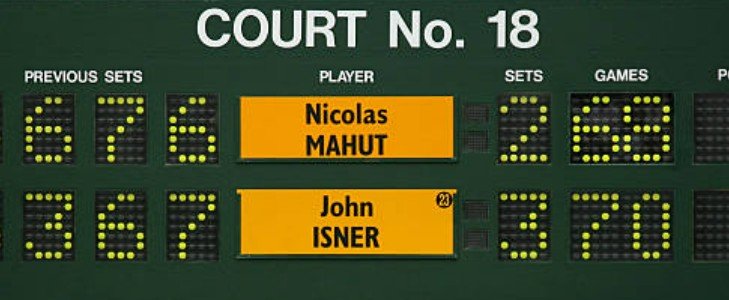
John Isner and Nicholas Mahut played out a match over 3 days, where the final set was eventually decided at 70 games to 68. It was then quickly decided that tennis cannot continue like this, so the tiebreak was introduced for the deciding set.
What is a Match Tiebreak?
The match tiebreak is used in the deciding sets of a Grand Slam when scores reach 6-6, or in most doubles events after sets are tied at 1-1.
The match tiebreak is played out in exactly the same way as a normal tiebreak, however, the winner must reach 10 points first, rather than seven. The two-point buffer remains the same.
The tiebreak ensures:
- fairness
- time control
- consistent match structure
Related: What Does Advantage mean, What is Deuce, Tennis Scoring Explained
Read more of our instructional articles here.
Read more of our player focus articles here.
Follow The Tennis Site on X: @thetennissite
Follow Todd Scoullar on X: @toddscoullar

Comments are closed, but trackbacks and pingbacks are open.