
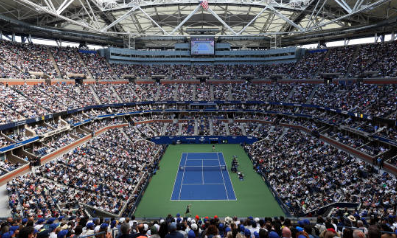
For the first time in several years, the US Open men’s draw feels somewhat unpredictable.
World No. 1 Jannik Sinner has withdrawn with a knee injury. Defending champion Carlos Alcaraz is returning after more than four months away from singles competition. Novak Djokovic is 39 and still chasing more history, while Alexander Zverev enters as the top seed and a Grand Slam champion for the first time.
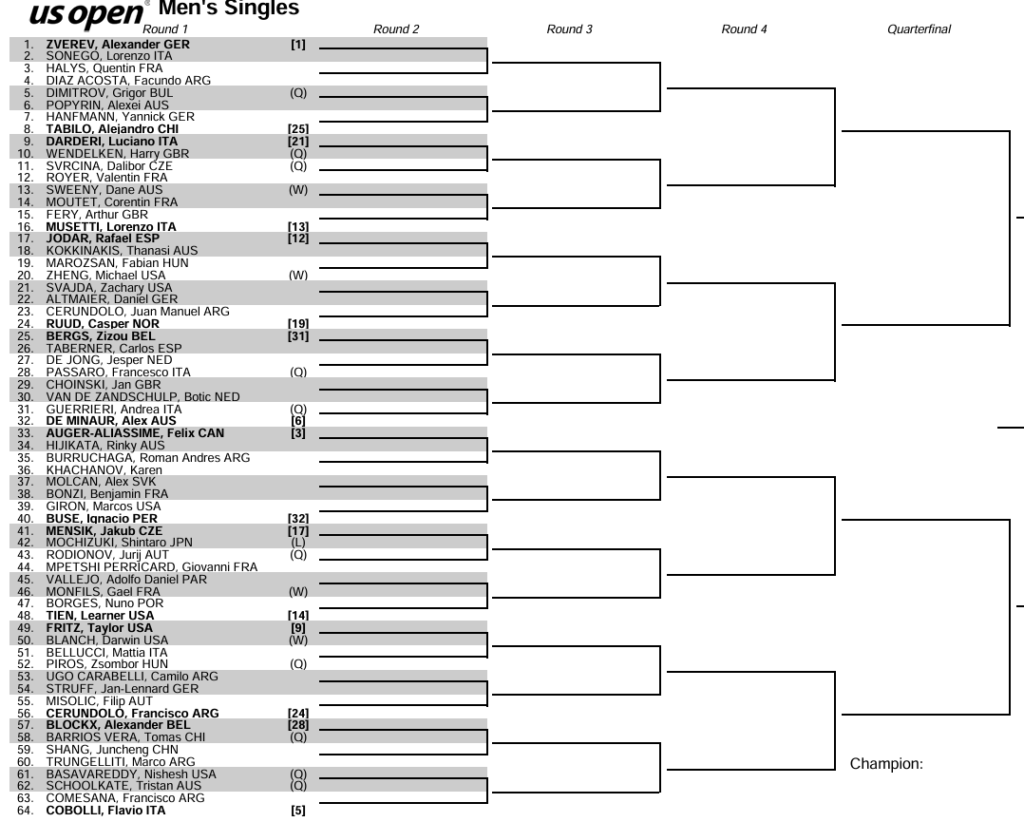
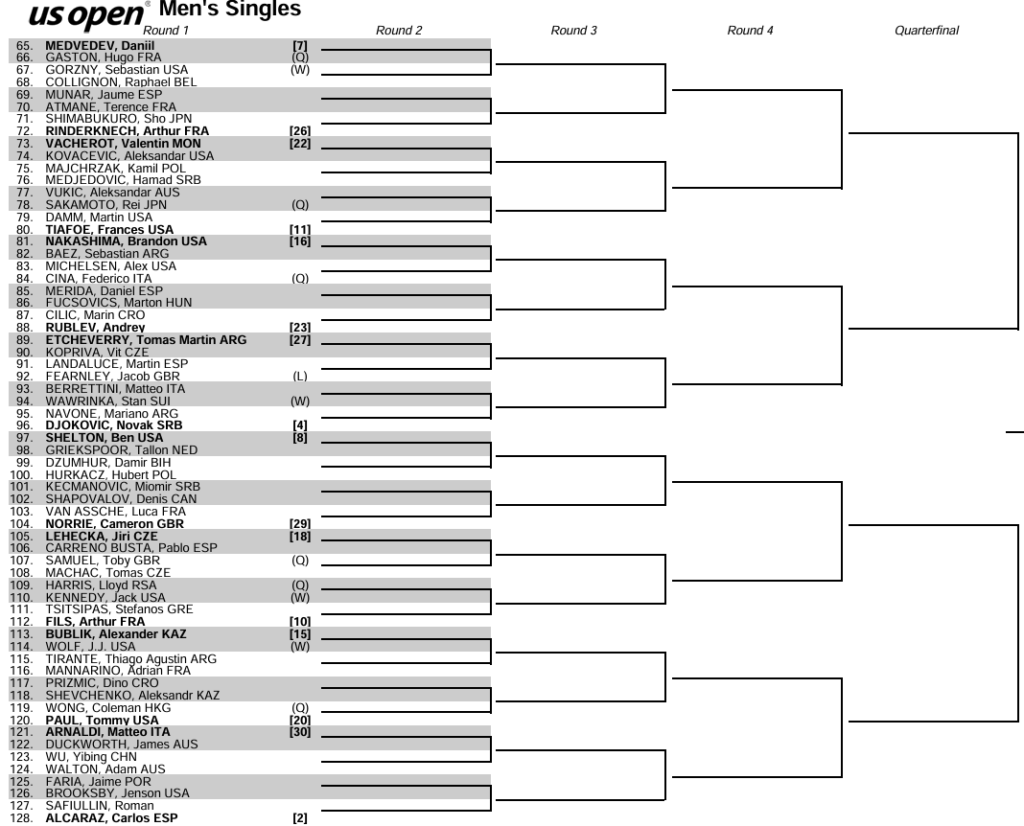
Alcaraz has been placed in an unforgiving bottom quarter, while Djokovic’s route is packed with big names but may not be quite as difficult as it initially appears.
The projected quarterfinals are Zverev against Alex de Minaur, Felix Auger-Aliassime against Flavio Cobolli, Daniil Medvedev against Djokovic, and Ben Shelton against Alcaraz.
But we all know it would be an absolute longshot for all eight to survive.
Arthur Fils, Taylor Fritz, Rafael Jódar, Learner Tien and Brandon Nakashima are among the players whose recent performances suggest they can disrupt the seedings. Fils, in particular, has landed in the most significant section of the draw after winning his first Masters 1000 title in Cincinnati.
Shelton and Alcaraz Have No Time to Ease In
Ben Shelton may have won Montreal, but the eighth seed has been handed one of the most difficult unseeded opponents in the draw.
Tallon Griekspoor possesses the serve and first-strike tennis to make Shelton uncomfortable. There may be few extended rallies, meaning the outcome could be decided by a handful of points and one or two tiebreaks. Shelton should have the superior athleticism over five sets, particularly with the New York crowd behind him, but it is a dangerous beginning for a player carrying significant expectations.
Shelton reached the semifinals at Flushing Meadows in 2023 and enters this tournament as one of the leading candidates to end the long wait for an American men’s champion. Andy Roddick, in 2003, remains the last American man to win the US Open.
Alcaraz has an even more complicated assignment.
Roman Safiullin is ranked outside the leading group, but he has already shown that he can trouble the Spaniard. Safiullin defeated Alcaraz 6-3, 6-4 at the 2023 Paris Masters before Alcaraz reversed the result at the 2024 Paris Olympics. Their head-to-head is tied at one victory each.
Under normal circumstances, Alcaraz would be a commanding favourite. After more than four months without singles competition, the match carries much greater uncertainty.
Safiullin strikes a clean, flat ball and can take time away from an opponent whose movement or timing is slightly below its usual standard. Alcaraz may ultimately prove that his wrist and match fitness are no longer issues, but his opening match is not an exhibition in which he can gradually rediscover his rhythm.
Even if he advances, the difficulty does not disappear. Tommy Paul and Alexander Bublik are possible fourth-round opponents, while Shelton, Fils, Jiri Lehecka and Cameron Norrie occupy the other side of the quarter.
Fils and Tsitsipas Headline the First Round
The most striking first-round match is Arthur Fils against Stefanos Tsitsipas, although their current trajectories suggest it may be less evenly balanced than their reputations imply.
Fils arrives in New York after winning his first Masters 1000 title in Cincinnati, where he defeated Frances Tiafoe 6-3, 1-6, 6-0 in the final. The 22-year-old has risen to a career-high No. 11 and has now established himself as a serious contender.
Tsitsipas, meanwhile, has fallen to No. 53 and trails Fils 5-0 in their head-to-head series. Their most recent meeting was particularly severe: Fils won 6-0, 6-1 in Miami earlier this season.
Those numbers leave little doubt about the favourite. Tsitsipas remains capable of playing exceptional attacking tennis, but his return position and one-handed backhand are vulnerable against an opponent who takes the ball early and produces heavy pace from both sides. Fils also enters the tournament with considerably greater confidence.
The intrigue lies in whether Fils can recover physically and emotionally after his Cincinnati title. If he can, he should win. More importantly, he could travel much further than the first round.
Elsewhere, the draw has produced two matches filled with US Open history.
Former champion Marin Cilic will face four-time quarterfinalist Andrey Rublev. Rublev leads their official head-to-head 4-3, but Cilic won their most memorable encounter, a five-set quarterfinal at Roland Garros in 2022. Cilic may no longer be a weekly contender, but his serve and first forehand remain dangerous in fast conditions. Rublev has been given virtually no time to settle into the tournament.
Matteo Berrettini and Stan Wawrinka will meet for the right to face Djokovic, assuming the Serbian defeats Mariano Navone.
Wawrinka is playing the final major of his career, 10 years after defeating Djokovic in the 2016 US Open final. At 40, his chances of making a deep run are remote, but one more memorable night on Arthur Ashe Stadium is not. Berrettini, a US Open semifinalist in 2019, will be favoured because of his serve and greater physical reserves.
The possibility of Wawrinka facing Djokovic one last time gives the match an extra special meaning.
Jódar Is the Player the Seedings May Underestimate
Rafael Jódar’s first-round match against Thanasi Kokkinakis is another contest worth watching closely.
Jódar is only 19, but his recent results and season performance ratings suggest he is already operating above his official position. Tennis Abstract’s Elo ratings, which account for the strength of each opponent rather than simply awarding points according to the round reached, place him among the leading players in the field.
Kokkinakis can beat almost anyone when healthy. His serve and forehand give him control of large sections of a match, but his body has repeatedly struggled with the demands of the tour. Over five sets, Jódar is likely to be just far too good.
If the young Spaniard advances, he is projected to meet 2022 finalist Casper Ruud in the third round. Ruud’s New York record deserves respect, but hard courts have never been his strongest surface. It would not be a major surprise if Jódar emerged as Zverev’s quarterfinal opponent.
Lorenzo Musetti also faces a difficult opening match against Britain’s Arthur Fery. Musetti is the 13th seed, but his best results have traditionally come on clay and grass. Fery’s flatter ball and willingness to play close to the baseline could rush the Italian in the faster New York conditions.
Musetti remains the favourite, although this is one of the more realistic first-round upset opportunities involving a top-16 seed.
Zverev Has the Clearest Route
Zverev begins against Lorenzo Sonego and has been given the most favourable quarter of the leading contenders.
The German is 18-2 at Grand Slam tournaments this season. He won his first major at Roland Garros and then reached the Wimbledon final, where Sinner stopped him from claiming consecutive titles.
His preparation in North America has been less convincing. Zverev lost his opening match in Toronto and then surrendered a match point against Tommy Paul in Cincinnati. Nevertheless, his serve and controlled baseline power make him exceptionally difficult to defeat across five sets.
Zverev could meet Alejandro Tabilo in the third round and Musetti in the fourth. Neither is an ideal opponent, but neither should prevent him from reaching the quarterfinals if he plays close to his normal level.
The more interesting question is who meets him there.
De Minaur is the seeded choice. Eight of his 11 ATP titles have come on outdoor hard courts, and he has avoided Alcaraz, Djokovic, Medvedev, Shelton and Fils until at least the semifinals. His speed and consistency should be enough to navigate the early rounds, although a possible second-round match with Botic van de Zandschulp cannot be dismissed.
Van de Zandschulp has already produced one enormous US Open upset, defeating Alcaraz in 2024. He also arrived at this tournament in encouraging form, recently beating Luciano Darderi 6-1, 6-0 in Winston-Salem.
A likely match-up with Jodar will be a massive test for De Minaur, but this remains, at least on paper, a decent opportunity to move to a Grand Slam quarterfinal.
Fritz Could Replace Cobolli in the Last Eight
The second quarter is led by Auger-Aliassime and Cobolli, but Taylor Fritz may be the stronger quarterfinal candidate.
Fritz reached the US Open final in 2024 and has the game for these conditions: a powerful serve, compact groundstrokes and the ability to absorb pace without giving up court position. He begins against 18-year-old American Darwin Blanch and could meet Jan-Lennard Struff in the third round.
Cobolli has enjoyed an outstanding season, but his results have been stronger across all surfaces than they have been specifically on outdoor hard courts. A projected fourth-round match with Fritz would favour the American, particularly over five sets and in front of a home crowd.
Auger-Aliassime has a more complicated path than a third seed would ordinarily expect. He opens against Rinky Hijikata and could face former US Open semifinalist Karen Khachanov in the second round.
Beyond that, Learner Tien and Jakub Mensik are positioned to meet in the third round. Tien’s return, anticipation and ability to redirect pace make him particularly effective on hard courts, while Mensik has enough serving power to remove time and rhythm from almost any opponent.
Auger-Aliassime remains the logical quarterfinal choice, but this is one of the tournament’s more open sections.
Djokovic’s Draw Looks Harder Than It May Be
At first glance, Djokovic’s route is crowded with danger.
Navone comes first, followed by Wawrinka or Berrettini. Tomas Martin Etcheverry is the likely third-round opponent, with Rublev, Cilic or Brandon Nakashima potentially waiting in the fourth.
The names are impressive at first glance, but their present threat level is more difficult to assess.
Wawrinka and Cilic are both former champions but are now deep into the final stages of their careers. Berrettini remains dangerous but has struggled to stay healthy. Rublev has not shown the consistency that once made him an almost automatic Grand Slam quarterfinalist.
Nakashima may be the most credible obstacle. His composed, compact game is well suited to hard courts, and he is capable of progressing through a section containing several more celebrated opponents. His form is also very solid over the last couple of months.
Even so, Djokovic should reach the quarterfinals. He remains one of the world’s best players and has won the US Open four times. His age—39—makes recovery between difficult matches a concern, but his early path may be less punishing than its collection of famous names suggests.
Medvedev is the likely quarterfinal opponent. The 2021 champion begins against a qualifier and is projected to face Frances Tiafoe in the fourth round. Tiafoe’s history in New York and connection with the crowd would make that one of the matches of the tournament, but Medvedev remains the more reliable player across five sets.
Fils Could Break the Projected Quarterfinals
The seedings point towards Shelton against Alcaraz in the bottom quarter. Current form suggests Fils may have something to say about that.
After Tsitsipas, Fils could face Lehecka in the third round and Shelton in the fourth. That is a difficult path, but his Cincinnati title demonstrated that he is capable of beating elite opposition repeatedly across a major event.
Lehecka is dangerous, while Shelton’s serve and home support will make him difficult to stop. Yet Fils is currently the more complete player from the baseline. His movement has improved, his forehand can dictate without becoming reckless, and he is defending with considerably more discipline than earlier in his career.
The winner of that section may then meet an Alcaraz who has already been forced to negotiate several difficult matches immediately after a long absence.
That makes Fils the player most likely to disrupt the projected quarterfinal line-up.
The most probable last eight appears to be Zverev against de Minaur, Auger-Aliassime against Fritz, Medvedev against Djokovic, and Fils against Alcaraz.
Zverev has the safest path. Djokovic has the experience. Fils and Shelton have the momentum. Alcaraz still has the highest level available to anyone in the draw, but also the greatest uncertainty.
For the first time in a while, the final men’s major of the season does not feel decided before a ball has been hit. The favourite may still win, but there are enough questions—and enough credible alternatives—to make the path through New York far more interesting than the seedings alone suggest.
Read the US Open Women’s preview here
Read more of our exclusive feature articles here.
Read more of our player focus articles here.
Follow The Tennis Site on X: @thetennissite
Follow Todd Scoullar on X: @toddscoullar

Comments are closed, but trackbacks and pingbacks are open.