

Death threats, attacks on family members and sexually abusive messages have become an alarming feature of professional tennis. The experience of an 18-year-old Australian player has brought renewed attention to gambling-related harassment and the protection available to young athletes entering the professional game.
When Australian teenager Taylah Lessue walked off court following a qualifying defeat at the City of Playford Tennis International in South Australia on Sunday, 22 November 2026, her family had reason to be proud of her efforts.
The 18-year-old had been recovering from glandular fever and, according to her mother, Rachelle, had spent much of the preceding three weeks unable to train. She had recently required hospital treatment.
Lessue won the opening set 6–4 but lost the following two sets 6–0, 6–0 as the effects of her illness took their toll.
According to ABC News, within 15 minutes of completing the match, she was receiving death threats and messages threatening sexual and physical violence.
The incident occurred while Lessue was standing courtside with City of Playford Mayor Glenn Docherty, who subsequently expressed his disgust at the messages.
Her mother later explained the circumstances surrounding her daughter’s performance on social media.
“These people have no idea what Tay has battled the last few weeks,” she wrote.
South Australian Police confirmed they were investigating the messages, while Tennis Australia became involved in supporting the player and her family.
Lessue’s match had been streamed live, and her mother raised concerns about betting on such contests. Although the motivation of the people responsible for the threats has not been established publicly, the connection between gambling and online abuse in professional tennis has been extensively documented.
For several years, established professionals have been warning about the consequences of this behaviour, particularly for younger players entering the sport.
Katie Boulter: The Abuse Has Become Overwhelming
In June 2025, British player Katie Boulter spoke to the BBC about the threatening messages she regularly received through social media.
Among the incidents she disclosed was a series of messages sent during her first-round match against France’s Carole Monnet at the French Open.
Boulter lost the opening set in a tiebreak before recovering to win the match. Despite ultimately progressing to the second round, she received disturbing messages targeting both herself and her family.
Her experience demonstrated that the trigger for abuse does not necessarily need to be a defeat. Losing a set, conceding a break of serve or failing to satisfy the conditions of a particular wager can also prompt individuals to target players.
Boulter explained that the uncertainty surrounding the identity and whereabouts of those sending threatening messages added another dimension to the problem.
“I think it just kind of shows how vulnerable we are,” she said.
Speaking about the earlier stages of her career, Boulter recalled taking personal criticism particularly hard. She also expressed concern about the increasing severity of messages and the ability of younger players to manage them.
It was a warning that now carries particular relevance following the events at Playford.
Boulter told the BBC that she wanted the sport to find ways of protecting emerging professionals from experiencing the same problems she had encountered during her career.
Her interview, also reported by ABC News, highlighted an important, yet disturbing aspect of online harassment. Players can become accustomed to receiving abuse without becoming immune to its consequences.
Caroline Garcia Questions Tennis’s Relationship With Gambling
Boulter was far from the first established professional to speak publicly about the issue.
Following her opening-round defeat to Mexico’s Renata Zarazúa at the 2024 US Open, France’s Caroline Garcia shared examples of the abuse she had received on social media.
The former world No. 4 questioned both the role of social media platforms and the commercial relationship between professional tennis and betting companies.
Garcia argued that the sport’s promotion of gambling could encourage unhealthy betting behaviour. She also questioned why individuals were able to make threats anonymously online when comparable conduct in person could have legal consequences.
Although Garcia had developed strategies to manage the psychological effects of online abuse, she was particularly concerned about players who had yet to acquire that experience.
“It really worries me when I think about younger players coming up, that have to go through this,” she wrote.
Garcia stopped short of calling for betting companies to be banned, instead questioning whether professional sport should continue actively promoting them.
Her comments, reported by Reuters, received support from fellow professionals including Iga Swiatek and Madison Keys.
Jessica Pegula also responded, highlighting how commonplace threats against players and their families had become, irrespective of whether they won or lost.
The parallels between Garcia’s concerns in 2024, Boulter’s experiences in 2025 and the Lessue incident in 2026 are difficult to ignore. And as anyone involved in tennis knows, this is far more widespread than just a handful of isolated incidents.
Established professionals have repeatedly warned that young players entering the sport could be particularly ill-equipped to manage this aspect of professional tennis.
Abuse Across the Professional Tours
French professional Alice Tubello’s experience demonstrates that online abuse is not confined to the sport’s biggest tournaments.
Following a defeat in Arequipa, Peru, in August 2024, Tubello received hundreds of abusive messages. The harassment subsequently extended to members of her family, prompting her to seek legal assistance and lodge a complaint.
Speaking to Le Monde in December 2025, Tubello described the frequency of the abuse.
“I still get about 10 messages per match, whether I win or lose.”
Australian professional Omar Jasika has experienced similar harassment. In a March 2026 interview with The First Serve, he described receiving threats against himself and his loved ones, while explaining that restricting access to his social media accounts could cost him potential sponsorship opportunities.
“I’d probably say every match I play, I’ve received some sort of abuse.”
In September 2026, Estonia’s Mark Lajal published screenshots of death threats following his semifinal defeat at the Mallorca Challenger. Some individuals had obtained his personal telephone number.
Speaking about the sport’s commercial relationship with gambling companies, Lajal questioned the price players were paying.
“At the end of the day, ATP keeps accepting all this money from betting platforms, but at what cost?” he said, as reported by Estonian Public Broadcasting.
The issue resurfaced in November when British player Jodie Burrage published abusive messages following her defeat at the Chennai Open, her first WTA main-draw singles appearance in 16 months.
Just days after the Lessue incident, 22-year-old Argentine Juan Manuel La Serna also published a video documenting threatening Instagram messages from an apparent bettor, including threats against his family, as reported by TyC Sports.
For players attempting to establish financially sustainable careers on the Challenger and ITF circuits, these experiences represent another burden in an already demanding profession.
The Statistics Behind Tennis’s Online Abuse Problem
In July 2026, the Women’s Tennis Association (WTA) and World Tennis published their second annual report examining online abuse directed at professional players.
The findings were compiled using Signify Group’s Threat Matrix service, which combines automated monitoring, human analysis and specialist investigations.
The initiative covers more than 10,000 players and officials, monitoring publicly available content across several major social media platforms in 57 languages.
The report identified the following figures for the 2025 season:
| Category | 2025 findings |
|---|---|
| Posts and comments analysed | More than 1.2 million |
| Posts classified as abusive | More than 12,000 |
| Posts classified as serious abuse | 3,726 |
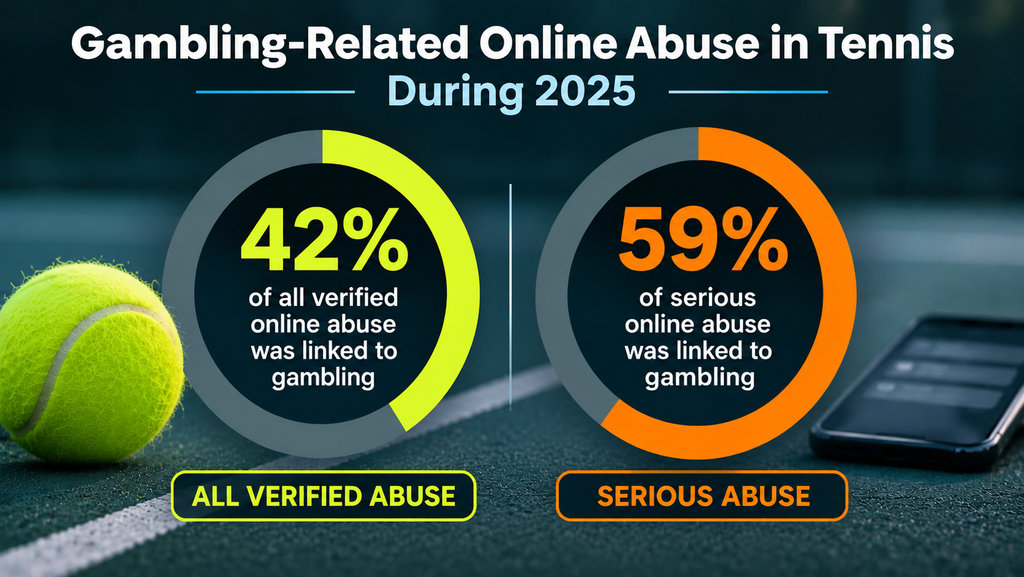
| Verified abuse attributed to angry gamblers | 42% |
| Serious abuse attributed to angry gamblers | 59% |
The serious abuse category included violent, sexual and racist content, as well as targeted threats.
The figures are particularly concerning because gambling-related abuse accounted for a greater proportion of serious incidents than it did of the overall abuse identified.
The findings were published by both the WTA and World Tennis and subsequently reported by Reuters.
The previous year’s findings had already established the extent of the problem.
The inaugural WTA and ITF annual report, published in June 2025, identified approximately 8,000 abusive or threatening posts and comments during the 2024 season. Those messages originated from around 4,200 accounts.
Across the year, 458 players were directly targeted with abuse or threats.
Angry gamblers accounted for 40 per cent of the detected abuse.
The proportion was considerably higher in the direct abuse reported by players to the monitoring service, where gambling-related communications accounted for 77 per cent.
That latter figure must be viewed within the context of the reporting sample. It was based on communications submitted to the service, rather than a comprehensive assessment of every private message received by professional tennis players.
Similarly, the increase in verified abusive content from approximately 8,000 posts in 2024 to more than 12,000 in 2025 should not automatically be interpreted as a precise measure of the increase in abuse across the sport.
Changes in monitoring, reporting awareness and the population covered can affect the number of incidents identified.
What the reports do establish is that gambling-related harassment is a persistent and substantial problem.
Jessica Pegula Calls for Action at the Source
As part of the publication of the inaugural report, Jessica Pegula, speaking as a member of the WTA Players’ Council, welcomed the introduction of measures designed to identify offenders.
“Online abuse is unacceptable, and something that no player should have to endure,” she said.
However, Pegula argued that the governing bodies’ efforts would be insufficient without meaningful intervention from the industries associated with the problem.
She called on betting companies and social media platforms to address the underlying behaviour rather than leaving sporting organisations and individual athletes to manage its consequences.
Her position is particularly relevant given the findings of the second annual report.
During 2025, a small proportion of accounts was responsible for a substantial concentration of the most concerning abuse.
Just 9 per cent of abusive accounts were responsible for 87 per cent of the content classified by analysts as being of high concern.
Identifying and taking action against persistent offenders could therefore have a significant impact.
For players, however, the effectiveness of that intervention depends partly on whether those individuals can be prevented from establishing new accounts or finding alternative ways to contact their targets.
Men’s Tennis Faces a Similar Problem
The issue is equally relevant to the men’s professional game.
In July 2024, the ATP introduced its Safe Sport initiative, developed in partnership with Tennis Data Innovations, Sportradar and Arwen AI.
The program uses automated technology to identify and hide harmful content on players’ social media accounts.
Its first-year assessment, published in August 2025, examined over 3.1 million comments and flagged more than 162,000 severe comments aimed at 245 players.
The ATP also reported that investigations had identified 68 perpetrators and resulted in 28 referrals to law enforcement.
Serbian professional Dušan Lajović, a member of the ATP Player Advisory Council, described how the service helped separate his online identity from the judgement of strangers following his results.
“This way my social media presence is defined by who I am, not by my performance on the court,” he said.
That difference is important for professional athletes whose public profiles can become closely associated with their performances.
Social media gives players opportunities to communicate directly with supporters and sponsors. It can also expose them to personal attacks following disappointing results.
Further figures published in October 2026 underlined the extent of the problem.
According to Reuters reporting on the ATP’s second-year findings, more than 3.7 million comments across player and ATP social media channels had been assessed, with over 284,000 identified as abusive.
Approximately 234,000 comments were prevented from reaching players and fans.
More than 85 per cent of men’s players who attracted online engagement during the monitoring period were affected by abuse.
| ATP Safe Sport: second-year findings | Figures |
|---|---|
| Comments examined | More than 3.7 million |
| Abusive comments identified | More than 284,000 |
| Abusive comments blocked | Approximately 234,000 |
| Proportion removed in real time | More than 82% |
The ATP and WTA monitoring initiatives use different methodologies and cover different populations. Their figures should therefore be considered separately rather than combined or used to determine which tour experiences more abuse.
Together, however, they demonstrate the scale of the challenge facing professional tennis.
The Particular Challenges Facing Lower-Ranked Players
The Lessue incident has drawn attention to an aspect of player welfare that receives relatively little public discussion.
How well equipped are young professionals competing at smaller tournaments to manage the behaviour of people following their results from around the world?
The ATP Challenger Tour and ITF World Tennis Tour are essential components of the professional pathway. They allow players to accumulate ranking points, develop their games and gain experience against increasingly difficult opposition.
For many competitors, these events also represent years of financial uncertainty.
Travel, accommodation, coaching, equipment and medical expenses can consume much of a player’s earnings. Family support is often important while athletes attempt to establish financially sustainable careers.
Online abuse introduces an additional challenge.
An internationally recognised player may have an agent, communications staff, coaches and other support personnel capable of helping manage threatening messages or security concerns.
A teenager travelling to ITF tournaments may be responsible for managing their own social media accounts, often with limited professional assistance.
Not to mention the easier access to players on the lower tour, which could potentially result in not just social media abuse, but in-person physical threats.
This does not establish that lower-ranked players receive more abuse than leading professionals. The available data does not support such a conclusion.
Indeed, the 2024 WTA and ITF report found that a significant proportion of detected abuse was concentrated among a small number of players.
However, the ability to manage the consequences of abuse may vary considerably depending on the resources available to an individual.
There is an important difference in the scope of the protection programs currently documented by the governing bodies.
The WTA and World Tennis state that their Threat Matrix service covers all players competing across their respective tours and events throughout the season.
The ATP’s August 2025 announcement, meanwhile, specified that its Safe Sport social media service was available to players ranked inside the top 250 in singles and top 50 in doubles.
That does not mean players outside those ranking thresholds are without protection. Other safeguarding arrangements may apply, and program eligibility may subsequently have changed.
It does, however, raise legitimate questions about how consistently different forms of protection are available throughout the professional pathway.
The sport would benefit from greater clarity about the support accessible to players competing in qualifying draws, smaller tournaments and the early stages of their professional careers.
When Every Point Can Carry Financial Consequences
Professional tennis is particularly well suited to live betting because of the structure of its scoring system.
A match consists of numerous individual points, games and sets, creating opportunities for wagers beyond the eventual result.
A player can win a match and still upset someone who has placed a bet on the outcome of a particular set or another aspect of the contest.
Boulter’s experience at Roland Garros illustrates this problem.
The British player ultimately won her match against Monnet, but that did not prevent abusive messages from being directed towards her after losing the opening set.
The availability of live streams and detailed scoring at smaller tournaments also means that interest in professional tennis is no longer confined to internationally recognised events.
Someone following a wager may know almost nothing about the athlete involved.
They may be unaware of an injury, illness, personal circumstances or the technical reasons a particular match is unfolding unexpectedly.
In Lessue’s case, someone following the scoreboard would have seen an 18-year-old win the opening set before losing the next twelve games.
They would not necessarily have known about her illness or recent hospital treatment.
Nor should such an explanation be necessary.
Professional tennis involves unpredictable performances, fluctuations in form and unexpected results. Players are under no obligation to satisfy the expectations of people wagering on their matches.
The financial consequences of an unsuccessful bet belong to the person who placed it.
The Responsibility of the Gambling Industry
The evidence collected by tennis authorities raises a legitimate question about the responsibilities of betting companies towards the athletes whose performances underpin their commercial activities.
The issue is not that everyone who bets on tennis behaves abusively. The monitoring reports themselves demonstrate that much of the most harmful behaviour is concentrated among a relatively small number of accounts.
That concentration creates opportunities for targeted intervention.
Betting operators could strengthen customer conduct policies, investigate customers credibly linked to threatening behaviour and, where legally permitted, suspend or close accounts belonging to verified offenders.
Cooperation with governing bodies and law enforcement could also help identify individuals responsible for serious or repeated abuse.
There are already indications that parts of the industry are moving in this direction.
The July 2026 WTA and World Tennis report identified US-based bookmaker Fanatics Sportsbook as the first betting operator to adopt investigative tools, including Threat Matrix, through its Bad Actor Program.
The program is designed to help identify individuals responsible for online abuse and support appropriate action against them.
Both governing bodies have encouraged other operators to adopt similar measures.
The important question is whether such practices will become widespread across the industry or remain confined to a relatively small number of companies.
Betting operators have access to customer information that sporting organisations and players generally do not possess. Subject to applicable privacy laws and appropriate investigative procedures, that information could be useful in identifying individuals responsible for serious threats.
Operators could also contribute financially to independent safeguarding services that protect players throughout professional tennis.
Given the commercial value derived from sporting events, there is a reasonable argument that the cost of addressing gambling-related harassment should not fall exclusively on athletes and governing bodies.
Should Betting on Entry-Level Professional Tennis Be Restricted?
The involvement of young players raises a further question.
Should betting markets be available on every level of professional tennis, including qualifying matches involving teenagers?
A teenager competing in an ITF tournament may still be transitioning from junior competition while learning to manage international travel, financial pressures and the demands of professional sport.
The availability of betting markets adds a form of public attention that some players may find particularly difficult to wrap their head around.
There are several possible approaches worth examining.
Regulators could consider restrictions on selected betting markets involving younger competitors or particular entry-level professional events.
Operators could also be required to demonstrate that appropriate safeguarding arrangements are in place before offering certain markets.
Or perhaps a simpler reform would be to do away with the ‘spot betting’ in tennis. Allow betting on the outcome of a match, set betting, etc, but do we need to be able to bet on who wins each game or each point?
Any such proposal would require careful assessment.
Restrictions might have unintended consequences, including the displacement of wagering towards unregulated operators. That could make harmful behaviour and suspicious betting activity more difficult to investigate.
There are also commercial and integrity considerations that would need to be addressed.
Nevertheless, the potential difficulties associated with regulation should not prevent a serious discussion about whether all existing betting markets are appropriate.
Greater research into the age, ranking and competition level of athletes receiving abuse would help inform that debate.
At present, published aggregate statistics establish the overall magnitude of the problem but provide limited insight into whether players at particular stages of their careers face distinct risks.

Are Tennis Authorities Making Progress?
The latest monitoring figures offer reasons for cautious optimism.
The July 2026 WTA and World Tennis report found that a substantial proportion of harmful content had been removed and that many accounts previously responsible for serious abuse had not been detected again.
The findings included:
- Removal of 66 per cent of content classified as serious abuse.
- Referral of 35 accounts, linked to 12 individuals, to law enforcement.
- Removal of 26 persistent abusive accounts from X and Instagram.
- No reappearance during 2025 of 89 per cent of accounts identified as responsible for serious abuse during 2024.
These are meaningful outcomes, particularly where investigations have resulted in referrals to authorities capable of pursuing further action.
However, the disappearance of an account does not necessarily establish that the individual responsible has permanently stopped engaging in abusive behaviour.
Continued monitoring and investigation remain important.
The tennis governing bodies have acknowledged that their efforts depend heavily on cooperation from social media platforms, the gambling industry and law enforcement agencies.
Tennis Australia’s involvement following the Lessue incident also displays the importance of national associations.
In his comments to ABC Adelaide, Tennis Australia’s head of integrity, Dan Stuk, explained that abuse can originate from gambling-related activity or other sources.
The organisation’s response includes player education, advice on reporting harmful messages, access to moderation services and assistance for affected players and their families.
For athletes competing in smaller professional tournaments, knowing about these services before an incident occurs could make a considerable difference.
Social Media Is Part of a Professional Player’s Career
One of the commonly suggested ways for athletes to avoid online abuse is to spend less time on social media.
While limiting exposure can be a useful personal strategy, withdrawing entirely is not necessarily a practical solution for a young professional.
Social media can help emerging athletes develop a public profile, attract sponsorship, promote their achievements and establish relationships with supporters.
Those opportunities may be particularly valuable for players who receive relatively little traditional media coverage.
Requiring athletes to abandon those platforms because of the behaviour of abusive individuals would place an additional burden on the people being targeted.
Australia’s eSafety Commissioner recognises that persistent online harassment can damage wellbeing and discourage people from participating in sport.
Its guidance encourages sporting organisations to prioritise the safety of affected participants, assist with the removal of harmful content and provide continuing welfare support.
For professional tennis, that responsibility should extend throughout the sport’s competitive pathway.
Players could receive clearer information about reporting abusive communications when they begin entering international competitions.
Tournament organisers could provide identifiable safeguarding contacts alongside the medical, administrative and officiating services already available to participants.
There is also a strong argument for making effective moderation and specialist welfare assistance accessible to emerging players regardless of their ranking.
Such measures would not eliminate the problem. They could, however, reduce the burden placed on individuals who may have limited experience dealing with threatening behaviour.
Where Does Professional Tennis Go From Here?
The experiences shared by Caroline Garcia, Katie Boulter and other established professionals have demonstrated that online abuse can remain distressing even after years of competing at the highest level.
Their repeated concern about younger players deserves particular attention following the events at Playford.
Taylah Lessue is at a stage of her career when the focus should be on developing her game, gaining experience and establishing herself in professional tennis.
Dealing with death threats should never be considered part of that development.
The circumstances of her defeat have understandably attracted attention. But her illness, the scoreline and the manner in which the match unfolded are ultimately irrelevant to whether anyone had the right to threaten her.
Tennis authorities have made meaningful progress in identifying harmful content, supporting players and investigating persistent offenders.
The next challenge is ensuring that protection is consistently available throughout the professional game and that organisations deriving commercial benefit from it contribute appropriately to player welfare.
An emerging professional competing in qualifying at an ITF tournament should be entitled to the same basic expectation as a Grand Slam champion: to finish a tennis match without receiving threats against their personal safety.
Support for Players Experiencing Online Abuse
Australian athletes experiencing online harassment can seek assistance through their sporting organisation and the eSafety Commissioner’s online safety resources.
Players receiving threatening messages should preserve relevant evidence, including screenshots and account details, and report the content to the appropriate platform and sporting authority.
Serious abuse may also be reported through the eSafety Commissioner’s reporting service.
Threats to personal safety should be reported to police. In Australia, anyone facing immediate danger should call Triple Zero (000).
Continue Reading
- The Price of a Tennis Dream: Why Professional Tennis Can Cost More Than It Pays
- Alice Tubello Wins First WTA 125 Title After Years of Injury Setbacks
- ITF World Tennis Tour Explained: Levels, Ranking Points and How It Works
- ATP Challenger Tour Explained: Levels, Ranking Points and How It Works
Read more of our exclusive feature articles here.
Read more of our player focus articles here.
Follow The Tennis Site on X: @thetennissite
Follow Todd Scoullar on X: @toddscoullar

Comments are closed, but trackbacks and pingbacks are open.