
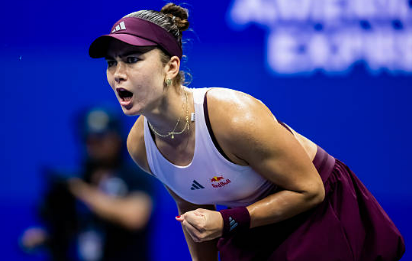
Before the match, Iva Jovic and Alexandra Eala were friends, rising stars and part of US Open Fan Week’s warmest scenes, when they brought their fathers on court during a playful doubles exhibition. For three hours and three minutes on Saturday night, however, that was all put aside.
In the first competitive Arthur Ashe Stadium appearance for both players, the 18-year-old Jovic defeated 21-year-old Eala 7-5, 3-6, 7-5, surviving a deciding set in which she trailed 4-2 and 30-0. The American won five of the final six games to reach the US Open fourth round for the first time and set up an all-American meeting with fourth seed Coco Gauff.
“That felt like a marathon,” Jovic said on court, later adding that she had “lost my sanity five times over” in the effort required to win.
That description was probably no exaggeration. The match contained 17 breaks of serve in 33 games, repeated changes of momentum and a standard of baseline hitting that remained ferocious even as fatigue became impossible to hide. Jovic lost an earring, fell hard enough to cut her knees and consistently found herself pushed towards the edge by Eala, whose speed, timing and appetite for the contest matched her own.
The first set established how this match would play out. Seven of its opening 11 games went against serve. Neither player could protect an advantage for long, partly because both returners stood close to the baseline and attacked second serves, and partly because the exchanges so often began at full pace. Eala redirected the ball superbly and used her left-handed forehand to alter the geometry of rallies; Jovic responded with depth, weight and a willingness to change direction often before an opening even appeared.
Jovic broke four times in the set and finally held the narrowest of margins, taking it 7-5. Eala, undeterred, broke Jovic three times in the second set, defended with greater discipline and made her move when shorter balls arrived. A 6-3 set drew her level and turned the match into exactly what the crowd wanted to see.
The decider seemed to be leaning towards Eala. She broke in the opening game after Jovic put a backhand into the net. Jovic recovered the break in the fourth game with a forehand winner, only to double-fault the advantage away immediately. When Eala moved ahead 4-2 and then reached 30-0, she stood two points away from an almost unassailable position and mere points from the fourth round.
Jovic’s response was exactly what we all hoped for. She seemed to narrow her focus, absorb Eala’s first strike and began extending rallies by one more shot. A backhand return winner completed the break back for 4-4. From 2-4 down, she won five of the last six games, but even that basic summary understates just how tough the final games were. Neither woman would give an inch, and didn’t the crowd soak it up!
In the final game, a Jovic forehand winner created match point. Eala’s last forehand found the net, ending one of the tournament’s best matches at 7-5 in the third. Jovic couldn’t hide her joy.
“This one really meant a lot to me,” she said.
The numbers support the sense that the match was decided by small advantages. Jovic won 112 of the 214 points, Eala 102. The winner struck 44 winners against 27 unforced errors; Eala finished with 34 winners and 33 unforced errors. Jovic converted nine of 17 break points, while Eala converted eight of 20. Jovic also led four aces to three, with four double faults against Eala’s five.
Embed from Getty ImagesServe was rarely a refuge. Jovic landed 59 per cent of first serves and won 61.3 per cent of those points; Eala made 64.2 per cent and won 55.7 per cent. The more interesting figures were behind the second delivery: Jovic won 41.9 per cent of her second-serve points, Eala 35.9 per cent. With both players so aggressive on return, almost every service game carried pressure.
“The level was absolutely incredible from both sides,” Jovic said afterwards.
Of her escape, she added: “It literally took everything to somehow squeeze my way through that.”
Eala’s disappointment was there for all to see, but so was her ability to assess the match without diminishing it.
“I think in general, of course, there’s disappointment in losing,” she said. “But trying to see the positive side, I think it was a really good match.”
She was right. This was not a match elevated merely by the hype around these two young women. It was excellent tennis on its own terms: early ball-striking, brave changes of direction, elite court coverage and sustained tactical pressure. Eala had genuine winning positions, but Jovic took them back.
Jovic had won their two previous meetings this season, one on clay at Roland Garros and one on grass at Queen’s. The Ashe victory extended her head-to-head lead to 3-0 and gave her a win over Eala on each of the sport’s three main surfaces.
Eala rejected the notion that their off-court friendship made either player less ruthless.
“We’re professionals,” she said..
The crowd complicated the usual home-player dynamic. Eala’s rapidly expanding Filipino support was loud enough that Jovic felt the balance of support occasionally tilt away from the American.
“I would say it was a little more for her,” Jovic said.
Eala described the backing as “indescribable”; speaking about the experience of playing on Ashe, she said she felt “really lucky to have these people support me.”
Eala is carrying unprecedented expectations for Philippine tennis, yet her ambition is clearly to be a Grand Slam champion, rather than just a symbol of hope for the Filipino people alone. Jovic, already a major quarterfinalist and a WTA champion while still in her teens, possesses the technique and instincts of a player built for the latter stages of the biggest events.
For Eala, the defeat will sting because victory was close and attainable. It should also reinforce how narrow the distance has become between her and the second week of a major. She had chances, created them herself and forced an opponent ranked and seeded above her to find something exceptional.
For Jovic, the reward is another night on Ashe and a fourth-round meeting with Gauff.
“I’m going to be more than happy to just bring this fight and this energy,” she said of that assignment.
After this display, no one can doubt either quality.
The scoreboard has Jovic as the winner: 7-5, 3-6, 7-5, but the match might just be the first great chapter of what could become one of the biggest WTA rivalries over the coming decade. And if it turns out to be that way, finding a ticket for their future match-ups won’t get any easier.
Read more of our news articles here.
Read more of our exclusive feature articles here.
Read more of our player focus articles here.
Follow The Tennis Site on X: @thetennissite
Follow Todd Scoullar on X: @toddscoullar

Comments are closed, but trackbacks and pingbacks are open.