
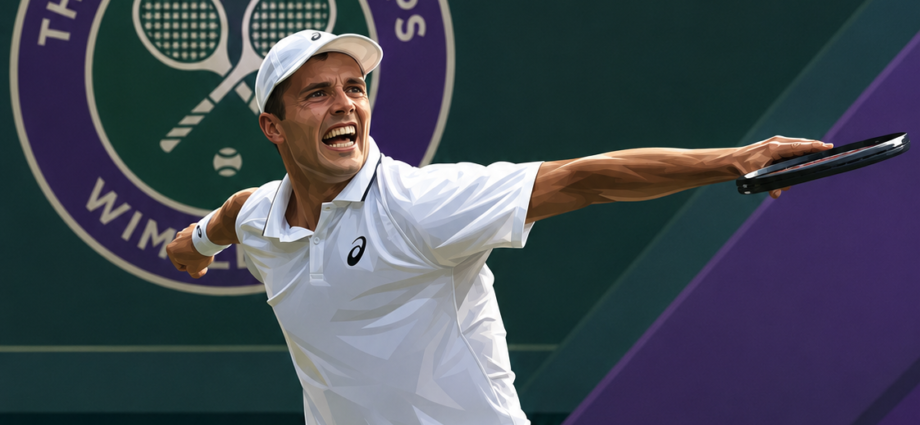
Wimbledon has never merely crowned champions. It has canonised improbable dreams. For nearly one hundred and fifty years, the All England Club has served as far more than tennis’ oldest cathedral. It is where tradition acquires the aura of ritual, where immaculate white attire remains sacred, where strawberries and cream accompany Centre Court as faithfully as applause, and where the manicured lawns seem to preserve memories as tenderly as they cradle footsteps. Every July, the sport returns not simply to contest another Grand Slam, but to revisit its own mythology.
Yet beneath the pageantry lies another tradition, subtler but every bit as cherished. Wimbledon has always possessed an uncanny fondness for the unexpected. Every generation bequeaths its own unlikely hero to posterity: a qualifier who momentarily forgets his ranking, an ageing veteran granted one final flourish, a wildcard whose fortnight transcends all reasonable expectation.
It was here that Goran Ivanišević transformed the most unlikely wildcard into a Wimbledon championship in 2001. It was here that Andy Murray finally ended Britain’s seventy-seven-year wait for a coveted title, in 2013. And it was here that a relatively unknown Marcus Willis turned into a national sensation for one unforgettable week in 2016. Long before trophies are remembered, Wimbledon immortalises belief.
The summer of 2026 has now added another chapter to that tradition. His story did not culminate with the Gentlemen’s Singles trophy, nor did it need to. It belonged instead to a twenty-four-year-old wildcard whose awe-inspiring journey reminded tennis that rankings may shape expectation, but they can never extinguish possibility. His name is Arthur Fery.
The Boy Next Door
If Wimbledon became the stage upon which Arthur Fery would eventually astonish the tennis world, his journey began scarcely a mile away. Born on 12 July, 2002, in the Parisian suburb of Sèvres, Fery was still an infant when his family relocated across the Channel to London, unknowingly placing him on the doorstep of the sport’s most hallowed arena.
Some children inherit Wimbledon through television broadcasts and fading posters on bedroom walls. Fery inherited it as part of his everyday landscape. Centre Court was never a distant fantasy but a familiar presence, nourishing an ambition that would mature alongside him.
The game itself flowed naturally through the family. His mother, Olivia Gravereaux, had competed professionally on the WTA Tour, introducing her son to tennis almost as soon as he could hold a racket. At the nearby Westside Tennis Club, within touching distance of the All England Club, the foundations of his game were patiently laid. There were no extravagant expectations as such.
Tennis was encouraged, certainly, but so too were curiosity, education and the simple joys of childhood. While many promising youngsters surrendered ordinary adolescence to the rigorous demands of elite sport, Fery attended King’s College School in Wimbledon, played football and basketball with equal enthusiasm, and grew up remarkably insulated from the pressures that usually tend to define modern junior tennis.
It proved to be an unconventional beginning for a player who would later produce one of Wimbledon’s most captivating stories.
The Making of an Unlikely Contender
In modern tennis, mercurial prodigies are whisked from one international tournament to another, their adolescence measured less by birthdays than by ranking points. The prevailing wisdom insists that the earlier a player begins climbing the junior ladder, the greater the likelihood of future success. Arthur Fery’s development shattered that stereotype.
As the son of businessman Loïc Fery, assumptions inevitably followed him. Social media critics have been quick to dismiss his achievements through the convenient labels of privilege and nepotism, pointing to his family’s wealth rather than the years of toil & labour that preceded his breakthrough. Those who knew him during his formative years tell a markedly different story.
Coaches who oversaw his development have consistently recalled a grounded youngster whose upbringing was deliberately kept as ordinary as possible. He attended mainstream school, travelled sparingly on the junior circuit, used second-hand phones and was encouraged to pursue interests beyond tennis rather than allowing the sport to consume his childhood.
That philosophy shaped the player he would eventually become. Standing at just 5 feet 9 inches, Fery never possessed the imposing physique traditionally associated with the men’s game. Instead, his coaches resisted the temptation to chase junior rankings before he was physically and emotionally ready, prioritising technical development, tactical imagination and an immense love for the sport.
While many contemporaries accumulated ranking points, Fery accumulated something arguably more valuable: patience. When the time finally arrived to compete internationally, his rise proved meteorically swift, not because he had been hurried towards success, but because success had been allowed to arrive on its own terms.
An Unfashionable Path to Excellence
The decision to prioritise growth over immediate success continued long after Fery emerged as one of Britain’s brightest junior prospects. Rather than abandoning education for the professional tour, he chose an altogether different route, enrolling at Stanford University in California to study Science, Technology and Society. It was an unconventional choice in an era when many gifted teenagers view university as an unnecessary detour. For Fery, it became another stage in his evolution.
Three years in collegiate tennis refined not only his game but also his temperament, producing a competitor capable of embracing pressure without allowing it to overwhelm him. His achievements reflected that steady progression. He became a two-time ITA All-American, captured the Pac-12 singles title and was named the conference’s Singles Player of the Year before returning to the professional circuit with a maturity that belied his age.
The qualities cultivated during those years are strikingly reminiscent of an earlier generation of grass-court tennis. Fery is not built around overwhelming power or relentless baseline attrition. Instead, he relies upon deft hands, intelligent movement and an instinctive understanding of space. He advances towards the net with confidence, improvises under pressure and recognises opportunities that many of his contemporaries hesitate to seize.
While the game is largely dominated by attritional exchanges from behind the baseline today, his game feels refreshingly anachronistic, recalling a style that once flourished on Wimbledon’s lawns before homogenised court speeds gradually reshaped the sport. Perhaps that explains why the All England Club seemed the ideal stage for his breakthrough.
The Fortnight That Changed Everything
The opening week steadily gathered momentum. Fery first accounted for Damir Džumhur before dispatching Finland’s Otto Virtanen with assured authority. By the time he overcame the dangerous Belgian Zizou Bergs, the conversation surrounding the unheralded wildcard had begun to shift. What initially appeared an enjoyable home story was slowly but surely assuming the shape of something far more substantial. Fery was no longer merely surviving the draw. He was imposing himself upon it with a composure that belied both his ranking and his relative inexperience at the highest level.
The defining moment arrived beneath the closed roof of Centre Court against Grigor Dimitrov. Trailing by two sets to one against one of the most aesthetically gifted players of his generation, Fery confronted the greatest examination of his young career. Lesser competitors might have retreated into caution. Instead, he embraced the occasion. Point by point, the deficit dissolved before a deciding tie-break demanded one final display of nerve. When the final ball landed beyond Dimitrov’s reach, Centre Court rose in unanimous acclaim. Wimbledon had discovered its newest protagonist.
If that victory announced his arrival, the quarter-final confirmed it beyond all reasonable doubt. Standing opposite him was Flavio Cobolli, fresh from a runner-up finish at the 2026 French Open and widely regarded as one of the most accomplished young players on the ATP Tour. Fery, however, betrayed neither awe nor anxiety.
Producing perhaps the most complete performance of his career, he dismissed the Italian in straight sets through a masterclass of intelligent serving, inventive shot-making and fearless attacking tennis. The victory propelled an unseeded wildcard into the Wimbledon semi-finals, a feat achieved by only one other wildcard in the Open Era before him, Goran Ivanišević.
The fairytale ultimately concluded against Alexander Zverev in the last four. Defeat inevitably closed the final chapter, but scarcely diminished what had already been accomplished. By the end of the fortnight, Fery had ascended to World No. 36 in the live rankings, become Britain’s new No. 1 and, fittingly, celebrated his twenty-fourth birthday with a career transformed. He departed the All England Club without the Gentlemen’s Singles trophy, yet with something arguably rarer: the conviction that he belonged among the sport’s elite.
The Everlasting Beauty of the Underdog
Professional sport has become quite efficient. Rankings are meticulously calculated, performance is measured to the smallest statistical detail and predictive models leave ever less room for genuine surprise. More often than not, the strongest eventually prevail.
Perhaps that is why underdog stories continue to resonate with such unusual force. They momentarily disrupt the comforting certainty that greatness belongs only to the established elite. They remind us that sport is not merely an exercise in probability but an expression of possibility.
Across a myriad of sports, there are umpteen instances of not-so-mundane and profoundly pulchritudinous rags-to-riches tales. Football remembers Greece in 2004 and Leicester City in 2016. Cricket still speaks reverentially of Kapil Dev’s India in 1983. Ice hockey still immortalises the United States’ “Miracle on Ice” against the Soviet Union at the 1980 Winter Olympics.
Horse racing has its unlikely champions, boxing its improbable giant-slayers, and every Olympic Games seems to uncover an athlete who momentarily renders the impossible entirely plausible. Wimbledon, meanwhile, has built its own folklore around those who arrived with little expectation and departed having altered the tournament’s emotional landscape forever.
Arthur Fery now occupies a place within that tradition. He fell agonisingly shy of capping off his dream run in the manner of Goran Ivanišević, but that was never the idea to begin with. For two unforgettable weeks, he persuaded an entire nation to believe that the impossible remained tantalisingly within reach. And that may be his most precious victory yet.
Read more of our exclusive feature articles here.
Read more of our player focus articles here.
Follow Sujal Swain on Instagram: @officialsujal10
Follow Sujal Swain on X: @offcialsujal10
Follow Sujal Swain on Threads: @officialsujal10
Follow The Tennis Site on X: @thetennissite

Comments are closed, but trackbacks and pingbacks are open.