

Eight of the world’s leading singles players, eight elite doubles teams and one final championship to conclude the ATP Tour season.
The ATP Finals are among the most prestigious events in men’s professional tennis, bringing together the players who have accumulated the strongest results throughout the year.
Unlike the Grand Slams and regular ATP tournaments, the championship does not follow a conventional knockout format. Players begin in round-robin groups, where an early defeat does not necessarily end their title hopes.
A player can lose a match and still become champion, while two opponents can meet during the group stage and again in the final.
With up to 1,500 ranking points available, substantial prize money and a history dating back to 1970, the ATP Finals provide a fitting conclusion to the professional tennis season.
What Are the ATP Finals?
The ATP Finals are the season-ending championship of men’s professional tennis. Eight singles players and eight doubles teams qualify through their performances during the year. Each competition begins with two round-robin groups of four, followed by semifinals and a final. An undefeated singles champion can earn a maximum of 1,500 ranking points.
The tournament occupies a unique position on the tennis calendar.
At a Grand Slam, 128 players enter the singles main draw. At an ATP Masters 1000 tournament, the field is also considerably larger.
The ATP Finals, by contrast, bring together just eight singles competitors who have earned their places through their results during the season.
That concentration of talent means there are no conventional early rounds. Every match is between players who have demonstrated their ability to compete at the highest level.
The event is currently known as the Nitto ATP Finals under its sponsorship agreement.
How Do Players Qualify for the ATP Finals?
Qualification is determined by the ATP Race to Turin, which measures players’ performances during the current season.
The Race differs from the regular ATP rankings.
The traditional world rankings operate on a rolling 52-week system, with results from previous tournaments eventually dropping off.
The Race focuses on points accumulated during the current season, providing a clearer picture of which players are on course to qualify for the year-end championship.
As the season progresses, the qualification battle often becomes one of the most interesting storylines on the ATP Tour.
The Top Seven and the Grand Slam Champion Rule
Under ATP qualification rules, the top seven eligible players in the Race qualify for the championship.
The eighth position is subject to a special provision involving Grand Slam champions.
If a player has won a Grand Slam singles title during the season and finishes between eighth and 20th in the Race, he can receive the final qualifying place ahead of a higher-ranked player who has not won a major.
If more than one Grand Slam champion meets those conditions, the higher-ranked champion receives priority.
If no Grand Slam champion qualifies through this provision, the eighth position goes to the next eligible player in the Race standings.
Consider a hypothetical example.
A player finishes eighth in the Race without winning a Grand Slam. Another finishes 12th but has won Wimbledon.
The Wimbledon champion would receive the final qualifying position, provided he meets the eligibility requirements.
However, winning a Grand Slam does not automatically guarantee qualification. A major champion who finishes outside the top 20 in the Race cannot use this provision to enter the tournament.
Qualification is finalised after the regular ATP Tour season, with the Paris Masters forming an important part of the closing qualification race. The precise cut-off follows the ATP’s published rules and calendar for the relevant season.
Can a Player Qualify Without Winning a Tournament?
Yes.
A player does not need to win a title during the season to qualify for the ATP Finals.
Consistently reaching the later rounds of Grand Slams and ATP Masters 1000 tournaments can generate enough points to secure a place.
A player who reaches several major semifinals and finals may accumulate more points than someone who wins multiple lower-level tournaments.
The Race therefore rewards sustained performance across the calendar, rather than simply counting tournament victories.
The doubles competition has its own qualification standings, based on the results of partnerships rather than individual singles rankings.
For more information, see Tennis Ranking Points Explained.
How Does the ATP Finals Format Work?
The ATP Finals use a round-robin group stage followed by knockout semifinals and a final.
The structure is similar to the WTA Finals, but it differs substantially from the single-elimination draws used at most professional tournaments.
The Round-Robin Stage
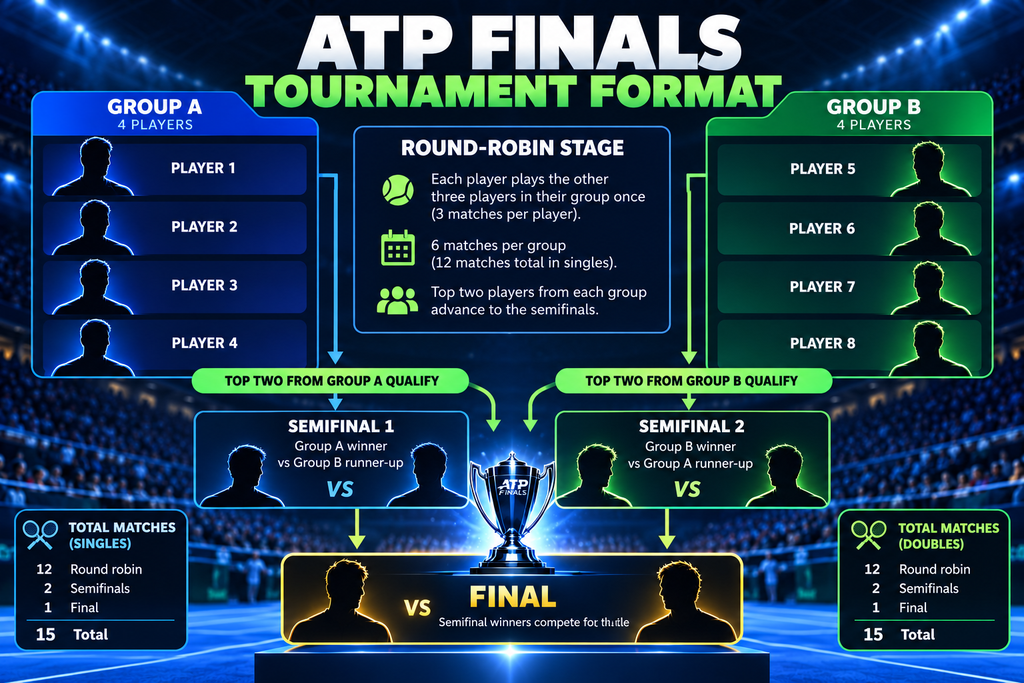
The eight singles players are divided into two groups of four.
Each player faces the other three members of his group once.
That means every player is scheduled to contest three round-robin matches.
Each group produces six matches, giving the singles competition 12 group-stage matches overall.
The two players with the best records in each group advance to the semifinals.
The doubles competition follows the same basic structure, with eight teams divided into two groups.
How the Semifinals Work
The semifinal pairings are determined by the final group standings.
The winner of Group A faces the runner-up from Group B.
The winner of Group B plays the runner-up from Group A.
The two semifinal winners then meet for the championship.
| Stage | Singles matches |
|---|---|
| Round robin | 12 |
| Semifinals | 2 |
| Final | 1 |
| Total | 15 |
The doubles competition also features 15 scheduled matches, giving the tournament 30 across both draws under the standard format.
How Are the Matches Played?
All singles matches at the ATP Finals are played over the best of three tie-break sets, including the final.
This differs from men’s Grand Slam singles, where matches are played over the best of five sets.
The doubles competition uses two sets with no-ad scoring, followed by a match tie-break if the teams split the opening two sets.
These formats allow the tournament to accommodate singles and doubles matches throughout the championship while maintaining a consistent schedule.
Can a Player Lose and Still Win the ATP Finals?
Yes, and it is one of the most interesting features of the event.
At Wimbledon, Roland Garros, the Australian Open or the US Open, a singles defeat ends a player’s tournament.
At the ATP Finals, a player can lose during the round-robin stage and still become champion.
A player might lose his opening match, win the next two, qualify for the semifinals and then win both knockout matches.
He would finish the tournament with four victories and one defeat.
It is even possible to advance from a group with just one victory if the other results and tiebreaking procedures fall into place.
This means the significance of individual matches can extend beyond the simple question of who wins.
A player who has already secured a semifinal place may still be competing to finish first in his group. Another might need to win a particular number of sets or games to remain in contention.
The format also creates the possibility of a rematch in the final.
In 2023, Jannik Sinner defeated Novak Djokovic during the round-robin stage in Turin. Both players advanced, and Djokovic reversed the result in the championship match, winning 6–3, 6–3 to claim his seventh ATP Finals title.
It was an excellent example of how the tournament can produce two very different outcomes between the same opponents within a single week.
What Happens When Players Finish Level in a Group?
Round-robin competitions inevitably create the possibility of tied standings.
Two players might finish with identical win-loss records, while three players could each record two victories and one defeat.
The ATP has established procedures for separating players in these situations.
Group standings are determined primarily by the number of wins. When players are tied, the rules take account of matches played and, where applicable, head-to-head results.
For a two-player tie, the result of their meeting generally determines which player finishes ahead.
Three-way ties are more complicated. The ATP’s procedures can use the percentage of sets won, followed by the percentage of games won, to separate players.
If those calculations reduce a three-way tie to two players, their head-to-head result may then decide the remaining order. ATP rankings can also be used as a final tiebreaking criterion where required.
Withdrawals, retirements and incomplete group schedules are covered by additional provisions in the official tournament regulations.
These rules explain why individual sets and games can become particularly important.
A player who loses a close three-set match may be better positioned in a tiebreaking scenario than someone who loses comfortably in straight sets.
It also explains why players continue competing for every game, even when the overall match result appears unlikely to change.
At the ATP Finals, a single game can potentially determine who reaches the semifinals.
How Many Ranking Points Are Available at the ATP Finals?
An undefeated ATP Finals champion can earn a maximum of 1,500 ranking points.
Unlike most tournaments, where ranking points are awarded according to the round reached, the ATP Finals reward individual match victories.
The points distribution is:
| Achievement | Ranking points |
|---|---|
| Each round-robin victory | 200 |
| Semifinal victory | 400 |
| Final victory | 500 |
| Maximum for an undefeated champion | 1,500 |
A player who wins all three round-robin matches earns 600 points.
Victory in the semifinal adds another 400, while winning the final contributes 500.
That produces the maximum total of 1,500 points.
A champion who loses one round-robin match earns 1,300 points, assuming he wins his other two group matches.
A champion who qualifies from the group stage with only one victory earns 1,100 points.
The structure rewards both the eventual champion and players who perform consistently during the group stage.
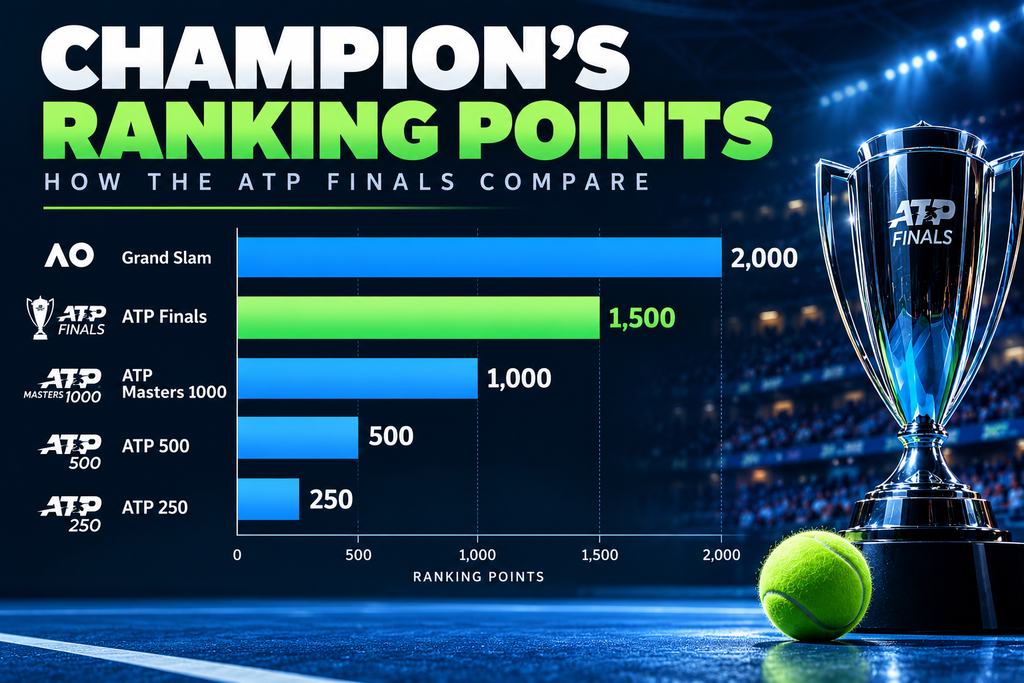
How Do ATP Finals Points Compare With Other Tournaments?
| Tournament | Maximum champion’s points |
|---|---|
| Grand Slam | 2,000 |
| ATP Finals | 1,500 |
| ATP Masters 1000 | 1,000 |
| ATP 500 | 500 |
| ATP 250 | 250 |
Only a Grand Slam singles title offers more ranking points than an undefeated ATP Finals championship.
That makes the event especially important when the year-end world No. 1 ranking remains undecided.
Two players may arrive in Turin separated by only a few hundred points.
A strong performance at the ATP Finals can determine which player finishes the season at the top of the rankings.
How Much Prize Money Is Available at the ATP Finals?
The ATP Finals are among the richest tournaments in professional tennis.
For the 2025 championship, the ATP announced a record prize fund of approximately US$15.5 million, with an undefeated singles champion eligible to earn US$5,071,000.
The prize-money system rewards participation, individual round-robin victories and progression through the knockout rounds.
ATP Finals Singles Prize Money — 2025
| Achievement | Prize money (USD) |
|---|---|
| Participation fee (three matches) | $331,000 |
| Each round-robin victory | $396,500 |
| Semifinal victory | $1,183,500 |
| Final victory | $2,367,000 |
| Undefeated champion | $5,071,000 |
The participation fee is adjusted if a player competes in fewer than three matches.
ATP Finals Doubles Prize Money — 2025
| Achievement | Prize money per team (USD) |
|---|---|
| Participation fee (three matches) | $134,200 |
| Each round-robin victory | $96,600 |
| Semifinal victory | $178,500 |
| Final victory | $356,800 |
| Undefeated champions | $959,300 |
These figures relate specifically to the 2025 tournament. The prize-money schedule is reviewed for each edition and should not be assumed to remain unchanged.
Why Do Players Receive Different Amounts for Reaching the Same Stage?
Because the tournament rewards individual victories, two players who reach the same stage may receive different payments.
For example, one semifinalist might have won all three round-robin matches, while another qualified with only two victories.
Both reached the semifinals, but the undefeated player would have earned an additional round-robin victory payment.
The same principle applies to the champion.
A player who wins the tournament undefeated receives more than a champion who lost during the group stage.
For a broader explanation of player earnings, see Tennis Prize Money Explained.
When and Where Are the ATP Finals Played?
The ATP Finals are held near the conclusion of the men’s professional tennis season, normally in November.
Unlike the Grand Slams, the championship has moved between several host cities throughout its history.
The inaugural event took place in Tokyo in 1970. Subsequent editions were held in cities including Paris, Barcelona, Boston, Melbourne, Stockholm, Houston, New York, Frankfurt, Hannover, Lisbon, Sydney, Shanghai and London.
These moves reflected the event’s changing commercial arrangements and its growing international profile.
Since 2021, Turin in Italy has been its home.
ATP Finals 2026: Turin, Italy
The 2026 ATP Finals are scheduled for November 15–22 at the Inalpi Arena in Turin.
The tournament will be played on indoor hard courts.
Turin is also scheduled to host the championship in 2027 under the ATP’s current hosting arrangements.
The indoor conditions distinguish the event from most Grand Slams.
With no wind, rain or changing outdoor temperatures, players compete in a controlled environment where serving, returning and precise shot-making can become especially important.
The host city, dates, field and prize money should be updated annually, while the tournament’s core rules and history can remain part of this evergreen reference article.
The History of the ATP Finals
The ATP Finals began in 1970, when the inaugural season-ending championship was held in Tokyo.
Known as the Pepsi-Cola Masters, the original event featured six players competing in a round-robin competition.
American Stan Smith became the first champion, finishing with four victories and one defeat.
Rod Laver also finished with a 4–1 record, but Smith claimed the title through his head-to-head victory over the Australian.
There was no conventional championship final that year.
The tournament subsequently developed into one of the most prestigious events in men’s professional tennis.
During the 1970s, Ilie Năstase became its dominant figure, winning four titles.
New York’s Madison Square Garden hosted the championship from 1977 to 1989, an era that featured champions such as Björn Borg, John McEnroe and Ivan Lendl.
In 1990, the event became known as the ATP Tour World Championships, with Frankfurt and later Hannover hosting during the decade.
The tournament underwent further changes in name and location before moving to London’s O2 Arena in 2009.
London hosted the championship through 2020, providing the setting for several memorable battles involving Roger Federer, Novak Djokovic, Rafael Nadal and Andy Murray.
Turin took over as host city in 2021.
Although its name and location have changed repeatedly, the tournament has maintained its central purpose: bringing together the leading performers of the season to contest one final championship.
Who Has Won the Most ATP Finals Titles?
Novak Djokovic holds the record for the most ATP Finals singles titles, with seven.
He moved ahead of Roger Federer in 2023, defeating Jannik Sinner in the final in Turin.
Federer won the championship six times, while Ivan Lendl and Pete Sampras each claimed five titles.
| Player | ATP Finals singles titles |
|---|---|
| Novak Djokovic | 7 |
| Roger Federer | 6 |
| Ivan Lendl | 5 |
| Pete Sampras | 5 |
| Ilie Năstase | 4 |
| Boris Becker | 3 |
| John McEnroe | 3 |
Djokovic’s record is particularly impressive given the concentrated strength of the field.
Unlike many tournaments, where a leading player might encounter lower-ranked opponents in the early rounds, the ATP Finals require competitors to face elite opposition from the outset.
Federer’s six championships are also an important part of his legacy, while Lendl’s remarkable consistency made him a central figure at the tournament throughout the 1980s.
Recent ATP Finals Singles Champions
| Year | Champion |
|---|---|
| 2025 | Jannik Sinner |
| 2024 | Jannik Sinner |
| 2023 | Novak Djokovic |
| 2022 | Novak Djokovic |
| 2021 | Alexander Zverev |
| 2020 | Daniil Medvedev |
| 2019 | Stefanos Tsitsipas |
| 2018 | Alexander Zverev |
| 2017 | Grigor Dimitrov |
| 2016 | Andy Murray |
In 2025, Sinner defeated Carlos Alcaraz 7–6(4), 7–5 in the final to secure his second consecutive ATP Finals title.
The result continued a remarkable run at the tournament for the Italian, who had also defeated Taylor Fritz in the 2024 final.
The list of recent champions illustrates how the ATP Finals can serve different purposes for different players.
For established Grand Slam champions, it provides another opportunity to strengthen an already impressive record.
For others, winning the championship can represent one of the defining achievements of their careers.
How Are the ATP Finals Different From a Grand Slam?
Both events occupy important places in professional tennis, but their formats create very different challenges.
| Feature | ATP Finals | Grand Slam |
|---|---|---|
| Singles field | 8 players | 128 players |
| Entry | Season-long Race | Rankings, qualifying and wild cards |
| Format | Round robin, then knockout | Single elimination |
| Can a player lose and still win? | Yes | No |
| Men’s singles match format | Best of three sets | Best of five sets |
| Maximum ranking points | 1,500 | 2,000 |
| Scheduled singles matches | 15 | 127 |
A Grand Slam champion must normally win seven consecutive singles matches.
At the ATP Finals, a player must negotiate a smaller but exceptionally strong field, with every opponent among the season’s leading performers.
The round-robin format creates an additional challenge because players must consider group standings, head-to-head results and potential tiebreaking scenarios.
There is also the difference in match length.
Men’s Grand Slam singles matches are contested over the best of five sets, while ATP Finals singles matches are best of three.
The physical and tactical demands are therefore different, although both competitions require players to perform consistently under considerable pressure.
For more information, see Grand Slam Tennis Explained.
Why the ATP Finals Matter
Qualifying for the ATP Finals is an achievement in itself.
A player must produce strong results throughout the season to earn a place among the eight singles competitors.
Winning the championship requires another level of performance.
The round-robin format creates opportunities for recovery, but it also means players face elite opposition from their opening match.
A single set can influence qualification. A narrow defeat can leave a player facing a complicated path to the semifinals. And a competitor who loses during the group stage can still finish the week holding the trophy.
The event also offers substantial ranking points and prize money, with the potential to influence the final world rankings.
Its history connects generations of champions, from Stan Smith and Ilie Năstase through to Roger Federer, Novak Djokovic and Jannik Sinner.
For some players, the ATP Finals title provides the finishing touch to a dominant season. For others, it becomes the greatest achievement of their professional careers.
Either way, the tournament offers something few other events can replicate: the opportunity to finish the season by competing directly against the very best players of the year.
Continue Reading
- ATP Tour Explained
- Grand Slam Tennis Explained
- ATP Masters 1000 Explained
- Tennis Ranking Points Explained
- Tennis Prize Money Explained
- WTA Finals Explained
Read more of our tournament structure articles here
Read more of our player focus articles here.
Follow The Tennis Site on X: @thetennissite
Follow Todd Scoullar on X: @toddscoullar

Comments are closed, but trackbacks and pingbacks are open.