
Most of professional tennis is built around individuals.
Players travel the world under their own names, accumulate their own ranking points and compete for their own titles.
The Davis Cup is different.
Players represent their countries.
Singles specialists become teammates. Doubles can suddenly decide everything. Matches can be played in front of fiercely partisan home crowds rather than the more neutral atmosphere of a regular Tour event.
First played in 1900, the Davis Cup has grown from a contest between the United States and Great Britain into the major international men’s team competition in tennis. A remarkable 157 nations entered in 2025, making it one of the largest international team competitions in world sport.
But its format can be confusing.
What exactly is a Davis Cup tie? How many matches are played? How does a country qualify for the Finals? And what is the difference between the Qualifiers, World Groups and Final 8?
Here’s how it all works.
What Is the Davis Cup?
The Davis Cup is an international men’s team tennis competition in which players represent their countries rather than themselves.
Think of it as tennis’s equivalent of a national-team competition.
Instead of:
Player vs Player
the central contest becomes:
Country vs Country
A meeting between two countries is called a tie.
Depending on the stage of the competition, that tie consists of either three or five individual matches.
Each match won gives the country one point towards winning the tie.
The competition stretches across different levels and several periods of the tennis season, eventually culminating in the Davis Cup Final 8 in November.
How Does the Davis Cup Work?
The easiest way to understand the modern Davis Cup is as a pyramid.
At the top is the Final 8, where the world champion is decided.
Below that are the Qualifiers.
Then come World Group I and World Group II.
Below those are regional Groups III, IV and V.
A simplified structure looks like this:
DAVIS CUP FINAL 8
8 countries
↑
QUALIFIERS
↑
WORLD GROUP I
↑
WORLD GROUP II
↑
REGIONAL GROUPS III, IV & V
Countries can move through the structure via promotion and relegation. The precise route depends on where a nation begins and its results.
This means Davis Cup isn’t simply an eight-team tournament played once a year.
The Final 8 is only the top of a much larger global competition.
What Is a Davis Cup Tie?
One of the first pieces of Davis Cup terminology to understand is the word tie.
A tie is simply a contest between two countries.
For example:
Country A vs Country B = one Davis Cup tie
Within that tie, the countries play a series of individual tennis matches.
In the home-and-away stages, a tie is played as the best of five matches.
The first country to win three matches wins the tie.
At stages played at a central location, including the Final 8, ties are shorter: two singles matches and one doubles match. The first nation to win two of those three matches advances.
The word rubber was traditionally used for an individual Davis Cup match. You’ll still sometimes hear commentators and long-time tennis fans use expressions such as “dead rubber”, although the competition now generally refers simply to matches.
How Does a Home-and-Away Davis Cup Tie Work?
The traditional Davis Cup atmosphere remains particularly visible during home-and-away ties.
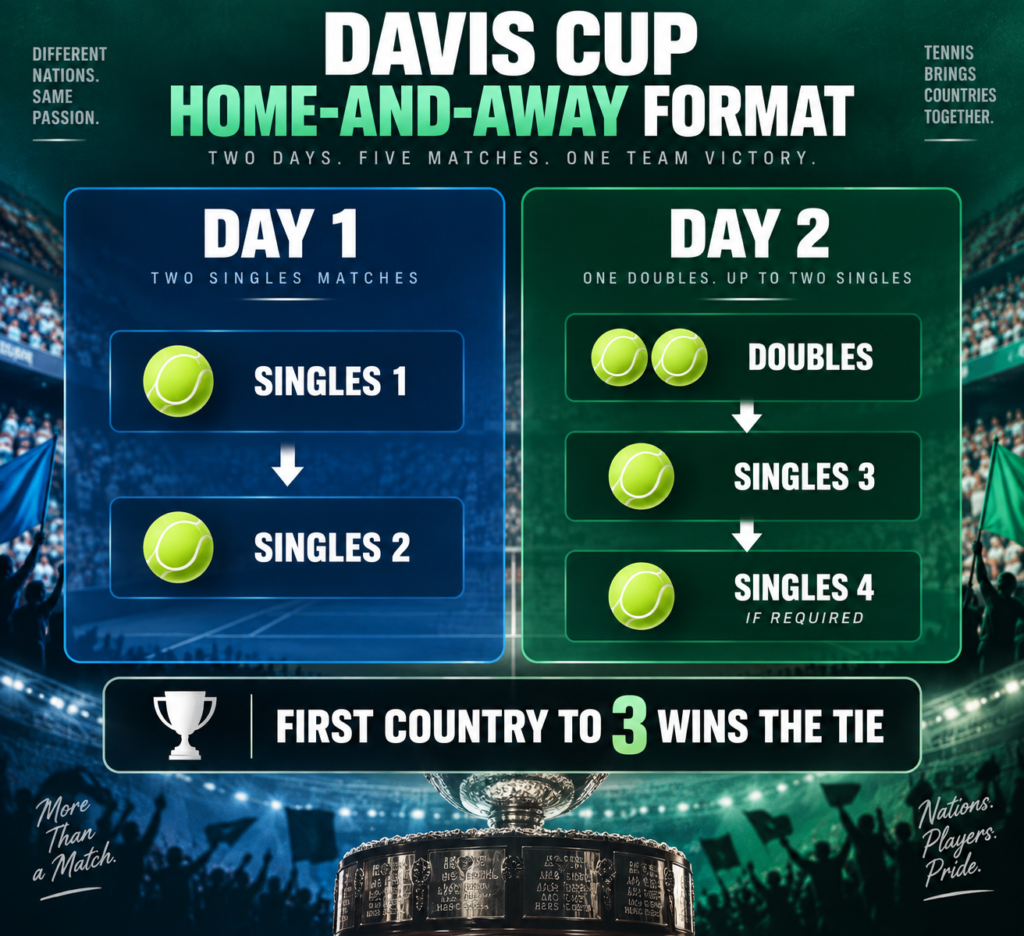
These are played over two days and can contain up to five matches.
The structure is:
Day One
Singles Match 1
Singles Match 2
Day Two
Doubles Match
Singles Match 3
Singles Match 4 — if required
Each team nominates its No. 1 and No. 2 singles players.
On the opening day, the No. 1 player from one country faces the No. 2 from the other, and vice versa.
The second day begins with doubles before the singles players potentially return.
The first nation to reach three match victories wins the tie.
Why Is Doubles So Important in Davis Cup?
In regular professional tennis, singles and doubles are largely separate worlds.
Davis Cup brings them together.
That can make the doubles match strategically crucial.
In a five-match tie, it opens the second day’s play. If the countries split the opening singles matches 1-1, doubles immediately becomes the match that puts one country ahead.
In the three-match Final 8 format, doubles can be even more dramatic.
If the two singles matches are split, the doubles becomes the deciding match for the entire tie.
That means a nation with two excellent singles players isn’t necessarily unbeatable.
Team selection matters.
Doubles combinations matter.
And a strong specialist doubles pairing can become enormously valuable.
How Do Countries Qualify for the Davis Cup Final 8?
For 2026, the top-level qualifying process is split across two rounds.
The Qualifiers 1st Round was held in February, shortly after the Australian Open.
Winning nations progressed to the Qualifiers 2nd Round in September.
The seven winners of that second qualifying round advance to the Final 8, where they join host nation Italy, which received a wild card. Spain, the 2025 runner-up, received the other wild card and a bye into the second qualifying round.
So the basic 2026 route is:
QUALIFIERS 1ST ROUND
↓
QUALIFIERS 2ND ROUND
↓
FINAL 8
↓
QUARTERFINALS
↓
SEMIFINALS
↓
DAVIS CUP FINAL
↓
🏆 WORLD CHAMPION
The qualifying system also connects to the levels beneath it.
Countries that lose at different stages are placed into the appropriate level for the following phase or season, creating the promotion-and-relegation structure that links the competition together.
What Is the Davis Cup Final 8?
The Final 8 is the season-ending championship stage.
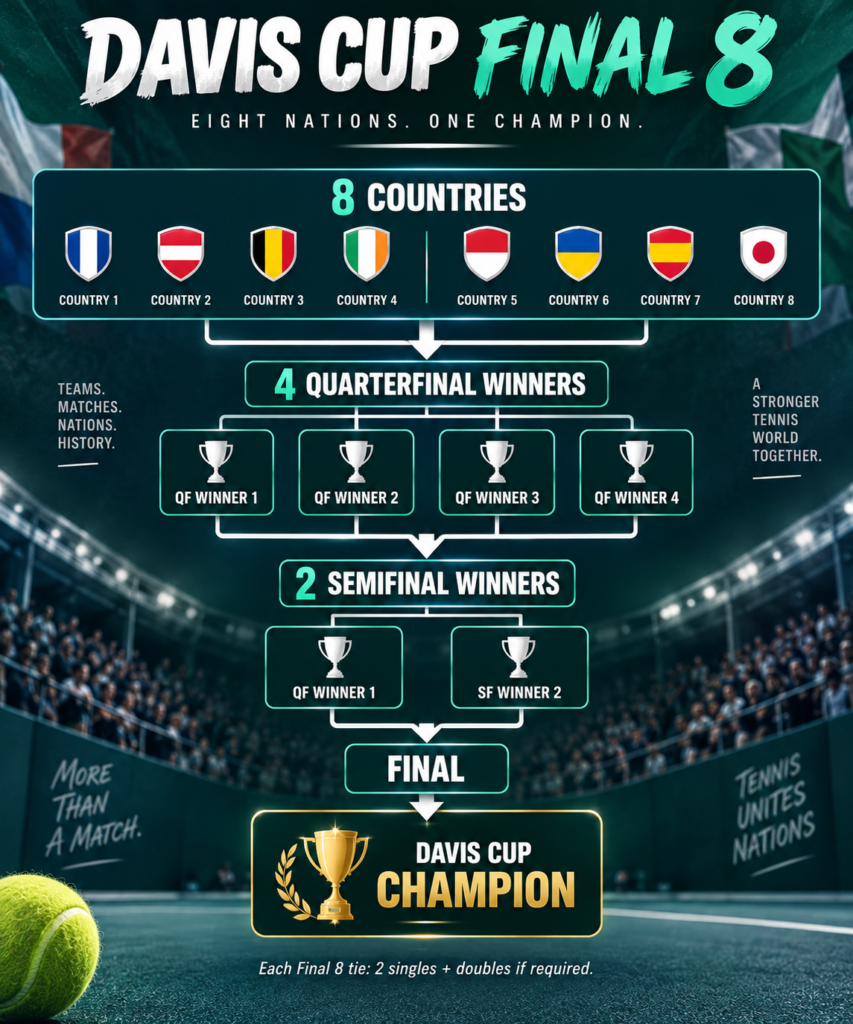
Eight countries compete in a six-day knockout tournament at one host venue.
In 2026, the Final 8 is scheduled for November 24-29 in Bologna, Italy.
There are:
4 quarterfinals
↓
2 semifinals
↓
1 final
↓
🏆 Davis Cup champion
Unlike the five-match home-and-away format, each Final 8 tie consists of up to three matches:
Singles Match 1
↓
Singles Match 2
↓
Doubles — if required
The first country to win two matches advances.
That creates a simple knockout finish.
Lose the tie and the country’s Davis Cup campaign is over.
Win three consecutive ties at the Final 8 and the country lifts the trophy.
What Are World Group I and World Group II?
Not every country begins the season with a realistic route straight to the Final 8.
Below the Qualifiers sit World Group I and World Group II.
These levels form an important part of the promotion-and-relegation system.
In the current structure, 26 teams participate in each of World Group I and World Group II, with countries drawn against each other according to ranking. Their ties are played home or away using the five-match, two-day format.
Teams are effectively trying to work their way upwards.
A strong run through the lower groups can eventually put a country into the Qualifiers and give it a route towards competing for the Davis Cup itself.
Conversely, poor results can push countries down the structure.
What Are Davis Cup Groups III, IV and V?
Below World Group II, the competition becomes regional.
Countries compete in geographical groups covering:
Africa
Americas
Asia/Oceania
Europe
These events generally take place during June, July and August and can use round-robin pools followed by promotion and relegation play-offs.
The structure allows countries with very different tennis resources and playing strength to participate in the same global competition.
A nation doesn’t need Top 100 singles players to enter Davis Cup.
It can begin much lower in the pyramid and attempt to climb.
That helps explain the extraordinary scale of the event: 157 nations entered in 2025.
Are Davis Cup Matches Best of Three or Best of Five Sets?
Modern Davis Cup singles matches are played as best-of-three tiebreak sets.
This wasn’t always the case.
For much of Davis Cup history, matches could be best of five sets, contributing to some famously long and physically demanding encounters.
But since the current format was introduced in 2019, live Davis Cup matches have been played as best of three tiebreak sets.
So today, an individual Davis Cup match looks much more like a regular ATP Tour match in terms of scoring.
The difference comes from what that match means to the overall team tie.
Do Players Earn ATP Ranking Points at Davis Cup?
This is an important distinction from the ATP tournaments we’ve just covered in this cluster.
Davis Cup has its own nation ranking system, which ranks countries based on their performances in the competition. Points are awarded through a combination of stage points and bonuses for results, opponent ranking and certain away victories.
That is separate from the normal ATP tournament hierarchy.
So you shouldn’t think of Davis Cup as another category alongside:
ATP 250
ATP 500
Masters 1000
Grand Slam
Its purpose is different.
The central prize is national-team success and ultimately the Davis Cup itself.
Who Can Play Davis Cup?
Players represent eligible nations under the competition’s nationality and representation rules.
Countries nominate teams for individual ties, with captains deciding who plays singles and doubles.
This produces a completely different dynamic from ordinary Tour tennis.
A player who spends almost the entire season competing only for himself suddenly becomes part of a team.
There is a captain.
There are teammates on the bench.
Players can be selected for singles, doubles or both.
And the best-ranked singles players aren’t necessarily the only important members of the team.
A specialist doubles player might barely feature in singles during the season but become crucial to his country’s Davis Cup chances.
Who Has Won the Most Davis Cups?
The United States is the most successful country in Davis Cup history with 32 titles.
Australia is second with 28.
The leading nations are:
| Country | Davis Cup Titles |
|---|---|
| United States | 32 |
| Australia | 28 |
| France | 10 |
| Great Britain | 10 |
| Sweden | 7 |
| Spain | 6 |
| Italy | 4 |
Sixteen nations in total have won the competition.
Italy’s position has changed dramatically in recent years.
After winning in 1976, the country waited almost half a century for another title before winning in 2023, 2024 and 2025, completing three consecutive championships.
That run made Italy the reigning champion entering the 2026 competition.
When Did the Davis Cup Begin?
The competition dates back to 1900.
Its origins came from four members of the Harvard University tennis team who wanted to organise an international match between the United States and Great Britain.
One of them was Dwight Davis.
Davis helped devise the format and paid for the trophy himself.
The first competition was staged at Longwood Cricket Club in Boston, where the United States defeated Great Britain.
The tournament was originally called the International Lawn Tennis Challenge, but eventually became known as the Davis Cup after the trophy associated with Dwight Davis.
From those two countries, the competition expanded dramatically.
By the 1920s, more than 20 nations were regularly participating.
More than a century later, entry had grown to 157 countries in 2025.
Embed from Getty ImagesWhy Is Home Advantage Important?
For much of Davis Cup history, home-and-away ties were one of its defining characteristics.
And they still matter outside the centralised Final 8.
The home nation can have significant advantages.
There is the crowd, for a start.
Davis Cup audiences can be far louder and more partisan than those at normal Tour events.
Then there are playing conditions.
Surface and venue choices can potentially suit the home team’s players.
A clay-heavy nation might be much happier playing on clay than a visiting team built around fast hard-court players.
Indoor conditions, altitude, climate and court speed can all contribute to the character of a tie.
That home-and-away element gives Davis Cup something rarely found elsewhere in professional tennis:
A genuine sense of home territory.
How Is Davis Cup Different From the Billie Jean King Cup?
The basic distinction is straightforward.
Davis Cup = men’s national team competition
Billie Jean King Cup = women’s national team competition
Both have long histories and both involve players representing their countries rather than competing purely as individuals.
Their formats and competition structures aren’t identical, however, so it’s better to treat them as separate events rather than simply assuming one is an exact copy of the other.
We’ll cover the women’s competition next in Billie Jean King Cup Explained.
Davis Cup vs United Cup
The United Cup is another international team event, but it is very different.
Davis Cup is a men’s national-team competition with more than a century of history and a huge global participation structure.
United Cup combines ATP and WTA players on the same national team and is played in Australia at the beginning of the season.
So while both involve countries competing against each other, their structure, history and place in the calendar are quite different.
We’ll cover that event separately in United Cup Explained.
Why Does the Davis Cup Matter?
For much of the season, professional tennis is relentlessly individual.
If a player loses, there is nobody else to rescue the result.
Davis Cup changes that.
A singles player can lose and still see his country win.
A doubles specialist can become the hero of an entire tie.
Players who normally sit on opposite sides of the net suddenly sit together on the same bench.
And fans who might normally support different individual players unite behind one country.
That national-team element has helped attract many of the greatest players in tennis history. Rod Laver, Bjorn Borg, John McEnroe, Andre Agassi, Pete Sampras, Roger Federer, Rafael Nadal, Novak Djokovic and Andy Murray are among the champions and major stars who have represented their countries in Davis Cup competition.
The format has changed substantially over more than a century.
The basic appeal hasn’t.
Embed from Getty ImagesFrequently Asked Questions
What is the Davis Cup?
The Davis Cup is an international men’s team tennis competition in which players represent their countries.
When did the Davis Cup begin?
The first competition was held in 1900 between the United States and Great Britain.
What is a Davis Cup tie?
A tie is the overall contest between two countries. It consists of a series of individual singles and, depending on the format, doubles matches.
How many matches are in a Davis Cup tie?
Home-and-away ties can contain five matches, while ties at the Final 8 contain up to three.
How many countries reach the Davis Cup Final 8?
Eight.
Where is the 2026 Davis Cup Final 8?
The 2026 Final 8 is scheduled for Bologna, Italy, from November 24-29.
How many countries compete in Davis Cup?
157 nations entered the competition in 2025.
Which country has won the most Davis Cups?
The United States holds the record with 32 titles, ahead of Australia’s 28.
Who won the 2025 Davis Cup?
Italy defeated Spain 2-0 in the final in Bologna to win its third consecutive title.
Is Davis Cup only singles?
No. Doubles is an important part of Davis Cup competition and can decide a tie.
Are Davis Cup matches best of five sets?
No. Under the modern format, live matches are played as best-of-three tiebreak sets.
Final Thoughts
The Davis Cup occupies an unusual place in professional tennis.
It doesn’t fit neatly into the ladder of Grand Slams, Masters 1000s, ATP 500s and ATP 250s.
It isn’t supposed to.
For more than 125 years, its purpose has been something different: turning an individual sport into a team competition between nations.
That can mean two days of tennis in front of a partisan home crowd.
It can mean a doubles match deciding whether a country advances.
And for eight nations at the end of the season, it means travelling to the Final 8 with the opportunity to become world champion.
The format has evolved enormously since the United States and Great Britain met in Boston in 1900.
But the idea at its heart remains remarkably simple:
Not player against player.
Country against country.
Continue Reading
Billie Jean King Cup Explained
United Cup Explained
Olympic Tennis Explained
Laver Cup Explained
The ATP Tour Explained
Grand Slams Explained
Tennis Ranking Points Explained
Read more of our instructional articles here.
Read more of our player focus articles here.
Follow The Tennis Site on X: @thetennissite
Follow Todd Scoullar on X: @toddscoullar

Comments are closed, but trackbacks and pingbacks are open.