

Not every WTA tournament features dozens of Top 20 players or offers 1,000 ranking points to the champion.
Much of the week-to-week life of professional women’s tennis happens at a different level: WTA 250.
These tournaments are staged around the world and throughout the season, giving established professionals, emerging players and qualifiers opportunities to compete for WTA Tour titles and valuable ranking points.
There are 22 WTA 250 tournaments on the 2026 calendar, making them the most numerous category on the main WTA Tour.
And the name tells us the basic ranking reward.
Win the singles title and a player earns 250 WTA ranking points.
But where exactly does WTA 250 fit in professional tennis, and how important is winning one?
What Is a WTA 250 Tournament?
WTA 250 is one of the three main tournament categories on the WTA Tour.
The simplified hierarchy is:
Grand Slam — 2,000 champion’s points
↓
WTA 1000 — 1,000
↓
WTA 500 — 500
↓
WTA 250 — 250
↓
WTA 125
↓
ITF World Tennis Tour
The “250” refers to the 250 ranking points awarded to the singles champion.
It does not mean the tournament offers $250,000 in prize money.
WTA 250 is therefore the lowest category on the main WTA Tour, sitting immediately below WTA 500 and above WTA 125.
That last distinction is important.
Calling WTA 250 the “lowest level of women’s professional tennis” would be incorrect. There is an extensive professional structure beneath it.

How Many WTA 250 Tournaments Are There?
The WTA announced 22 WTA 250 tournaments for the 2026 season.
They are spread widely across the calendar.
The year begins with tournaments in Auckland and Hobart. Other events take the Tour through Europe, North and South America and Asia, with tournaments including Cluj-Napoca, Ostrava, Austin, Bogotá, Rouen, Rabat, ‘s-Hertogenbosch, Athens, Prague, Hamburg, Memphis, São Paulo and Hong Kong.
The calendar can change from season to season, and individual events can move location or category.
Athens, for example, returned to the WTA Tour in 2026 for the first time in more than 35 years, while Memphis returned after an absence of almost 15 years. Both joined the calendar as WTA 250 events.
That flexibility is one reason the 250 level plays such an important role in taking WTA tennis to different markets around the world.
How Many Ranking Points Are Available at a WTA 250?
A WTA 250 singles champion receives 250 ranking points.
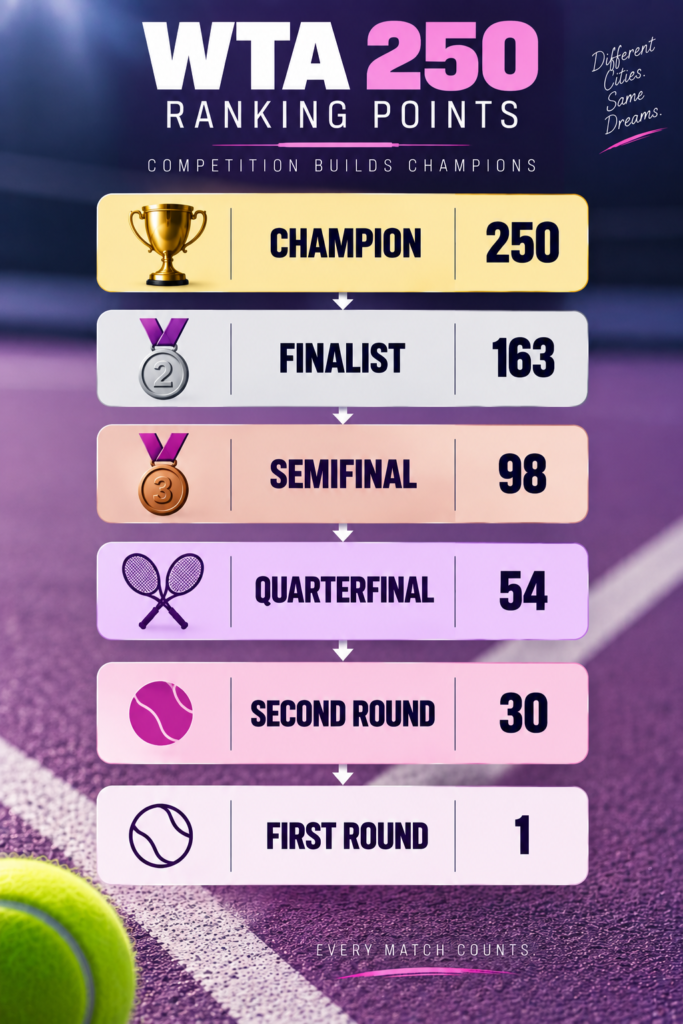
The current allocation through a standard 32-player draw is:
| Result | Ranking Points |
|---|---|
| Champion | 250 |
| Finalist | 163 |
| Semifinal | 98 |
| Quarterfinal | 54 |
| Second Round | 30 |
| First Round | 1 |
These figures were used across 2026 WTA 250 events including Athens, Iasi, Prague, Hamburg, Memphis and São Paulo.
One thing worth noticing is that these figures aren’t identical to the equivalent ATP 250 points.
The WTA and ATP use their own ranking structures.
The category names tell you what the champion earns, but you shouldn’t automatically assume that every round below the champion carries identical points on the men’s and women’s Tours.
How Important Are 250 Ranking Points?
For a player near the top of the rankings, 250 points represents only one part of a much larger season.
For somebody trying to establish herself on the WTA Tour, it can be enormous.
The WTA rankings operate on a rolling 52-week system, with points determined by tournament level and how far a player progresses. For leading singles players, results from WTA 500, WTA 250, WTA 125 and ITF events can form part of the group of results used to calculate the ranking.
A WTA 250 title can therefore contribute significantly to a player’s ranking total.
And a better ranking can lead to:
Direct entry into stronger tournaments
Fewer qualifying events
Better Grand Slam entry prospects
Potential seeding
Access to WTA 500 and WTA 1000 tournaments
This is why a first WTA 250 title can become such an important career milestone.
It isn’t simply a trophy.
It can change the tournaments a player is able to enter next.
WTA 250 vs WTA 500
WTA 500 sits immediately above WTA 250.
The most obvious difference is the champion’s ranking reward:
WTA 500 champion — 500 points
WTA 250 champion — 250 points
But the points aren’t exactly doubled at every round:
| Result | WTA 500 | WTA 250 |
|---|---|---|
| Champion | 500 | 250 |
| Finalist | 325 | 163 |
| Semifinal | 195 | 98 |
| Quarterfinal | 108 | 54 |
| Round of 16/Second Round* | 60 | 30 |
*Round naming depends on draw structure.
The WTA 500 level is also designed to attract stronger fields and sits higher within the Tour’s tournament structure.
But this doesn’t mean a WTA 250 title is easy to win.
A 250 field can still include Top 20 players, Grand Slam champions, experienced Tour professionals and dangerous younger players.
See WTA 500 Explained for the category immediately above.
WTA 250 vs WTA 125
This distinction can be confusing because the names sound very similar.
Both carry WTA branding, but WTA 250 is part of the main WTA Tour, while WTA 125 tournaments form a level below it.
The simplified pathway is:
WTA 500
↓
WTA 250
↓
WTA 125
↓
ITF World Tennis Tour
A WTA 125 tournament can be an important bridge for players trying to move from lower-level professional events towards regular Tour competition.
WTA 250 represents the next step.
That is why reaching a WTA 250 main draw regularly can be a significant indication that a player is establishing herself at Tour level.
What Surfaces Are WTA 250 Tournaments Played On?
WTA 250 tournaments are played across all three main tennis surfaces.
Hard Court
A large number are played on hard courts.
Auckland, Hobart, Athens, Prague, Memphis, São Paulo and Hong Kong are among the hard-court WTA 250 events on the 2026 calendar.
Clay
The category also provides numerous clay-court opportunities.
Iasi and Hamburg, for example, were both WTA 250 clay events during the 2026 summer.
Grass
WTA 250 tournaments are particularly useful during the short grass season.
‘s-Hertogenbosch is one example, providing players with Tour-level grass-court competition in preparation for Wimbledon.
That variety means WTA 250 tournaments serve a different purpose depending on where they appear in the calendar.
For some players, they’re a chance to chase a title.
For others, they’re ideal preparation for a larger event.
How Big Is a WTA 250 Draw?
Many WTA 250 tournaments use 32-player singles draws.
Athens, Iasi, Prague, Hamburg, Memphis and São Paulo all used 32-player fields in 2026.
Hong Kong also has a 32-player singles draw and 16-team doubles field.
In a straightforward 32-player knockout draw, a player entering in the first round needs five victories to win the title:
32 players
↓
16
↓
Quarterfinals
↓
Semifinals
↓
Final
↓
Champion
Tournament formats can vary, so 32 shouldn’t be treated as a universal rule for every WTA 250 in every season.
But the compact nature of the category is part of its appeal.
A player can arrive on Monday and, five wins later, leave as a WTA Tour champion.
Who Plays WTA 250 Tournaments?
One of the strengths of WTA 250 events is the mixture of players they attract.
A typical field might contain:
An established star looking for match practice or a title.
A Top 50 player trying to improve her ranking.
An experienced Tour professional who regularly competes at this level.
A young prospect trying to establish herself on the WTA Tour.
A qualifier who has earned her way into the main draw.
A local wild card receiving an opportunity at Tour level.
That mixture can make the tournaments unpredictable.
The 2026 Auckland field, for example, included established players alongside rising names and was headed by Elina Svitolina, who went on to win the title.
WTA 250 tournaments can therefore become places where the next generation first begins to make itself known.
Why Do Leading Players Enter WTA 250 Events?
The obvious answer isn’t always ranking points.
A Top 10 player has access to tournaments offering considerably more than 250 points.
But scheduling matters.
A WTA 250 can provide:
- match practice after a break,
- preparation on a particular surface,
- competition immediately before a Grand Slam,
- an opportunity to rebuild confidence,
- or a convenient tournament within a player’s schedule.
Hobart, for example, is played immediately before the Australian Open.
Grass-court 250s can provide valuable Wimbledon preparation.
Other tournaments fit naturally between larger events.
Professional tennis players aren’t simply choosing whichever tournament offers the most points.
They’re constructing a season.
Can Players Qualify for a WTA 250?
Yes.
Players can reach a WTA 250 main draw through several routes:
Direct acceptance through ranking
Qualifying
Wild card
Lucky loser entry when applicable
Qualifying can be particularly important at this level.
A player moving up from WTA 125 or ITF competition may not initially have a ranking high enough for direct entry.
But if she qualifies for a WTA 250 and then wins several main-draw matches, the ranking rewards can accelerate her progress.
A quarterfinal is worth 54 points.
A semifinal earns 98.
A final earns 163.
A title brings 250.
For a player trying to move rapidly through the rankings, one exceptional week can matter enormously.
See What Is a Qualifier?, What Is a Wild Card? and What Is a Lucky Loser?
Do All WTA 250 Tournaments Offer the Same Prize Money?
No.
The “250” refers to ranking points, not prize money.
Financial rewards can differ between tournaments and can change from year to year.
For example, the 2026 Hong Kong tournament lists a total financial commitment of $283,347, while individual 2026 WTA 250 events also offered different winner’s cheques depending on the tournament and currency.
So:
WTA 250 = 250 champion’s ranking points
It does not mean:
WTA 250 = $250,000 prize money
See Tennis Prize Money Explained for more.
Why WTA 250 Tournaments Matter
It’s easy to focus on the biggest tournaments.
Grand Slams generate the most attention.
WTA 1000 events bring many of the leading players together.
But WTA 250 tournaments perform a different role.
They create opportunities.
For a young player, it might be the first chance to compete regularly on the main Tour.
For somebody ranked around No. 70, a title could produce a significant rankings improvement.
For an established player returning from injury or struggling for form, it can provide valuable match wins.
And for the host cities, WTA 250 events bring elite women’s tennis to places that may never host a Grand Slam or WTA 1000 tournament.
With 22 events on the 2026 calendar, they also provide a significant part of the week-to-week structure of the WTA season.

Frequently Asked Questions
What does WTA 250 mean?
WTA 250 is a tournament category on the main women’s professional WTA Tour. The singles champion receives 250 ranking points.
How many WTA 250 tournaments are there?
The 2026 WTA calendar contains 22 WTA 250 tournaments.
How many points does a WTA 250 finalist receive?
A finalist receives 163 ranking points under the current system.
How many points does a WTA 250 semifinalist receive?
A semifinalist receives 98 ranking points.
How many points does a WTA 250 quarterfinalist receive?
A quarterfinalist receives 54 points.
Is WTA 250 lower than WTA 500?
Yes. WTA 250 sits one category below WTA 500.
Is WTA 250 higher than WTA 125?
Yes. WTA 250 is part of the main WTA Tour and sits above WTA 125.
Are WTA 250 tournaments played on grass?
Yes. The category includes hard-court, clay-court and grass-court tournaments.
Can Top 10 players compete in WTA 250 tournaments?
Yes, although WTA player-entry rules affect participation and scheduling for leading players.
Does WTA 250 mean $250,000 in prize money?
No. The 250 refers to ranking points awarded to the singles champion.
Final Thoughts
WTA 250 may be the lowest tournament category on the main WTA Tour, but “lowest” shouldn’t be confused with unimportant.
These events form a substantial part of the professional calendar.
They give established players opportunities to compete and win titles, while providing emerging players with one of the most important gateways into regular Tour-level tennis.
A champion leaves with 250 ranking points.
But the bigger reward can be what those points make possible next.
A better ranking can mean direct entry rather than qualifying. It can open the door to WTA 500 and WTA 1000 events. It can move a player closer to Grand Slam main draws and eventually Grand Slam seeding.
For many players, that is what WTA 250 represents:
Not the bottom of professional tennis, but an important step towards the top.
Continue Reading
WTA 500 Explained
WTA 1000 Explained
The WTA Tour Explained
Tennis Ranking Points Explained
Tennis Prize Money Explained
What Is a Qualifier in Tennis?
ITF World Tennis Tour Explained
Read more of our instructional articles here.
Read more of our player focus articles here.
Follow The Tennis Site on X: @thetennissite
Follow Todd Scoullar on X: @toddscoullar

Comments are closed, but trackbacks and pingbacks are open.