

Between the elite WTA 1000 tournaments and the more numerous WTA 250 events sits an important middle tier of women’s professional tennis: WTA 500.
These tournaments appear throughout the season and across all three major surfaces. They regularly attract leading players, offer substantial ranking points and can play an important role in everything from Grand Slam preparation to the race for the WTA Finals.
There are 17 WTA 500 events on the 2026 WTA calendar, making the category a significant part of the professional season.
And the name tells us the most important number.
Win a WTA 500 singles title and you earn 500 ranking points.
So how does the category work, and where does it fit in the wider structure of women’s professional tennis?
What Is a WTA 500 Tournament?
WTA 500 is one of the three main tournament categories on the WTA Tour.
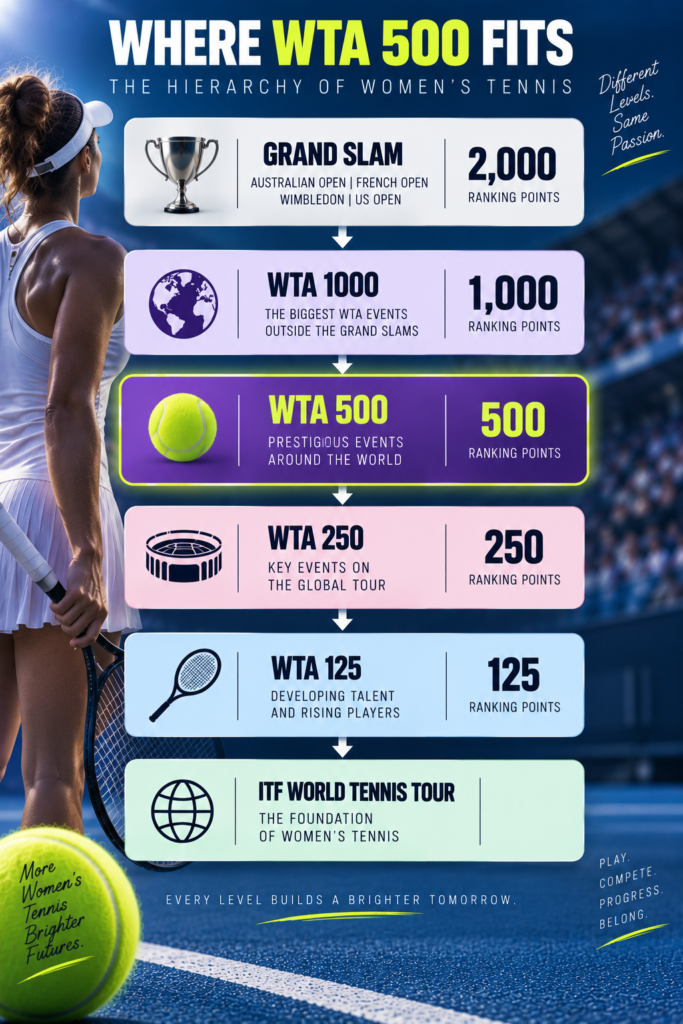
The basic hierarchy is:
Grand Slam — 2,000 champion’s points
↓
WTA 1000 — 1,000
↓
WTA 500 — 500
↓
WTA 250 — 250
↓
WTA 125
↓
ITF World Tennis Tour
The “500” refers to the number of ranking points awarded to the singles champion.
It does not mean $500,000 in prize money.
WTA 500 therefore occupies the middle tier of the regular WTA Tour: below WTA 1000, but above WTA 250.
How Many WTA 500 Tournaments Are There?
There are 17 WTA 500 events on the 2026 calendar.
They are spread across the season and include tournaments in Australia, the Middle East, Europe, North America, Mexico and Asia.
The category also provides considerable variety.
Players can compete at WTA 500 level on hard courts, clay and grass, indoors and outdoors.
That means the same 500-point reward can be available under completely different conditions.
A player might win a WTA 500 on Australian hard courts at the beginning of the season, European clay in the spring or grass immediately before Wimbledon.
This makes the category an important link between the biggest tournaments on the calendar.
How Many Ranking Points Are Available at a WTA 500?
The singles champion receives 500 ranking points.
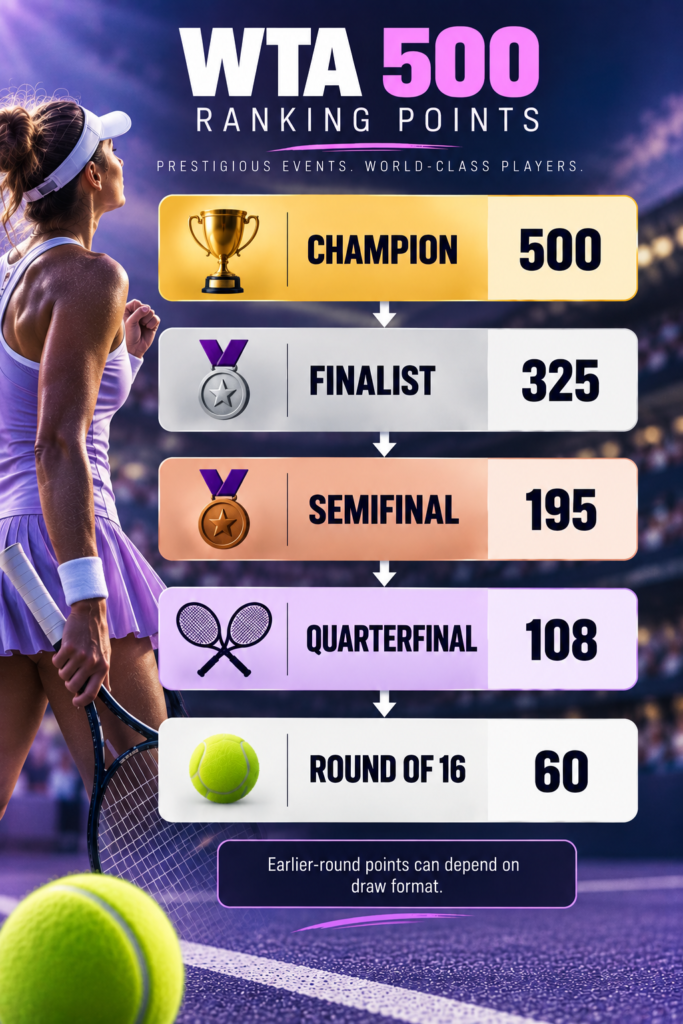
The current allocation through the later rounds is:
| Result | Ranking Points |
|---|---|
| Champion | 500 |
| Finalist | 325 |
| Semifinal | 195 |
| Quarterfinal | 108 |
| Round of 16 | 60 |
At a standard 28-player event, a first-round loss earns one ranking point. Larger draw formats can have additional rounds and different early-round allocations.
This is worth noting because the WTA and ATP do not use identical points distributions at their respective 500-level events.
An ATP 500 finalist, for example, receives 330 points.
A WTA 500 finalist receives 325.
The category names are the same because both champions receive 500 points, but the allocations beneath the champion are different.
How Important Is Winning a WTA 500?
Five hundred ranking points can make a major difference.
For a player around the middle of the Top 100, a WTA 500 title can produce a substantial ranking jump.
For an established player, those same points can influence:
Grand Slam seeding
WTA Finals qualification
Career-high rankings
Tournament entry
Year-end ranking
It also provides an easy way to understand where the category sits.
A WTA 500 title is worth half the champion’s points of a WTA 1000 and twice the champion’s points of a WTA 250.
So:
WTA 1000 — 1,000
WTA 500 — 500
WTA 250 — 250
For more on how those results are incorporated into a player’s ranking, see Tennis Ranking Points Explained
WTA 500 vs WTA 1000
WTA 1000 is the category immediately above WTA 500.
The most obvious difference is ranking points:
| Result | WTA 1000 | WTA 500 |
|---|---|---|
| Champion | 1,000 | 500 |
| Finalist | 650 | 325 |
| Semifinal | 390 | 195 |
| Quarterfinal | 215 | 108 |
| Round of 16 | 120 | 60 |
Interestingly, the points are almost exactly doubled at WTA 1000 level.
The higher category also generally features deeper elite fields, larger draws and greater financial rewards.
But that doesn’t make WTA 500 tournaments easy to win.
Some attract extremely strong fields, particularly when their position on the calendar makes them ideal preparation for a Grand Slam or another major event.
See WTA 1000 Explained for the category above.
WTA 500 vs WTA 250
WTA 250 sits one level below.
At the simplest level:
WTA 500 champion — 500 points
WTA 250 champion — 250 points
So winning a WTA 500 is worth twice as many champion’s ranking points.
The 500-level events are also intended to attract stronger fields. As part of its restructuring of the calendar, the WTA specifically strengthened the WTA 500 category with new entry rules designed to increase the quality of player fields.
That distinction matters.
WTA 250 events remain full Tour-level tournaments, but WTA 500 sits a clear step higher in the professional structure.

What Surfaces Are WTA 500 Tournaments Played On?
Unlike WTA 1000, which currently has no grass-court tournament, the WTA 500 category covers all three major surfaces.
Hard Court
Many WTA 500 tournaments are played on hard courts.
These include events at different stages of the season, from Australia at the beginning of the year through to North America, Mexico and Asia later on.
Conditions can still vary enormously between hard-court tournaments depending on climate, court speed and whether the event is indoors or outdoors.
Clay
WTA 500 events also form an important part of the clay season.
Charleston is particularly unusual because it is played on green clay, while tournaments such as Stuttgart, Strasbourg and Linz provide other high-level clay-court opportunities during the season.
Linz moved to indoor clay for 2026, adding another variation within the category.
Grass
WTA 500 tournaments are particularly important during the short grass-court season.
London and Berlin are among the 500-level grass events in 2026. The London event at Queen’s Club uses a 28-player singles draw and offers 500 points to the champion.
These events provide high-level preparation ahead of Wimbledon.

How Big Are WTA 500 Draws?
Many WTA 500 tournaments use compact singles draws.
Queen’s Club, Tokyo, Monterrey and Guadalajara, for example, each have 28-player singles draws in 2026.
A 28-player draw generally means the four highest seeds receive first-round byes.
Other events can use different formats, so it is better not to think of “WTA 500” as describing a particular draw size.
The number describes the tournament category and the champion’s ranking reward.
A relatively compact draw can also create strong early-round matches.
When numerous highly ranked players enter a 28-player tournament, there is simply less room for them to be separated.
That can make some WTA 500 draws particularly competitive.
Why Do Top Players Enter WTA 500 Tournaments?
Ranking points are an obvious reason.
Five hundred points is a significant reward.
But scheduling can be just as important.
A player might choose a WTA 500 because it:
- provides preparation for a Grand Slam,
- is played on a preferred surface,
- fits conveniently into the calendar,
- offers valuable match practice,
- or provides an opportunity to strengthen her ranking.
The grass season is a good example.
With only a few weeks of competition available before Wimbledon, a strong WTA 500 field can provide some of the best preparation available.
The same applies during the clay and hard-court seasons.
A WTA 500 can therefore be both a significant tournament in its own right and preparation for something even bigger.
Can Lower-Ranked Players Enter WTA 500 Tournaments?
Yes.
Ranking is the primary route into the main draw, but it isn’t the only one.
Players can also enter through qualifying, while tournaments award wild cards to selected players.
Under the relevant circumstances, a player who loses in qualifying can also enter the main draw as a lucky loser.
This can create major opportunities.
A lower-ranked player who qualifies and then makes a deep run can accumulate significant ranking points very quickly.
A semifinal is worth 195 points.
A final earns 325.
Winning the tournament earns 500.
That can transform a player’s ranking in a single week.
See What Is a Qualifier?, What Is a Wild Card? and What Is a Lucky Loser?
Can WTA 500 Tournaments Have Top-10 Fields?
Absolutely.
The category regularly attracts elite players.
Berlin’s 2026 field, for example, was scheduled to include six Top-10 players.
That’s an important reminder that tournament category and draw difficulty aren’t exactly the same thing.
A WTA 500 remains formally below a WTA 1000.
But an individual 500 can still contain a large number of the world’s best players.
This is particularly likely when the event is well positioned on the calendar or provides useful preparation for a Grand Slam.
Do All WTA 500 Events Offer the Same Prize Money?
No.
The 500 refers to ranking points, not money.
Prize money can vary considerably between tournaments.
For example, the 2026 Queen’s Club event had total prize money of $1.915 million, while Charleston increased its overall financial package to $2.5 million, including $2.3 million in on-site player prize money.
Those figures will change over time, while the tournament category can remain the same.
This is why WTA 500 should never be interpreted as a dollar figure.
See Tennis Prize Money Explained
Why WTA 500 Tournaments Matter for Rising Players
WTA 500 events occupy an interesting position for players trying to climb towards the elite.
A player who has become comfortable competing at WTA 250 level may find 500 tournaments provide the next major test.
The fields are generally stronger.
More points are available.
And a breakthrough can have greater consequences.
A player could begin a tournament outside the Top 50 and finish the week with hundreds of additional ranking points.
That can improve future tournament entry, Grand Slam seeding prospects and access to stronger events.
The pathway looks something like:
Win matches
↓
Earn ranking points
↓
Improve ranking
↓
Gain better tournament access
↓
Compete more regularly at WTA 500 and WTA 1000 level
This is why WTA 500 tournaments can become important stepping stones between establishing a career on Tour and joining the game’s elite.
WTA 500 and the Race to the WTA Finals
WTA 500 results can also matter considerably at the very top.
Players qualify for the season-ending WTA Finals based on their performances across the year.
Grand Slams and WTA 1000 tournaments provide the largest individual points opportunities, but 500-level results can still make the difference when players are separated by relatively small margins.
A title brings 500 points.
A final brings 325.
Two strong WTA 500 performances can therefore significantly alter a player’s position in the race.
That becomes particularly important during the latter stages of the season.
Frequently Asked Questions
What does WTA 500 mean?
WTA 500 is a tournament category on the women’s professional WTA Tour. The singles champion receives 500 ranking points.
How many WTA 500 tournaments are there?
There are 17 WTA 500 events on the 2026 WTA calendar.
How many points does a WTA 500 finalist receive?
A finalist receives 325 ranking points.
How many points does a WTA 500 semifinalist receive?
A semifinalist receives 195 points.
How many points does a WTA 500 quarterfinalist receive?
A quarterfinalist receives 108 points.
Is WTA 500 higher than WTA 250?
Yes. WTA 500 sits one category above WTA 250.
Is WTA 500 lower than WTA 1000?
Yes. A WTA 1000 champion receives 1,000 points compared with 500 at a WTA 500.
Are WTA 500 tournaments played on grass?
Yes. Unlike the WTA 1000 category, WTA 500 includes grass-court tournaments.
Does WTA 500 mean $500,000 prize money?
No. The number refers to ranking points, not prize money.
Final Thoughts
WTA 500 tournaments occupy the middle ground of the main women’s Tour, but their importance shouldn’t be underestimated.
There are 17 on the 2026 calendar, played across different continents, surfaces and stages of the season.
They provide a bridge between the WTA 250 level and the elite WTA 1000 tournaments.
For the world’s leading players, they offer valuable points, titles and preparation for bigger events.
For those trying to climb the rankings, they offer something even more valuable: opportunity.
A good week can produce 195 or 325 points.
A great week brings 500 points and a WTA Tour title.
That is enough to change a ranking, change a season and, for an emerging player, potentially change the direction of a career.
Continue Reading
WTA 1000 Explained
WTA 250 Explained
The WTA Tour Explained
Grand Slams Explained
Tennis Ranking Points Explained
Live Rankings Explained
Tennis Prize Money Explained
What Is a Qualifier in Tennis?
Read more of our instructional articles here.
Read more of our player focus articles here.
Follow The Tennis Site on X: @thetennissite
Follow Todd Scoullar on X: @toddscoullar

Comments are closed, but trackbacks and pingbacks are open.