

Below the four Grand Slams, one tournament category sits at the top of the regular women’s professional tour: WTA 1000.
These are some of the biggest events in women’s tennis.
They take players from the hard courts of Doha and Dubai to the vast combined events at Indian Wells and Miami, onto European clay in Madrid and Rome, through the North American summer and finally to Beijing and Wuhan late in the season.
There are 10 WTA 1000 tournaments on the 2026 calendar, and winning one delivers one of the largest ranking rewards available outside a Grand Slam: 1,000 points.
But what exactly does WTA 1000 mean? And how do these tournaments compare with Grand Slams and the WTA 500 and 250 levels below them?
What Is a WTA 1000 Tournament?
WTA 1000 is the highest tournament category on the regular WTA Tour.
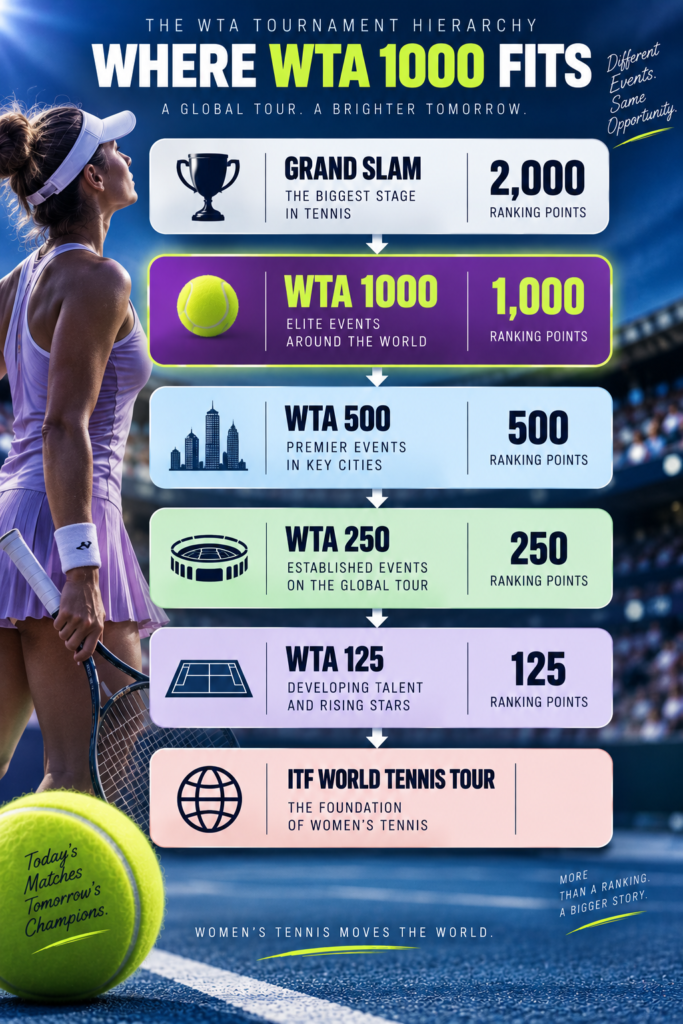
The basic women’s professional hierarchy looks like this:
Grand Slam — 2,000 champion’s points
↓
WTA 1000 — 1,000
↓
WTA 500 — 500
↓
WTA 250 — 250
↓
WTA 125
↓
ITF World Tennis Tour
The “1000” refers to the ranking points awarded to the singles champion.
It doesn’t mean $1,000 in prize money, nor does it describe the number of players in the tournament.
Win the title and the player earns 1,000 PIF WTA Ranking points.
Which Tournaments Are WTA 1000 Events?
There are 10 WTA 1000 tournaments in 2026:
| Tournament | Location | Surface |
|---|---|---|
| Qatar Open | Doha | Hard |
| Dubai Tennis Championships | Dubai | Hard |
| Indian Wells | Indian Wells | Hard |
| Miami Open | Miami | Hard |
| Madrid Open | Madrid | Clay |
| Italian Open | Rome | Clay |
| Canadian Open | Toronto/Montreal | Hard |
| Cincinnati Open | Cincinnati | Hard |
| China Open | Beijing | Hard |
| Wuhan Open | Wuhan | Hard |
The Canadian tournament alternates between Toronto and Montreal, with Toronto hosting the women’s event in 2026.
This group forms the backbone of the WTA season between the Grand Slams.
They aren’t all identical, however.
Some take place over approximately two weeks with large draws, while others retain a more compact format.
Why Are They Called WTA 1000 Tournaments?
The answer is ranking points.
A WTA 1000 singles champion receives:
1,000 points
That makes the category easy to position against the other major levels:
Grand Slam champion — 2,000
WTA 1000 champion — 1,000
WTA 500 champion — 500
WTA 250 champion — 250
So in simple headline terms:
1 Grand Slam title = 2 WTA 1000 titles
1 WTA 1000 title = 2 WTA 500 titles
1 WTA 1000 title = 4 WTA 250 titles
Those comparisons refer only to the number of champion’s ranking points. They don’t suggest that the achievements themselves are equivalent.
Winning one tournament is very different from winning several others, and ranking calculations involve more than simply adding every result a player records.
See Tennis Ranking Points Explained for the full system.
How Many Ranking Points Can Players Earn?
A WTA 1000 title is worth 1,000 points, but substantial points are available throughout the later rounds.
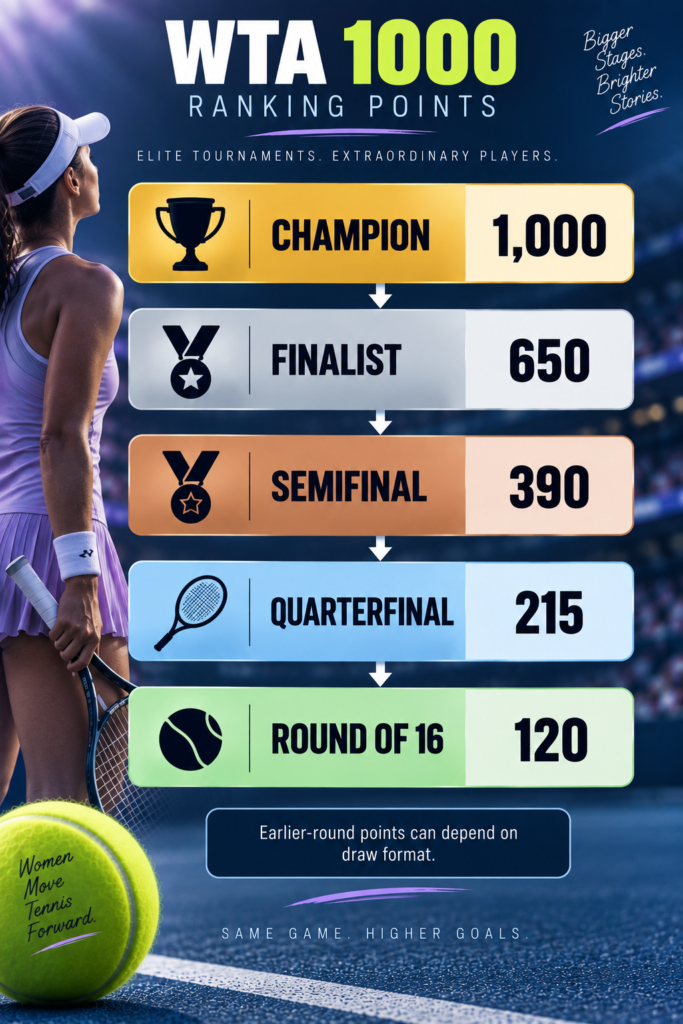
The current allocation is:
| Result | Ranking Points |
|---|---|
| Champion | 1,000 |
| Finalist | 650 |
| Semifinal | 390 |
| Quarterfinal | 215 |
| Round of 16 | 120 |
Earlier-round allocations can vary with draw format. At the 2026 Doha event, for example, players received 65 points for reaching the Round of 32 and 10 for the Round of 56.
This helps explain why WTA 1000 tournaments can have such a major effect on the rankings.
A player doesn’t need to win the title to have a hugely productive week.
A quarterfinal produces 215 points.
A semifinal earns 390.
A finalist takes 650.
For a player trying to reach the Top 20, Top 10 or qualify for the WTA Finals, those numbers can be significant.
WTA 1000 vs Grand Slam
Grand Slams sit above WTA 1000 tournaments.
The biggest difference is ranking value.
A Grand Slam singles champion earns:
2,000 points
A WTA 1000 champion earns:
1,000 points
But the differences go beyond rankings.
Grand Slams feature 128-player singles draws and require a champion to win seven matches. They are also the four most prestigious individual tournaments in tennis.
WTA 1000 events occupy the next level of the women’s calendar.
That makes a WTA 1000 title one of the biggest achievements available outside the Australian Open, Roland Garros, Wimbledon and US Open.
See Grand Slams Explained for more.
WTA 1000 vs WTA 500
WTA 500 sits immediately below WTA 1000.
The easiest comparison is again the winner’s points:
WTA 1000 — 1,000
WTA 500 — 500
So a WTA 1000 title is worth twice as many champion’s ranking points.
The 1000-level events also generally attract deeper fields because of their status and participation requirements.
That doesn’t mean every individual WTA 1000 match is automatically harder than every WTA 500 match. Draw strength can vary enormously.
But as a tournament category, WTA 1000 is clearly the higher level.
We’ll look at the category below in WTA 500 Explained.
Why Are Some WTA 1000 Tournaments Longer Than Others?
This is one of the biggest differences between modern WTA 1000 tournaments.
The category has gradually moved towards larger, longer events.
For 2026, the WTA says seven of the 10 WTA 1000 tournaments use the enhanced 12-day format.
Indian Wells and Miami were already known for their extended format, while Madrid, Rome, Beijing, Cincinnati and the Canadian Open have also expanded. The WTA announced this broader restructuring as part of an effort to strengthen the top level of the Tour and provide more consistent appearances from leading players.
This means a modern WTA 1000 can look quite different from the traditional one-week tournament.
Madrid in 2026, for example, had a 96-player singles draw and ran from April 21 to May 3.
Toronto also featured 96 singles players over an extended period in 2026.
Byes mean seeded players in these larger draws don’t necessarily have to win as many matches as an unseeded player entering in the opening round.
What Surfaces Are WTA 1000 Tournaments Played On?
WTA 1000 events are played predominantly on hard courts.
Eight of the 10 tournaments are hard-court events.
The exceptions are:
Madrid — clay
Rome — clay
There are currently no WTA 1000 grass-court tournaments.
That makes the structure noticeably different around Wimbledon.
Players preparing for the grass-court Grand Slam instead compete at WTA 500 and WTA 250 tournaments.

Why Are WTA 1000 Tournaments So Important for the Rankings?
One thousand points is enough to reshape a player’s season.
Imagine a player enters a WTA 1000 ranked around No. 30 and unexpectedly wins the tournament.
They have suddenly added a result worth 1,000 ranking points.
That can produce a dramatic ranking rise and potentially change:
Grand Slam seeding
Tournament entry
Future draws
WTA Finals qualification chances
Career-high ranking
The effect can be particularly dramatic when a player is defending very few points from the corresponding period of the previous season.
The reverse can also happen.
If a player won a WTA 1000 the previous year and loses early when those points are due to come off their ranking, their position can fall significantly.
That’s why you’ll often see large movements in live rankings during WTA 1000 events.
See Live Rankings Explained and Tennis Ranking Points Explained.
Why Do the Best Players Compete in WTA 1000 Events?
WTA 1000 tournaments are designed to bring the leading players together regularly outside the Grand Slams.
The WTA’s restructuring of the Tour strengthened player-entry requirements at the 1000 level specifically to create a more consistent presence from top players.
That is a major part of the category’s identity.
At a Grand Slam, virtually everyone wants to play.
At a WTA 250, the field can vary significantly depending on the week.
WTA 1000 tournaments sit much closer to the Grand Slam end of that spectrum.
For fans, that means frequent matches between leading players.
For players, it means the chance to earn major ranking points against elite opposition.
Can Lower-Ranked Players Enter WTA 1000 Tournaments?
Yes.
Not everyone enters through direct acceptance.
As with other professional tournaments, WTA 1000 events include pathways such as:
Direct entry through ranking
Qualifying
Wild cards
Lucky loser entry when applicable
Large WTA 1000 events can therefore create important opportunities for players outside the elite.
A lower-ranked player might qualify, upset a seeded opponent and suddenly find herself deep in one of the biggest tournaments on the regular Tour.
Because of the points available, a breakthrough at this level can have enormous consequences.
See What Is a Qualifier?, What Is a Wild Card? and What Is a Lucky Loser?
Do WTA 1000 Events All Offer the Same Prize Money?
No.
As with ATP categories, the number in WTA 1000 refers to ranking points rather than prize money.
The financial rewards differ between tournaments.
For example, Doha’s 2026 event had total prize money of just over $4.08 million, while the WTA lists Madrid’s total financial commitment at more than $8.23 million.
Those amounts can change from year to year, which is another reason not to interpret “1000” as a financial figure.
See Tennis Prize Money Explained
Embed from Getty ImagesCan a WTA 1000 Be More Difficult Than Another WTA 1000?
Yes.
All WTA 1000 tournaments carry the same 1,000-point reward for the champion, but that doesn’t mean every draw is identical.
Player withdrawals, injuries, scheduling and surface preferences can affect the field.
Conditions differ too.
Doha and Dubai are outdoor hard-court tournaments early in the season.
Madrid is played on clay at altitude.
Rome is also clay but produces different playing conditions.
Cincinnati comes during the North American hard-court summer.
Beijing and Wuhan arrive late in a long season.
The official category is the same.
The challenge presented by each tournament can be quite different.
WTA 1000 Tournaments and the WTA Finals
WTA 1000 results can be crucial in determining who qualifies for the season-ending WTA Finals.
A title delivers 1,000 points towards a player’s season.
Two strong WTA 1000 performances can therefore dramatically change the race.
This becomes particularly important late in the year.
Beijing and Wuhan are among the final WTA 1000 opportunities of the season, meaning players still fighting for WTA Finals qualification have large numbers of points available.
A semifinal, final or title at that stage can transform the standings.
Why WTA 1000 Titles Matter
Grand Slam titles define careers.
But immediately beneath them, WTA 1000 titles provide another important measure of sustained excellence.
Winning one requires navigating a field filled with Tour-level players and, in many cases, a large number of the world’s best.
They also provide an interesting measure across a player’s career.
Winning repeatedly at WTA 1000 level demonstrates an ability to succeed across different continents, conditions and stages of the season.
The category has produced its own impressive records. Serena Williams won 13 WTA 1000 titles, while Iga Swiatek had reached 11 by the end of the 2025 season.
Those totals help show why the category matters historically as well as mathematically.
Embed from Getty ImagesFrequently Asked Questions
What does WTA 1000 mean?
WTA 1000 is the highest regular tournament category on the WTA Tour. The singles champion earns 1,000 ranking points.
How many WTA 1000 tournaments are there?
There are 10 WTA 1000 tournaments on the 2026 calendar.
Is WTA 1000 below a Grand Slam?
Yes. A Grand Slam champion earns 2,000 ranking points, compared with 1,000 at a WTA 1000.
Is WTA 1000 higher than WTA 500?
Yes. A WTA 1000 champion earns twice as many ranking points as a WTA 500 champion.
How many points does a WTA 1000 finalist earn?
A finalist earns 650 ranking points.
How many points does a WTA 1000 semifinalist earn?
A semifinalist earns 390 points under the current structure.
Are WTA 1000 tournaments played on grass?
No. There are currently no WTA 1000 grass-court events.
Are all WTA 1000 tournaments two weeks long?
No. Seven of the 10 events use the WTA’s expanded 12-day format in 2026, while the others remain shorter events.
Does WTA 1000 mean $1,000 in prize money?
No. The number refers to ranking points awarded to the singles champion.
Final Thoughts
WTA 1000 tournaments form the highest level of the regular women’s Tour.
There are only 10 of them in 2026, and that scarcity is part of what makes them important.
Winning one brings 1,000 ranking points, substantial prize money and a title earned against one of the strongest fields available outside a Grand Slam.
But their importance goes further than the trophy.
WTA 1000 results can determine Grand Slam seedings, reshape rankings, propel emerging players towards the top of the sport and decide who reaches the WTA Finals.
The four Grand Slams remain tennis’s biggest individual tournaments.
Immediately beneath them, though, the WTA 1000s provide many of the matches and storylines that define the rest of the women’s season.
Continue Reading
Grand Slams Explained
The WTA Tour Explained
WTA 500 Explained
Tennis Ranking Points Explained
Live Rankings Explained
Tennis Prize Money Explained
What Is a Qualifier in Tennis?
Read more of our instructional articles here.
Read more of our player focus articles here.
Follow The Tennis Site on X: @thetennissite
Follow Todd Scoullar on X: @toddscoullar

Comments are closed, but trackbacks and pingbacks are open.