
Quick Answer
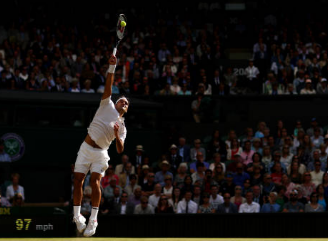
Every point in tennis begins with a serve.
To make a legal serve, a player must:
- Stand behind the baseline.
- Serve diagonally into the correct service box.
- Strike the ball before it bounces.
- Avoid committing a foot fault.
- Clear the net.
If the first serve is missed, the player receives a second serve. Missing both results in a double fault, and the point is awarded to the opponent.
Where Must the Server Stand?
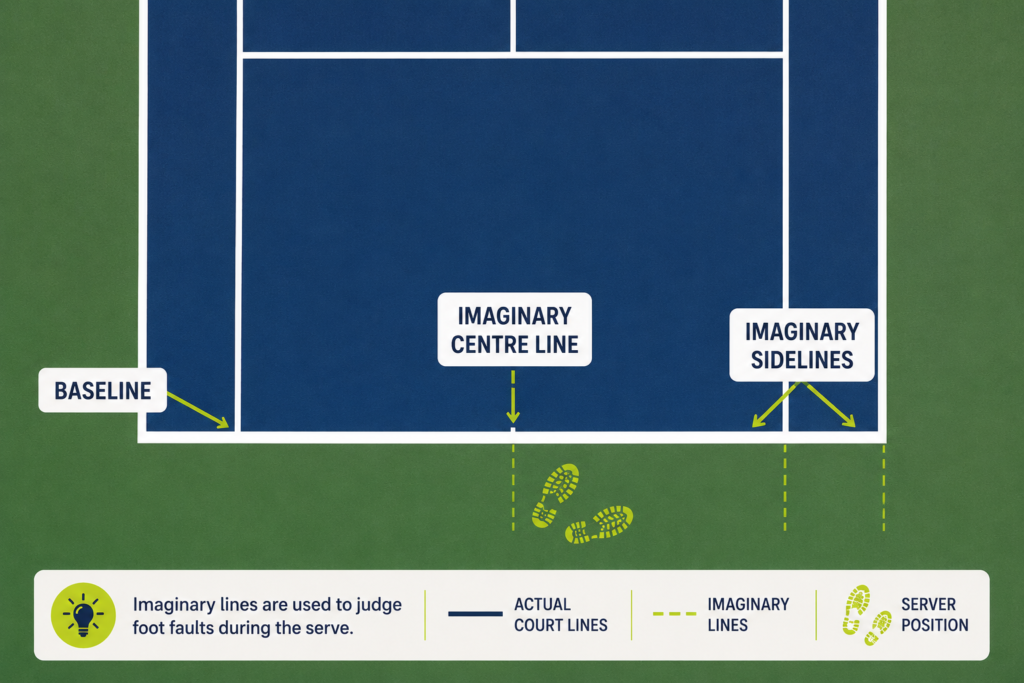
Before serving, both feet must remain behind the baseline.
The server must stand:
- Behind the baseline.
- Between the centre mark and the singles sideline.
- Without touching the baseline until the ball has been struck.
Players alternate serving from the right and left sides of the court after every point.
📸 PHOTO 2
A diagram showing the legal serving positions behind the baseline on both the deuce and ad sides.
Where Must the Ball Land?
The serve must land in the diagonally opposite service box.
For example:
- Serving from the right (deuce court) means the ball must land in the opponent’s right-hand service box.
- Serving from the left (ad court) means the ball must land in the opponent’s left-hand service box.
If the ball lands outside the service box, it’s a fault.
First Serve and Second Serve
Players are allowed two attempts to start each point.
First Serve
Most players try to generate more pace and power with the first serve.
If it lands in, play begins.
If it misses, the player gets another opportunity.
Second Serve
The second serve is usually struck with greater margin for error.
Missing the second serve results in a double fault.
What Is a Fault?
A serve is a fault if:
- It lands outside the correct service box.
- It hits the net and lands out.
- It misses the ball completely during the service motion.
- The server commits a foot fault.
A single fault isn’t costly because players receive a second serve.
What Is a Double Fault?
A double fault occurs when both serves are faults.
The point immediately goes to the returner.
Although everyone hits the occasional double fault, keeping them to a minimum is an important part of consistent serving.
What Is a Foot Fault?
A foot fault occurs when the server breaks the serving rules with their feet.
Common examples include:
- Touching the baseline before striking the ball.
- Stepping inside the court before contact.
- Standing outside the imaginary extension of the singles sideline.
- Crossing over the centre mark.
Foot faults are treated exactly the same as any other service fault.
What Happens if the Serve Hits the Net?
It depends on where the ball lands.
The Serve Hits the Net and Lands In
This is called a let.
The serve is replayed.
There is no limit to the number of lets.
The Serve Hits the Net and Lands Out
This is simply a fault.
The player either serves again or loses the point if it was their second serve.
For a full explanation, read What Is a Let in Tennis?
Who Serves First?
Before the match begins, a coin toss or racket spin determines who serves first.
Players then alternate serving every game throughout the match.
Common Serving Mistakes
Many beginners:
- Stand on the wrong side of the centre mark.
- Serve into the wrong service box.
- Step on the baseline.
- Forget to alternate between the deuce and ad courts.
- Rush the second serve after a fault.
Understanding the basic rules makes serving much less confusing.
Common Myths
“You only get one serve.”
False.
Every player is allowed two serves unless the first serve is a let.
“Touching the line is allowed when serving.”
False.
Touching the baseline before striking the ball is a foot fault.
“A serve that clips the net is always a fault.”
Not necessarily.
If it lands in the correct service box, it’s a let and is replayed.
Frequently Asked Questions
How many serves do you get in tennis?
Players receive two serves to begin each point unless the first serve is a let.
Can you step on the baseline while serving?
No.
Touching the baseline before striking the ball is a foot fault.
Which service box do you serve into?
Always the diagonally opposite service box.
What happens if your serve hits the net?
If it lands in the correct service box, it’s a let and the serve is replayed. If it lands out, it’s a fault.
Do players change sides after every serve?
No.
Players alternate between the deuce and ad courts after every point, but the same player serves throughout the game.
Final Thoughts
The serve is the only shot in tennis completely under your control, making it one of the most important skills to understand. While the rules are straightforward, knowing where to stand, where to aim and what constitutes a fault helps every match run smoothly.
Once you’ve mastered the basic serving rules, concepts such as lets, foot faults and scoring become much easier to understand.
Continue Reading
- Tennis Scoring Explained
- Tennis Court Dimensions Explained
- Official Tennis Net Height
- What Is a Let in Tennis?
- What Is a Foot Fault in Tennis?
- The Ultimate Tennis Glossary: 60 Tennis Terms Every Fan Should Know
Read more of our instructional articles here.
Read more of our player focus articles here.
Follow The Tennis Site on X: @thetennissite
Follow Todd Scoullar on X: @toddscoullar

Comments are closed, but trackbacks and pingbacks are open.