
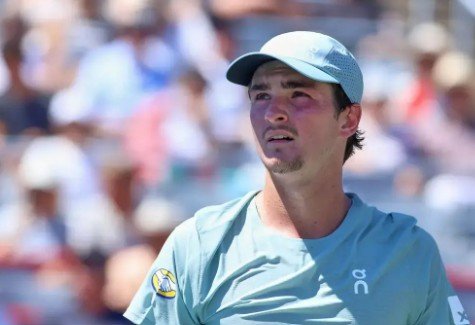
João Fonseca returned to the ATP Tour with an impressive victory in Montreal, defeating former world No.3 Stefanos Tsitsipas 7-6(3), 7-5 to advance to the third round of the National Bank Open.
Playing his first tour-level match since losing to Roman Safiullin in the third round at Wimbledon, the 19-year-old produced a composed and assured performance across the almost two hour match. He struck eight aces, won 83 per cent of his first-serve points and converted all three of the break points he created.
Fonseca Stays Mentally Strong
Possibly the most revealing part of the contest, however, came after Fonseca initially failed to serve out the match.
Leading 5-4 in the second set, Fonseca was broken as Tsitsipas levelled at 5-5. It was the type of setback that might once have derailed the Brazilian prodigee. This time, he remained composed, won eight of the next nine points and completed the match without requiring a tiebreak.
Fonseca spoke at length with The Tennis Channel after the match. “I knew it was going to be difficult. Almost one month without playing and it’s always tense to end a match, serve for the match especially.”
Rather than dwelling on the lost service game, Fonseca recognised that Tsitsipas was also dealing with pressure.
“I’m happy the way that I stayed positive after the break and the five all. I knew it was going to be difficult for him as well. He would take a little bit of nervous and, yeah, happy with the way that I stayed mentally with good returns and confident with my skills.”
Fonseca believed his ability to reset after the disappointment demonstrated how much he has matured over the past two years. Asked whether the João Fonseca of a year earlier would have reacted in the same way, he was honest in his assessment.
“It’s difficult to say, but he’ll be more like angry, I’ll say,” Fonseca said. “I think nowadays I’m more mature and the experience that I had in this two years were super important for me, my development.”
Exposure Against the Top Players is Important
Those experiences have included facing some of the best players in the world and observing how they handle the most important stages of a match. An underrated aspect of moving deep into big tournaments is exactly that – a chance to get a first-hand look at the best of the best on regular occasions.
“Especially this year playing against the top five guys and having the experience to see them dealing with pressure and important points, it was important for me,” he said.
Fonseca’s victory also continued his perfect record against Tsitsipas. He previously defeated the Greek in Davis Cup competition last year and now leads their official head-to-head series 2-0.
It was another disappointing result for Tsitsipas at a tournament where he has previously produced some of his best tennis. In 2018, he defeated four consecutive top-10 opponents before losing to Rafael Nadal in the final. He arrived in Montreal this year with renewed confidence after winning his first title in 16 months in Gstaad, but Fonseca proved the stronger player in the decisive moments.
Tsitsipas converted two of his five break-point opportunities, while Fonseca saved three of the five he faced. The Brazilian landed 66 per cent of his first serves and won 39 of the 47 points behind them. He was also highly effective against Tsitsipas’ serve, winning 31 return points and breaking three times from only three opportunities.
The result was Fonseca’s first victory at the Canadian Masters. He had lost his opening match to Tristan Schoolkate in 2025, but his breakthrough in Montreal has made him the first Brazilian man since former world No.1 Gustavo Kuerten to reach the third round of the Canadian ATP Masters 1000 event.
Fonseca said his improving composure is becoming an important complement to the explosive forehand and aggressive style that have been a hallmark of his early career.
“I like to be aggressive, as you guys say, as you guys see. I like to go for the shot,” he explained.
“Approaching the ball and being aggressive, but at the same time solid, is important for the guy to feel the pressure.”
Balancing Tennis With Home Life
His return to competition followed an extended break after Wimbledon. Fonseca spent time in Brazil with his family and team, using the rare gap in the calendar to practice and recover from the physical and psychological demands of the tour.
“We don’t have so much time to practice, so we took this space that we had to, well, to focus on the future,” he said.
More significantly, Fonseca revealed that protecting his mental health had been an important part of the decision to return home.
“We are focusing on my mental health, so staying with the team, staying with the family is important, staying in Brazil, which is far,” he said. “So, I was a long time away and some people say it’s bad for me, but only me and my team know.“
“So, yeah, I stayed a little bit at home and then now healthy again and good mentally. So, that’s most important.”
Fonseca did play during his time away, appearing at the unconventional UTS event in Rio de Janeiro. The opportunity to compete in front of a home crowd gave him a welcome boost before returning to the regular tour.
“Good experience. I mean different event, different rules, but, yeah, the atmosphere there was crazy,” he said. “I love playing in Brazil. We don’t normally have this experience, so to have this experience was good for me, and pretty intense.”
Brazilian supporters were again highly visible in Montreal, where Fonseca was surprised by the number of yellow shirts around Centre Court.
“I didn’t even know there was so many Brazilians here, but the crowd was full,” he said.
“I saw so many yellow shirts today. So, yeah, that helped me to feel excited for the match and for sure the support is pretty important for me. And I love playing with the crowd.”
Fonseca will next face ninth seed Casper Ruud, who defeated Juan Manuel Cerúndolo 6-1, 6-2 in the second round. It will be their second meeting, with Fonseca holding a 1-0 advantage after beating the Norwegian at Roland Garros in May.
After returning home, taking care of his mental health and ignoring outside criticism, Fonseca has arrived in Montreal refreshed. His victory over Tsitsipas showed that the most important development may not be another improvement to his powerful forehand, but his growing ability to remain composed when a match threatens to turn against him.
Read more of our news articles here.
Read more of our exclusive feature articles here.
Follow The Tennis Site on X: @thetennissite
Follow Todd Scoullar on X: @toddscoullar

Comments are closed, but trackbacks and pingbacks are open.