
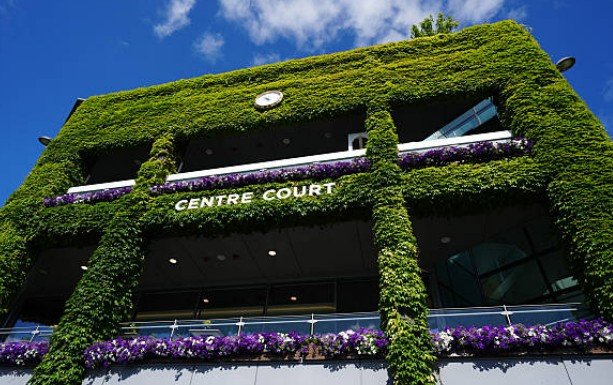
There is something about Wimbledon that invites reflection; the grass, the history, the ghosts of champions past lingering around Centre Court. Every summer, we are reminded not just of greatness and yet, if this year’s Championships have reinforced anything, it is this: in tennis, as in life, legacy is almost irrelevant in the moment. It is ever and always about now.
That idea was captured perfectly by Novak Djokovic during his post match quarterfinal interview after defeating Canada’s Félix Auger-Aliassime and on his way to meeting Sinner in the semis. The BBC interviewer, standing courtside on Centre Court, reeled off the familiar list of his achievements, records and the milestone of reaching yet another Wimbledon semifinal (his 16th at the tournament) Djokovic listened, but his response cut through the nostalgia. It doesn’t matter, he said, what he has done before. It only matters what he does now. He knew that to survive at the highest level, the player must narrow their focus to the next point, the next game, the next match.
Kobe Bryant articulated this mentality perhaps more bluntly than anyone. Great athletes, he said, have no memory or at least, a very short one. They forget the wins as quickly as the losses. Not because they don’t matter, but because dwelling on either is dangerous. Success breeds comfortable complacency and failure breeds doubt. Both are enemies of a top performance.
Andre Agassi arrived at a similar conclusion from a different angle. In his autobiography, he describes the moment he became world No. 1 only to discover that it changed nothing internally. The external validation was enormous, but the internal landscape remained the same.
He said “A win doesn’t feel as good as a loss feels bad, and the good feeling doesn’t last long as the bad.” The chase, it turns out, never really ends and that is where tennis becomes something more than sport. It becomes a reflection of how we experience our own lives.
We look back and construct meaning from achievements, milestones, and memories. We imagine that those moments must have felt monumental as they happened. But often, they didn’t. Often, they felt like just another day.
Serena Williams – back playing singles after four years but out in the first round – has spoken openly about wanting her family to see her compete — to witness the greatness that defined her career. It raises an uncomfortable question: when she was at the height of her powers, winning Grand Slam after Grand Slam, did it feel as significant as it looks in retrospect? Or was she, like every elite competitor, too focused on the next match to truly absorb it? Serena has hinted at the possibility of stepping back onto the court, perhaps at the US Open this year. It is a compelling narrative, but also a complicated one. Can greatness be revisited or does it belong, preserved, to its time?
Young players at Wimbledon have surged forward this year, reminding us that the present is always replacing the past. Coco Gauff and Nostrova continue to embody the future of the women’s game, while emerging names this year like UK’s Arthur Fery have seized their moments on one of sport’s grandest stages.
It may be true to say that the past may define reputation but it does not win matches. Every player, no matter how decorated, walks onto the court with nothing guaranteed, not history, not legacy, not even confidence, for only the present moment is real and only the next point matters. The grass does not care who you were. The crowd may remember, but the game does not.
In the end, tennis strips everything back to a simple, almost brutal truth: you are only as good as what you can do right now.
And right now is all there ever is.
Read more of our exclusive feature articles here.
Read more of our player focus articles here.
Follow Fionnaigh on Instagram: @fionnaighc
Follow Fionnaigh on LinkedIn: Fionnaigh Connaughton-O’Connor

Comments are closed, but trackbacks and pingbacks are open.